
PRODUCT OVERVIEW
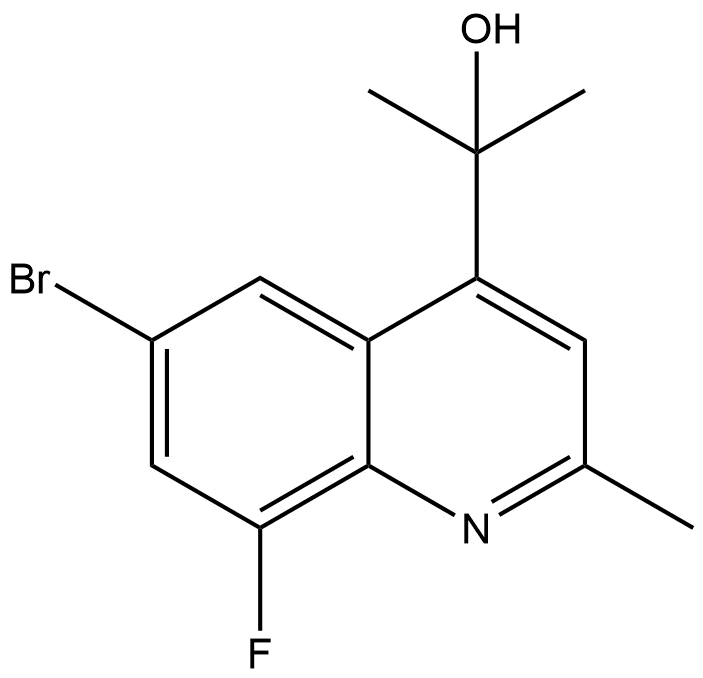
2-(6-bromo-8-fluoro-2-methylquinolin-4-yl)propan-2-ol | CAS 2776103-42-3 is a fluorinated quinoline derivative with heterocyclic architecture and a tertiary alcohol side chain. Its unique substitution pattern – combining bromine and fluorine atoms on a quinoline core with an isopropanol functional group – makes it a valuable intermediate for advanced organic synthesis, particularly in medicinal chemistry and drug discovery research. The compound’s CAS registry number is 2776103-42-3 and its molecular formula is commonly reported as C₁₃H₁₃BrFNO with a molecular weight around 298.15 g/mol.
CHEMICAL IDENTITY & STRUCTURE
-
IUPAC Name: 2-(6-Bromo-8-fluoro-2-methylquinolin-4-yl)propan-2-ol
-
CAS Number: 2776103-42-3
-
Molecular Formula: C₁₃H₁₃BrFNO
-
Molecular Weight: 298.16 g/mol
-
Synonyms: 6-Bromo-8-fluoro-α,α,2-trimethyl-4-quinolinemethanol; 4-Quinolinemethanol, 6-bromo-8-fluoro-α,α,2-trimethyl-
Structural Insight:
The molecule features a quinoline core, which is a bicyclic heterocycle consisting of a benzene ring fused to a pyridine ring. The ring is substituted with a bromine atom at the 6-position and a fluorine atom at the 8-position, which together influence electronic characteristics and reactivity. An isopropanol moiety attached at the 4-position provides a tertiary alcohol functional group, increasing polarity compared to a simple quinoline.
PHYSICAL & CHEMICAL PROPERTIES
While detailed measured physical data for this specific CAS aren’t widely published, predicted properties based on similar fluorinated quinoline alcohols include:
-
Boiling Point: ~394–395 °C (predicted)
-
Density: ~1.48 g/cm³ at 20 °C (predicted)
-
Acid-Base Behavior: Predicted pKa ~13 (tertiary alcohol)
Physical Appearance: Typically a solid to off-white crystalline material under standard conditions (based on structural analogs).
Solubility: Soluble in organic solvents such as dichloromethane, tetrahydrofuran, and DMF; limited water solubility (typical of substituted quinoline alcohols).
APPLICATIONS of 2-(6-bromo-8-fluoro-2-methylquinolin-4-yl)propan-2-ol | CAS 2776103-42-3
1. Medicinal Chemistry & Drug Discovery
Quinoline derivatives are foundational in medicinal chemistry due to their bioactive potential. Substituted quinolines have been explored as intermediates for compounds with antibacterial, antiviral, antimalarial, and anticancer properties. Although this specific compound is primarily an intermediate, its halogenated and tertiary alcohol functionalities allow medicinal chemists to build more complex molecules with enhanced biological profiles.
The presence of fluorine and bromine atoms:
-
Influences lipophilicity and metabolic stability.
-
Can enhance binding interactions in target proteins due to unique halogen bonding potential.
These traits make such intermediates useful in structure-activity relationship (SAR) studies where fine-tuning of chemical structures is critical.
2. Organic Synthesis Intermediate
This compound serves as a building block in multi-step syntheses toward larger heterocyclic frameworks. Its tertiary alcohol group can undergo:
-
Oxidation to ketones or aldehydes
-
Functional group transformations
-
Cross-coupling reactions via the bromine substituent
These pathways make it valuable for designing complex heterocyclic libraries.
SAFETY & HANDLING
As a research chemical, 2-(6-bromo-8-fluoro-2-methylquinolin-4-yl)propan-2-ol should be handled with appropriate laboratory safety practices:
-
Use PPE: Gloves, goggles, lab coat.
-
Engineering Controls: Fume hood recommended for weighing and transfer.
-
Storage: Keep sealed in a cool, dry environment to prevent moisture ingress.
-
Hazards: While specific MSDS data aren’t broadly published for this CAS, halogenated quinoline derivatives may cause irritation upon contact and should not be ingested or inhaled.
-
Disposal: Follow institutional hazardous waste protocols.
(This safety guidance is based on general practice for halogenated heterocyclic laboratory chemicals.)
PACKAGING & AVAILABILITY
ResolveMass Laboratories supplies this compound as a high-purity research material, ideal for R&D and small-scale synthesis projects. Please contact sales for packaging sizes, certificates of analysis, and material data sheets.
Reviews
There are no reviews yet.