
Deuterated Acetyl-d3 Chloride | CAS 19259-90-6
Overview
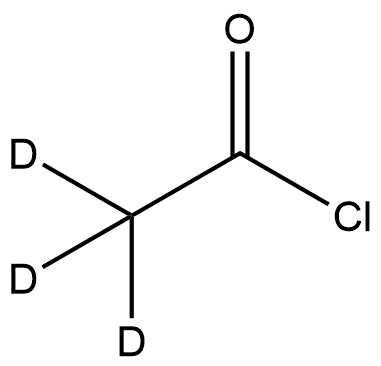
Deuterated Acetyl-d3 Chloride (CAS No. 19259-90-6) is a high-purity isotopically labeled derivative of acetyl chloride, where the three hydrogen atoms of the acetyl methyl group are replaced with deuterium (²H). This subtle yet powerful isotopic modification results in a compound widely used in advanced research, particularly in NMR spectroscopy, mechanistic studies, and isotope-labeled synthesis pathways.
With the molecular formula C₂D₃ClO and a molecular weight of approximately 81.52 g/mol, Acetyl-d3 chloride serves as an essential building block for introducing a deuterated acetyl group into target molecules. Its isotopic enrichment allows scientists to track reaction pathways, improve spectral resolution, and distinguish labeled compounds from their non-deuterated counterparts in complex analytical systems.
ResolveMass Laboratories Inc. supplies Deuterated Acetyl-d3 Chloride with stringent quality control standards to ensure reliability for sensitive research and analytical applications.
Chemical Identity and Properties
Deuterated Acetyl-d3 Chloride is a clear, colorless to slightly yellow liquid characterized by high reactivity and moisture sensitivity. Like its non-deuterated analogue, it belongs to the class of acyl chlorides, which are known for their strong electrophilic nature.
Key physicochemical properties include:
- Molecular Formula: C₂D₃ClO
- Molecular Weight: 81.52 g/mol
- Boiling Point: ~46–52 °C
- Melting Point: approximately -112 °C
- Density: ~1.1–1.15 g/mL at 25 °C
- Flash Point: ~4–5 °C
- Vapor Pressure: Moderate (volatile compound)
- Refractive Index: ~1.386 (20 °C)
- Storage Conditions: 2–8 °C, tightly sealed, moisture-free environment
The compound reacts vigorously with water, producing deuterated acetic acid and hydrogen chloride. Therefore, strict anhydrous handling conditions are required.
Isotopic Significance (Why Deuterium Matters)
The substitution of hydrogen with deuterium in Acetyl-d3 chloride introduces a measurable isotopic mass shift without significantly altering the chemical reactivity of the acetyl group. This makes it particularly valuable in:
- Stable isotope labeling studies
- NMR signal differentiation
- Pharmacokinetic tracking
- Metabolic pathway analysis
- Mechanistic organic chemistry investigations
Because deuterium exhibits different vibrational frequencies compared to hydrogen, it helps researchers trace molecular transformations without interfering with the underlying chemistry.
Applications in Research and Industry
Deuterated Acetyl-d3 Chloride is primarily used as a synthetic reagent and labeling agent in high-level chemical research. Its main applications include:
1. NMR Spectroscopy Standards
One of its most important uses is in the preparation of deuterated derivatives for NMR analysis. The presence of deuterium reduces background proton signals, allowing for clearer spectral interpretation and improved structural assignment.
2. Isotope-Labeled Compound Synthesis
It is widely used to introduce a CD₃CO– (deuterated acetyl) group into alcohols, amines, and other nucleophilic substrates. These labeled compounds are essential in:
- Drug metabolism studies
- Reaction mechanism tracking
- Internal standard preparation for LC-MS/MS analysis
3. Pharmaceutical and Medicinal Chemistry
In drug discovery and development, isotopic labeling helps scientists understand how drug molecules behave in biological systems. Acetyl-d3 chloride enables selective labeling of intermediates used in:
- ADME (Absorption, Distribution, Metabolism, Excretion) studies
- Bioavailability tracking
- Metabolic stability testing
4. Mechanistic Organic Chemistry
Due to its high reactivity as an acylating agent, it is used in studying reaction pathways involving acyl substitution, rearrangements, and nucleophilic attack mechanisms.
Reactivity and Handling Considerations
Deuterated Acetyl-d3 Chloride is a highly reactive and moisture-sensitive compound. Upon exposure to water or atmospheric humidity, it rapidly hydrolyzes, releasing corrosive hydrogen chloride gas.
Key handling precautions include:
- Use only in a dry, inert atmosphere (nitrogen or argon)
- Store in tightly sealed containers at 2–8 °C
- Avoid exposure to moisture, alcohols, and amines unless reaction is intended
- Use appropriate PPE including gloves, goggles, and fume hood
- Keep away from heat sources due to low flash point and flammability risk
Due to its corrosive and volatile nature, it must be handled only by trained laboratory personnel.
Quality and Purity Standards
ResolveMass Laboratories Inc. ensures that Deuterated Acetyl-d3 Chloride is manufactured and tested under strict quality protocols. Typical specifications include:
- High isotopic enrichment (commonly ≥98–99 atom % D)
- High chemical purity suitable for analytical applications
- Low water content to prevent hydrolysis
- Batch-wise Certificate of Analysis (COA) available upon request
These standards ensure reproducibility and accuracy in sensitive research environments.
Safety Information
Deuterated Acetyl-d3 Chloride is classified as a hazardous chemical due to its corrosive, flammable, and reactive nature.
Hazard classifications typically include:
- Flammable liquid
- Corrosive to skin and eyes
- Causes severe respiratory irritation upon exposure
- Reacts violently with water and protic solvents
Proper laboratory safety procedures and regulatory compliance are essential when working with this compound.
Learn more about Deuterated Chemicals through,
- Deuterated Polymers: A Cornerstone Guide to Synthesis, Applications, and Future Trends
- Availability of All the Deuterated Chemicals at ResolveMass Laboratories Inc.
- ResolveMass Laboratories: Leading Deuterated Chemical Synthesis Company in the United States.
- Deuterated Internal Standards for LC-MS: Selection & Custom Synthesis
- How to Choose the Right Deuterated Labelled Chemical Synthesis Company in Canada
- How to Choose the Right Deuterium Labelled Compounds Supplier for Your Lab
- Deuterium-Labelled Compounds — Synthesis, Applications & Ordering
- Custom Synthesis of Deuterated Chemicals
Reviews
There are no reviews yet.