
OVERVIEW
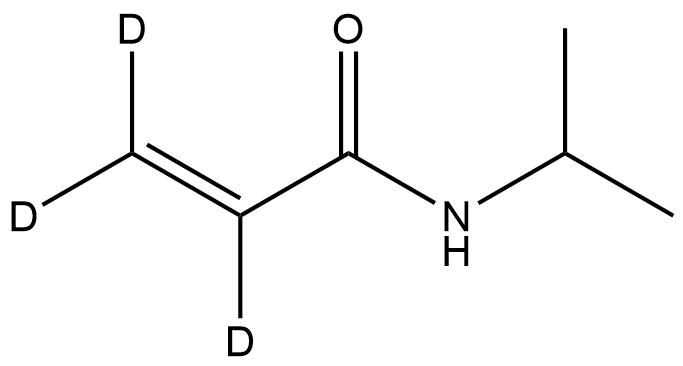
Deuterated N-Isopropyl acrylamide-d3 (NIPAM-d₃) is a strategically labeled monomer widely used in polymer chemistry, biomedical materials research, and advanced analytical investigations. The incorporation of three deuterium atoms within the isopropyl group provides highly valuable isotopic distinction, enabling researchers to track polymerization behavior, quantify incorporation efficiency, and investigate microstructural changes in thermoresponsive copolymers with exceptional precision.
At ResolveMass Laboratories Inc., this material is offered with high chemical purity and rigorous analytical authentication, making it suitable for research, method development, mechanistic studies, and specialized materials engineering applications.
CHEMICAL INFORMATION
Chemical Name: N-Isopropyl acrylamide-d₃
Synonyms: NIPAM-d₃, Deuterated N-isopropylacrylamide, N-Isopropyl acrylamide (d₃-labeled)
Isotopic Labeling: Three deuterium atoms (D₃) substituted in the isopropyl moiety
Chemical Class: Deuterated acrylamide monomer
Functional Group: Acrylamide (polymerizable vinyl monomer)
Molecular Formula: C₆H₁₀D₃NO
Applications: Polymer science, LC–MS method development, polymer degradation studies, hydrogel characterization, thermoresponsive materials research
Deuterium incorporation significantly enhances mass spectrometric sensitivity and enables differentiation from non-deuterated analogs, which is essential in tracing polymerization kinetics and characterizing polymer microstructure.
KEY FEATURES & BENEFITS
• Isotopically Distinct (D₃): Allows precise LC–MS tracking of monomer incorporation, degradation pathways, and copolymer composition in complex formulations.
• Ideal for Thermoresponsive Polymer Studies: NIPAM-based polymers such as PNIPAM exhibit lower critical solution temperature (LCST) behavior; the deuterated version allows monitoring of this behavior in mixed polymer systems without interference.
• High Chemical & Isotopic Purity: Ensures reproducible polymerization kinetics, predictable molecular weight distribution, and reliable cross-study comparisons.
• Excellent for Mechanistic Investigations: Researchers studying chain-transfer reactions, block copolymer formation, and radical polymerization mechanisms rely on isotopic monomers to quantify reaction pathways.
• Versatile Across Multiple Research Domains: Compatible with aqueous and organic polymerization systems, biomedical hydrogel development, and nanomaterial synthesis.
APPLICATIONS of Deuterated N-Isopropyl acrylamide-d3
1. Thermoresponsive Polymer & Hydrogel Engineering
N-Isopropyl acrylamide is the foundational monomer for PNIPAM hydrogels, which exhibit phase-transition behavior near physiological temperatures. The deuterated version is crucial for researchers studying structural dynamics, LCST shifts, swelling ratios, and polymer–solvent interactions using neutron scattering, NMR, or MS-based techniques.
2. Polymerization Mechanism Studies
Deuterated monomers allow high-resolution tracking of:
• chain propagation and termination rates
• monomer conversion profiles
• block versus random copolymer architecture
• initiator efficiency and radical-transfer events
NIPAM-d₃ provides a clear isotopic signal that supports kinetic modeling and regulatory documentation in material development.
3. LC–MS Method Development & Validation
In analytical laboratories, N-Isopropyl acrylamide-d₃ functions as a stable isotope internal standard for:
• quantifying trace residual monomers in PNIPAM products
• validating extraction and purification processes
• developing stability-indicating methods
• confirming isotopic distribution during polymer degradation studies
Its mass shift facilitates unambiguous peak identification, even in complex matrices.
4. Biomedical Materials & Soft Matter Research
Isotopically labeled PNIPAM-based materials are used in:
• drug delivery carriers
• cell scaffolds
• tissue-engineering substrates
• temperature-responsive nanogels
Researchers rely on deuterated building blocks to differentiate between surface-grafted layers, block copolymer segments, and dispersed PNIPAM chains.
TECHNICAL ADVANTAGES FOR FORMULATION SCIENTISTS
• Enhanced Analytical Traceability: Deuterium labeling provides a predictable +3 mass shift, optimal for HRMS and LC–MS quantitation.
• Supports Structure–Property Correlation: Enables precise mapping of how monomer ratios influence LCST, rheology, and mechanical performance.
• Useful in Copolymer & Block Polymer Design: NIPAM-d₃ allows selective tracking of one polymer segment within multiblock systems such as PNIPAM-PEG, PNIPAM-PLA, and amphiphilic architectures.
• Stable Under Polymerization Conditions: Maintains isotopic integrity during free-radical, RAFT, ATRP, and photo-initiated polymerization processes.
• Critical for Quality & Regulatory Documentation: Isotopic standards strengthen analytical dossiers and ensure robust data interpretation in R&D and GMP environments.
WHY CHOOSE RESOLVEMASS LABORATORIES INC.
ResolveMass Laboratories is committed to supplying high-purity isotopically labeled monomers backed by analytical documentation, reproducible quality, and technical support. Our deuterated materials integrate seamlessly into high-precision polymer science workflows, advanced materials R&D projects, and analytical method development programs.
Whether you are optimizing polymer architectures, enhancing LC–MS assays, or engineering next-generation thermoresponsive materials, N-Isopropyl acrylamide-d₃ from ResolveMass Laboratories offers the reliability, stability, and scientific rigor required for cutting-edge research.
Learn more,
Deuterated Polymers: A Cornerstone Guide to Synthesis, Applications, and Future Trends
Availability of All the Deuterated Chemicals at ResolveMass Laboratories Inc.
ResolveMass Laboratories: Leading Deuterated Chemical Synthesis Company in the United States.
Deuterated Internal Standards for LC-MS: Selection & Custom Synthesis
How to Choose the Right Deuterated Labelled Chemical Synthesis Company in Canada
How to Choose the Right Deuterium Labelled Compounds Supplier for Your Lab
Deuterium-Labelled Compounds — Synthesis, Applications & Ordering
Custom Synthesis of Deuterated Chemicals

Reviews
There are no reviews yet.