Introduction to QC Testing for Peptide Oligonucleotide Conjugates
QC Testing for Peptide Oligonucleotide Conjugates is an essential analytical process used to verify the identity, purity, and structural integrity of hybrid biomolecules that combine peptides with oligonucleotide therapeutics. These tests ensure that the final therapeutic compound matches its intended molecular design and performs consistently across different manufacturing batches. Maintaining strong quality control is important for product safety, regulatory compliance, and reliable therapeutic performance.
Because these conjugates contain two chemically different components connected by a linker, their characterization requires advanced analytical techniques capable of detecting both peptide-related and oligonucleotide-related impurities. The linker structure may also introduce additional variability that must be monitored during testing.
Peptide–oligonucleotide conjugates are increasingly used in targeted delivery systems for antisense oligonucleotides, siRNA, and other nucleic acid therapeutics. As their use in drug development continues to expand, QC Testing for Peptide Oligonucleotide Conjugates plays a critical role in ensuring product quality, stability, and consistency throughout development and manufacturing.
Explore our specialized services: POC Synthesis and Characterization
Share via:
Quick Summary (Key Takeaways)
- QC Testing for Peptide Oligonucleotide Conjugates focuses on confirming structural integrity, conjugation efficiency, impurity profile, and stability of hybrid biomolecules.
- These conjugates combine two chemically different biomolecules, making analytical characterization significantly more complex than peptides or oligonucleotides alone.
- LC-MS, ion-pair reversed-phase HPLC, capillary electrophoresis, and orthogonal chromatographic methods are central to detecting sequence-related impurities and confirming molecular identity.
- Multi-attribute QC workflows are required to evaluate linker stability, peptide degradation, oligonucleotide truncations, and conjugation heterogeneity.
- Regulatory expectations require comprehensive impurity profiling, validated analytical methods, and stability-indicating assays for peptide-oligonucleotide therapeutics.
- Modern QC strategies rely heavily on high-resolution mass spectrometry and multidimensional chromatography to ensure product quality and batch-to-batch consistency.
Why QC Testing for Peptide Oligonucleotide Conjugates Requires Specialized Analytical Approaches
QC Testing for Peptide Oligonucleotide Conjugates requires specialized analytical strategies because these molecules contain peptide chemistry, nucleic acid chemistry, and linker chemistry within a single structure. Each component contributes different chemical and structural properties that must be analyzed together. This combination creates analytical challenges that are significantly more complex than traditional pharmaceutical testing.
Unlike small molecules or conventional biologics, peptide-oligonucleotide conjugates often produce heterogeneous molecular populations. These molecules may vary slightly in mass, charge, or sequence due to synthesis variations. Even small differences can influence therapeutic activity, stability, or biological behavior, making precise analytical detection extremely important.
Learn more about our solutions: Peptide Oligonucleotide Conjugates (POCs) Synthesis Services
Another challenge is that synthesis and purification processes can produce several related molecular species. These species must be carefully separated, detected, and quantified to ensure product purity and safety. Without appropriate analytical methods, some impurities may remain undetected and compromise product quality.
Key Analytical Challenges
- Dual molecular composition (peptide + oligonucleotide)
- Charge heterogeneity and polydispersity
- Multiple synthesis-related impurities
- Linker instability and hydrolysis
- Sequence-related truncations in oligonucleotides
- Peptide oxidation or deamidation
Studies on oligonucleotide therapeutics demonstrate that sequence-related impurities and synthesis byproducts must be carefully monitored using chromatographic and mass spectrometry techniques (El Zahar et al., 2018). Careful monitoring allows researchers to identify unwanted molecular variants generated during synthesis or storage.
Similarly, conjugated molecules introduce additional heterogeneity due to variable conjugation efficiency and linker modifications (Azari et al., 2025). These factors can produce mixtures of fully conjugated and partially conjugated species that require highly sensitive analytical detection.
Partner with an expert CRO: Peptide Oligonucleotide Conjugates CRO
Because of these complexities, QC Testing for Peptide Oligonucleotide Conjugates must rely on multiple orthogonal analytical techniques instead of a single test. Combining complementary analytical methods provides a more reliable and comprehensive evaluation of molecular structure and purity.
Core Analytical Techniques Used in QC Testing for Peptide Oligonucleotide Conjugates
Reliable QC Testing for Peptide Oligonucleotide Conjugates typically combines chromatographic separation with high-resolution mass spectrometry to confirm molecular identity and detect impurities. These analytical approaches allow scientists to study complex biomolecules in great detail. They also help detect even low-abundance impurities that could influence drug safety or performance.
In practice, laboratories use several analytical techniques together to build a robust quality control workflow. Each technique provides different types of information about molecular composition, structural integrity, and heterogeneity of the conjugate.
Discover our testing capabilities: Peptide Characterization Service
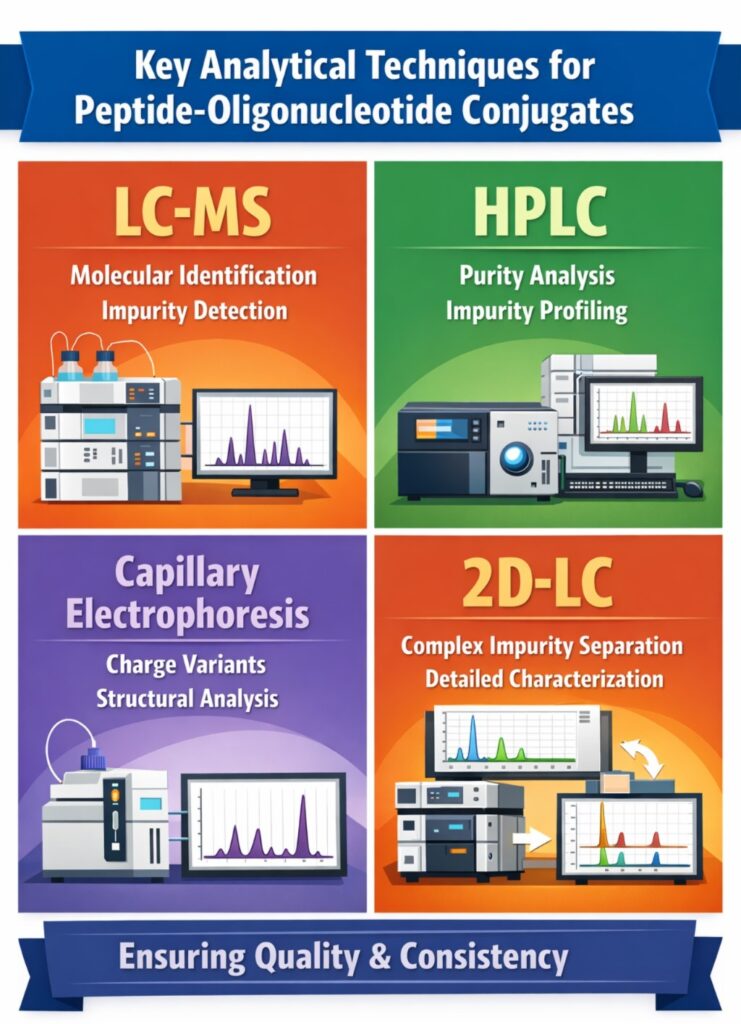
1. LC-MS for Molecular Identity and Conjugation Confirmation
Liquid Chromatography–Mass Spectrometry (LC-MS) is one of the most important techniques used in QC Testing for Peptide Oligonucleotide Conjugates. It confirms molecular weight, verifies successful conjugation, and helps identify impurity structures. The chromatographic step separates molecular species, while mass spectrometry provides precise molecular identification.
Access professional support: Peptide Oligonucleotide Conjugation Services
LC-MS provides:
- Accurate molecular mass confirmation
- Identification of truncated oligonucleotide species
- Detection of peptide degradation products
- Characterization of linker modifications
High-resolution LC-MS also allows deconvolution of multiply charged oligonucleotide ions, which is essential for analyzing large conjugate molecules (Bartlett & Chen, 2013). Advanced instruments provide exceptional sensitivity and accuracy when studying complex therapeutic biomolecules.
2. Ion-Pair Reversed-Phase HPLC for Purity Profiling
Ion-pair reversed-phase high-performance liquid chromatography (IP-RP-HPLC) is widely used in QC Testing for Peptide Oligonucleotide Conjugates to separate full-length conjugates from truncated oligonucleotide impurities. Ion-pairing reagents help improve retention and separation of highly charged oligonucleotide molecules. This allows precise measurement of product purity.
This method is particularly useful for:
- Quantifying full-length product
- Separating n-1 or n-2 oligonucleotide truncations
- Detecting unconjugated peptide or oligonucleotide
Rentel et al. (2022) demonstrated that IP-RP-HPLC combined with MS detection provides highly accurate purity and impurity measurements for therapeutic oligonucleotides. Because of its reliability and reproducibility, this technique is widely used in pharmaceutical analytical laboratories.
3. Capillary Electrophoresis (CE) for Charge Heterogeneity
Capillary electrophoresis is another powerful technique used in QC Testing for Peptide Oligonucleotide Conjugates to evaluate charge variants and structural heterogeneity. The method separates molecules based on their electrophoretic mobility under an electric field. This separation helps identify subtle differences in charge distribution.
CE methods can identify:
- Charge variants caused by chemical modifications
- Phosphorothioate diastereomers
- Conjugation heterogeneity
Because oligonucleotides carry strong negative charges, CE offers excellent resolution when separating closely related species. This makes it a valuable technique for analyzing nucleic acid therapeutics and their conjugates.
4. Two-Dimensional LC for Complex Impurity Profiles
Two-dimensional liquid chromatography (2D-LC) is increasingly applied in QC Testing for Peptide Oligonucleotide Conjugates when traditional analytical methods cannot fully resolve complex impurity mixtures. By combining two independent separation mechanisms, this technique significantly improves analytical resolution.
This technique combines different separation mechanisms, such as:
| Dimension | Separation Mechanism | Purpose |
|---|---|---|
| 1st Dimension | Ion-exchange chromatography | Separate charge variants |
| 2nd Dimension | Reversed-phase LC | Resolve structural variants |
Advanced studies have shown that 2D-LC significantly improves resolution of manufacturing impurities in oligonucleotide therapeutics (Vanhinsbergh, 2020). As therapeutic molecules become more complex, multidimensional chromatography is becoming an increasingly valuable analytical strategy.
Critical Quality Attributes Evaluated in QC Testing for Peptide Oligonucleotide Conjugates
QC Testing for Peptide Oligonucleotide Conjugates focuses on several critical quality attributes (CQAs) that determine safety, efficacy, and regulatory compliance. These attributes represent measurable properties that must remain within defined limits throughout the product lifecycle. Accurate evaluation of these attributes ensures that the therapeutic product maintains consistent quality.
Monitoring CQAs allows manufacturers to detect variations during production and maintain consistent product performance. Analytical techniques are carefully selected to measure each attribute with high sensitivity and reliability.
Key Quality Attributes
| Quality Attribute | Analytical Approach | Purpose |
|---|---|---|
| Molecular identity | LC-MS | Confirm expected conjugate mass |
| Purity | HPLC / LC-MS | Quantify full-length product |
| Conjugation efficiency | LC-MS | Detect unconjugated components |
| Impurity profile | LC-MS / CE | Identify synthesis byproducts |
| Stability | Stability-indicating assays | Monitor degradation |
| Sequence integrity | MS fragmentation | Confirm nucleotide sequence |
Regulatory frameworks for oligonucleotide therapeutics emphasize detailed characterization of impurities, sequence integrity, and stability profiles to ensure product quality (Srivatsa, 2011). Proper characterization helps reduce the risk of unexpected safety issues during clinical development.
View our CMC solutions: CMC Services for Peptide Oligonucleotide Conjugates
Impurity Profiling in QC Testing for Peptide Oligonucleotide Conjugates
Impurity profiling is a critical part of QC Testing for Peptide Oligonucleotide Conjugates because synthesis processes often generate multiple types of impurities. Understanding these impurities allows scientists to evaluate manufacturing efficiency and improve purification strategies.
Detailed impurity analysis also ensures that unwanted molecular species remain within acceptable regulatory limits. Sensitive analytical techniques are required to detect very low levels of impurities in complex biomolecular mixtures.
Major Types of Impurities
1. Sequence-related impurities
- Truncated oligonucleotides (n-1, n-2 species)
- Base deletion or insertion errors
- Phosphorothioate stereoisomers
These impurities usually result from incomplete coupling reactions during oligonucleotide synthesis. Monitoring them is important because sequence variations may influence biological activity.
2. Peptide-derived impurities
- Oxidation
- Deamidation
- Truncated peptide sequences
Peptide impurities often occur during synthesis or long-term storage and may affect conjugate stability. Analytical methods must detect these modifications to maintain consistent product quality.
3. Conjugation-related impurities
- Incomplete conjugation
- Linker hydrolysis
- Cross-linked species
Chromatographic and mass spectrometry approaches are commonly used to identify these impurities with high sensitivity (El Zahar et al., 2018). Modern analytical instruments allow accurate characterization even when impurities occur at very low concentrations.
Stability Studies in QC Testing for Peptide Oligonucleotide Conjugates
Stability testing in QC Testing for Peptide Oligonucleotide Conjugates evaluates degradation pathways that may influence therapeutic performance during storage and handling. Understanding these degradation mechanisms helps scientists design formulations that maintain molecular integrity over time.
Typical stability risks include:
- Linker cleavage
- Peptide oxidation
- Oligonucleotide depurination
- Hydrolytic degradation
Accelerated stability testing often includes:
- Elevated temperature studies
- pH stress experiments
- Oxidative stress testing
These studies help establish stability-indicating analytical methods capable of detecting degradation products (Azari et al., 2025). The results also guide appropriate storage conditions and shelf-life determination.
Method Validation Requirements for QC Testing for Peptide Oligonucleotide Conjugates
Analytical methods used in QC Testing for Peptide Oligonucleotide Conjugates must be validated according to regulatory guidelines to ensure accuracy, reliability, and reproducibility. Method validation demonstrates that analytical procedures provide consistent and trustworthy results.
Key validation parameters include:
- Specificity – ability to distinguish conjugate from impurities
- Accuracy – correct quantification of analytes
- Precision – reproducibility of results
- Linearity – proportional response to concentration
- Limit of detection (LOD)
- Limit of quantification (LOQ)
Regulatory frameworks emphasize that validated analytical methods are essential for consistent quality control in oligonucleotide therapeutic manufacturing (Chimento et al., 2025). Proper validation also supports regulatory submissions and international pharmaceutical compliance.
Optimize your drug discovery process: Custom Synthesis for Drug Discovery
Future Trends in QC Testing for Peptide Oligonucleotide Conjugates
QC Testing for Peptide Oligonucleotide Conjugates is evolving quickly as new analytical technologies become available. Advances in high-resolution mass spectrometry, multidimensional chromatography, and automated data analysis allow scientists to study complex biomolecules more efficiently and accurately.
Emerging technologies include:
- Native LC-MS for intact conjugate characterization
- Automated impurity identification algorithms
- Hybrid LC-MS/CE analytical workflows
- Multi-attribute monitoring methods
These innovations help reduce analysis time while providing deeper insights into molecular structure and impurity profiles. As peptide-oligonucleotide therapeutics continue to grow in importance, advanced analytical tools will play a critical role in supporting safe and effective drug development.
Conclusion
QC Testing for Peptide Oligonucleotide Conjugates is essential for ensuring the structural integrity, purity, and stability of hybrid therapeutic molecules that combine peptides with oligonucleotides. Comprehensive analytical testing ensures that these complex biomolecules meet strict regulatory and quality requirements before clinical use. Reliable quality control also helps maintain consistent therapeutic performance across manufacturing batches.
Because these conjugates present complex analytical challenges, effective quality control requires integrated workflows that combine LC-MS, chromatographic separation techniques, capillary electrophoresis, and multidimensional analytical approaches. Each method contributes valuable information that supports complete molecular characterization.
By carefully evaluating conjugation efficiency, impurity profiles, molecular identity, and stability, advanced analytical strategies allow scientists to fully characterize peptide-oligonucleotide conjugates throughout development and manufacturing. As nucleic acid therapeutics continue to expand, QC Testing for Peptide Oligonucleotide Conjugates will remain a key part of pharmaceutical quality assurance and regulatory compliance.
For expert analytical support and specialized testing services, contact the team at ResolveMass Laboratories:
Frequently Asked Questions (FAQs)
Quality control of peptides refers to the analytical testing used to verify the identity, purity, sequence accuracy, and stability of peptide molecules. Techniques such as LC-MS, HPLC, and capillary electrophoresis are commonly used to detect impurities, confirm molecular weight, and assess structural integrity. These tests ensure that peptides meet required quality standards for research, pharmaceutical development, and therapeutic applications. Proper QC also helps maintain batch-to-batch consistency and regulatory compliance.
The most commonly used analytical methods include LC-MS, ion-pair reversed-phase HPLC, capillary electrophoresis, and multidimensional chromatography. These techniques provide complementary information about molecular identity, purity, and impurity profiles. Using multiple analytical methods helps scientists accurately characterize complex conjugate molecules.
Common impurities include truncated oligonucleotides, peptide degradation products, linker hydrolysis products, and incomplete conjugation species. These impurities may develop during synthesis, purification, or storage. Monitoring them carefully helps maintain product safety and consistency.
Conjugation efficiency is usually measured using LC-MS or HPLC methods. These techniques quantify the amount of unconjugated peptide and oligonucleotide remaining in the sample. By comparing these values, scientists can determine how effectively the conjugation reaction occurred.
Common chromatographic methods include ion-pair reversed-phase HPLC, ion-exchange chromatography, and hydrophilic interaction chromatography (HILIC). Each technique uses a different separation mechanism to analyze complex oligonucleotide mixtures. Using multiple methods improves the reliability of purity analysis.
Orthogonal analytical methods use different principles of separation and detection. This allows scientists to evaluate impurities and structural variants from multiple perspectives. Using several complementary techniques ensures a more accurate and comprehensive analysis.
Common stability concerns include linker degradation, peptide oxidation, and oligonucleotide hydrolysis. These degradation pathways can affect the biological activity and shelf life of the therapeutic molecule. Stability studies help determine proper storage conditions and product lifespan.
Reference:
- Venkatesan, N., & Kim, B. H. (2006). Peptide conjugates of oligonucleotides: Synthesis and applications. Chemical Reviews, 106(9), 3712–3761. https://doi.org/10.1021/cr0502448
- Malinowska, A. L., Huynh, H. L., & Bose, S. (2024). Peptide-oligonucleotide conjugation: Chemistry and therapeutic applications. Current Issues in Molecular Biology, 46(10), 11031–11047. https://doi.org/10.3390/cimb46100655
- Klabenkova, K., Fokina, A., & Stetsenko, D. (2021). Chemistry of peptide-oligonucleotide conjugates: A review. Molecules, 26(17), 5420. https://doi.org/10.3390/molecules26175420
Get In Touch With Us
About The Author