


Introduction
A peptide purity testing report, commonly presented as a Certificate of Analysis (CoA) or analytical datasheet, is a critical technical document used to verify a peptide’s chemical identity, purity, and composition. For biopharmaceutical organizations seeking to qualify and audit a CDMO, reviewing these reports requires much more than confirming the stated purity percentage. A comprehensive technical assessment should examine the analytical methodologies used, signal-to-noise ratios, chromatographic performance, mass balance information, and supporting quantitative data.
Ready to streamline your supply chain? Learn more about how to outsource peptide manufacturing to a CDMO.
Both Solid-Phase Peptide Synthesis (SPPS) and liquid-phase synthesis can generate structurally related side-products, including deletion sequences, insertion sequences, diastereomers, and chemically modified adducts. Therefore, relying exclusively on a single high-performance liquid chromatography (HPLC) peak area percentage can provide an incomplete representation of peptide quality. A scientifically rigorous assessment requires evaluation of chromatographic conditions, mass spectrometry resolution, counterion quantitation, residual components, and total net peptide content.
Dive deeper into the unique physiochemical properties of biopolymers with our guide on the difference between a peptide and a small molecule drug.
Share via:
Quick Summary:
- Peptide CoA auditing must go beyond HPLC purity—review identity, purity, mass balance, impurities, counterions, moisture, solvents, and safety data.
- Use orthogonal analytical methods: RP-HPLC/UHPLC for purity, LC-HRMS/MS for identity and sequence confirmation, and AAA/qNMR/CHN for net peptide content.
- RP-HPLC review should include wavelength, column chemistry, gradient, co-elution, baseline integration, resolution, and signal-to-noise—not just the reported purity percentage.
- Mass spectrometry strengthens identity verification through accurate mass, monoisotopic mass, charge-state resolution, and detection of modifications such as deamidation.
- Mass balance matters: a peptide can show high HPLC purity while containing significant counterions, moisture, residual solvents, and other non-peptide components.
- Impurity and safety testing should cover deletion/insertion sequences, diastereomers, oxidation/deamidation products, TFA, residual solvents, elemental impurities, and bacterial endotoxins.
- A complete CDMO audit should verify method validation and system suitability—including specificity, linearity, precision, LOQ, robustness, tailing, efficiency, resolution, S/N, and complete CoA traceability.
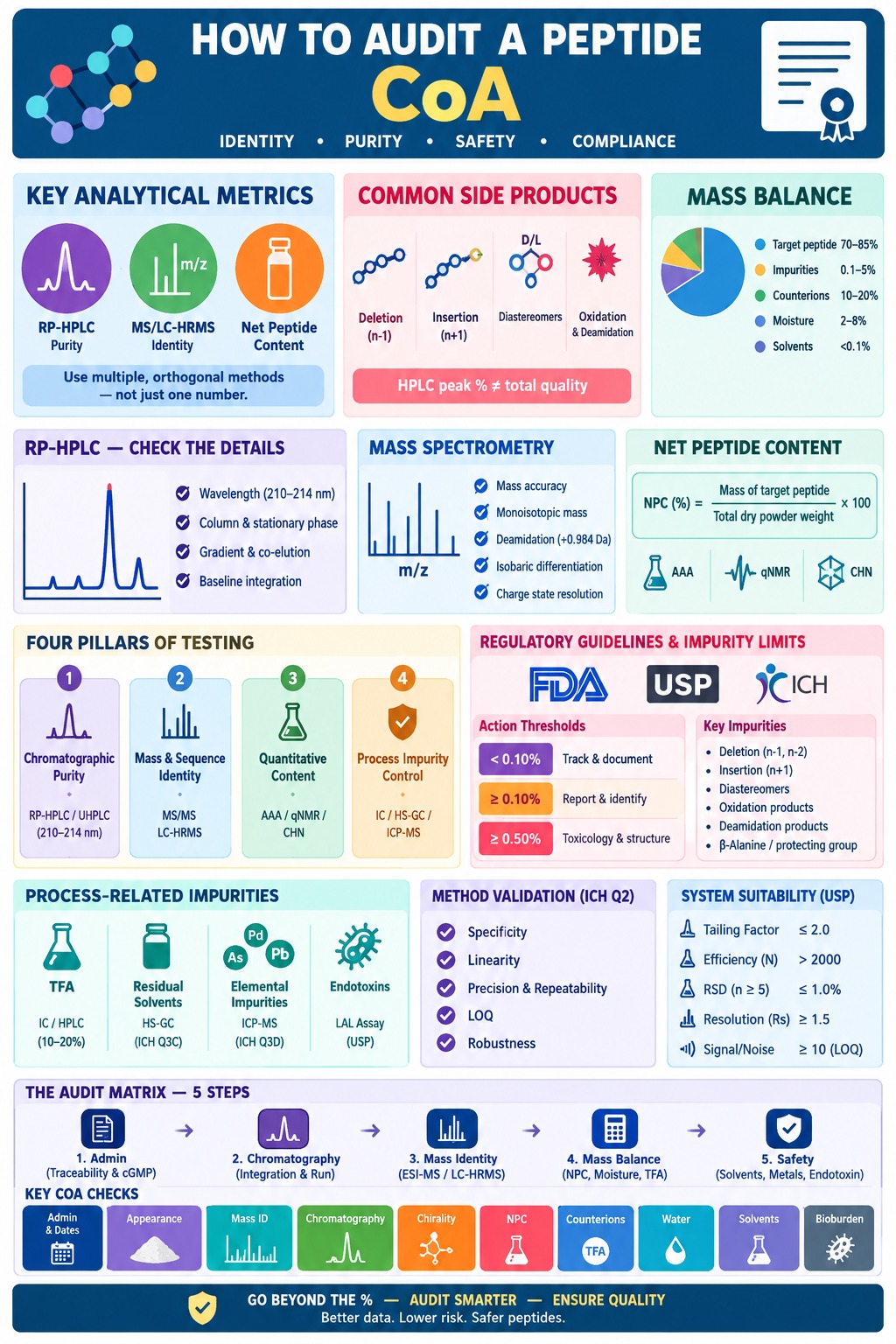
Core Analytical Metrics to Qualify and Audit a CDMO Peptide Certificate of Analysis
The principal analytical metrics reported on a peptide Certificate of Analysis include reversed-phase high-performance liquid chromatography (RP-HPLC) purity, mass spectrometry identity confirmation, and net peptide content determination. Reviewing these interconnected parameters helps establish whether peptide quality has been assessed using appropriate and orthogonal analytical methodologies rather than relying on a single analytical dimension.
Learn what criteria matter most when deciding partner facilities with our expert guide on how to choose a peptide CDMO in the US.
For a comprehensive vendor datasheet audit, analytical scientists should evaluate the complete mass balance of a lyophilized peptide sample. The dry mass of a synthetic peptide drug substance may contain the target peptide sequence, peptide-related side products, inorganic salts, absorbed moisture, residual solvents, and counterions.
| Mass Balance Component | Primary Analytical Methodology | Typical Mass Contribution | Scientific Significance in Quality Audits |
|---|---|---|---|
| Target Peptide Sequence | RP-HPLC / UHPLC with UV at 210–214 nm | 70% – 85% w/w | Quantifies relative UV purity of the active sequence. |
| Peptide Impurities | LC-MS / High-Resolution Mass Spectrometry | 0.1% – 5.0% w/w | Identifies deletion (n-1) sequences, diastereomers, and oxidation products. |
| Counterions (TFA, Acetate) | Ion Chromatography (IC) / RP-HPLC | 10% – 20% w/w | Associates with basic residues (Lys, Arg, His) and can affect formulation and biological assay performance. |
| Residual Moisture | Karl Fischer Titration (Coulometric) | 2% – 8% w/w | Can promote hydrolytic degradation and deamidation during storage. |
| Residual Solvents | Headspace Gas Chromatography (HS-GC) | < 0.1% w/w (< 880 ppm DMF) | Supports compliance with ICH Q3C safety limits. |
Reversed-Phase High-Performance Liquid Chromatography (RP-HPLC) Purity
Reversed-Phase High-Performance Liquid Chromatography (RP-HPLC) purity represents the integrated peak area of the target peptide sequence relative to the UV-absorbing components detected at a specified wavelength. This measurement provides a relative optical purity percentage, commonly determined at 210 nm or 214 nm. However, it does not establish absolute chemical purity and may not account for constituents that have weak or negligible UV absorbance at the selected wavelength.
When reviewing RP-HPLC chromatograms included in a CoA, auditors should carefully examine the analytical settings and chromatographic conditions, including the following:
- Wavelength Selection: Detection at 210–214 nm primarily reflects peptide bond absorption (n → π* transition), providing a broadly applicable response for peptide species. Detection at wavelengths above 250 nm emphasizes aromatic side chains such as Tryptophan, Tyrosine, and Phenylalanine and may therefore underrepresent impurities that do not contain aromatic residues.
- Column Chemistry and Stationary Phase: Mobile phase pH and column selection, such as C18, C8, or C4 stationary phases with 100 Å to 300 Å pore sizes, should be appropriate for the peptide’s hydrophobicity and secondary structure. Appropriate selection helps minimize irreversible column binding and excessive band broadening.
- Gradient Profile and Co-elution: Linear gradient profiles, such as acetonitrile/water containing 0.1% trifluoroacetic acid, should provide adequate resolving power for the peptide and its related impurities. Closely eluting diastereomers or single-amino-acid deletion peptides (n-1) may co-elute with the main peak when excessively steep gradient profiles are used, potentially resulting in an artificially elevated reported purity percentage.
- Baseline Integration: Integration parameters should cover the complete chromatographic run, including the gradient wash and re-equilibration phases. Manual baseline adjustments or arbitrary threshold settings that exclude minor peaks above the limit of quantitation (LOQ) can compromise the reliability of the reported purity value.
Discover advanced techniques specifically tailored for complex metabolic regulators by exploring GLP-1 peptide analytical characterization.
Mass Spectrometry (MS and LC-HRMS) for Identity Verification
Mass spectrometry confirms peptide identity by comparing experimentally observed mass-to-charge ratios ($m/z$) with the theoretical molecular mass of the expected peptide. Liquid Chromatography coupled with High-Resolution Mass Spectrometry (LC-HRMS) provides accurate monoisotopic mass confirmation and fragmentation information, allowing closely related sequence variants and peptide impurities to be investigated.
Single-quadrupole mass spectrometers can provide basic molecular mass confirmation, whereas high-resolution platforms such as Quadrupole Time-of-Flight (Q-TOF) and Orbitrap mass spectrometers provide higher mass accuracy for the characterization of complex synthetic peptides.
| Mass Spectrometry Parameter | Low-Resolution MS (Unit Mass) | High-Resolution MS (LC-HRMS) | Impact on Quality Audit |
|---|---|---|---|
| Mass Accuracy | ± 0.5 Da to ± 1.0 Da | < 5 ppm (± 0.001 Da) | Provides greater capability to differentiate closely related species and subtle chemical modifications. |
| Mass Measured | Average Molecular Weight | Monoisotopic Mass | Allows comparison with the expected isotopic distribution of the target peptide sequence. |
| Deamidation Detection | Limited detection of the +0.984 Da shift | Confirmed through accurate mass shift | Supports identification of Asparagine deamidation to Aspartic/Isoaspartic acid. |
| Isobaric Differentiation | Cannot distinguish Leu/Ile | Distinguishes sequence isomers through MS/MS fragmentation | Supports sequence fidelity assessment and identification of potential amino acid misincorporation. |
| Charge State Resolution | Resolves single/double charges | Resolves multi-charged envelopes ([M+H]+ … [M+nH]n+) | Important for accurate mass deconvolution of large peptides ($> 30$ amino acids). |
Net Peptide Content vs. Total Purity Percentage
Net peptide content (NPC) represents the absolute proportion of target peptide mass present in a lyophilized powder, whereas total purity percentage represents the relative chromatographic peak area among UV-absorbing species. Consequently, a sample demonstrating 98% HPLC purity may have a net peptide content of only 70% to 85% because the powder can also contain residual water, counterions, and organic solvents.
Determination of the total active peptide delivered per vial therefore depends on distinguishing chromatographic purity from net peptide content. Net peptide content can be calculated using quantitative analytical techniques:
Net Peptide Content (%) = (Mass of Target Peptide Sequence / Total Dry Lyophilized Powder Weight) × 100
Accurate measurement of net peptide content can involve Elemental Analysis (CHN), Amino Acid Analysis (AAA), or quantitative Nuclear Magnetic Resonance (qNMR). During a CDMO datasheet audit, scientists should verify that dosing calculations account for NPC. Calculating doses solely from gross vial weight without adjusting for NPC can result in substantial under-dosing during biological assays and non-clinical studies.
Ensure physical stability and optimal reconstitution by learning more about formulating a lyophilized peptide injectable.
An effective testing strategy can organize analytical methodologies into four sequential pillars to support comprehensive sample characterization:
- Pillar 1: Chromatographic Purity: RP-HPLC and Ultra-High Performance Liquid Chromatography (UHPLC) with UV detection at 210–214 nm determine relative sequence purity.
- Pillar 2: Mass and Sequence Identity: LC-HRMS and tandem mass spectrometry (MS/MS) fragmentation support confirmation of the primary amino acid sequence and monoisotopic weight.
- Pillar 3: Quantitative Content: Amino Acid Analysis (AAA), quantitative NMR (qNMR), or Elemental CHN analysis determine absolute net peptide content.
- Pillar 4: Process Impurity Control: Ion Chromatography (IC), Headspace Gas Chromatography (HS-GC), and ICP-MS are used to quantify counterions, organic solvents, and elemental catalysts.
Regulatory Compliance and Impurity Profiling Guidelines
Regulatory guidelines established by the FDA, USP, and ICH provide frameworks for the identification, reporting, and qualification of peptide-related and process-related impurities in drug substances. Regulatory compliance requires appropriate control of organic impurities at or above applicable reporting thresholds, together with systematic monitoring of residual solvents, counterions, and elemental impurities.
Regulatory Impurity Limits and FDA Guidance Frameworks
FDA regulatory guidance for synthetic peptides provides expectations for the identification and reporting of peptide-related impurities based on their relative abundance and analytical significance. Impurities at or above applicable reporting thresholds should be appropriately identified and reported, while higher-level impurities may require additional structural and toxicological assessment to support product quality and patient safety.
Synthetic peptide manufacturers should control impurity profiles using applicable compendial and regulatory standards, including USP General Chapter (“Quality Attributes of Synthetic Peptide Drug Substances”) and USP (“Quality Attributes of Starting Materials for Synthetic Peptide Drug Substances”).
Regulatory action thresholds for peptide-related impurities specify different requirements according to relative chromatographic peak area:
- Relative Area < 0.10%: The impurity should be tracked and documented in the internal chromatogram integration report.
- Relative Area ge 0.10%: The impurity should be formally reported on the Certificate of Analysis and characterized for molecular identity.
- Relative Area \ge 0.50%: The impurity may require comprehensive toxicological qualification and structural identification through high-resolution LC-MS/MS or isolation.
Key peptide-related impurities that can be generated during SPPS and should be considered in analytical reports include:
- Deletion Sequences (n-1, n-2): These are produced when an amino acid coupling step is unsuccessful during synthesis, resulting in truncated peptide chains that lack one or more internal amino acids.
- Insertion Sequences (n+1): These can result from incomplete deprotection or dibenzofulvene-amino acid adduct formation, potentially causing duplicate amino acid additions within the peptide sequence.
- Diastereomeric Impurities: These can develop through amino acid racemization at the Cα position during activation and coupling steps, generating unwanted D-amino acid diastereomers.
- Oxidation Products: Methionine, Cysteine, and Tryptophan residues may undergo oxidation to form sulfoxides, sulfones, or disulfide-linked dimers during cleavage, purification, or storage.
- Deamidation Products: Asparagine and Glutamine residues can hydrolyze into Aspartic acid/Isoaspartic acid and Glutamic acid, respectively, contributing to charge heterogeneity.
- $\beta$-Alanine and Protecting Group Adducts: These may arise from residual piperidine cleavage agents or incomplete removal of side-chain protecting groups such as Pbf, Trt, and tBu.
Inorganic, Residual Solvent, and Counterion Analysis
Inorganic impurities, counterions, and residual organic solvents represent non-peptide components that require quantitative assessment using appropriate analytical techniques, including ion chromatography and headspace gas chromatography. Effective control of residual trifluoroacetic acid (TFA) and Class 1/2 solvents is important for minimizing formulation instability, potential cellular toxicity, and regulatory non-compliance.
During SPPS purification, TFA is commonly used as an ion-pairing agent in reversed-phase liquid chromatography. As a result, synthetic peptides can form TFA salts at basic amino acid residues, including Lysine, Arginine, and Histidine, as well as at the N-terminus.
Analytical testing frameworks address four major process-related impurity categories:
- Trifluoroacetic Acid (TFA) Quantitation: TFA can be measured using Ion Chromatography (IC) or Reversed-Phase HPLC according to applicable USP requirements. Research peptides may contain 10% to 20% TFA by weight. For clinical development, TFA content should be quantitatively characterized and may be exchanged for acetate or hydrochloride salt forms when appropriate because TFA can affect biological assays and may raise concerns regarding cell-based applications.
- Residual Solvents (ICH Q3C): Residual manufacturing solvents such as N,N-Dimethylformamide (DMF), Dichloromethane (DCM), Piperidine, and Acetonitrile should be quantified using Headspace Gas Chromatography (HS-GC). Class 2 solvents, such as DMF and Acetonitrile, and Class 1 toxic solvents should be controlled within applicable international safety limits.
- Elemental Impurities (ICH Q3D / USP /): Elemental impurities and heavy metal catalysts, including Palladium, Lead, Arsenic, Cadmium, and Mercury, that may be introduced during synthesis or cleavage should be evaluated using Inductively Coupled Plasma Mass Spectrometry (ICP-MS).
- Bacterial Endotoxins (USP ): Reconstituted peptides intended for in vivo administration require appropriate endotoxin testing, commonly using the Limulus Amebocyte Lysate (LAL) assay, to ensure that endotoxin levels remain within applicable regulatory limits.
Secure your submission timeline with expert guidance on CMC documentation at a CDMO for ANDA.
Key Steps to Qualify and Audit a CDMO via Method Validation
Validation of analytical methods according to ICH Q2(R2) and applicable USP requirements helps demonstrate that a CDMO’s testing procedures are specific, accurate, linear, precise, and reproducible. Auditing system suitability characteristics, including peak tailing, column efficiency, and signal-to-noise ratios, provides additional evidence that the analytical system is functioning appropriately for generating reliable batch release data.
System suitability parameters described under USP General Chapter (“Chromatography”) are used to establish whether a chromatographic system is performing adequately before analysis of batch samples. Analytical instrument qualification should also follow applicable USP framework standards covering Design Qualification, Installation Qualification, Operational Qualification, and Performance Qualification.
| System Suitability Parameter | USP Acceptance Standard | Audit Verification Metric | Scientific Risk of Failure |
|---|---|---|---|
| Peak Symmetry / Tailing Factor (T) | T ≤ 2.0 measured at 5% peak height | Check main peak tailing factor across replicate injections. | Peak tailing can contribute to overestimation of main peak area and may obscure trailing deletion impurities. |
| Column Efficiency (N) | N > 2000 theoretical plates | Evaluate resolution of narrow-eluting species. | Low efficiency may indicate column degradation and reduced chromatographic resolving power. |
| Injection Precision (RSD) | Relative Standard Deviation ≤ 1.0% for n ≥ 5 | Review peak area and retention time reproducibility. | High RSD may indicate unstable flow rates, autosampler injection-volume variability, or detector drift. |
| Chromatographic Resolution ($R_s$) | Rs ≥ 1.5 between main peak and nearest impurity | Inspect baseline separation of closely eluting critical pairs. | Inadequate resolution can result in unquantified co-eluting sequence isomers or diastereomers. |
| Signal-to-Noise Ratio ($S/N$) | S/N ≥ 10 at LOQ; S/N ≥ 3 at LOD | Verify detector baseline noise levels. | High baseline noise can obscure low-level impurities that must be evaluated against applicable reporting thresholds. |
Method validation under ICH Q2(R2) involves assessment of key validation performance characteristics, including:
- Specificity: Demonstrates adequate chromatographic separation of the target peptide sequence from synthetic side-products, degradation products, and relevant matrix components.
- Linearity: Establishes a proportional detector response across the intended analytical range, such as 50% to 150% of the nominal test concentration, with an appropriate correlation coefficient.
- Precision and Repeatability: Evaluates the reproducibility of peak area measurements across multiple replicate injections on the same analytical system, with predefined acceptance criteria.
- Quantitation Limit (LOQ): Establishes that low-level impurities can be quantified with suitable accuracy and precision at an analytically justified S/N level and acceptable recovery.
- Robustness: Demonstrates that analytical performance remains reliable following small, deliberate variations in parameters such as mobile phase pH, column temperature, and organic gradient composition.
Evaluate the benefits of one-stop CDMO analytical services for ANDA to accelerate your drug development path.
A Scientist’s Audit Matrix: What to Check on Every Peptide CoA
A scientist’s audit matrix provides a structured approach for evaluating peptide Certificates of Analysis across administrative information, physical attributes, mass identity, chromatographic integration, and process safety characteristics. This systematic verification process helps reduce the risk of accepting peptide lots that have been inadequately characterized, improperly documented, or affected by degradation.
A complete technical audit can be performed through five distinct operational verification steps:
- Step 1: General and Administrative Review: Confirm lot/batch number traceability, manufacturing date, expiration date, and quality management accreditation, such as ISO 17025 or cGMP.
- Step 2: Chromatographic Integration Audit: Review RP-HPLC baseline stability, integration start and stop points, detection wavelength, and total run length.
- Step 3: Mass Identity Verification: Compare observed ESI-MS or LC-HRMS monoisotopic mass spectra with theoretical peptide sequence masses.
- Step 4: Mass Balance and Content Assessment: Review Net Peptide Content (through AAA/qNMR), residual moisture determined by Karl Fischer analysis, and counterion percentages such as TFA/Acetate.
- Step 5: Process Impurity and Bioburden Safety Audit: Verify residual organic solvent levels under ICH Q3C, elemental impurities by ICP-MS, and bacterial endotoxin levels.
The detailed audit matrix below provides a structured scientific workflow for evaluating vendor-submitted analytical datasheets:
| CoA Section | Critical Checking Point | Standard Acceptance Criteria | Common Red Flags & Discrepancies |
|---|---|---|---|
| General & Administrative | Manufacturer details, Batch/Lot number, Manufacturing date, Expiration date. | Clear batch traceability matching vial labels; ISO 17025 or cGMP facility accreditation listed. | Missing batch numbers, mismatched production dates, or generic and unverified third-party templates. |
| Physical Appearance | Lyophilized powder clarity, color, and reconstitution behavior. | White to off-white, fluffy lyophilized cake; rapid and complete dissolution in the specified vehicle. | Clumpy material, oily residue, or discolored yellow/brown powder that may indicate thermal degradation or residual solvent. |
| Mass Identification | Mass Spectrometry spectral raw data (ESI-MS / LC-HRMS). | Monoisotopic or average mass matching the theoretical molecular weight within ± 0.01%. | Single-peak mass spectrum provided without raw m/z charge-state information or missing MS source parameters. |
| Chromatographic Purity | RP-HPLC chromatogram baseline, integration table, and mobile phase details. | Main peak integrated appropriately; all impurities ≥ 0.05% integrated; target purity meets the applicable specification (≥ 95/98%). | Split main peak, baseline drift, truncated run time ending immediately after the main peak, or cropped chromatogram axes. |
| Optical Purity / Chiral Testing | Racemization testing and stereochemical configuration. | D-amino acid content < 0.5% per chiral amino acid position. | Complete absence of chiral analysis or optical rotation data for peptides containing multiple chiral centers. |
| Net Peptide Content (NPC) | Quantitative amino acid analysis (AAA), qNMR, or elemental nitrogen. | NPC reported separately from HPLC purity; typically 70% – 85% depending on salt form. | CoA reports “100% Net Peptide Content” or treats HPLC purity percentage as equivalent to peptide mass. |
| Counterion Content | Quantitative measurement of TFA, Acetate, or Hydrochloride salts. | Stoichiometrically consistent with basic residues; TFA < 1.0% for acetate-exchanged peptides. | Unreported counterion identity or unquantified residual TFA levels. |
| Water Content | Karl Fischer Titration or Loss on Drying (LOD). | Water content typically $\le 5.0% \text{ w/w}$ for lyophilized powders. | High moisture levels ($> 8.0%$), which may accelerate deamidation, hydrolysis, and chemical instability during storage. |
| Residual Solvents | Headspace Gas Chromatography (HS-GC) peak table for DMF, DCM, ACN. | Class 1 solvents absent; Class 2/3 solvents within applicable ICH Q3C regulatory limits. | No residual solvent data provided, with removal assumed during lyophilization without analytical evidence. |
| Safety & Bioburden | Bacterial Endotoxin (LAL) and Total Aerobic Microbial Count (TAMC). | Endotoxin within applicable limits; sterile or low bioburden where appropriate for parenteral administration. | Absence of microbiological or endotoxin data for materials intended for biological evaluation. |
Understand structural differences in vendor offerings by reviewing peptide CDMO vs CMO.
Conclusion
Comprehensive evaluation of peptide testing reports requires assessment beyond headline purity values, including chromatographic parameters, mass accuracy, counterion content, net peptide content, residual impurities, and analytical method validation characteristics. Establishing these auditing practices is important when biopharmaceutical organizations seek to qualify and audit a CDMO for sustained development and manufacturing activities.
By moving beyond simple headline purity percentages and independently reviewing RP-HPLC integration and baseline integrity, high-resolution LC-MS sequence identification, net peptide content, and residual process impurity levels, scientific teams can obtain a more complete understanding of peptide quality and batch consistency. For advanced analytical characterization, impurity profiling, or third-party validation support when evaluating peptide quality, contact the expert technical team at ResolveMass Laboratories Inc..
Frequently Asked Questions
A 100% HPLC purity result means that the chromatographic method detected only the target peak under the specified conditions. UV-based detection may not reveal non-UV-absorbing substances such as inorganic salts, residual solvents, water, or counterions. Co-eluting impurities, including diastereomers and deletion sequences, may also require orthogonal techniques such as LC-HRMS or chiral analysis for detection.
The amount of residual trifluoroacetate (TFA) depends on the intended application and the peptide’s final formulation. Research-grade peptides purified using TFA-containing systems may retain measurable TFA, whereas clinical and therapeutic applications generally require tighter control. Salt exchange into acetate or hydrochloride forms may be used to reduce TFA when necessary for biological compatibility and downstream applications.
Mass spectrometry establishes peptide identity by measuring the mass-to-charge ratio (m/z) of the intact molecule and comparing its observed monoisotopic mass with the calculated theoretical mass. LC-MS/MS can provide additional confirmation through fragmentation of the peptide backbone. Analysis of characteristic b-ions and y-ions can help verify the expected amino acid sequence.
Synthetic peptide impurity control may involve applicable FDA guidance, USP General Chapters, and relevant ICH guidelines, depending on the product and development stage. These frameworks address impurity identification, qualification, reporting, and analytical control. The applicable acceptance or reporting threshold should be determined according to the specific peptide, dosage form, stage of development, and regulatory requirements.
Optical purity testing helps identify stereochemical impurities that may arise from racemization during peptide synthesis, particularly during coupling reactions. Formation of D-amino acid residues can generate peptide species with properties that differ from the intended sequence. Chiral or stereochemical analysis therefore supports confirmation of peptide quality and helps identify potentially significant process-related impurities.
Karl Fischer titration is used to quantitatively determine the water content of a lyophilized peptide sample. Moisture measurement is important because water contributes to the overall composition of the material and is required when assessing net peptide content. Excess moisture can also influence peptide stability and promote degradation pathways such as hydrolysis and deamidation.
Monoisotopic mass is calculated using the exact masses of the specific isotopes present in a molecule, including ¹²C, ¹H, ¹⁴N, and ¹⁶O. Average molecular mass instead reflects the natural isotopic abundance of each element. High-resolution mass spectrometry can resolve isotope distributions and determine monoisotopic mass with the accuracy required for peptide identity confirmation.
Residual organic solvents introduced during peptide synthesis and purification can be measured using Headspace Gas Chromatography (HS-GC) or HS-GC-MS. Common solvents requiring evaluation include N,N-dimethylformamide, dichloromethane, piperidine, and acetonitrile. The analytical approach and acceptance criteria should be established according to the applicable solvent classification and ICH Q3C requirements.
USP General Chapter 621 provides guidance on chromatographic procedures, system suitability, and permitted adjustments to chromatographic conditions. It addresses parameters such as column dimensions, particle size, flow rate, and other operational variables within defined limits. System suitability requirements can include controls for peak tailing, injection precision, and chromatographic resolution to demonstrate adequate method performance.
Reference:
- Zhang, L. (2024). The effects of transforming the CDMO strategy on the business performance of Porton based on financial statement analysis. In Proceedings of the 7th International Conference on Economic Management and Green Development (pp. 224–234). Springer. https://doi.org/10.1007/978-981-97-0523-8_20
- Kurata, H., Ishino, T., Ohshima, Y., & Yohda, M. (2022). CDMOs play a critical role in the biopharmaceutical ecosystem. Frontiers in Bioengineering and Biotechnology, 10, 841420. https://doi.org/10.3389/fbioe.2022.841420
- Rivera Rojas, J. E. (2025). The CDMO model in lyophilization: Bridging technological gaps and postharvest losses in emerging economies (Case study: Colombia). ResearchGate. ResearchGate publication
Get In Touch With Us
About The Author


