

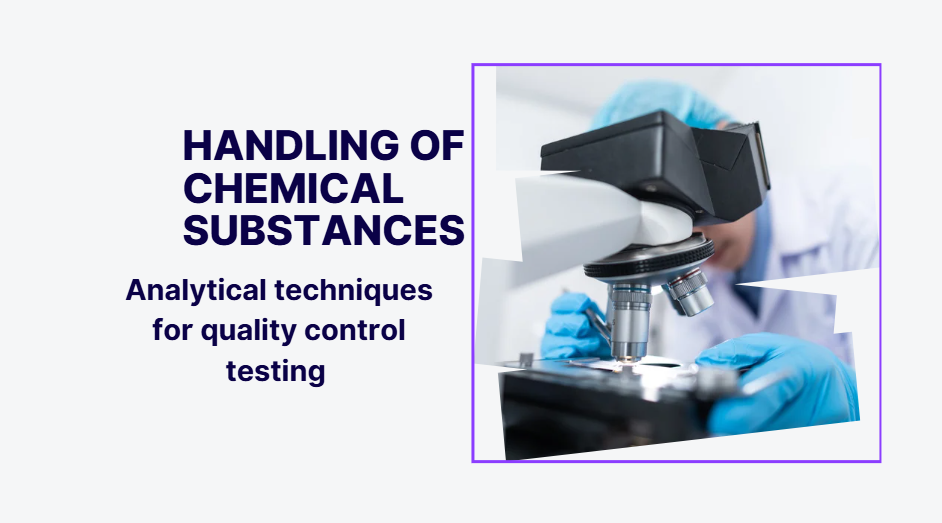
Quality control testing is the cornerstone of ensuring product safety, reliability, and compliance in various industries. In Canada, regulatory bodies like Health Canada, the Canadian Food Inspection Agency (CFIA), and Environment and Climate Change Canada (ECCC) enforce strict standards to safeguard public health and the environment. To meet these standards, advanced analytical techniques are employed for quality control testing.
This blog explores the critical analytical techniques used across industries in Canada, their applications, and their role in ensuring that products meet regulatory and market requirements.
The Importance of Quality Control Testing in Canada
Quality control testing ensures that products are safe, effective, and meet their intended specifications. It covers the entire product lifecycle—from raw material analysis to in-process checks and final product testing. Industries such as pharmaceuticals, food and beverages, environmental monitoring, and materials manufacturing rely heavily on quality control testing to ensure compliance with national and international standards.
Regulatory Framework for Quality Control in Canada
In Canada, quality control testing is guided by:
- Health Canada: Enforces guidelines for pharmaceuticals, medical devices, and food safety.
- CFIA: Regulates food production and agriculture to maintain safety and quality.
- ECCC: Sets environmental standards for monitoring pollutants and emissions.
- ISO Standards: Laboratories often adhere to ISO/IEC 17025 for testing competence.
Key Analytical Techniques for Quality Control Testing
1. High-Performance Liquid Chromatography (HPLC)
HPLC is a widely used technique for separating, identifying, and quantifying components in a mixture.
Applications in Canada:
- Pharmaceuticals: Ensuring drug purity and content uniformity.
- Food Industry: Detecting contaminants like mycotoxins and additives.
- Environmental Testing: Analyzing water and soil samples for pollutants.
Example:
A study showcased the application of HPLC in analyzing pharmaceutical impurities, highlighting its accuracy and reliability
2. Gas Chromatography-Mass Spectrometry (GC-MS)
GC-MS combines the separation capabilities of gas chromatography with the detection accuracy of mass spectrometry, making it indispensable for volatile and semi-volatile compound analysis.
Applications in Canada:
- Environmental Monitoring: Detecting volatile organic compounds (VOCs).
- Food Safety: Analyzing flavor compounds and detecting pesticide residues.
Example:
GC-MS was effectively used to identify VOCs in environmental samples in Canada
3. Fourier-Transform Infrared Spectroscopy (FTIR)
FTIR is a non-destructive technique that identifies chemical bonds in molecules through infrared absorption.
Applications in Canada:
- Material Science: Analyzing polymers, coatings, and composites.
- Pharmaceuticals: Identifying functional groups in drug formulations.
Example:
FTIR was utilized in analyzing polymer samples for medical device applications
4. Mass Spectrometry (MS)
Mass spectrometry is an advanced analytical technique that measures the mass-to-charge ratio of ions to identify and quantify compounds.
Applications in Canada:
- Proteomics: Identifying biomarkers in pharmaceutical research.
- Materials Science: Characterizing advanced materials.
Example:
Mass spectrometry was used for proteomic analysis in Canadian research
5. X-Ray Diffraction (XRD)
XRD is a powerful tool for studying crystalline structures and analyzing material properties.
Applications in Canada:
- Mining Industry: Identifying mineral compositions.
- Pharmaceuticals: Investigating drug polymorphism.
Example:
XRD was employed in Canadian mining studies for mineral characterization
Emerging Technologies in Quality Control Testing
1. Artificial Intelligence (AI) in Quality Control
AI algorithms can analyze large datasets, predict trends, and identify anomalies in quality control processes. AI is increasingly being adopted in Canada to enhance testing accuracy and efficiency.
2. Automation in Analytical Techniques
Automated systems for chromatography and spectrometry reduce human error and improve testing throughput.
3. Portable Analytical Devices
Portable instruments like handheld spectrometers enable on-site quality control testing, especially in remote areas.
Industry-Specific Applications of Analytical Techniques
Pharmaceuticals
- Ensuring drug purity, potency, and stability.
- Regulatory compliance with Health Canada and global standards.
Food and Beverages
- Detecting contaminants like pesticides, heavy metals, and allergens.
- Ensuring compliance with CFIA standards for food safety.
Environmental Monitoring
- Analyzing air, water, and soil for pollutants.
- Supporting ECCC initiatives for environmental sustainability.
Materials Manufacturing
- Characterizing the physical and chemical properties of materials.
- Ensuring the quality of polymers, metals, and composites.
Challenges in Quality Control Testing in Canada
1. Stringent Regulations
Complying with multiple regulatory standards can be complex and resource-intensive.
2. Technological Costs
Advanced analytical instruments require significant capital investment and skilled personnel.
3. Evolving Market Demands
Keeping up with new regulations and customer expectations requires continuous innovation.
REFERENCES
- Nelson F. Quality control program for a geochemical laboratory, Department of Geological Sciences, University of Saskatchewan, Canada (Doctoral dissertation, University of Saskatchewan).
- Abzalov M. Quality control of assay data: a review of procedures for measuring and monitoring precision and accuracy. Exploration and Mining Geology. 2008 Jul 1;17(3-4):131-44.
- Mitra A. Fundamentals of quality control and improvement. John Wiley & Sons; 2016 May 2.
GET STARTED WITH YOUR PROJECT
Partner with ResolveMass Laboratories Inc. for unparalleled expertise in quality control testing. Reach out to us today—your success is our priority!

FDA Withdraws Its 2015 Biosimilarity Guidance: What Replaces It and What Changes for Developers
Introduction On March 9, 2026, the U.S. Food and Drug Administration (FDA) officially announced the…
Oligonucleotide Drug Development at a CDMO: Analytical Characterization and Impurity Challenges
Introduction: Oligonucleotide CDMO Services give drug developers a single, analytically grounded route from sequence design…

Statistical Approaches to Analytical Similarity: Quality Ranges, Equivalence Testing and How FDA Judges the Data
Introduction Statistical Approaches to Analytical Similarity encompass quantitative, risk-based frameworks used by regulatory authorities and…

Residual Uncertainty in Biosimilar Development: How the Stepwise Approach Decides What Studies You Need Next
Introduction Residual uncertainty in biosimilar development determines the scope of regulatory clinical trials by requiring…
Case Study: Improving Conjugation Yield in a Complex Peptide-Oligonucleotide Program
Introduction: Peptide-Oligonucleotide Conjugation Yield Optimization is the systematic improvement of the reaction and recovery processes…
Data Integrity at CDMOs: ALCOA+ Principles and 21 CFR Part 11 Expectations
Introduction: Data Integrity at CDMOs: ALCOA+ and 21 CFR Part 11 is the foundation of…

