
Introduction
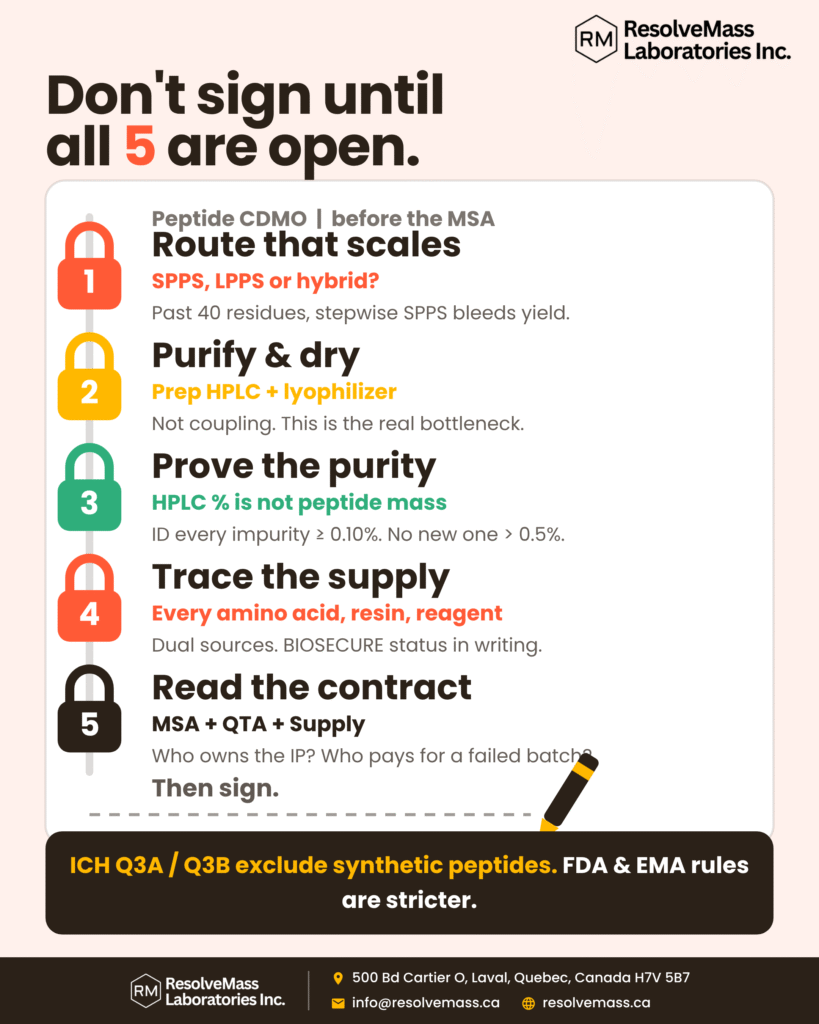
The most critical questions to ask a Peptide CDMO before signing a Master Services Agreement (MSA) revolve around five major technical and commercial considerations: synthesis route scalability, preparative purification and lyophilization capacity, orthogonal impurity characterization in accordance with peptide-specific regulatory thresholds, raw-material supply chain security, and contractual liability for intellectual property (IP) and failed batches. Since synthetic therapeutic peptides occupy a regulatory and chemical space between small molecules and recombinant biologics, conventional pharmaceutical vendor questionnaires are often insufficient to identify the yield reductions, immunogenicity risks, and hidden operational costs that can disrupt peptide development programs.
Evaluating these five areas before entering into an agreement helps prevent expensive complications after the contract is signed. Conventional stepwise Solid-Phase Peptide Synthesis (SPPS) frequently experiences significant yield losses when sequences exceed 40 amino acid residues. Meanwhile, downstream preparative reversed-phase HPLC (RP-HPLC) and lyophilization, rather than reactor coupling, commonly determine manufacturing timelines and Cost of Goods Sold (COGS). From a regulatory perspective, synthetic peptides are excluded from ICH Q3A and Q3B impurity qualification guidelines. Consequently, sponsors must follow stringent FDA and EMA frameworks in which newly identified impurities within the 0.10%–0.5% range may require mandatory immunogenicity assessments. From a commercial standpoint, peptide API supplier guidance based on industry estimates indicates that an initial Request for Proposal (RFP) quotation may account for only 60%–70% of the actual relationship expenditure after incorporating method transfers, stability pulls, deviation investigations, and change orders.
Share via:
Quick Summary:
- Five areas decide the deal. Before signing an MSA with a peptide CDMO, interrogate synthesis route scalability, purification and lyophilization capacity, orthogonal impurity characterization, raw-material supply security, and contractual terms on IP and failed batches. Generic vendor questionnaires miss all of these.
- Match the synthesis route to the molecule, not to the vendor’s equipment. SPPS suits sequences up to ~40 residues; LPPS suits short peptides at 100+ kg; hybrid convergent synthesis (fragments joined by solution-phase condensation or native chemical ligation) handles 30–60+ residue chains like GLP-1 analogues by isolating deletion errors inside fragments. Also confirm GMP experience with cyclization, non-natural residues, PEGylation, lipidation and conjugates.
- Downstream capacity, not coupling, sets the timeline and COGS. Ask about preparative RP-HPLC column diameters, daily cycle throughput, acetonitrile recycling, lyophilizer shelf area and scheduling — plus alternatives to multi-step chromatography (crystallization, IEX, mixed-mode) and greener replacements for DMF/NMP/DCM under REACH pressure.
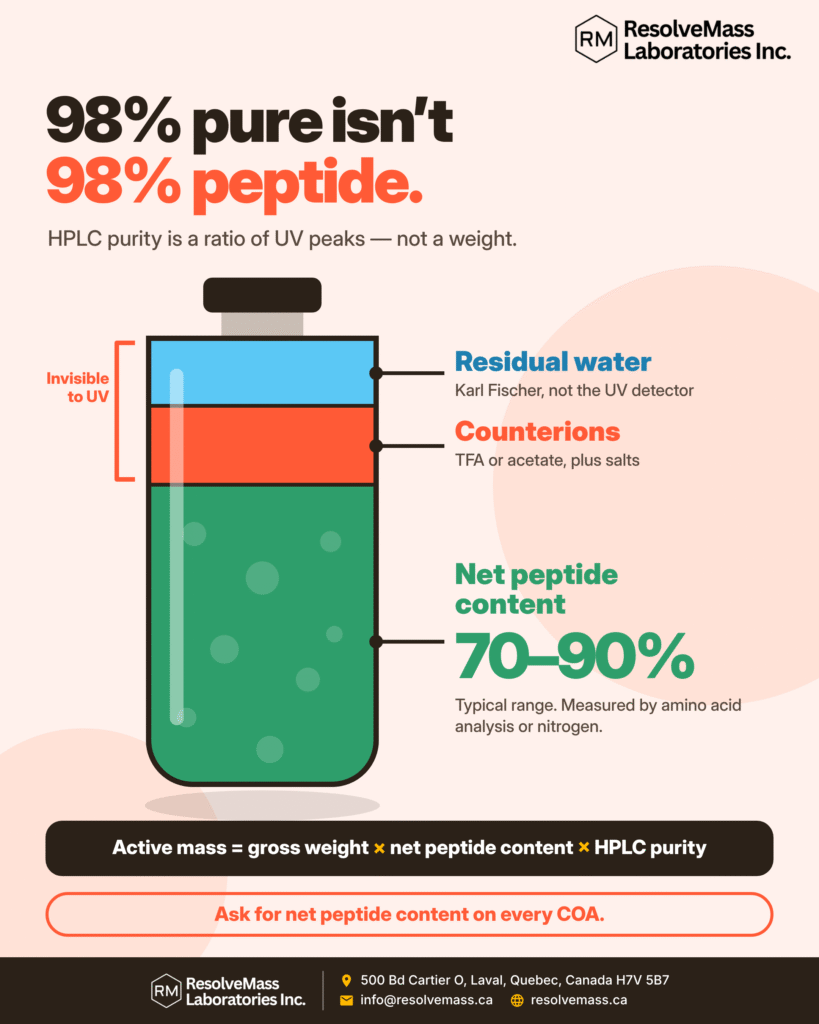
- HPLC purity is not active peptide mass. Net peptide content typically runs 70–90%, so active mass = gross weight × NPC × HPLC purity — and even that assumes the two are independent. Require orthogonal characterization: UHPLC-HRMS and LC-MS/MS, peptide mapping, qNMR, CE, CD and SEC, plus controls for residual TFA, acetate, elemental impurities, nitrosamines and endotoxins.
- Peptides sit outside ICH Q3A/Q3B, so the thresholds are stricter. FDA’s 2021 synthetic peptide ANDA guidance requires identifying every peptide-related impurity at or above 0.10% and blocks new specified impurities above 0.5%; those in between need justification, often with immunogenicity data. EMA and Ph. Eur. 2034 set report >0.1%, identify >0.5%, qualify >1.0%. Also check DMF history, Form 483 outcomes, ALCOA+ data integrity, ICH Q1A(R2) stability and Annex 1 compliance for sterile fill-finish.
- Supply chain and continuity need written commitments. Trace every protected amino acid, resin and reagent to its primary manufacturer; require dual sourcing, BIOSECURE and Section 1260H representations with notification and termination rights. Ask whether your scientists get direct access to bench chemists, start conversations 12–18 months before the first GMP batch, and insist on a non-GMP engineering run first.
- Contracts carry as much financial risk as the chemistry. Use three documents — MSA, Quality Technical Agreement and Supply Agreement — and negotiate clear foreground vs. platform IP, three-tier batch-failure liability, carve-outs from liability caps for gross negligence and IP infringement, change-control thresholds, subcontracting consent and defined exit terms. Compare total cost of ownership, since method transfers, stability pulls, OOS investigations and change orders can push actual spend well beyond the headline quote.
Synthesis and Analytical Questions to Ask a Peptide CDMO
Before selecting a manufacturing partner, determine whether its synthesis technologies, downstream isolation equipment, and analytical instrumentation are appropriate for your peptide’s sequence length, structural complexity, and anticipated clinical-to-commercial manufacturing requirements. Choosing a CDMO based on the limitations of its existing equipment, rather than selecting synthesis and formulation approaches that suit the molecule, can create substantial difficulties during subsequent scale-up activities.
Synthesis Route Selection and Scale-Up Architecture
Ask whether the CDMO performs Solid-Phase Peptide Synthesis (SPPS), Liquid-Phase Peptide Synthesis (LPPS), and hybrid convergent synthesis strategies under GMP conditions. Request historical yield data for peptides with comparable sequence lengths and hydrophobicity profiles.
During early discovery, SPPS typically uses substantial reagent excesses, often 5 to 10 equivalents, to drive coupling reactions toward completion within shorter processing times. However, this approach can become economically impractical and generate significant impurity burdens when transferred to pilot and commercial manufacturing scales. For sequences exceeding 30 to 40 residues, including GLP-1 analogues, conventional stepwise SPPS can accumulate deletion and truncation errors that create substantial challenges during downstream chromatography.
Hybrid convergent synthesis addresses these limitations by producing shorter protected fragments through SPPS or LPPS. These intermediates are subsequently purified and joined through solution-phase condensation or Native Chemical Ligation (NCL). This approach can improve manufacturing efficiency and provide better control over impurities associated with lengthy peptide sequences.
You should also confirm the CDMO’s experience in executing GMP manufacturing processes involving complex structural modifications, including disulfide bridges, lactam cyclization, D-amino acids, non-natural residues, PEGylation, fatty-acid lipidation, and peptide-oligonucleotide conjugates (POCs).
| Synthesis Methodology | Typical Sequence Length | Target Scale Range | Key Chemical Advantages | Scale-Up Considerations and Clinical Fit |
|---|---|---|---|---|
| Solid-Phase (SPPS) | Up to 40+ residues | Grams to 25+ kg/batch | High automation, rapid route optimization, and effective management of hydrophobic or aggregation-prone chains | Suitable for early clinical supply, cyclic peptides, and neoantigens; however, yield reductions and high solvent mass intensity can become significant above 40 residues. |
| Liquid-Phase (LPPS) | 2 to 15 residues | 100+ kg campaigns | High volumetric productivity, elimination of resin costs, and strong alignment with green chemistry principles | Appropriate for short peptide APIs and linkers; requires effective intermediate isolation controls and bulk solvent abatement. |
| Hybrid / Convergent | 30 to 60+ residues | Multi-kilogram scale | Enables deletion errors to be isolated within individual fragments before ligation, improving crude yields and scalability | Commonly used for commercial GLP-1 analogues and long polypeptides; performance depends on fragment purity and ligation conversion efficiency. |
Purification, Lyophilization, and Solvent Sustainability
Evaluate the CDMO’s preparative RP-HPLC column capacity, lyophilizer availability, and solvent-handling infrastructure. Purification and isolation, rather than amino acid coupling, frequently represent the primary bottlenecks in peptide manufacturing.
As peptide sequence length increases, crude product purity generally decreases. This can necessitate multiple preparative chromatography cycles, increase acetonitrile consumption, and extend freeze-drying durations. At the same time, conventional SPPS consumes considerable quantities of hazardous polar aprotic solvents, including DMF, NMP, and DCM. These solvents create additional environmental and operational concerns because of increasingly stringent European REACH restrictions and rising waste-abatement costs.
During facility qualification, ask the following operational questions:
- What are your maximum preparative RP-HPLC column diameters, daily cycle throughput, and acetonitrile recycling capabilities?
- When the peptide’s sequence properties allow, can you replace multi-step chromatography with intermediate crystallization, ion-exchange (IEX), or mixed-mode purification to reduce the overall purification burden?
- What lyophilization shelf area, cold storage capacity, and scheduling availability do you maintain for clinical and commercial manufacturing campaigns?
- Have you validated greener alternatives to conventional SPPS solvents, such as N-butylpyrrolidinone (NBP) or binary green solvent mixtures? Alternatively, do you have thermal oxidizer or carbon-abatement systems for managing bulk solvents used in LPPS?
- How do you monitor and minimize Process Mass Intensity (PMI) when transferring a synthesis route from early clinical manufacturing to Phase III production?
Examine the capabilities required to manage peptide manufacturing scale-up, including production capacity, process optimization, and downstream operations.
Explore Peptide CDMO Scale-Up Services
Analytical and COA Questions to Ask a Peptide CDMO
Before accepting any quantity of API, establish whether the prospective manufacturing partner combines routine purity testing with orthogonal structural characterization and has appropriate systems to prevent Certificate of Analysis (COA) blind spots.
One common mistake in peptide procurement is treating HPLC purity as equivalent to the actual quantity of active peptide present in a sample. Reversed-phase HPLC with UV detection at 214 nm or 220 nm determines the proportion of the target peptide relative to other UV-absorbing peptidic impurities. However, this measurement does not account for moisture, residual salts, counterions, or co-eluting isomers.
Determining the actual active peptide mass requires Net Peptide Content (NPC), which typically ranges from 70%–90% when measured through quantitative Amino Acid Analysis (AAA) or elemental nitrogen testing. The calculation is expressed as follows:
Active Mass = Gross Weight × (NPC [%] / 100) × (HPLC Purity [%] / 100)
However, this calculation also has an important analytical limitation. It assumes that NPC and HPLC purity function as independent correction factors. Furthermore, quantitative AAA alone does not necessarily differentiate the intact target sequence from truncated peptidic impurities.
For this reason, ask whether the CDMO routinely combines orthogonal analytical platforms to identify co-eluting deletions, diastereomers, methionine oxidation, deamidation, and aggregation. Essential analytical capabilities include:
- UHPLC-HRMS and LC-MS/MS sequencing: These techniques support molecular mass confirmation, sequence verification, and detailed characterization of peptide-related impurities.
- Enzymatic peptide mapping: This provides additional sequence-level characterization in accordance with applicable USP and Ph. Eur. requirements.
- 2D or quantitative NMR (qNMR): These methods support structural elucidation and quantitative assessment of peptide-related components.
- Capillary Electrophoresis (CE): This technique helps identify and characterize charge variants.
- Circular Dichroism (CD): This method provides information about peptide secondary structure.
- Size Exclusion Chromatography (SEC-LC): This technique quantifies dimers, trimers, and aggregates rather than grouping them under broad and insufficiently defined descriptions such as “high-molecular-weight impurity.”
You should also verify the availability of quantitative controls for residual trifluoroacetic acid (TFA) under USP <503.1>. Residual TFA counterions can influence membrane permeation and biological assay results. Additional controls should address acetate limits under applicable USP requirements, residual hydrofluoric acid when used during deprotection, elemental impurities (ICH Q3D / USP), nitrosamines (USP), bacterial endotoxins (USP), and sterility (USP).
For sponsors assessing analytical capabilities alongside GMP compliance, reviewing the laboratory’s certifications and regulatory credentials can provide an objective basis for evaluating quality systems. ResolveMass Laboratories Inc., for instance, operates as a Health Canada GMP-compliant facility (Drug Establishment Licence 3-002945-A), a US FDA-registered laboratory (FEI 3042696771), and an ISO 9001:2015 certified organization with ISO/IEC 17025 accreditation for specialized trace testing, including nitrosamine analysis. Its analytical infrastructure includes HRMS, NMR, peptide mapping, and stability workflows within a unified quality system.
Explore analytical approaches for evaluating the identity, purity, and structural characteristics of GLP-1 peptide products.
Learn About GLP-1 Peptide Analytical Characterization
Regulatory and Quality Questions to Ask a Peptide CDMO
Confirm that the CDMO’s analytical specifications, regulatory inspection history, and Chemistry, Manufacturing, and Controls (CMC) documentation comply with peptide-specific FDA, EMA, and USP expectations rather than relying on conventional small-molecule regulatory templates.
Since ICH Q3A and Q3B exclude synthetic peptides, and ICH Q6A has only partial or no applicability in certain peptide contexts, sponsors must address more stringent impurity identification requirements and specific immunogenicity considerations.
In the United States, the FDA’s May 2021 guidance, ANDAs for Certain Highly Purified Synthetic Peptide Drug Products That Refer to Listed Drugs of rDNA Origin, addresses synthetic generic versions of five recombinant reference products: glucagon, liraglutide, nesiritide, teriparatide, and teduglutide. The guidance also acknowledges that its scientific principles may be relevant to other peptides, depending on their associated risks.
Under this framework, sponsors must identify every peptide-related impurity present at or above 0.10%. New specified impurities exceeding 0.5% are not acceptable, while newly identified or elevated impurities between 0.10% and 0.5% require appropriate justification supported by comparative immunogenicity data. Relevant assessments may include in silico MHC binding screens, in vitro T-cell assays, innate immune response modulating impurity (IIRMI) tests, and stress aggregation studies.
A regulatory analysis of the 2026 draft FDA Product-Specific Guidances (PSGs) describes a related approach that establishes reporting thresholds above 0.1% and identification thresholds above 0.5%. It also recommends maintaining shared impurities at or below the Reference Listed Drug (RLD) level or 1.0%, whichever is greater, while keeping new impurities below 1.0% and total impurities at or below the RLD’s total impurity level.
In Europe, the EMA synthetic peptide guideline and Ph. Eur. General Monograph 2034 establish reporting thresholds above 0.1%, identification thresholds above 0.5%, and qualification thresholds above 1.0% for peptide-related impurities. They also require preclinical qualification of impurities exceeding 1.0% during clinical development and apply ICH M7 principles to non-peptide mutagenic impurities.
| Regulatory or Compendial Framework | Reporting / Identification Threshold | Qualification / New Impurity Ceiling | Required Characterization and Controls |
|---|---|---|---|
| FDA 2021 Synthetic Peptide ANDA Guidance | Identify each peptide-related impurity ≥ 0.10% | New impurities > 0.5% are unacceptable; impurities between 0.10% and 0.5% require justification. | Comparative in silico MHC binding, in vitro T-cell testing, IIRMI assessment, and aggregation comparability against the RLD. |
| 2026 Draft FDA PSGs (according to third-party regulatory review) | Report > 0.1%; identify > 0.5%. | Keep new impurities < 1.0%; shared impurities ≤ RLD or 1.0%; total impurities ≤ RLD total. | Out-of-range impurities require safety and efficacy justification, alongside innate immune and host-cell impurity controls. |
| EMA Guideline / Ph. Eur. General Monograph 2034 | Report > 0.1%; identify > 0.5%. | Qualify > 1.0%, including preclinical qualification above 1.0% during early clinical trials. | Orthogonal MS for co-elution, SEC-LC for dimers and aggregates, and ICH M7 controls for non-peptide impurities. |
| USP , , , <503.1> | Sequence- and monograph-dependent, often ≥ 0.10%. | Applicable compendial acceptance limits, including requirements for Met oxidation, TFA, and endotoxins. | Starting material attributes, peptide mapping, TFA testing under <503.1>, and nitrosamine controls. |
Before finalizing the CDMO selection, ask the following targeted quality and regulatory questions:
- How many Type II Drug Master Files (DMFs) have you submitted for peptide APIs across the FDA, EMA, and PMDA, and what were the outcomes of your most recent FDA Form 483 inspection and independent Rx-360 audits?
- How do your electronic laboratory records and batch records maintain compliance with ALCOA+ data integrity principles?
- Are your analytical method transfers conducted in accordance with applicable USP requirements? Do your stability chambers support complete ICH Q1A(R2) long-term, accelerated, forced degradation, photostability, and freeze-thaw testing protocols?
- If your manufacturing scope includes parenteral sterile fill-finish, are your aseptic filling isolators, including closed or gloveless workcells, compliant with the contamination-control expectations introduced through the 2022 EU GMP Annex 1 updates?
Review the approaches used to identify, evaluate, and control pharmaceutical impurities under ICH Q3A requirements.
Explore Impurity Control Strategies
Supply Chain Resilience and Clinical-to-Commercial Continuity
Require the CDMO to establish the origin of every protected amino acid, resin, and coupling reagent by tracing each material back to its primary manufacturer. You should also determine how the manufacturing process will transition from flexible clinical supply to controlled commercial production without requiring an unplanned technology transfer.
Commercial peptide manufacturing campaigns consume considerable quantities of Fmoc/tBoc amino acid derivatives, linkers, and specialized non-natural building blocks. Consequently, disruptions in the upstream supply of these materials can directly affect manufacturing schedules and clinical program continuity.
Evaluate supply chain resilience by asking whether the CDMO manufactures peptide building blocks and fragments internally or maintains qualified dual sources for critical intermediates in accordance with applicable USP requirements.
In the post-BIOSECURE Act environment, request written representations concerning BIOSECURE and Section 1260H status. The agreement should also establish an affirmative obligation to notify you immediately if any relevant designation occurs, along with contractual rights to terminate the agreement or approve an alternative supplier when necessary.
Operational suitability and communication arrangements should be assessed alongside geographical considerations. Commercial-scale CDMOs often maintain separate departments for formulation, analytical development, regulatory affairs, and manufacturing. Although this organizational structure may support specialized operations, it can also create communication barriers, delay early-stage modifications, and increase the likelihood of errors during departmental handovers.
Ask whether your scientific team will have direct access to the bench chemists responsible for synthesis and characterization or whether all technical communication must pass through project managers. Direct scientific interaction can improve the resolution of technical concerns and facilitate faster decision-making throughout development.
Geographical considerations also influence CDMO selection. North American sponsors frequently evaluate regional advantages and operational trade-offs across different development phases. Comparative vendor analyses estimate that Canadian Research and Development tax incentives (SR&ED) may reduce eligible early-phase development costs by approximately 20%–45%, depending on contract eligibility. In comparison, large US manufacturing facilities may offer 10,000 L+ reactors and mega-prep HPLC systems designed to support high-volume commercial launches.
Compare regional manufacturing capabilities, infrastructure, and operational considerations when evaluating peptide CDMOs in Canada and the United States.
Explore Canadian vs. US Peptide CDMOs
Manufacturing timelines must also be established realistically. Initiate discussions with prospective CDMOs at least 12–18 months before the anticipated first GMP batch. General analytical and process technology transfers can require 6–12+ months, while published benchmarks for complex biologics or commercial manufacturing site changes extend to approximately 12–24 months.
Before committing GMP materials, insist on conducting a non-GMP engineering run. This preliminary exercise helps identify equipment-related limitations, process inconsistencies, and scale-up challenges before they affect GMP manufacturing activities.
Evaluate the factors that influence peptide CDMO selection, including manufacturing experience, technical capabilities, and production readiness.
Read How to Choose a Peptide CDMO in the US
Contractual, IP Ownership, and Cost Questions Before Signing
Contractual arrangements deserve the same level of scrutiny as the chemistry and analytical package. Disagreements involving foreground IP ownership, unsuccessful GMP batches, and unexpected expansions in project scope can result in some of the most substantial financial losses in CDMO partnerships.
Before initiating work, establish a clear contractual structure consisting of three documents:
- Master Services Agreement (MSA): This agreement should define commercial terms, contractual responsibilities, liability provisions, and IP ownership.
- Quality Technical Agreement (QTA): This document should establish cGMP responsibilities, quality-related obligations, and the respective roles of both parties during regulatory inspections and manufacturing activities.
- Supply Agreement: This agreement should address binding production forecasts, material supply commitments, and manufacturing capacity reservations.
The following table highlights common contractual risks and the provisions sponsors should consider negotiating.
| Contractual Clause | Common Risk in Standard Templates | Sponsor-Protective Standard to Negotiate |
|---|---|---|
| Intellectual Property | Ambiguous improvement provisions; default inventorship rules may award innovations conceived by CDMO scientists to the CDMO. | Clearly distinguish Client Foreground IP, CDMO Platform IP, and Springing Licenses, which are triggered by supply failures. Consider Field-of-Use carve-outs where appropriate. |
| Batch Failure Liability | The CDMO provides credits only for processing fees, leaving the sponsor responsible for wasted peptide API and lost clinical development time. | Establish three separate liability categories: CDMO fault, including a funded re-run, priority re-slotting, and material reimbursement; Sponsor material defects; and Development uncertainty. |
| Liability Carve-Outs | Broad liability caps and blanket exclusions of consequential damages may also apply to serious vendor misconduct. | Negotiate uncapped or super-capped liability for gross negligence, willful misconduct, regulatory debarment, data loss, and IP infringement. |
| QTA Change Control | The vendor may implement internal change-control thresholds without informing the sponsor about relevant process modifications. | Define clear thresholds distinguishing changes that require prior sponsor approval from those that require notification after implementation. |
| Subcontracting & Exit | Standard agreements may provide unrestricted subcontracting rights and impose unclear or open-ended charges for exit activities. | Require prior written sponsor consent for subcontractors while retaining the CDMO’s compliance liability. Mandate the handover of MBR, raw data, and validation documentation at predetermined rates. |
Always assess the Total Cost of Ownership (TCO) rather than relying exclusively on headline synthesis quotations when comparing peptide CDMOs. Initial manufacturing estimates may not include several additional expenses that accumulate throughout the partnership.
Unplanned costs commonly arise from analytical method transfer and refinement, stability pulls and storage, out-of-specification (OOS) investigations, batch-record revisions, and exit technology-transfer consulting. These expenses can significantly increase the total financial commitment if they are not addressed during initial negotiations.
To minimize contractual uncertainty, define batch yield assumptions, sponsor review timelines, and cancellation schedules in the initial Statement of Work (SOW). Establishing these requirements before manufacturing begins reduces the likelihood of disagreements, unexpected financial obligations, and difficult renegotiations during active production campaigns.
Understand the differences between peptide CDMO and CMO operating models before agreeing on technical responsibilities, manufacturing scope, and commercial terms.
Explore Peptide CDMO vs. CMO
Conclusion
Following this comprehensive technical, regulatory, and contractual checklist of Questions to Ask a Peptide CDMO can protect peptide development programs from manufacturing bottlenecks, regulatory deficiencies, and unexpected commercial dependencies. By confirming hybrid synthesis capabilities, preparative HPLC and lyophilization throughput, orthogonal impurity profiling against FDA and EMA requirements, BIOSECURE-compliant supply chains, and balanced QTA liability provisions before signing an agreement, sponsors can establish a more predictable pathway for advancing therapeutic peptides from development to clinical trials and commercial markets.
If your development team requires specialized peptide analytical characterization, impurity identification, method validation, or GMP support aligned with Health Canada and FDA expectations, connect directly with the scientific team at ResolveMass Laboratories Inc. through our Contact Us page:
Frequently Asked Questions
The FDA’s May 2021 synthetic peptide ANDA guidance requires identification of peptide-related impurities present at or above 0.10% and does not accept new specified impurities exceeding 0.5%. In Europe, the EMA guideline and Ph. Eur. General Monograph 2034 establish reporting, identification, and qualification thresholds above 0.1%, 0.5%, and 1.0%, respectively. A regulatory review of the 2026 draft FDA PSGs also describes reporting above 0.1% and identification above 0.5%, with recommendations to keep new impurities below 1.0%.
Under the FDA’s May 2021 synthetic peptide ANDA guidance, newly introduced or increased peptide-related impurities between 0.10% and 0.5% require scientific justification through comparative safety and immunogenicity assessments against the Reference Listed Drug (RLD). Sponsors may use in silico MHC binding predictions, in vitro T-cell response assays, and innate immune response modulating impurity (IIRMI) testing. Stress-induced aggregation studies can provide additional evidence when evaluating potential immunogenicity risks.
Reversed-phase HPLC performed at 214–220 nm measures the target peptide relative to other UV-absorbing peptidic impurities but does not account for moisture, residual salts, or counterions such as TFA and acetate. Net Peptide Content (NPC), generally ranging from 70%–90%, provides an estimate of the actual peptide content using quantitative Amino Acid Analysis or elemental nitrogen testing. Considering both NPC and HPLC purity helps sponsors calculate active peptide mass more accurately and avoid relying solely on chromatographic purity values.
Sponsors should begin evaluating potential peptide CDMOs, conducting facility audits, and negotiating contracts approximately 12–18 months before their first planned GMP manufacturing batch. Analytical and manufacturing technology transfers can take 6–12+ months because they involve method validation, raw material qualification, process documentation, and equipment readiness. More complex biologics transfers and commercial manufacturing site changes may require 12–24 months, depending on process complexity and regulatory requirements.
Although regulations do not universally require a non-GMP engineering run, conducting one before the first GMP campaign is an important manufacturing risk-reduction measure. It allows the CDMO to evaluate the process using the actual production equipment and identify potential limitations involving mixing, cleavage, filtration, and preparative HPLC. Addressing these issues before GMP manufacturing helps prevent material losses, processing delays, and deviations during regulated production.
Responsibility for a failed GMP peptide batch depends on the contractual provisions established in the Master Services Agreement (MSA) and Quality Technical Agreement (QTA). If an investigation establishes that the failure resulted from CDMO negligence or cGMP non-compliance, the agreement may require a vendor-funded replacement batch, priority manufacturing scheduling, and reimbursement of agreed material costs. However, failures caused by sponsor-supplied material defects or previously accepted development risks may remain the sponsor’s responsibility.
Ownership of process improvements and newly developed intellectual property depends on applicable patent laws and the specific contractual arrangements between the sponsor and CDMO. Without clearly defined IP provisions, the CDMO may obtain rights to certain inventions developed by its employees during manufacturing activities. Sponsors should therefore establish ownership of product-specific foreground IP in advance and negotiate appropriate Springing Licenses or Field-of-Use protections for CDMO Platform IP to maintain manufacturing flexibility.
The Quality Technical Agreement (QTA) establishes the responsibilities of the sponsor and CDMO for cGMP compliance, quality control, documentation, deviation management, and manufacturing change approvals. Maintaining it as a separate or severable document from the Master Services Agreement (MSA) helps distinguish regulatory obligations from commercial arrangements involving pricing, liability, and supply commitments. This structure also makes quality responsibilities easier to review during regulatory inspections and helps prevent commercial disagreements from interfering with essential GMP requirements.
The initial Request for Proposal (RFP) quotation may exclude several expenses that arise during the manufacturing partnership. Common additional charges include analytical method transfers and modifications, stability testing and storage, deviation investigations, out-of-specification (OOS) assessments, batch-record revisions, and exit technology-transfer services. Industry estimates cited by peptide API manufacturers suggest that the initial quotation may represent only 60%–70% of the total relationship expenditure once these additional activities and change orders are included.
Reference:
- Li, Y. (2022, September 20). Common deficiencies associated with comparative peptide impurity profile studies and qualification of impurity levels and proposed limits. U.S. Food and Drug Administration. https://www.fda.gov/media/166572/download
- United States Pharmacopeia. (n.d.). Peptide impurities and related substances [Brochure]. USP. https://www.usp.org/sites/default/files/usp/document/our-work/biologics/resources/1699-peptide-flyer.pdf
- Pang, E. (2020, September 20). Assessing immunogenicity risk of peptides: The synthetic peptide guidance and PSGs [Presentation]. U.S. Food and Drug Administration (FDA). https://www.fda.gov/media/166571/download
- European Medicines Agency. (2025, December 4). Guideline on the development and manufacture of synthetic peptides (EMA/CHMP/CVMP/QWP/367182/2025). https://www.ema.europa.eu/en/documents/scientific-guideline/guideline-development-manufacture-synthetic-peptides_en.pdf
- Erckes, V., Streuli, A., Chamera Rendueles, L., Krämer, S. D., & Steuer, C. (2025). Towards a consensus for the analysis and exchange of TFA as a counterion in synthetic peptides and its influence on membrane permeation. Pharmaceuticals, 18(8), 1163. https://doi.org/10.3390/ph18081163
Get In Touch With Us
About The Author