
Introduction
Raw Material Characterization Before Extractable & Leachable Testing is essential for establishing an accurate chemical baseline, identifying thermal transition limits, and determining additive compositions within polymer matrices before conducting controlled solvent extraction studies. This preliminary assessment helps prevent solvent-induced matrix degradation, reduces the risk of false-positive analytical findings, and supports material equivalence across international regulatory requirements.
Polymeric materials used in Class II and Class III medical devices, drug delivery systems, and primary container closure systems are seldom composed of pure homopolymers. Instead, they typically contain complex combinations of low-molecular-weight additives, including antioxidants, plasticizers, heat stabilizers, lubricants, slip agents, and processing aids. These materials may also contain residual monomers, oligomers, and synthesis catalysts. When exposed to exaggerated or exhaustive extraction procedures required under ISO 10993-18:2020 and USP <1663>, inadequately characterized polymers can introduce considerable analytical challenges. The use of excessively aggressive solvents or extraction temperatures that exceed the polymer’s thermal transition limits can disrupt phase equilibrium, produce excessive polymer swelling, or trigger thermal depolymerization. Such experimental artifacts can compromise the extractable profile and introduce degradation products that are not physiologically relevant into liquid chromatography-mass spectrometry (LC-MS) and gas chromatography-mass spectrometry (GC-MS) screening results.
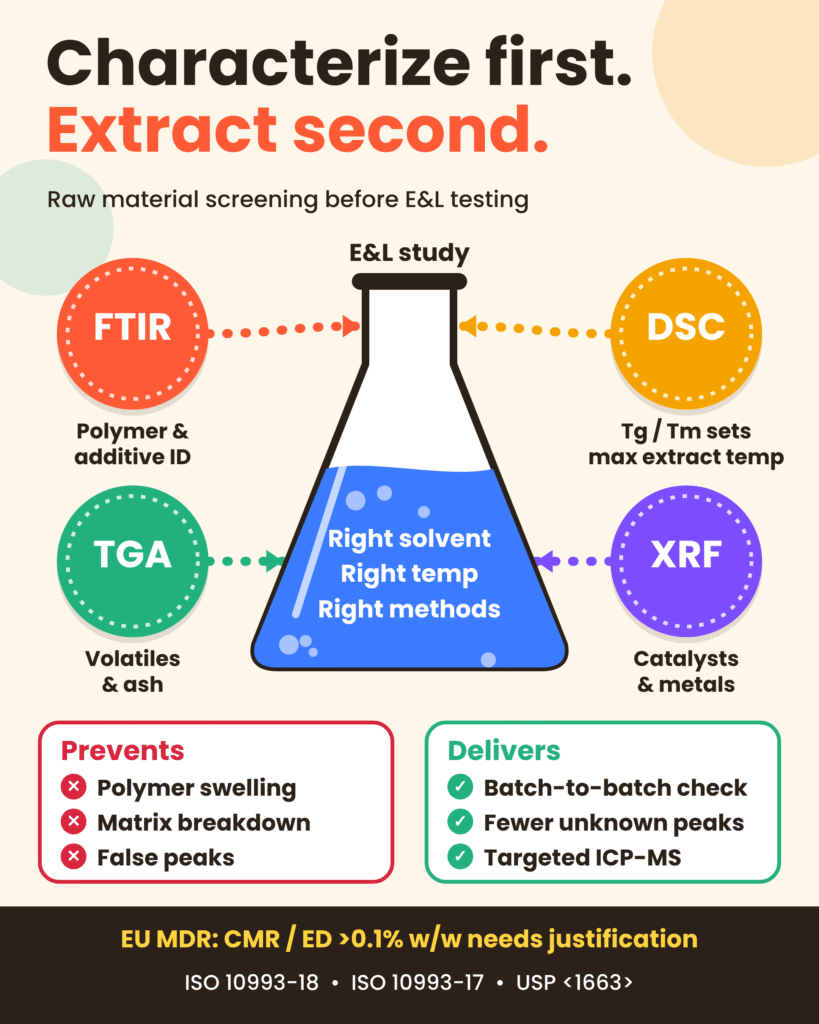
Conducting chemical characterization at the initial stage through Fourier-Transform Infrared Spectroscopy (FTIR), Differential Scanning Calorimetry (DSC), Thermogravimetric Analysis (TGA), and Energy-Dispersive X-Ray Fluorescence (ED-XRF) provides a detailed understanding of the material composition. This preliminary information enables analytical testing facilities, including ResolveMass Laboratories Inc., to select appropriate extraction vehicles, establish incubation temperatures below critical physical transition limits, and determine accurate Analytical Evaluation Thresholds (AET) using relevant toxicological safety criteria.
Explore the importance of solvent selection in E&L investigations: Solvents for Extractables Studies
Share via:
Quick Summary:
- Why characterize first: Medical device and packaging polymers contain additives, residual monomers and catalysts. Screening the raw material before E&L testing sets a chemical baseline, prevents solvent-induced damage to the polymer, and reduces false-positive peaks.
- Regulatory basis: ISO 10993-18:2020 and USP <1663> expect the material’s composition to be established before extraction studies, and findings feed into the toxicological risk assessment under ISO 10993-17:2023. Under EU MDR, CMR 1A/1B and endocrine-disrupting substances above 0.1% w/w must be justified.
- FTIR: Identifies the polymer type (polyolefin, fluoropolymer, polyurethane, silicone) and major additive classes such as ester plasticizers, phenolic antioxidants and amide slip agents.
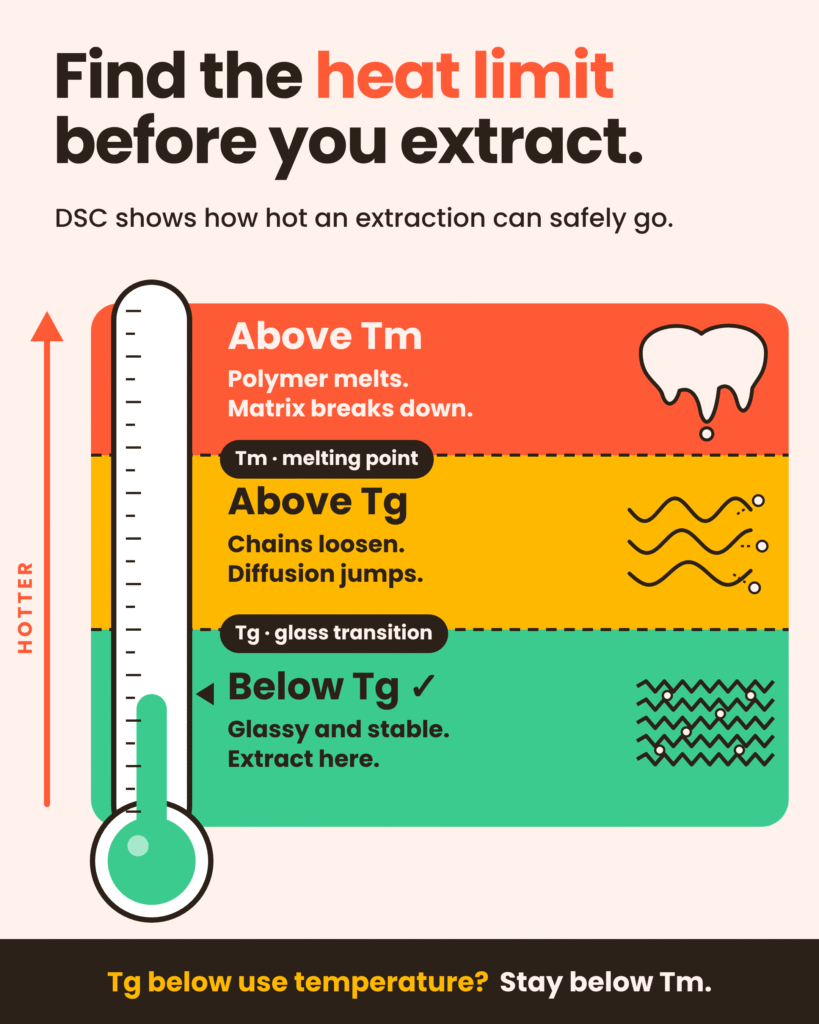
- DSC: Measures Tg, Tm and crystallinity, which set the maximum extraction temperature. Extracting above these limits can cause swelling, degradation and extractables that wouldn’t migrate in real use.
- TGA and XRF: TGA measures volatiles, plasticizer content, degradation onset and ash. XRF screens for elements such as catalyst residues (Ti, Pt, Zn), flame retardants and fillers, which guides targeted ICP-MS testing.
- Practical benefits: Knowing the composition helps chemists choose solvents that won’t dissolve or damage the polymer. It also lets manufacturers catch unannounced supplier or batch changes and show material equivalence without repeating full E&L studies.
- Bottom line: Upfront characterization makes E&L studies more reliable and defensible, with fewer unidentified peaks. Note that the article’s claim that it justifies a lower AET uncertainty factor isn’t accurate, because ISO 10993-18 bases the UF on the analytical method’s response-factor variation.
Regulatory Imperatives for Raw Material Characterization Before Extractable & Leachable Testing
Regulatory frameworks, including ISO 10993-18:2020 and USP <1663>, require early chemical characterization to establish the composition of materials before beginning quantitative extractable and leachable investigations. Following this sequential, risk-based methodology ensures that toxicological assessments are supported by comprehensive material composition data rather than relying exclusively on potentially incomplete extraction findings.
The approach described in ISO 10993-18:2020 establishes a five-stage hierarchical process for evaluating medical device safety:
Step 1: Qualitative Information Gathering: Collecting comprehensive information about material composition, monomer synthesis pathways, processing aids, and supplier-provided documentation.
Step 2: Material Equivalence Assessment: Evaluating incoming polymer batches or alternative candidate materials against previously established clinical predicate materials to determine whether additional chemical testing is necessary.
Step 3: Quantitative Chemical Information: Performing direct spectroscopic, thermal, and elemental characterization of raw materials using techniques such as FTIR, DSC, TGA, and XRF.
Step 4: Controlled Extractions & E&L Analysis: Conducting targeted solvent extraction procedures and analyzing the resulting samples through chromatographic and elemental screening techniques, including GC-MS, LC-MS, and ICP-MS.
Step 5: Toxicological Risk Assessment: Assessing identified chemical compounds against permissible exposure limits and relevant toxicological safety requirements under ISO 10993-17:2023.
The European Union Medical Device Regulation (EU MDR 2017/745) Annex I further strengthens this approach by requiring the identification of Carcinogenic, Mutagenic, or Reproductive Toxicants (CMR Category 1A and 1B) and Endocrine Disrupting (ED) chemicals present at concentrations exceeding a 0.1% weight-by-weight (w/w) threshold. Meeting this regulatory requirement without preliminary raw material characterization is extremely difficult because the overall polymer composition determines the potential migration pathways of CMR substances.
Similarly, USP <1663> highlights the importance of characterizing packaging materials of construction to identify potential chemical migrants before conducting controlled extraction investigations. The United States Food and Drug Administration (FDA) 2024 draft guidance on chemical characterization also emphasizes that extraction procedures must be scientifically justified according to the properties of the raw materials being evaluated. Extractables profiles generated using inadequately characterized materials can frequently result in regulatory deficiency notices, particularly when chromatographic peaks remain unidentified or analytical thresholds have not been calculated correctly.
Spectroscopic and Thermal Screening of Polymer Matrices
Spectroscopic and thermal characterization techniques examine polymer functional groups, chemical structures, and phase transitions to determine whether materials can maintain their structural integrity during laboratory testing. Integrating analytical methods such as FTIR, DSC, TGA, and XRF enables testing facilities to evaluate both organic additive formulations and inorganic catalyst residues present within polymer matrices.
FTIR Spectroscopy for Chemical Identification and Additive Profiling
Fourier-Transform Infrared Spectroscopy (FTIR) is used to identify polymer backbone structures and recognize major categories of organic additives through their characteristic molecular vibrational absorptions in the mid-infrared region. The analytical procedure involves passing mid-infrared radiation (4000–400 cm-1) through an Attenuated Total Reflectance (ATR) crystal interface. The resulting infrared absorption spectrum is then compared with authenticated reference libraries to determine the chemical identity of the material.
ATR-FTIR systems equipped with diamond or germanium crystals facilitate direct, non-destructive surface examination of solid polymer pellets, extruded tubing, molded components, and elastomeric seals. The penetration depth of the infrared beam (dp) within the polymer matrix depends on the wavelength (λ), refractive indices of the crystal (n1) and sample (n2), and angle of incidence (θ):
dp = λ / [2πn1√(sin2θ – (n2/n1)2)]
By comparing obtained spectra with extensive chemical reference databases, ATR-FTIR helps determine whether a raw resin belongs to the polyolefin category (e.g., Polyethylene, Polypropylene), fluoropolymers (e.g., PTFE, FEP), polyurethane-based materials, or silicone elastomers. In addition to identifying the primary polymer structure, FTIR can recognize characteristic absorption bands associated with several commonly used additive categories:
- Carbonyl Stretching (1740–1720 cm-1): This absorption region indicates the possible presence of ester-based plasticizers, phthalate esters, or ester-containing antioxidants, including Irganox 1010.
- Hindered Phenol Hydroxyl Absorption (3650–3600 cm-1): Absorption signals in this region can indicate primary phenolic antioxidants incorporated into polyolefins to protect against thermal degradation.
- Amide I and II Bands (1650 cm-1 and 1550 cm-1): These characteristic bands help identify amide-containing slip agents, such as erucamide and oleamide, which are incorporated into molded components to reduce their coefficient of friction.
Differential Scanning Calorimetry (DSC) for Thermal Transition and Phase Equilibrium Analysis
Differential Scanning Calorimetry (DSC) evaluates the difference in heat flow between a polymer sample and an inert reference material as temperature changes. This measurement helps establish essential thermodynamic transition points that determine the thermal behavior of polymeric materials. DSC identifies the Glass Transition Temperature (Tg), Melt Temperature (Tm), Crystallization Temperature (Tc), and Enthalpy of Fusion (ΔHm) through controlled heating and cooling cycles.
The physical condition of a polymer has a direct influence on its extraction behavior and chemical diffusion kinetics. ISO 10993-18:2020 Clause 3.6 highlights that laboratory extraction conditions should not modify the phase equilibrium of the material. When the temperature rises above the glass transition temperature (Tg), amorphous polymer chains move from a rigid, glassy condition into a more flexible, rubbery state. This transformation produces a significant increase in free volume and molecular diffusion rates (D), which can be represented using the Arrhenius relationship:
D = D0 × exp(-Ea / RT)
When an extractable study exposes a polymer to temperatures above its Tg or close to its Tm, the rate of chemical diffusion can increase beyond naturally occurring levels. Such changes in the physical state of the material may cause excessive swelling, artificial polymer depolymerization, and the release of chemical substances that would not normally migrate under actual clinical storage or operating conditions. DSC analysis identifies these thermal transition limits and helps establish appropriate maximum incubation temperatures for E&L extraction procedures.
Additionally, DSC determines the percentage crystallinity (% Xc) of semi-crystalline polymers, including PEEK, Nylon, and HDPE, using the following relationship:
% Xc = (ΔHm / ΔHm°) × 100%
Here, ΔHm represents the experimentally measured melting enthalpy, whereas ΔHm° denotes the theoretical melting enthalpy of a completely crystalline reference polymer. Materials with higher crystallinity generally restrict solvent diffusion, while their more amorphous regions can absorb extraction solvents more readily. These differences in polymer structure can significantly influence extraction behavior and alter extraction stoichiometry.
Complementary Screening: TGA and ED-XRF for Total Volatiles and Inorganic Residues
Thermogravimetric Analysis (TGA) and Energy-Dispersive X-Ray Fluorescence (ED-XRF) provide complementary information about volatile mass loss and inorganic elemental residues in raw polymer materials. TGA determines changes in sample mass as a function of temperature under controlled nitrogen or air atmospheres. This analysis helps quantify volatile content, plasticizer concentration, polymer thermal degradation onset (Td), and residual inorganic ash content. Mass-loss events occurring below 200°C can indicate the presence of residual solvents and low-boiling volatile additives, helping establish suitable screening temperature ranges for Headspace GC-MS analysis.
ED-XRF spectroscopy enables non-destructive elemental screening of materials containing elements with atomic numbers Z ≥ 11, covering Sodium through Uranium. This technique helps identify inorganic catalyst residues, such as Titanium from Ziegler-Natta catalysts, Platinum from silicone vulcanization, and Zinc from rubber accelerators. It can also detect flame retardants containing Bromine and Antimony, along with inorganic fillers such as Talc, Silica, and Barium Sulfate. Establishing this preliminary elemental profile supports the development of targeted Inductively Coupled Plasma Mass Spectrometry (ICP-MS) methods, ensuring that heavy metals and potentially toxic elemental impurities are appropriately quantified during subsequent analytical investigations.
Learn how ICP-MS supports elemental impurity assessment in E&L studies: ICP-MS in Extractables and Leachables Testing
Strategic Advantages of Raw Material Characterization Before Extractable & Leachable Testing
Conducting Raw Material Characterization Before Extractable & Leachable Testing helps reduce experimental complications by improving solvent selection and establishing baseline material equivalence across different supply chain batches. This early-stage assessment provides essential information for designing extraction conditions that effectively recover non-bound chemical constituents without compromising the structural integrity of the underlying polymer matrix.
Optimizing Solvent Selection via Compatibility Screening
Selecting extraction solvents according to polymer solubility characteristics requires an accurate understanding of the raw material composition. This preliminary knowledge helps prevent physical dissolution, excessive swelling, or severe structural damage during controlled incubation. ISO 10993-18 requires extraction studies involving polar, mid-polar, and non-polar solvent systems. However, choosing an incompatible non-polar solvent, such as hexane or dichloromethane, for a low-density polyolefin or silicone resin may result in complete dissolution or substantial degradation of the polymer matrix.
By assessing Hansen Solubility Parameters (δd dispersion, δp polar, δh hydrogen bonding) using information obtained from raw material FTIR analysis, analytical chemists can select suitable extraction vehicles. These solvents should facilitate exaggerated extraction while maintaining the structural stability of the polymer. For example, if preliminary characterization identifies a polyurethane material that is susceptible to ethanol-induced transesterification, alternative mid-polar extraction vehicles, such as 50% isopropanol/water, can be considered to minimize unwanted chemical changes and preserve material integrity.
Understand how compatible extraction vehicles are selected: Solvents for Extractables Studies
Establishing Material Identification and Managing Supply Chain Variability
Raw material characterization provides medical device manufacturers with an effective approach to identifying unexpected supplier-related resin modifications, contamination from regrind materials, and variations in additive concentrations between production batches. Polymer manufacturers may occasionally modify catalyst formulations, mold release agents, or internal lubricants without communicating these changes to downstream medical device manufacturers.
Performing FTIR fingerprinting and DSC thermal analysis on incoming raw material batches establishes reliable reference data for future comparisons. For example, if a newly received resin batch demonstrates a change in Tg or unexpected FTIR absorption bands within the carbonyl region (1735 cm-1), analytical testing facilities can identify possible formulation changes before initiating expensive long-term stability studies or leachables validation programs.
Under ISO 10993-18 Step 2 (Material Equivalence), maintaining comprehensive historical characterization records allows manufacturers to demonstrate that newly supplied materials remain comparable to previously evaluated predicate materials. This evidence can help avoid unnecessary repetition of complete E&L testing procedures when relatively minor supply chain modifications occur.
Explore how packaging material selection influences chemical migration: Low-Leachables Packaging Materials
Quantitative Impact of Raw Material Characterization Before Extractable & Leachable Testing on the Analytical Evaluation Threshold (AET)
Raw Material Characterization Before Extractable & Leachable Testing contributes directly to the determination of the Analytical Evaluation Threshold (AET) by providing information required to establish suitable analytical uncertainty factors according to material complexity. The AET represents the concentration threshold at or above which an extractable chemical entity must undergo structural identification and reporting for subsequent toxicological assessment under ISO 10993-17:2023.
The AET is determined using the following established mathematical expression:
AET = [(DBT × A) / (B × C)] × (1 / UF)
Where:
- DBT: Represents the Dose-Based Threshold (µg/day). It is derived from the Threshold of Toxicological Concern (TTC) for unidentified organic compounds (1.5 µg/day for long-term contact devices under ICH M7 / ISO 10993-17) or other applicable toxicological safety limits.
- A: Represents the number of medical devices or the mass of raw material, expressed in grams, subjected to extraction during the laboratory study.
- B: Represents the total volume of the extraction solvent vehicle, expressed in mL.
- C: Represents the maximum clinical exposure ratio, defined by the number of devices or the quantity of material used by an individual patient per day.
- UF: Represents the Analytical Uncertainty Factor, which accounts for differences in analytical response factors during multi-detector chromatographic screening, including GC-MS and LC-MS.
Raw material characterization has a direct influence on the selection of the Analytical Uncertainty Factor (UF). When preliminary FTIR and XRF investigations demonstrate that a polymer matrix does not contain complex compounds with highly variable analytical responses, such as high-molecular-weight oligomers or heavy-metal complexes, toxicologists may be able to justify a lower uncertainty factor (e.g., UF = 1.3 instead of UF = 2.0). Establishing a more appropriate analytical threshold helps prevent laboratories from unnecessarily reporting harmless background signals while retaining adequate sensitivity for identifying important chemical constituents.
Learn more about establishing and applying AET in E&L investigations: AET for Extractables and Leachables Studies
Method Comparison for Polymer Raw Material Screening
Choosing an appropriate analytical technique involves evaluating the physical or chemical property under investigation and matching it with the capabilities, sensitivity, and analytical scope of the selected method. The following comparison presents the primary screening techniques commonly used before initiating E&L studies.
| Analytical Technique | Primary Physical/Chemical Parameter Measured | Sensitivity / Limit of Detection | Strategic Role in Pre-E&L Testing | Regulatory Standard Reference |
|---|---|---|---|---|
| Fourier-Transform Infrared Spectroscopy (FTIR) | Molecular functional group vibrations and polymer backbone structure. | Non-destructive surface/bulk screening; detection limit approximately 0.1%–1.0% w/w. | Confirms polymer identity, identifies major organic additives (antioxidants and slip agents), and evaluates resin lot equivalence. | USP <1663>, ISO 10993-18 |
| Differential Scanning Calorimetry (DSC) | Heat flow transitions (Tg, Tm, Tc, enthalpy of fusion ΔHm, and percentage crystallinity). | High thermal sensitivity (µW heat flow resolution); sample mass of 5–15 mg. | Establishes thermal limits (Tg, Tm) to prevent phase changes and polymer matrix degradation during extraction. | ASTM E1356, ISO 11357, ISO 10993-18 |
| Thermogravimetric Analysis (TGA) | Weight changes as a function of temperature under a controlled atmosphere. | Microgram-level mass resolution (0.1 µg); temperature range extending up to 1000°C. | Determines total volatile content, plasticizer concentration, degradation onset (Td), and residual inorganic ash content. | ASTM E1131, ISO 11358 |
| Energy-Dispersive X-Ray Fluorescence (ED-XRF) | Primary elemental composition (Z ≥ 11, Sodium through Uranium). | Quantitative elemental screening down to 10–100 ppm, depending on the sample matrix. | Detects inorganic fillers, catalyst residues (Pt, Ti, Zn), and heavy metal contaminants before ICP-MS analysis. | ASTM F2617, ISO 10993-18 |
Compare the analytical capabilities of GC-MS and LC-MS for chemical screening: GC-MS vs. LC-MS in Extractables and Leachables Testing
Conclusion
Comprehensive Raw Material Characterization Before Extractable & Leachable Testing establishes the essential scientific foundation for conducting compliant, reliable, and defensible E&L investigations. Characterizing polymer materials through FTIR, DSC, TGA, and XRF provides the information needed to develop appropriate extraction protocols, identify compatible solvent systems, avoid unwanted phase alterations, and establish scientifically justified Analytical Evaluation Thresholds (AET).
Determining material composition at the raw resin or component level enables medical device manufacturers and pharmaceutical developers to minimize regulatory complications associated with unidentified chromatographic peaks and altered extraction profiles. Advanced analytical laboratories, including ResolveMass Laboratories Inc., integrate spectroscopic and thermal characterization workflows to maintain the reliability and scientific defensibility of downstream E&L findings. These integrated analytical approaches support compliance with ISO 10993-18:2020, ISO 10993-17:2023, and USP <1663> regulatory requirements while strengthening the overall chemical safety evaluation of medical devices and pharmaceutical packaging materials.
Explore the importance of reliable and traceable analytical records: Data Integrity in Extractables and Leachables Testing
For technical consultations or to initiate a structured raw material characterization and E&L testing program, visit the ResolveMass Laboratories Inc. team directly:
Frequently Asked Questions (FAQs)
Differential Scanning Calorimetry (DSC) identifies important thermal transition points, including the Glass Transition Temperature (Tg) and Melting Temperature (Tm). These measurements help establish appropriate extraction temperatures that minimize changes in polymer structure and physical properties. Maintaining suitable temperatures prevents excessive chain mobility and reduces the possibility of artificial degradation during E&L studies.
No, FTIR spectroscopy cannot independently replace GC-MS or LC-MS because these techniques serve different analytical purposes. FTIR primarily identifies polymer structures and major functional groups, whereas chromatographic methods detect and characterize trace-level organic extractables. GC-MS and LC-MS provide the sensitivity required to investigate chemical migrants at much lower concentrations.
ISO 10993-18 Clause 3.6 requires extraction conditions to preserve the original phase equilibrium of the tested material. Exposure to temperatures beyond relevant thermal transition limits can change polymer chain mobility, increase molecular diffusion, and modify the physical structure of the matrix. These changes may generate artificial extractables that do not represent actual clinical exposure conditions.
Compositional screening provides information about potential chemical migrants and the complexity of the polymer formulation. Analytical chemists and toxicologists can use these findings to evaluate suitable Uncertainty Factors (UF) and Dose-Based Thresholds (DBT) when determining the AET. This approach supports appropriate identification of potentially hazardous compounds while minimizing unnecessary reporting of insignificant background signals.
Thermogravimetric Analysis (TGA) evaluates polymer weight changes during controlled temperature increases to determine volatile content, plasticizer concentration, and thermal decomposition characteristics. It also helps identify residual inorganic ash and establish the temperature at which material degradation begins. These findings support extraction temperature selection and the development of appropriate Headspace GC-MS screening conditions.
Raw material fingerprinting using FTIR and DSC generates reference profiles that can be used to evaluate incoming polymer batches. Comparing newly supplied materials with previously approved reference samples helps identify unexpected formulation changes, additive variations, and differences in thermal properties. This information supports ISO 10993-18 Step 2 material equivalence assessments and helps determine whether additional E&L testing is required.
When extraction temperatures exceed the Glass Transition Temperature (Tg), amorphous polymer regions can shift from a rigid, glassy state to a more flexible, rubbery condition. This transition increases molecular mobility and free volume, potentially accelerating the release of chemical constituents. Depending on the polymer chemistry and extraction conditions, unwanted degradation reactions, including hydrolysis or transesterification, may also occur.
Regulatory assessments consider material equivalency information generated under ISO 10993-18 Step 2 when determining whether changes in raw materials require additional chemical characterization. Comparative FTIR, DSC, and elemental analysis can demonstrate whether newly supplied resin batches maintain characteristics comparable to previously evaluated materials. Such documented evidence may support a scientifically justified reduction in repeat E&L testing when formulation changes do not introduce new safety concerns.
Energy-Dispersive X-Ray Fluorescence (ED-XRF) is a useful complementary technique for identifying inorganic elements and potential contaminants in polymer materials. When combined with FTIR and DSC, it provides a broader understanding of organic composition, thermal behavior, and elemental impurities. XRF findings also help laboratories develop targeted Inductively Coupled Plasma Mass Spectrometry (ICP-MS) methods for quantifying elements such as Platinum, Titanium, Zinc, and other potentially hazardous inorganic constituents.
Reference:
- Cafiero, L., Fabbri, D., Trinca, E., Tuffi, R., & Vecchio Ciprioti, S. (2015). Thermal and spectroscopic (TG/DSC–FTIR) characterization of mixed plastics for materials and energy recovery under pyrolytic conditions. Journal of Thermal Analysis and Calorimetry, 121(3), 1111–1119. https://doi.org/10.1007/s10973-015-4799-2
- Bicker, M., Müller, M., Mittermüller, M., Haines, D., & Rothhaar, U. (2021, May). Comparative extractable studies for injectables and medical devices aligned with USP <1663> and ISO 10993 guidelines. ONdrugDelivery, (120), 86–95. https://ondrugdelivery.com/comparative-extractable-studies-for-injectables-and-medical-devices-aligned-with-usp-and-iso-10993-guidelines/
- United States Pharmacopeia. (n.d.). Extractables and leachables. https://www.usp.org/quality-standards/impurities/extractables-and-leachables
- Zhong, M. (2018). Extractable and leachable testing in pharmaceutical analysis. Pharmaceutica Analytica Acta, 9(6), Article e193. https://doi.org/10.4172/2153-2435.1000e193
Get In Touch With Us
About The Author