

Introduction:
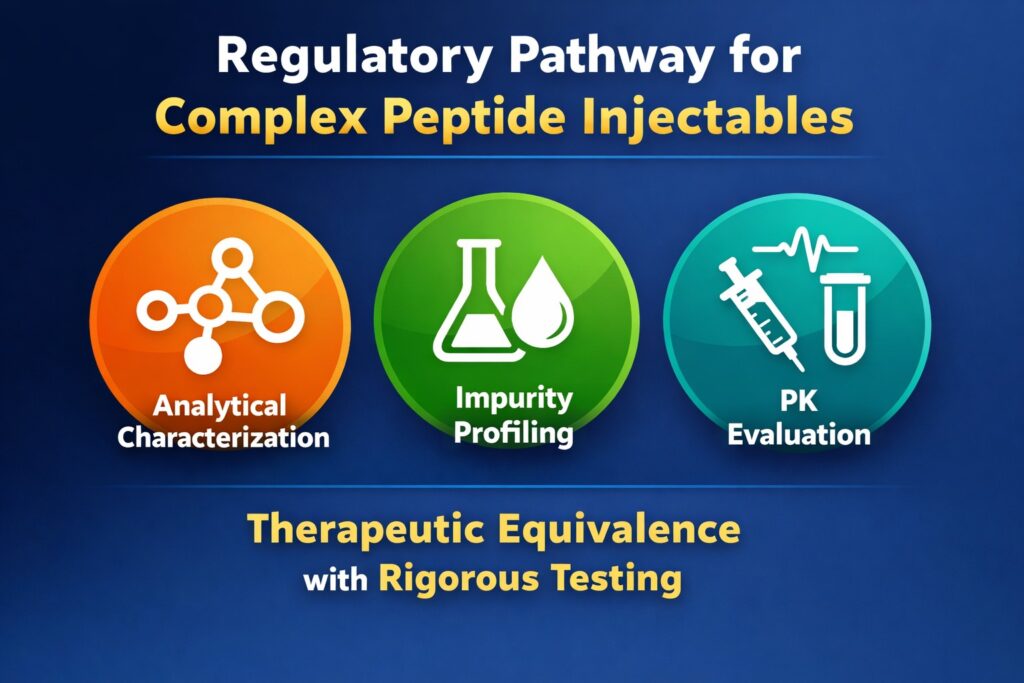
The Regulatory Pathway for Complex Peptide Injectables is a multi-faceted compliance framework that requires developers to establish therapeutic equivalence through a combination of highly sensitive analytical characterization, rigorous impurity profiling, and robust pharmacokinetic evaluation. In practice, this pathway demands a deep integration of chemistry, biology, and regulatory science to ensure that every aspect of the drug product aligns with the reference listed drug (RLD). Developers must also maintain strict documentation and reproducibility standards, as even minor deviations can lead to regulatory delays. As peptide-based therapies continue to expand in clinical use, this pathway is becoming increasingly important for ensuring consistent product quality and patient safety.
Share via:
Navigating the Regulatory Pathway for Complex Peptide Injectables
The Regulatory Pathway for Complex Peptide Injectables mainly follows the 505(j) Abbreviated New Drug Application (ANDA) route. This pathway allows approval of generic drugs while ensuring they perform the same as their RLDs. For synthetic peptides like leuprolide acetate, the process becomes more demanding because manufacturing methods can introduce new impurities. Regulatory authorities expect detailed data across multiple batches to confirm consistency. This level of evaluation reflects how critical it is to maintain consistent therapeutic outcomes in long-acting injectables.
Learn more about the core requirements for ANDA submission for generic drugs.
Peptides are defined by the FDA as chains of 40 or fewer amino acids, which allows them to be regulated as drugs instead of biologics. This classification supports the Regulatory Pathway for Complex Peptide Injectables, enabling developers to use the ANDA process when sameness is proven. For products like leuprolide depot, sameness includes not only the peptide but also the delivery system. Factors such as particle size, polymer structure, and release behavior must align closely with the RLD. Without this alignment, clinical performance may vary even if the peptide sequence is identical.
Explore our specialized peptide CDMO services for complex formulations.
A major regulatory update came with the 2021 FDA guidance that allowed synthetic versions of certain peptides previously made using recombinant DNA technology. This includes drugs like glucagon and liraglutide. This update is important for leuprolide developers because it highlights the need for advanced analytical tools. Techniques such as mass spectrometry and NMR now play a key role in meeting regulatory expectations. This shift reduces reliance on clinical trials and emphasizes strong analytical evidence.
Strategic Selection: 505(j) vs. 505(b)(2) Frameworks in the Regulatory Pathway for Complex Peptide Injectables
Choosing between 505(j) and 505(b)(2) is an important early decision in the Regulatory Pathway for Complex Peptide Injectables. The 505(j) pathway is used for products that closely match the RLD in all aspects. In contrast, the 505(b)(2) pathway is used when there are differences in formulation or delivery. This decision affects cost, timeline, and regulatory requirements. Making the right choice early can prevent delays later in development.
For leuprolide products, many manufacturers prefer the 505(j) pathway to achieve an “AB” rating, which allows pharmacy substitution. However, the 505(b)(2) pathway is still useful for new delivery systems. For example, Eligard uses a different delivery approach compared to Lupron Depot. In such cases, bridging studies may be required to support the differences. These studies often include pharmacokinetic comparisons or small clinical trials. Companies must balance innovation with regulatory complexity when selecting a pathway.
| Feature | 505(j) ANDA | 505(b)(2) NDA |
| Active Ingredient | Must be identical to RLD | Can be modified or a different salt |
| Clinical Data | Bioequivalence only | Bridging studies/limited clinical trials |
| Innovation Type | Generic duplication | Improved formulation/New delivery |
| Exclusivity | 180-day generic exclusivity | 3, 5, or 7-year exclusivity |
| Review Office | Office of Generic Drugs (OGD) | Office of New Drugs (OND) |
Active Pharmaceutical Ingredient (API) Sameness Evaluation
Proving API sameness is a key requirement in the Regulatory Pathway for Complex Peptide Injectables. This involves detailed analysis of the peptide’s structure at multiple levels. Developers must show that the synthetic peptide matches the RLD in sequence, shape, and behavior. Even small structural differences can affect how the drug works in the body. Therefore, a complete and accurate evaluation is essential.
For leuprolide acetate, techniques like LC-MS/MS and high-resolution mass spectrometry are used to confirm the primary structure. These methods provide detailed information about molecular weight and sequence. However, they may not fully capture higher-level structures. Additional methods are needed to build a complete profile. This combined approach reduces the risk of missing important differences.
Read more about how to develop generic leuprolide depot and prove API sameness.
To strengthen the analysis, techniques like Nuclear Magnetic Resonance (NMR) and Circular Dichroism (CD) are used. These methods provide insights into folding patterns and structural stability. Together, they create a strong dataset that supports regulatory submissions. This level of detail helps reduce the need for extensive clinical trials.
Orthogonal Analytical Techniques for Structural Confirmation in the Regulatory Pathway for Complex Peptide Injectables
The Regulatory Pathway for Complex Peptide Injectables requires the use of multiple analytical methods to ensure accurate results. Using different techniques helps confirm findings and reduces uncertainty. This is especially important for complex peptides, where one method alone may not be enough. Regulatory agencies expect this type of cross-validation.
For example, LC-MS/MS confirms peptide fragments, while amino acid analysis verifies composition. This combination ensures both sequence accuracy and proper structure. It also helps detect small variations that could affect performance. Such detailed testing supports regulatory confidence.
See the analytical requirements for ANDA generic drugs to ensure compliance.
| Analytical Attribute | Primary Technique | Orthogonal Method |
| Primary Sequence | LC-MS/MS Sequencing | Edman Degradation / AAA |
| Secondary Structure | Circular Dichroism (CD) | Fourier-Transform Infrared (FTIR) |
| Tertiary Structure | 2D NMR (NOESY/TOCSY) | Intrinsic Fluorescence |
| Oligomerization | Dynamic Light Scattering (DLS) | Size-Exclusion HPLC (SEC) |
| Chirality | Chiral HPLC | NMR / Specific Rotation |
NMR is particularly valuable for studying leuprolide structure. Advanced techniques like NOESY provide information about how atoms are arranged in space. At ResolveMass Laboratories, these tools are essential for confirming structural similarity. This ensures that generic products closely match the original drug.
Higher-Order Structure and Aggregation
Even small peptides like leuprolide can form aggregates under certain conditions. These structures can affect drug stability and immune response. The Regulatory Pathway for Complex Peptide Injectables requires careful monitoring of these properties. Small differences in aggregation can lead to changes in clinical outcomes.
Aggregation is more likely in long-acting injectables due to higher concentrations. In products like Lupron Depot, this can influence how the drug is released. Understanding these interactions helps improve formulation design. It also supports consistent product performance.
Review our leuprolide depot stability studies for long-term quality assurance.
Methods such as Size-Exclusion Chromatography and Analytical Ultracentrifugation are used to study aggregation. These techniques provide detailed information about molecular size and distribution. Controlling these factors is essential for regulatory approval.
Impurity Profiling and Immunogenicity Risk Assessment
Impurity control is one of the most challenging parts of the Regulatory Pathway for Complex Peptide Injectables. Synthetic manufacturing can introduce impurities that differ from those in natural products. Each impurity must be identified and evaluated for safety. This requires both advanced tools and strong scientific understanding.
Regulatory guidelines require identification of impurities above certain thresholds. If limits are exceeded, additional studies may be needed. This can increase both cost and development time. Careful process control helps avoid these issues.
Impurities can also trigger immune responses. This may reduce drug effectiveness or cause side effects. Therefore, impurity management is closely linked to patient safety. A strong risk assessment strategy is essential.
| Impurity Category | Threshold | Regulatory Action |
| Reporting Threshold | > 0.05% | Report in the application |
| Identification Threshold | \geq 0.10% | Characterize structure/sequence |
| ANDA Acceptability Limit | \leq 0.50% | Provide safety justification |
| Qualification (Ph. Eur.) | > 1.0% | Required in European markets |
Advanced Immunogenicity Assessment in the Regulatory Pathway for Complex Peptide Injectables
Modern approaches in the Regulatory Pathway for Complex Peptide Injectables include new methods for evaluating immunogenicity. These methods reduce the need for large clinical studies. They also provide faster and more cost-effective insights.
Computer-based models can predict how peptides interact with the immune system. These tools help identify potential risks early. They also guide formulation and impurity control decisions.
Discover how a CRO for leuprolide depot development can assist with complex risk assessments.
Laboratory-based assays provide additional confirmation. Tests using immune cells can measure responses such as cytokine release. Together, these approaches offer a complete evaluation of immunogenic risk.
Chemistry, Manufacturing, and Controls (CMC) for Leuprolide Depot
The CMC section is critical in the Regulatory Pathway for Complex Peptide Injectables, especially for depot formulations. Developers must show that their product matches the RLD at a microstructural level. This includes polymer type, particle size, and drug distribution.
Leuprolide depot products have a complex release pattern that must be replicated. Each phase of drug release plays a role in treatment effectiveness. Small differences can impact patient outcomes.
Explore our leuprolide depot CMC strategy for robust regulatory filings.
Strong process control and quality systems are needed to achieve this level of precision. Consistency across batches is essential for approval and long-term success.
PLGA Polymer Selection and Characterization
PLGA polymers are widely used in depot formulations. In the Regulatory Pathway for Complex Peptide Injectables, these materials must be carefully selected and tested. Key properties include molecular weight and composition.
These factors influence how the drug is released over time. For example, polymer ratios affect degradation speed. Balancing these properties is important for achieving desired performance.
Analytical tools such as NMR and DSC are used for characterization. These methods ensure the polymer matches the RLD as closely as possible. Proper selection is essential for bioequivalence.
| Polymer Parameter | Analytical Method | Impact on Bioequivalence |
| L:G Ratio | $^1H$ NMR | Degradation rate and hydrophobicity |
| Molecular Weight | GPC / SEC | Matrix erosion and lag phase duration |
| Acid Number | Titration | Degradation kinetics and drug interaction |
| Residual Monomers | GC / HPLC | Safety and polymer stability |
| Glass Transition (Tg) | DSC | Physical stability and release mechanism |
Microsphere Manufacturing: The Double-Emulsion Process
The double-emulsion method is commonly used to produce leuprolide microspheres. This process helps encapsulate the peptide within the polymer. However, it requires careful control to achieve consistent results.
Parameters like temperature and mixing speed affect encapsulation efficiency. Optimizing these conditions helps reduce product loss. Consistency is important for large-scale production.
Examine our leuprolide depot case study on sustained release for real-world manufacturing insights.
Residual solvents and particle size must also be controlled. These factors influence safety and drug release. Proper manufacturing practices ensure regulatory compliance.
Bioequivalence and Pharmacokinetic Standards
Bioequivalence studies are more complex for peptide injectables. The Regulatory Pathway for Complex Peptide Injectables often requires studies in patients rather than healthy volunteers. This is due to the drug’s biological effects.
Parallel study designs are commonly used for long-acting drugs. These designs simplify the study process and reduce patient burden. They also provide reliable comparison data.
Regulatory agencies set strict limits for pharmacokinetic parameters. Meeting these limits is essential for approval. Careful planning ensures successful study outcomes.
The Critical Role of AUC7−tAUC_{7-t}
A key parameter in leuprolide studies is AUC7−t. This measures drug exposure during the sustained-release phase. It ensures that the generic product matches the RLD over time.
Focusing on this phase helps regulators assess long-term performance. It prevents approval of products with incorrect release patterns. This improves treatment reliability.
This requirement highlights the complexity of long-acting injectables. Developers must design formulations that meet these strict criteria.
| PK Parameter | Significance in Leuprolide BE | Acceptance Limit (90% CI) |
| C{max} | Peak concentration; measures initial burst | 80.00% – 125.00% |
| AUC{0-t} | Total systemic exposure | 80.00% – 125.00% |
| AUC{7-t} | Sustained-release exposure (Day 7 to end) | 80.00% – 125.00% |
| T{max} | Time to peak concentration | Clinical assessment |
Biowaiver Strategies for Multi-Strength Applications
Biowaivers can simplify development in the Regulatory Pathway for Complex Peptide Injectables. They allow fewer in vivo studies when certain conditions are met. This can save time and resources.
Developers must show that different strengths behave similarly. This includes matching composition and release profiles. Supporting data is essential.
Dissolution studies play an important role in this process. They confirm consistent performance across strengths. This approach helps streamline approval.
Drug-Device Combination Product Requirements
Many leuprolide products include both a drug and a delivery device. The Regulatory Pathway for Complex Peptide Injectables requires these components to work together safely. Compatibility is essential.
Device design should match the RLD to avoid confusion. This includes how the product is used and labeled. Consistency improves patient safety.
Human factors studies are also required. These studies evaluate ease of use and reduce the risk of errors. Proper design supports successful treatment.
Case Study: Reverse Engineering Lupron Depot
Reverse engineering helps developers understand the RLD in detail. This approach is widely used in the Regulatory Pathway for Complex Peptide Injectables. It involves analyzing the product to identify key components.
Techniques such as polymer extraction and separation are used. These methods reveal important formulation details. This knowledge supports generic development.
Read our analysis on Lupron Depot particle characterization to guide your reverse engineering efforts.
By understanding the original product, developers can reduce uncertainty. This leads to more efficient formulation design.
Manufacturing Challenges and Shelf-Life Stability
Stability is a major concern for peptide injectables. The Regulatory Pathway for Complex Peptide Injectables requires long-term testing under different conditions. This ensures product quality over time.
Peptides are sensitive to heat, light, and moisture. Proper storage conditions must be defined. These factors affect product performance.
Monitoring degradation is also important. This helps ensure safety throughout the product’s shelf life. Strong stability programs are essential.
| Stability Challenge | Root Cause | Regulatory Solution |
| Microclimate Acidification | PLGA hydrolysis | Use of acid-neutralizing excipients |
| Peptide Aggregation | High local concentration | Optimized drug-polymer ratio |
| Oxidation | Residual oxygen/light | Opaque packaging/Nitrogen overlay |
| Burst Release Shift | Polymer “aging” | Controlled storage/Tg monitoring |
Forced Degradation and Stress Testing
Forced degradation studies expose the product to extreme conditions. These studies are required in the Regulatory Pathway for Complex Peptide Injectables. They help identify possible degradation products.
The results support method validation. They also ensure impurities can be detected accurately. This improves product understanding.
Such testing is important for regulatory approval. It shows that the product is well controlled and reliable.
Global Harmonization: EMA and USP Perspectives
Global alignment is becoming more important in drug development. The Regulatory Pathway for Complex Peptide Injectables must consider guidelines from different regions. This includes EMA and USP standards.
These organizations focus on impurity control and structural analysis. Following their guidance improves product quality. It also supports global approvals.
Meeting international standards shows commitment to safety and consistency. This benefits both regulators and patients.
Conclusion
The Regulatory Pathway for Complex Peptide Injectables is one of the most demanding areas in pharmaceutical development. For leuprolide depot products, success depends on matching both the peptide and its delivery system. This requires strong analytical methods, careful impurity control, and well-designed pharmacokinetic studies.
By following this pathway, developers can produce high-quality generic products that perform like their reference drugs. This improves patient access to important therapies while maintaining safety and effectiveness.
Partner with us to accelerate generic drug development in the US and Canada.
For expert consultation on your peptide development program or to learn more about our characterization services, please contact:
https://resolvemass.ca/contact/
Frequently Asked Questions (FAQs)
The FDA follows a “totality of evidence” approach to confirm sameness. This means the developer must prove that the amino acid sequence is exactly the same and that the overall structure behaves similarly. Advanced tools like HRMS and multi-dimensional NMR are used to compare structural details. In addition, impurity levels must closely match the reference drug, with no significant new impurities present.
The AUC{7-t} metric focuses on the drug’s sustained-release phase rather than the initial exposure. It measures how the drug performs from Day 7 until the end of the dosing period. This helps regulators confirm that the generic product releases the drug at the same rate as the reference. It ensures consistent long-term performance, especially for depot formulations.
PLGA controls how the drug is released from the microsphere system over time. Its composition, molecular weight, and chemical end groups all influence how quickly it breaks down. Even small differences can change the release pattern and affect treatment results. That is why detailed PLGA characterization is essential for proving bioequivalence.
Regulatory guidelines require that any impurity at or above 0.10% must be clearly identified. New impurities that are not present in the reference drug are usually limited to a maximum of 0.5%. If these limits are exceeded, additional safety data may be required. In some cases, it may even impact the approval pathway.
Q3 equivalence refers to matching the internal structure of the drug product with the reference. This includes particle size, shape, and internal composition. For leuprolide microspheres, these features control how the drug is released. Without Q3 similarity, the product may not perform the same in the body.
Synthetic peptides do not contain biological contaminants, but they can have unique chemical impurities. These impurities may trigger immune responses if not properly controlled. Risk assessment involves computer modeling and lab-based tests to study immune reactions. This helps ensure that the synthetic version is as safe as the original.
Leuprolide depot products stay in the body for a long time, making crossover studies difficult. A crossover design would require a very long washout period between doses. Parallel studies avoid this issue by treating different groups at the same time. This makes the study more practical and safer for patients.
The double-emulsion method requires careful control to keep the peptide inside the microspheres. Some drug loss can occur during processing, which reduces efficiency. Removing solvents completely is also important for safety and stability. Achieving consistent particle size and quality adds to the complexity.
For combination products, both the drug and the device must work together safely. The device should be easy to use and similar to the reference product. Human factors studies are often required to confirm usability. Any major design difference could affect approval, even if the drug itself meets all standards.
Reference:
- Klein, K., Borchard, G., Shah, V. P., Flühmann, B., McNeil, S. E., & de Vlieger, J. S. B. (2021). A pragmatic regulatory approach for complex generics through the U.S. FDA 505(j) or 505(b)(2) approval pathways. Annals of the New York Academy of Sciences, 1502(1), 5–13. https://doi.org/10.1111/nyas.14662
- U.S. Food and Drug Administration. (2021). ANDAs for certain highly purified synthetic peptide drug products that refer to listed drugs of rDNA origin: Guidance for industry. https://www.fda.gov/media/107622/download
- U.S. Food and Drug Administration. (2025). FY 2025 generic drug science and research initiatives. https://www.fda.gov/media/188041/download
- U.S. Food and Drug Administration. (2025). FY 2025 generic drug science and research initiatives: Assessment challenges with complex active ingredients, formulation sameness, and bioequivalence approaches. https://www.fda.gov/media/188042/download
- McCarthy, D., Cannon, J., & McCarthy, J. (2023). Reference standards to support quality of synthetic peptide therapeutics. Journal of Pharmaceutical Analysis, 13(5), 100–112. https://pmc.ncbi.nlm.nih.gov/articles/PMC10338602/
- Elsayed, Y. Y., Kühl, T., & Imhof, D. (2025). Regulatory guidelines for the analysis of therapeutic peptides and proteins. Journal of Peptide Science, 31(3), e70001. https://pmc.ncbi.nlm.nih.gov/articles/PMC11806371/
- U.S. Pharmacopeia (USP). (2025). USP peptide standards and solutions (BIO.1032.B). https://www.usp.org/sites/default/files/usp/document/our-work/biologics/documents/USP_PeptideStandardsFlyer_Digital_V11.pdf
- U.S. Food and Drug Administration. (2025, June 3–4). Fiscal year 2025 generic drug science and research initiatives public workshop. https://www.fda.gov/drugs/news-events-human-drugs/fiscal-year-2025-generic-drug-science-and-research-initiatives-public-workshop-06032025
Get In Touch With Us
About The Author


