

The Regulatory Requirements for Long Acting Injectable Development are complex and demand a clear link between formulation design, manufacturing quality, and clinical performance. In the United States and Canada, regulatory agencies expect a complete and well-organized data package that shows consistent product behavior over time. This includes proof of reliable manufacturing, strong sterility assurance, and meaningful bioequivalence results. Both laboratory (in vitro) and human (in vivo) studies must work together to confirm that the product performs as expected. Regulators also require tight control over batch-to-batch variation so that treatment outcomes remain consistent. In addition, companies must explain how their formulation delivers the drug in a predictable way over an extended period. Today, regulators are also focusing on a lifecycle approach, where product quality and performance continue to be monitored and improved even after approval.
Learn more about the technical hurdles: Analysis of Long Acting Injectable Formulations
Share via:
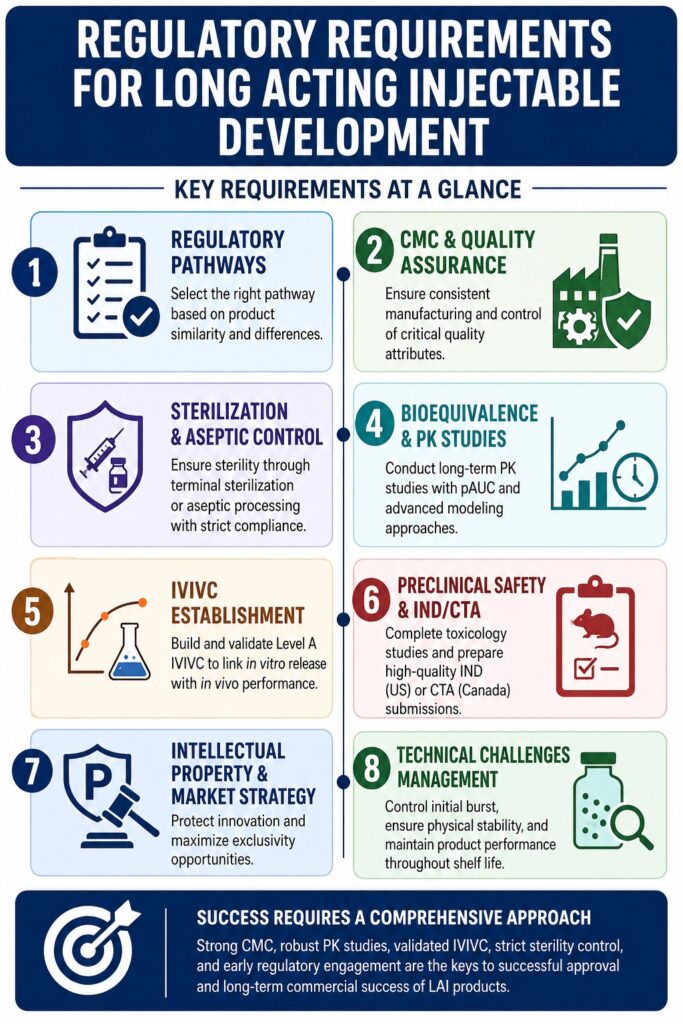
Comparative Regulatory Pathways for LAI Submissions under Regulatory Requirements for Long Acting Injectable Development
Selecting the right regulatory pathway depends on how similar the new product is to the Reference Listed Drug (RLD) in the US or the Canadian Reference Product (CRP). Under the Regulatory Requirements for Long Acting Injectable Development, these pathways are designed to balance faster approvals with the need for strong scientific evidence. Companies must decide whether their product qualifies as a generic or requires additional studies due to differences in formulation or performance. This choice affects timelines, costs, and regulatory risks. Early discussions with regulatory agencies are highly recommended, as they help clarify expectations and reduce the chance of delays. A well-planned strategy can strongly influence commercial success.
Explore the specific pathway for complex injectables: Regulatory Pathway for Complex Peptide Injectables
FDA Pathways: 505(j) vs. 505(b)(2)
In the United States, two main pathways are available for LAI approvals:
- 505(j) ANDA (Abbreviated New Drug Application):
Used for products that closely match the RLD in active ingredient, dosage form, strength, route of administration, and excipient composition (Q1/Q2 sameness). - 505(b)(2) NDA:
Allows certain changes, such as modified dosing schedules or new excipients, while still using existing safety data.
The 505(b)(2) pathway is often chosen for product improvements or lifecycle management. However, it requires extra data to support any differences. Choosing between these options involves balancing development effort with potential market benefits.
Compare development strategies: CRO vs In-House ANDA Development
Health Canada Pathways: ANDS and NDS
Canada follows a similar structure:
- ANDS (Abbreviated New Drug Submission): For generic products
- NDS (New Drug Submission): For new or modified products
A unique feature is the Notice of Compliance with Conditions (NOC/c) policy, which allows earlier approval for drugs addressing serious conditions. However, companies must complete post-approval studies to confirm safety and effectiveness. This approach helps patients gain faster access to important therapies while maintaining regulatory oversight.
Chemistry, Manufacturing, and Controls (CMC) in Regulatory Requirements for Long Acting Injectable Development
The CMC section is a critical part of any LAI submission. Meeting the Regulatory Requirements for Long Acting Injectable Development means proving that the manufacturing process consistently produces a high-quality product. This is especially important for formulations using biodegradable polymers like PLGA (poly(lactic-co-glycolide)). Even small changes in processing can impact drug release behavior. Therefore, detailed control of raw materials, intermediate steps, and final products is essential. Regulatory agencies expect strong scientific justification for all process parameters and confirmation through validation studies.
Understand essential CMC strategies: Leuprolide Depot CMC Strategy
PLGA Excipient Characterization and Sameness
PLGA must be carefully analyzed both as a raw material and within the finished product. Key factors include:
- Lactide-to-glycolide ratio
- Molecular weight ($M_w$)
- End-group chemistry
- Inherent viscosity
For generic products, matching the reference polymer is critical. Advanced analytical tools are often required. Any variation can change how the drug is released, which may impact safety and effectiveness.
Critical Quality Attributes (CQAs) of the Finished Dosage Form
LAI products must meet strict quality standards. Important CQAs include:
- Particle size distribution (PSD)
- Surface structure and porosity
- Batch uniformity
Techniques like scanning electron microscopy (SEM) and gas adsorption analysis are commonly used. Regulators expect clear evidence that these attributes directly affect clinical performance.
Deep dive into quality standards: Critical Quality Attributes for Long Acting Injectables
Sterilization Requirements in Regulatory Requirements for Long Acting Injectable Development
Sterility is a major challenge in LAI products. The Regulatory Requirements for Long Acting Injectable Development require a sterilization method that ensures safety without damaging the product. Companies must evaluate how sterilization affects both the drug and the polymer. Validation studies are essential to prove consistent sterility.
The Preference for Terminal Sterilization
Terminal sterilization is preferred because it provides the highest level of sterility assurance. However, methods like heat or radiation may damage sensitive formulations. If used, companies must show that product quality remains unchanged after sterilization.
Aseptic Processing and Annex 1 Compliance
When terminal sterilization is not possible, aseptic processing is used. This involves assembling sterilized components in cleanroom environments. In Canada, compliance with GUI-0119 (Annex 1) is required. Strong contamination control strategies, including isolators and closed systems, are essential. Media fill studies are also required to confirm process reliability.
Bioequivalence and PK Studies in Regulatory Requirements for Long Acting Injectable Development
Demonstrating bioequivalence for LAIs is more complex than for traditional drugs. The Regulatory Requirements for Long Acting Injectable Development require long-term pharmacokinetic (PK) studies that capture the full drug release profile. These studies may last several months and require detailed sampling plans.
PK Metrics and Partial AUC
Traditional PK measures like $C_{max}$ and total AUC are not always sufficient. Regulators now often require partial AUC (pAUC) to better understand drug release at different stages. This provides a clearer comparison between test and reference products.
Model-Integrated Bioequivalence Approaches
Advanced modeling techniques such as:
- Population PK (PopPK)
- Physiologically Based PK (PBPK)
are increasingly used to support development. These models must be validated with real clinical data to gain regulatory acceptance.
Learn about specialized formulation support: CDMO for Long Acting Injectable Formulation Development
Establishing IVIVC under Regulatory Requirements for Long Acting Injectable Development
A Level A IVIVC creates a direct link between lab-based drug release and human absorption. Within the Regulatory Requirements for Long Acting Injectable Development, this is a valuable tool for both approval and lifecycle management. It allows in vitro data to predict clinical outcomes, reducing the need for additional studies.
Developing a Regulatory-Grade IVIVC
This involves testing multiple formulations with different release rates and linking lab results to clinical data. Strong validation is required to ensure accurate predictions.
Applications in Biowaivers and Post-Approval Changes
A validated IVIVC can:
- Support biowaivers for new strengths
- Simplify approval of manufacturing changes
- Reduce the need for additional clinical trials
This flexibility is highly valuable in commercial production.
Preclinical Toxicology and Safety Assessment
Before clinical trials, LAI products must undergo detailed safety testing. This includes evaluating both the drug and its delivery system. Studies must reflect long-term exposure and include injection site assessments.
Toxicology Requirements for LAIs
Key requirements include:
- Studies in two species
- Evaluation of local and systemic toxicity
- Assessment of polymer safety and degradation
These studies ensure long-term safety for patients.
Regulatory Components of IND and CTA Packages
IND (US) and CTA (Canada) submissions include:
- Administrative data
- Quality (CMC) information
- Preclinical and clinical plans
Review timelines are typically around 30 days. Clear and consistent documentation is essential for approval.
Access expert development resources: CRO for Complex Injectables
Intellectual Property and Market Strategy
Intellectual property plays a major role in LAI commercialization. The Regulatory Requirements for Long Acting Injectable Development also influence exclusivity and competition. Strong patent strategies help protect market position and extend product lifecycle.
FDA 180-Day Generic Exclusivity
The first generic applicant challenging a patent may receive 180 days of exclusivity. This provides a strong commercial advantage but requires strict compliance with regulatory timelines.
Health Canada Patent Regulations
Canada offers:
- A 24-month stay during patent disputes
- Certificates of Supplementary Protection (CSPs)
These measures balance innovation with access to generics.
Discover strategies for generic success: Generic Drug Development Process ANDA
Overcoming Technical Challenges in Regulatory Requirements for Long Acting Injectable Development
LAI development presents several technical challenges. Meeting the Regulatory Requirements for Long Acting Injectable Development requires early planning, strong analytical methods, and careful process design.
Managing Initial Burst and Dose Dumping
Initial burst release can lead to unsafe drug levels. Formulation design must control this effect through polymer selection and processing conditions. Regulators require clear justification of acceptable limits.
Addressing Physical Stability and Ostwald Ripening
Stability issues such as particle growth and sedimentation can affect product performance. Studies must monitor these changes over time and ensure proper redispersion and usability.
See a real-world application: Leuprolide Depot Case Study Sustained Release
Conclusion: Navigating Regulatory Requirements for Long Acting Injectable Development
Meeting the Regulatory Requirements for Long Acting Injectable Development is essential for successfully launching LAI products in the US and Canada. These products require deeper scientific understanding compared to standard injectables, especially in polymer science and pharmacokinetics. By focusing on strong CMC practices, advanced modeling, IVIVC development, and strict sterility control, companies can improve their chances of approval. Ongoing collaboration with regulatory agencies and a proactive development strategy are key to long-term success.
Optimize your development timeline: CDMO Accelerate Generic Drug Development US and Canada
For specialized support in CMC documentation, bioequivalence strategy, and regulatory submissions for long-acting injectables, contact ResolveMass Laboratories Inc.:
https://resolvemass.ca/contact/
Frequently Asked Questions (FAQs)
Both the FDA and Health Canada follow similar bioequivalence standards, requiring key pharmacokinetic values like Cmax and AUC to fall within the 80–125% range. However, Health Canada often places stronger emphasis on partial AUC (pAUC) to evaluate different phases of drug release in modified-release products. The FDA also uses pAUC, but typically outlines these requirements in product-specific guidances. Overall, both agencies aim to ensure consistent therapeutic performance, but Health Canada may apply broader use of pAUC in certain cases.
The lactide-to-glycolide ratio plays a key role in how quickly the PLGA polymer breaks down and releases the drug. A higher glycolide content generally leads to faster degradation, while higher lactide content slows it down. Regulatory agencies expect this ratio to closely match the reference product, especially for generics. Even small changes can affect how long the drug stays active in the body. Because of this, precise control of the L:G ratio is critical for consistent performance and approval.
Flip-flop pharmacokinetics happens when drug absorption is slower than drug elimination. In long-acting injectables, this means the drug release from the injection site controls the overall blood concentration profile. As a result, studies must run for a longer time to fully capture how the drug is released and absorbed. Researchers need to collect data until most of the drug has been released from the depot. This makes trial design more complex and time-consuming.
A Level A IVIVC is very useful, but it usually cannot replace initial human clinical trials for a new long-acting injectable. Its main benefit comes after the primary study is completed, where it can support biowaivers for additional strengths or minor product changes. By linking lab results with real human data, it helps reduce the need for repeated clinical studies. This can save time and cost during later stages of development. However, initial clinical evidence is still required.
The 2024 update to Annex 1 introduces a stronger focus on risk-based contamination control strategies. Manufacturers are now expected to use advanced systems like isolators or barrier technologies to reduce human contact during sterile processing. It also increases expectations for environmental monitoring and cleaning validation. For LAI products, this is especially important due to their complex manufacturing processes. Overall, the update raises the standard for sterility assurance and process control.
A Paragraph IV certification is used when a generic company claims that an existing patent is invalid or will not be infringed by their product. This often leads to legal challenges from the original patent holder. However, if the generic company succeeds, it may receive 180 days of market exclusivity. During this time, it can be the only generic competitor available. This creates a strong financial incentive despite the legal risks involved.
The 505(b)(2) pathway allows companies to build on existing approved drugs while introducing improvements. For example, they can develop longer-acting versions or more convenient dosing options. This approach reduces the need to repeat all safety studies, saving time and development costs. At the same time, companies can still gain market exclusivity for their innovation. This balance of efficiency and opportunity makes the pathway increasingly attractive.
Regulators require detailed tissue analysis at the injection site to assess safety. This includes examining samples at different time points during drug release and after the material has been absorbed. The goal is to check for signs of inflammation, tissue damage, or long-term effects. These studies help confirm that both the drug and its delivery system are safe for repeated use. Strong histopathology data is essential for demonstrating local tolerability.
Reference:
- U.S. Food and Drug Administration. (2023). Long acting injectable drug products: Recommended in vitro and in vivo studies. https://www.fda.gov/media/166584/download
- Health Canada. (2023, September 11). Annex 1 to the good manufacturing practices guide: Manufacture of sterile drugs (GUI-0119). Government of Canada. https://www.canada.ca/en/health-canada/services/drugs-health-products/compliance-enforcement/good-manufacturing-practices/guidance-documents/gmp-guidelines-annex-1-manufacture-sterile-drugs-0119.html
- U.S. Food and Drug Administration. (2023). Challenges in pharmacokinetic bioequivalence studies for long-acting injectable drug products and opportunities for model-integrated approaches. https://www.fda.gov/media/166585/download
- U.S. Food and Drug Administration, Center for Drug Evaluation and Research. (1997). Extended release oral dosage forms: Development, evaluation, and application of in vitro/in vivo correlations — Guidance for industry. https://www.fda.gov/media/70939/download
- Health Canada. (2016, September 16). Guidance document: Notice of compliance with conditions (NOC/c). Government of Canada. https://www.canada.ca/en/health-canada/services/drugs-health-products/drug-products/applications-submissions/guidance-documents/notice-compliance-conditions.html
- Young, I. C., Pallerla, A., Cottrell, M. L., & Benhabbour, S. R. (2023). Long-acting injectable multipurpose prevention technology for prevention of HIV and unplanned pregnancy. Journal of Controlled Release, 363, 606–620. https://pmc.ncbi.nlm.nih.gov/articles/PMC10101551/
- Health Canada. (2023, September 11). Annex 1 to the good manufacturing practices guide: Manufacture of sterile drugs (GUI-0119) — Production and specific technologies. Government of Canada. https://www.canada.ca/en/health-canada/services/drugs-health-products/compliance-enforcement/good-manufacturing-practices/guidance-documents/gmp-guidelines-annex-1-manufacture-sterile-drugs-0119/production-specific-technologies.html
Get In Touch With Us
About The Author


