
Introduction: Why Related Substances Analysis Is Critical
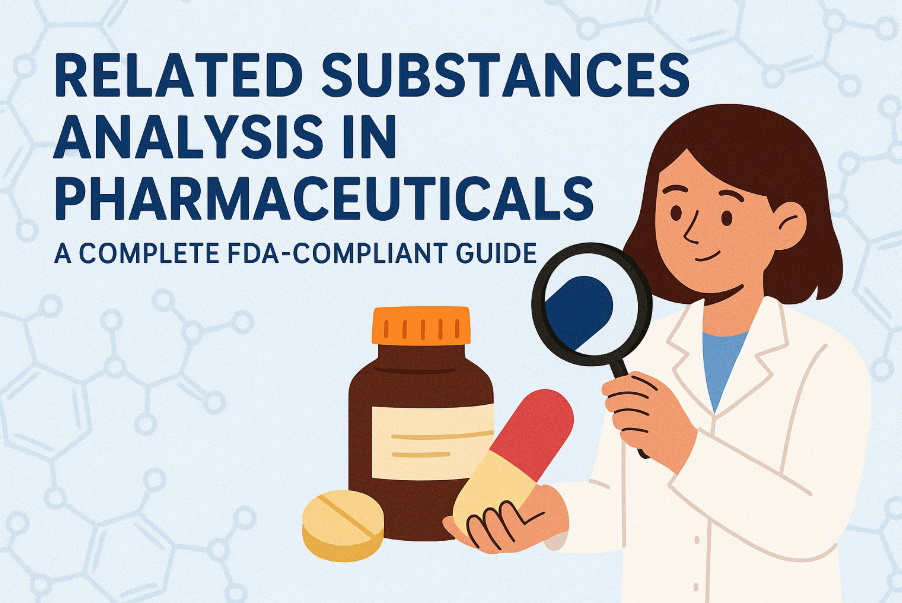
When making medicines, it’s important to make sure that no unwanted chemicals (called “related substances”) are left behind in the final drug product. These related substances could be leftover reactants, by-products, or degradation products. That’s why Related Substances Analysis in United States is a key part of meeting FDA rules for safety and quality.
At ResolveMass Laboratories Inc., we help pharma companies detect and measure these substances accurately using advanced tools like HPLC, LC-MS, and NMR. We offer full testing support to meet the strict standards set by FDA and ICH Q3A/B.
➡ More on our impurity profiling capabilities
🔬 Explore Our Related Substance Testing Services
What Are Related Substances?
These are any unwanted chemicals in a drug substance or product. They might come from:
- Impurities from raw materials
- Leftover reagents
- Process by-products
- Breakdown products (degradation)
Even in tiny amounts, some related substances can affect the drug’s safety. That’s why regulatory agencies require companies to identify, measure, and control them.
➡ More on our NMR structure elucidation services
Why Related Substances Analysis Matters for FDA and Health Canada
The FDA and Health Canada both want to see that your product is pure, safe, and stable over time. Related substances analysis is required during:
- IND, NDA, and ANDA filings
- Drug master file (DMF) submissions
- Stability studies
At ResolveMass, we offer Related Substances Analysis in United States and Canada using validated, compliant methods.
Step-by-Step Guide to Related Substances Testing
Step 1: Sample Preparation
We begin with a clean, careful sample prep to avoid contamination. This includes dissolving the sample in a suitable solvent, filtration, and dilution if needed.
Step 2: Analytical Method Selection
Depending on the nature of the compound, we use:
- HPLC for general impurity profiling
- LC-MS/MS for low-level and unknown impurities
- GC for volatile impurities
- NMR for structural confirmation (Explore NMR Services)
Step 3: Method Development and Optimization
We fine-tune the method using:
- Column type
- Mobile phase
- Flow rate
- Detector settings
Step 4: Method Validation
Validation is done as per ICH Q2(R1) guidelines and covers:
- Specificity
- Linearity
- Precision
- Accuracy
- Detection limits (LOD/LOQ)
Step 5: Reporting and Documentation
We provide:
- Complete impurity profile
- Structure confirmation (if needed)
- Validation reports
- Regulatory-ready documentation for submission
Real Case Study: FDA-Compliant Related Substances Analysis for an Antibiotic
Client: US-based generic drug manufacturer
Objective: Perform related substances testing for ANDA submission of a generic cephalosporin
Testing Tools:
- HPLC with UV detection
- LC-MS/MS for unknown impurity identification
- NMR for structure confirmation
Outcome:
- Identified and quantified 7 related substances
- One new impurity structurally confirmed via 1H-NMR and MS
- Accepted by FDA with no data deficiencies
This project shows our strength in impurity testing with clear, validated results.
How ResolveMass Helps You Stay Compliant
ResolveMass Laboratories offers complete analytical packages:
- Impurity method development
- Validation as per ICH/FDA
- Stability studies
- Batch-to-batch comparison
We support pharmaceutical developers in Montreal, across the US, and globally with:
- GMP-certified lab
- Fast turnaround (2–4 weeks)
- Regulatory guidance from start to submission
📍 We specialize in Related Substances Analysis in United States and across Canada.
Conclusion
Related substances analysis is essential for regulatory success. It proves your drug is pure, stable, and safe for patients. At ResolveMass Laboratories, we provide FDA-compliant, ICH-aligned services for impurity profiling using world-class instruments. Whether you’re based in Canada or looking for Related Substances Analysis in United States, we’re here to support your submission from early development to final filing.
✅ Start your impurity study with ResolveMass
✅ Talk to an expert
✅ Book a consultation today
FTIR and Raman Spectroscopy for Peptide Secondary Structure: Orthogonal Options Beyond Circular Dichroism
Introduction FTIR and Raman spectroscopy for peptide secondary structure provide label-free methods for evaluating molecular…
Do Nitrosamine Limits Apply to Each Impurity Individually or as a Total? Handling Multiple Nitrosamines in One Product
Introduction Nitrosamine limits apply both to individual impurities and to their cumulative total whenever two…
Case Study: How a Virtual Biotech Achieved IND Clearance in 9 Months with Outsourced CMC Strategy
Introduction: A virtual biotech can reach IND clearance in about 9 months when its CMC…
Nitrosamine Risk Assessment Services for API Suppliers and Contract Manufacturers: Supplier Qualification Support
Introduction Qualifying active pharmaceutical ingredient (API) vendors and contract manufacturing organizations (CMOs) requires Nitrosamine Risk…
Nitrosamine Testing for Peptide and GLP-1 Drug Products: Specialized CRO Services
Introduction Nitrosamine Testing for Peptide and GLP-1 drug products requires a comprehensive evaluation of synthetic-route…
Nitrosamine Testing Laboratory in Canada: Health Canada-Aligned Testing Services for Drug Sponsors
Introduction Selecting a qualified Nitrosamine Testing Laboratory in Canada requires verification of active Drug Establishment…