

Introduction
Selecting a Reliable CRO for Generic Drugs becomes more challenging when dealing with advanced or non-traditional formulations. Unlike simple oral tablets, complex generics demand detailed structural characterization, sophisticated analytical methods, and strong regulatory awareness from the start. These products often involve tight specifications and sensitive matrices.
Reliability in this setting goes far beyond basic laboratory testing. It requires accuracy, reproducibility, regulatory defensibility, and scientific judgment under strict timelines. Complex generics may behave differently under stress conditions, making deep analytical knowledge essential.
Partner with the right experts: Best CRO for Pharma Generic Projects
This article explains the scientific, regulatory, and operational factors that define a truly Reliable CRO for Generic Drugs. Understanding these elements helps sponsors lower risk, improve submission quality, and move confidently toward regulatory approval.
Summary: Key Attributes of a Reliable CRO for Complex Generic Molecules
- A Reliable CRO for Generic Drugs must demonstrate proven analytical expertise in handling complex formulations and difficult-to-characterize molecules.
- Advanced instrumentation, method development capabilities, and regulatory alignment are non-negotiable.
- Experience with highly potent APIs, modified-release systems, peptides, liposomes, and biologics-like generics is critical.
- Strong data integrity systems and global regulatory compliance determine long-term reliability.
- Transparent communication, scientific problem-solving ability, and reproducible outcomes define true partnership value.
- A track record of successful ANDA/NDA/505(b)(2) submissions significantly strengthens credibility.
- Risk mitigation strategies and scalability ensure consistent results across development phases.
Why Choosing a Reliable CRO for Generic Drugs Matters for Complex Molecules
A Reliable CRO for Generic Drugs protects sponsors from analytical errors, regulatory delays, and unexpected development costs. With complex generics, the margin for error is small. Incomplete or weak data packages often result in deficiency letters or repeat studies.
Complex generic molecules may include:
- Long-acting injectables
- Liposomal formulations
- Transdermal systems
- Inhalation products
- Peptides and polymer-based drugs
- Drug-device combination products
- Highly potent APIs (HPAPIs)
These dosage forms involve advanced release mechanisms, excipient interactions, and structural sensitivity. Analytical comparison must go beyond simple assay testing. It should include particle size, morphology, release kinetics, impurity profiles, and stability behavior.
Explore our full range of solutions: CRO Services for Generic Drug Development
Failure in impurity profiling, dissolution testing, or stability studies can delay approval by months or even years. Working with a Reliable CRO for Generic Drugs improves the chance of smooth regulatory review and predictable timelines.
| Risk Area | Impact of Unreliable CRO | Benefit of Reliable CRO |
|---|---|---|
| Bioequivalence Data | Study failure | Scientifically defensible equivalence |
| Impurity Profiling | Regulatory queries | Complete characterization package |
| Stability Studies | Batch rejection | Predictable shelf-life data |
| Method Transfer | Inconsistent results | Reproducible validated methods |
| Regulatory Filing | Deficiency letters | Smooth ANDA review process |
In complex generics, reliability is measured by data quality, reproducibility, and regulatory success—not marketing claims. A strong analytical foundation supports both scientific credibility and commercial goals.
Scientific Capabilities That Define a Reliable CRO for Generic Drugs
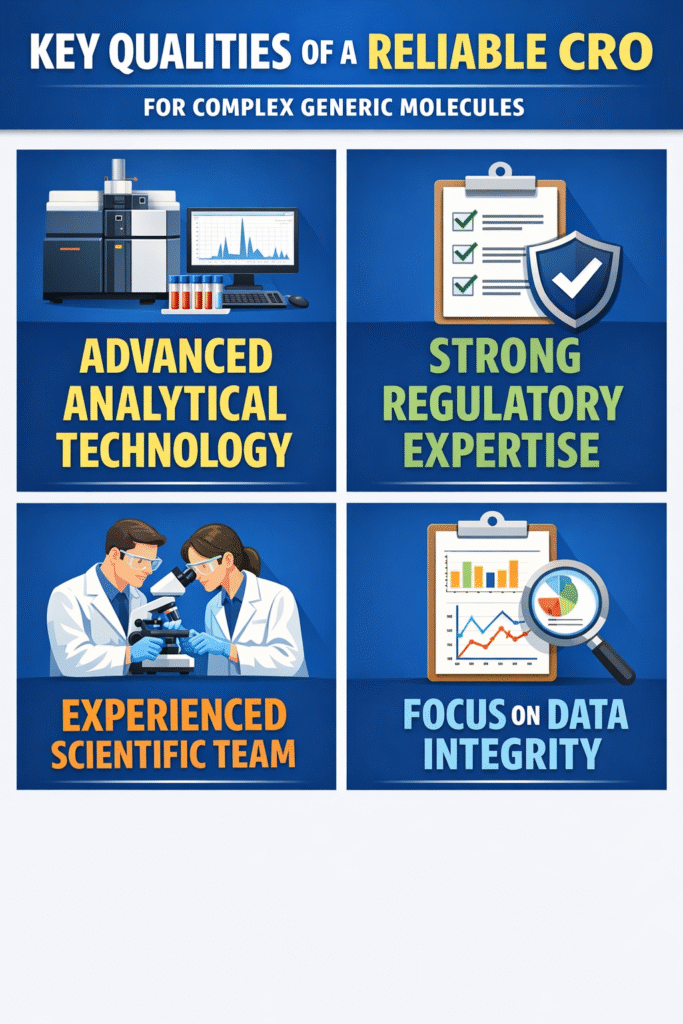
A Reliable CRO for Generic Drugs must maintain advanced analytical systems and highly trained scientists who can interpret complex datasets. Technical strength directly affects the ability to demonstrate equivalence and defend results during regulatory review.
1. Advanced Analytical Instrumentation
Complex generics typically require:
- High-resolution LC-MS/MS
- Q-TOF and Orbitrap mass spectrometry
- ICP-MS for elemental impurities
- Particle size analysis (DLS, laser diffraction)
- SEM/TEM imaging for morphology
- Rheology and viscosity profiling
- Dissolution systems for non-standard dosage forms
These technologies allow accurate detection of degradation products, elemental impurities, and structural differences. High-resolution mass spectrometry is especially important for identifying trace-level impurities and subtle molecular variations.
For example, liposomal generics require evaluation of:
- Particle size distribution
- Encapsulation efficiency
- Surface charge (zeta potential)
- In-vitro release behavior
Without advanced instrumentation, analytical comparison becomes incomplete. A Reliable CRO for Generic Drugs combines modern equipment with expert interpretation to produce defensible data.
Ensure robust data for your submission: Analytical Method Development and Validation Service
2. Method Development for Complex Matrices
A Reliable CRO for Generic Drugs must demonstrate strong expertise in developing stability-indicating methods for complex formulations. Many advanced dosage forms contain excipients that interfere with detection or behave unpredictably under stress.
Method development should address:
- Low-level impurities
- Isomer separation
- Polymorphic forms
- Degradation pathways
- Residual solvent detection
Key indicators of reliability include:
- Use of orthogonal analytical techniques
- Detailed forced degradation studies
- Full method validation protocols
- Reproducibility across analysts and instruments
Complex molecules may react differently to heat, light, humidity, or oxidation. Experienced teams anticipate these risks and design studies that detect vulnerabilities early in development.
Regulatory Expertise: A Core Requirement of a Reliable CRO for Generic Drugs
A Reliable CRO for Generic Drugs must align analytical strategy with FDA, Health Canada, EMA, and ICH expectations from the beginning. Regulatory misalignment often leads to additional studies, repeated testing, and delayed submissions.
Critical Regulatory Considerations
- ICH Q3A/Q3B impurity qualification
- ICH Q6A specification setting
- ICH Q1 stability guidelines
- ICH M7 mutagenic impurity assessment
- Product-specific FDA guidance
For inhalation products, transdermal systems, and other complex generics, regulators may request detailed physicochemical comparisons along with bioequivalence data. Sponsors must demonstrate structural and performance similarity.
A reliable CRO:
- Designs studies with regulatory review in mind
- Provides well-organized documentation packages
- Maintains audit-ready quality systems
- Ensures complete data traceability and ALCOA+ compliance
Regulatory foresight reduces review cycles and improves submission confidence.
Streamline your outsourcing strategy: Outsourcing Generic Projects to CROs
Experience with Highly Potent and Complex APIs
A Reliable CRO for Generic Drugs must have proven experience handling HPAPIs and structurally sensitive compounds. Analytical skill alone is not enough without proper safety systems and containment controls.
Why Experience Matters
Handling HPAPIs requires:
- Dedicated containment facilities
- Strict occupational exposure controls
- Validated cleaning procedures
- Specialized analytical workflows
Peptide generics may also require:
- Sequence confirmation
- Impurity mapping
- Aggregation studies
- Stability testing across pH conditions
Hands-on experience reduces contamination risks, variability, and safety concerns. Established procedures allow smooth project execution without unnecessary delays.
Navigate complex identification challenges: CRO for Unknown Impurity Identification
Data Integrity and Quality Systems in a Reliable CRO for Generic Drugs
A Reliable CRO for Generic Drugs operates under strict data integrity standards to ensure regulatory acceptance. Authorities now closely review electronic records, audit trails, and documentation practices.
Core Data Integrity Standards
- ALCOA+ compliance (Attributable, Legible, Contemporaneous, Original, Accurate)
- 21 CFR Part 11 compliance
- Secure electronic audit trails
- Laboratory Information Management Systems (LIMS)
- Regular internal and external quality audits
Regulatory warning letters often highlight poor documentation or uncontrolled data systems. Strong governance prevents these issues and protects submissions from risk.
Trust is built through transparency, documentation accuracy, and proactive compliance.
Problem-Solving Ability: The True Marker of a Reliable CRO for Generic Drugs
A Reliable CRO for Generic Drugs must demonstrate structured troubleshooting when challenges arise. Complex generics rarely move forward without unexpected analytical issues.
Common Challenges in Complex Generics
- Unknown impurity peaks
- Dissolution variability
- Stability failures
- Matrix interference
- Bioanalytical sensitivity limits
Reliability is reflected in:
- Clear root cause investigations
- Risk-based scientific decisions
- Cross-functional expert collaboration
- Timely and transparent communication
Strong problem-solving skills protect timelines and maintain data defensibility.
Address safety and compliance early: Nitrosamine Testing for Generic Drugs
Scalability and Long-Term Partnership
A Reliable CRO for Generic Drugs should support projects from early development to commercial validation. Consistency across phases reduces variability and strengthens regulatory confidence.
Lifecycle Support Includes:
- Pre-formulation studies
- Analytical method development
- Method validation and transfer
- Stability testing programs
- Commercial batch release testing
Scalable systems ensure smooth technology transfer and consistent analytical quality. As production volumes grow, the CRO must maintain the same level of scientific control and compliance.
Transparency and Communication
Open and structured communication strengthens collaboration. Sponsors need clear timelines, defined deliverables, and early identification of risks.
Key elements include:
- Realistic project schedules
- Clear scope of work
- Proactive risk updates
- Direct access to technical experts
- Transparent pricing structures
A Reliable CRO for Generic Drugs builds long-term partnerships through accountability and clear communication.
Measurable Indicators of a Reliable CRO for Generic Drugs
Below is a practical evaluation checklist:
| Evaluation Factor | What to Look For |
|---|---|
| Regulatory Track Record | Successful ANDA approvals |
| Analytical Capabilities | Advanced instrumentation |
| Scientific Team | Experienced analytical experts |
| Quality System | Audit-ready compliance |
| Experience | Documented complex generic projects |
| Risk Management | Formal investigation procedures |
| Scalability | Support from R&D to commercialization |
Reliability should be evaluated using documented performance and regulatory outcomes. Objective assessment reduces the risk of costly redevelopment.
Comprehensive support for your product lifecycle: Stability Studies for Pharma
Conclusion
A Reliable CRO for Generic Drugs supporting complex generic molecules must combine scientific depth, regulatory expertise, advanced instrumentation, and strong quality systems. Reliability means reproducible data, regulatory alignment, and consistent performance across development stages.
When selecting a partner for liposomal products, injectables, peptides, inhalation systems, or HPAPIs, sponsors should prioritize proven capability and compliance infrastructure. Careful evaluation reduces development risk and supports smoother regulatory approval.
If you are looking for analytical excellence and regulatory-focused support, connect with a team committed to precision and compliance:
Frequently Asked Questions (FAQs)
A Reliable CRO for Generic Drugs stands out because of its advanced analytical capabilities, regulatory knowledge, and real-world experience with complex dosage forms. It delivers consistent, reproducible results and maintains strong quality systems. A proven history of successful regulatory submissions also builds confidence in its expertise.
Complex generics often involve multiple components, special delivery systems, and sensitive stability profiles. Even small structural differences can affect performance and regulatory acceptance. This makes detailed analytical testing and precise characterization extremely important throughout development.
A CRO should be equipped with high-resolution LC-MS/MS systems, particle size analyzers, ICP-MS, and advanced imaging tools. Specialized dissolution equipment for non-standard dosage forms is also important. These technologies ensure accurate and detailed evaluation of complex formulations.
Highly potent APIs require strict containment measures and specialized analytical handling. Without proper facilities and trained staff, there is a risk of contamination or safety issues. Experienced CROs manage these challenges while maintaining reliable analytical performance.
Sponsors should review the CRO’s regulatory track record, analytical infrastructure, scientific expertise, and quality systems. Clear communication practices and the ability to scale operations are also important. A thorough evaluation supports informed decision-making and long-term project success.
While it may be possible, lack of experience increases the risk of delays and unexpected challenges. Complex generics require specialized knowledge and problem-solving skills. An experienced CRO can better anticipate issues and manage them effectively.
Reference:
- Department of Pharmaceuticals, Government of India. (2023). Study on CRO sector in India (CRO market report). https://pharma-dept.gov.in/sites/default/files/CRO%20Market%20Report_High%20Resolution.pdf
- U.S. Food and Drug Administration. (n.d.). Drug development and review definitions. https://www.fda.gov/drugs/investigational-new-drug-ind-application/drug-development-and-review-definitions
- Biala, G., Kedzierska, E., Kruk-Slomka, M., Orzelska-Gorka, J., Hmaidan, S., Skrok, A., Kaminski, J., Havrankova, E., Nadaska, D., & Malik, I. (2023). Research in the field of drug design and development. Pharmaceuticals, 16(9), 1283. https://doi.org/10.3390/ph16091283
Get In Touch With Us
About The Author


