
Introduction
Rescuing a delayed Phase I program depends on replacing fragmented, multi-vendor outsourcing arrangements with a single, integrated Contract Development and Manufacturing Organization (CDMO) that brings analytical testing and Chemistry, Manufacturing, and Controls (CMC) development together. This structural consolidation reduces inter-site analytical method transfers, addresses protocol inconsistencies, and can shorten early-stage clinical drug supply timelines by four to six months. For biopharmaceutical sponsors experiencing project delays, rescuing a delayed Phase I program requires identifying and resolving the underlying scientific and operational challenges that contribute to regulatory holds and postpone First-in-Human (FIH) clinical trials.
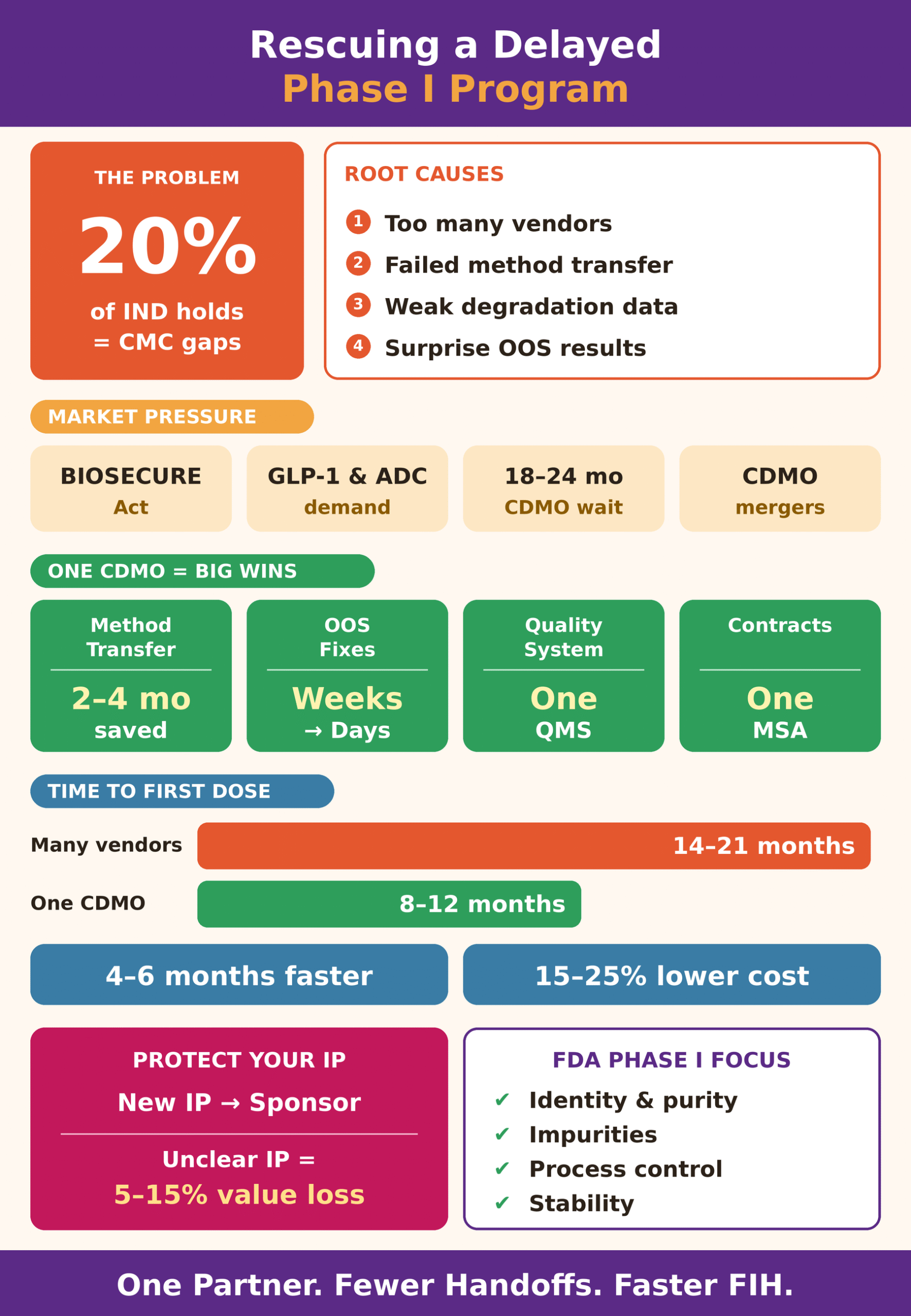
During early-stage drug development, CMC deficiencies account for approximately 20% of regulatory holds and non-approval decisions during Investigational New Drug (IND) reviews. When drug substance (API) synthesis, formulation development, and release and stability testing are distributed across separate vendors, even minor analytical discrepancies can escalate into delays that threaten the entire program. A single out-of-specification (OOS) result or an analytical assay transferred between laboratories without adequate validation can disrupt investor timelines and deplete clinical development funding. ResolveMass Laboratories Inc. addresses these systemic challenges by integrating specialized analytical characterization into phase-appropriate CMC development workflows.
For support with coordinated development and manufacturing, explore our peptide CDMO services in the United States.
Share via:
Quick Summary:
- Core idea: Delayed Phase I programs can be rescued by replacing several separate vendors with one integrated CDMO. That CDMO combines analytical testing and CMC development, and this can shorten timelines to First-in-Human dosing by 4–6 months.
- The problem: CMC deficiencies cause about 20% of regulatory holds during IND review. Splitting API synthesis, formulation and testing across separate vendors turns small analytical discrepancies into major delays.
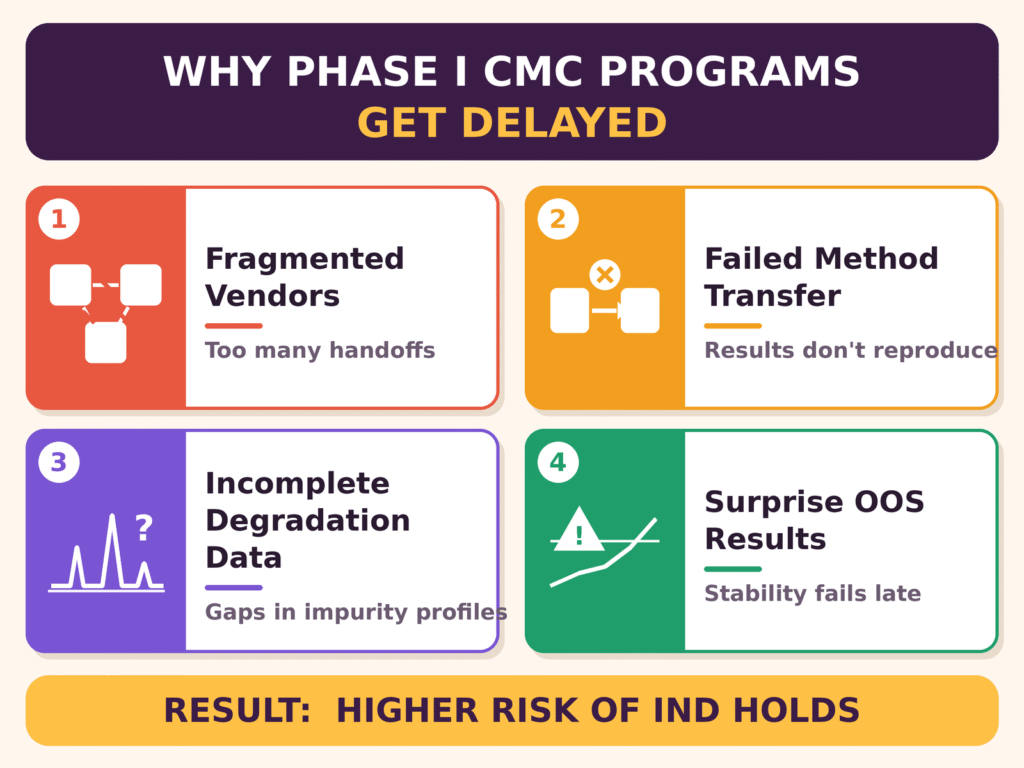
- Root causes: Delays come from fragmented vendor oversight, failed method transfers between labs, incomplete degradation profiling and unexpected out-of-specification stability results. Together these weaken CTD Module 3 submissions.
- Market pressures: The BIOSECURE Act, heavy demand for GLP-1 and ADC manufacturing, 18–24 month lead times at large CDMOs, and industry mergers are squeezing capacity for smaller Phase I programs.
- How integration helps: Co-located analytical and process teams avoid method transfer delays of 2–4 months. They cut OOS investigations from weeks to days and work under one quality system and one Master Services Agreement.
- IP and cost benefits: A single agreement clearly assigns new IP to the sponsor, which avoids the 5–15% valuation discount linked to unclear IP ownership. Consolidation can also cut development costs by 15–25%.
- Regulatory fit: For Phase I, the FDA focuses on identity, purity, impurity characterization, process control and stability rather than full commercial validation. A unified data history makes the dossier more consistent and easier to approve.
Root Causes of Delays in Early-Stage CMC and Analytical Development
Delays in early-stage CMC and analytical development primarily arise from fragmented vendor oversight, unsuccessful analytical method transfers between laboratories, incomplete degradation profiling, and unexpected out-of-specification stability results. These operational failures can result in inadequate Common Technical Document (CTD) Module 3 submissions, increasing the likelihood of regulatory holds during Investigational New Drug reviews.
Historically, biopharmaceutical companies have relied on a distributed outsourcing model involving Contract Research Organizations (CROs) for preliminary analytical screening, specialized chemistry providers for API scale-up, and separate contract manufacturers for final fill-finish operations. Although this arrangement provides access to specialized expertise, it can introduce considerable operational friction. One of the principal weaknesses of distributed development is analytical method transfer. Methods developed in an independent testing laboratory may not produce reproducible results when implemented at a manufacturing facility because of minor differences in equipment, environmental conditions, or raw material impurities. Resolving these discrepancies across separate organizations requires formal investigations, contract amendments, and repeated analytical testing, potentially consuming several months of development time.
Sponsors evaluating outsourcing strategies can compare the operational considerations of U.S. versus overseas peptide CDMOs before selecting a development partner.
Macroeconomic developments and geopolitical realignments have further intensified the vulnerabilities associated with early-phase outsourcing. Regulatory and policy changes, including legislative momentum surrounding the U.S. BIOSECURE Act, are encouraging biopharmaceutical sponsors to reassess foreign dependencies and consider moving critical development programs to integrated domestic laboratory networks. At the same time, substantial manufacturing demand from commercial GLP-1 peptide candidates and complex Antibody-Drug Conjugates (ADCs) has placed pressure on global CDMO capacity, extending lead times at tier-one providers to 18–24 months. Mergers and acquisitions involving large CDMOs have also affected access to manufacturing capacity for small and mid-sized biotechnology companies. Consequently, early-stage Phase I programs may face schedule delays and lose priority for manufacturing slots.
| Operational Vector | Multi-Vendor Distributed Model | Integrated Single-CDMO Model | Impact on Phase I IND Timeline |
|---|---|---|---|
| Analytical Method Transfer | Requires inter-laboratory transfer protocols and validation runs across multiple facilities. | Methods are developed and evaluated using production-aligned systems within the same facility. | Prevents 2–4 months of method transfer delays. |
| Quality and Documentation | Relies on disconnected Quality Management Systems (QMS) and separate batch records. | Maintains a unified QMS and continuous batch documentation history. | Reduces regulatory queries concerning CTD Module 3 consistency. |
| OOS Investigations | Requires cross-company liability reviews and shipment of split samples between facilities. | Enables immediate in-house root-cause investigations by co-located analytical teams. | Reduces investigation lead times from weeks to days. |
| Contractual Governance | Involves multiple Fee-For-Service (FFS) contracts with potentially conflicting change-order provisions. | Uses a single Master Services Agreement (MSA) with streamlined scope management. | Minimizes administrative delays and legal expenses. |
Operational Framework for Rescuing a Delayed Phase I Program
The operational framework for rescuing a delayed Phase I program focuses on bringing analytical method validation, batch release testing, and process scale-up together under one integrated Quality Management System. This co-located approach eliminates delays associated with sample transportation, facilitates real-time root-cause analysis of analytical deviations, and aligns formulation scale-up activities with ongoing stability studies.
In a multi-vendor environment, an unexpected degradation product or structural isomer identified during active pharmaceutical ingredient (API) synthesis may require the manufacturing facility to send samples to an external laboratory for liquid chromatography-mass spectrometry (LC-MS) characterization. The associated transportation, scheduling, and administrative handoffs can interrupt process development and leave synthesis equipment idle. In contrast, an integrated operating model allows process chemists and analytical specialists to collaborate directly within the same facility. In-process testing (IPT), structural elucidation, and forced degradation assessments can be performed alongside chemical synthesis, enabling impurities to be investigated and addressed before subsequent batch execution.
For specialized characterization throughout development, review our peptide analytical testing services.
The structural differences between these two development strategies can be understood through the following comparison.
Disintegrated Multi-Vendor Workflow: Analytical method development takes place at an external laboratory, requiring physical sample transfers to the API scale-up provider. If the method fails to perform as expected at the manufacturing site, formal cross-company out-of-specification (OOS) investigations may become necessary. These investigations can involve split-sample shipments, disputed change orders, and subsequent fill-finish delays. Collectively, these issues may contribute to a three-to-four-month timeline loss and increase the risk of a regulatory hold.
Consolidated Single-CDMO Workflow: Analytical services, batch release testing, process chemistry, and cGMP manufacturing operate within an integrated facility under a unified Quality Management System. In-process data and real-time testing results inform synthesis decisions directly, supporting the preparation of a submission-ready IND CTD Module 3 dossier. Under suitable project conditions, this approach can accelerate First-in-Human dosing by four to six months.
Consolidating Analytical Development and Method Validation
Integrating analytical testing directly into the manufacturing CDMO environment ensures that impurity profiling, potency assays, and stability data inform process chemistry decisions. This coordinated workflow reduces the risk of inter-laboratory method transfer failures and can accelerate batch release for First-in-Human clinical trials.
Analytical characterization provides the technical foundation for every CMC milestone. Instead of attempting to adapt an analytical method developed at an external laboratory to commercial manufacturing equipment late in development, an integrated CDMO can establish phase-appropriate, fit-for-purpose analytical methods alongside early formulation design. Purity assays, dissolution profiles, residual solvent screening, and solid-state characterization can be optimized in parallel with synthetic scale-up. This coordinated development approach helps ensure that the analytical documentation supporting the Investigational New Drug application is scientifically sound, reproducible, and appropriately organized for regulatory submission.
Robust impurity characterization is essential for identifying and managing process-related and degradation-related impurities. Learn more about impurity control strategies under ICH Q3A.
Mitigating Technology Transfer Bottlenecks and Intellectual Property Risks
Technology transfer bottlenecks can be reduced within an integrated CDMO environment by maintaining a continuous manufacturing history and batch record at a single facility. Additionally, using one Master Services Agreement helps protect asset valuation by clearly defining background and foreground intellectual property rights for the sponsor.
Transferring technical operations between external vendors represents one of the most significant risk points in Phase I drug development. Moving a complex small molecule, peptide, or high-potency active pharmaceutical ingredient (HPAPI) formulation between facilities can introduce physical variability related to mixing mechanics, equipment geometry, and environmental controls. Within an integrated facility, many external technology transfer activities can instead be managed through internal process scale-up. Analytical baselines, calibration curves, and degradation histories remain accessible within a single laboratory information management system, reducing the likelihood of data loss or inconsistencies during scale-up.
Contractual governance and intellectual property (IP) arrangements are equally important when restructuring a delayed development program. Multi-vendor arrangements can create ambiguity regarding foreground IP, including modified analytical assay conditions, newly identified polymorphs, and specialized excipient ratios. Such uncertainties may lead to disputes over ownership between vendors and sponsors. Industry financial analyses suggest that unresolved CDMO IP ownership provisions can contribute to a 5% to 15% Net Present Value (NPV) discount on early-stage biopharmaceutical assets during licensing or acquisition due diligence. Consolidating project responsibilities under a comprehensive Master Services Agreement establishes a clearer framework in which asset-specific foreground IP is assigned directly to the sponsor, while the CDMO retains rights to its pre-existing background platform technologies.
Quantitative Timeline and Financial Impact of Consolidation
Consolidating analytical and CMC operations under a single CDMO can shorten Phase I IND preparation timelines by four to six months while potentially reducing overall development costs by 15% to 25%. Independent benchmark research indicates that eliminating multi-vendor handoffs can reduce capital allocation risks and improve expected Net Present Value.
| Phase I CMC Development Milestone | Distributed Multi-Vendor Model Duration | Consolidated Single-CDMO Model Duration | Cumulative Timeline Reduction |
|---|---|---|---|
| API Process Scale-Up and Synthetic Tuning | 4 to 6 months | 3 to 4 months | 1 to 2 months saved |
| Analytical Method Development and Validation | 3 to 5 months at an independent facility | Integrated concurrently with synthesis | 1 to 2 months saved |
| Inter-Site Technology Transfer and Re-Testing | 2 to 3 months | 0 months through co-located execution | 2 to 3 months saved |
| cGMP Batch Release and Stability Testing | 3 to 4 months | 2 to 3 months | 1 month saved |
| CTD Module 3 Assembly and Regulatory Filing | 2 to 3 months for reconciliation of siloed data | 1 month with a unified batch history | 1 to 2 months saved |
| Total Cumulative Duration to FIH Dosing | 14 to 21 months | 8 to 12 months | 4 to 6 months accelerated |
The financial benefits of reducing development timelines directly affect the extension of a biopharmaceutical company’s funding runway. A fragmented, multi-vendor structure increases administrative expenditure through duplicate project management fees, repeated quality audits, international sample shipping costs, and poorly coordinated change orders. Fee-For-Service arrangements involving multiple vendors can also experience cost overruns when technical deviations occur, because each independent organization charges separately for investigations and activities outside the original scope.
An integrated service model aligns development spending more closely with scientific progress. By adopting agile manufacturing platforms and phase-appropriate analytical controls, sponsors can reduce unnecessary peptide or small-molecule synthesis runs and avoid additional expenditure on active raw materials. These efficiencies can preserve development capital while supporting the generation of the analytical and manufacturing data required to advance the program.
For programs involving GLP-1 candidates, consider the technical requirements for scaling a GLP-1 analog from preclinical synthesis to GMP manufacturing.
Regulatory Compliance and FDA Alignment
Obtaining timely regulatory authorization for a Phase I program requires sponsors to use applicable FDA phase-appropriate CMC flexibilities while preparing a consistent Common Technical Document Module 3 dossier. During initial Investigational New Drug assessments, regulatory reviewers prioritize subject safety, batch reproducibility, and adequate characterization rather than requiring the same level of commercial-scale validation expected for later development stages.
The regulatory framework for Phase I Investigational New Drug (IND) applications provides flexibility concerning the extent of manufacturing and analytical data required at the initial stages of development. Under applicable agency guidance, early-stage sponsors are generally not expected to provide full commercial process validation or extensive multi-batch statistical process controls at the outset. Instead, regulatory assessments focus on essential safety and quality considerations, including the following:
- Establishing clear drug substance identity, strength, quality, and purity profiles.
- Providing comprehensive characterization of potential impurities, degradation pathways, and residual solvents.
- Demonstrating that the manufacturing process is sufficiently controlled to produce reproducible clinical batches.
- Confirming that available stability data support drug product integrity throughout the intended clinical trial period.
Distributed vendor networks frequently generate separate documentation packages that complicate regulatory evaluation. When CTD Module 3 is assembled from inconsistent analytical reports, non-standardized batch records, and conflicting stability protocols, reviewers may request additional information or impose clinical holds. An integrated provider can help mitigate these compliance risks by maintaining a consistent, continuous quality history. Coordinating process chemistry, analytical release testing, and stability documentation within a unified submission package improves transparency, simplifies regulatory review, and supports timely authorization for First-in-Human dosing.
Accurate CMC documentation is particularly important when preparing submissions for generic drug programs. Explore our guidance on CMC documentation at a CDMO for ANDA submissions.
Conclusion: Strategic Execution for Rescuing a Delayed Phase I Program
Rescuing a delayed Phase I program requires a strategic shift away from fragmented, multi-vendor networks toward a consolidated CDMO partner capable of integrating analytical testing with CMC development. This unified operating model reduces critical handoff bottlenecks, lowers regulatory submission risks, and helps restore clinical development timelines.
For biopharmaceutical leadership teams managing schedule delays or regulatory holds, consolidating development activities with an integrated partner provides a practical pathway toward program recovery. Bringing analytical characterization and process manufacturing together under a single provider, such as ResolveMass Laboratories Inc., reduces inter-vendor friction, can shorten IND delivery schedules by up to six months, and helps protect overall asset valuation. Establishing robust analytical controls and implementing phase-appropriate manufacturing practices early in development also helps promising drug candidates progress toward human clinical studies with fewer avoidable interruptions.
For development programs requiring specialized peptide manufacturing, explore our GMP peptide API manufacturing services to learn more about supporting peptide development with appropriate manufacturing and quality controls.
For technical consultation on early-phase program recovery and integrated CMC strategy, contact the team directly through the ResolveMass Contact Us Page.
Frequently Asked Questions
An integrated CDMO coordinates analytical testing, process development, manufacturing, and quality documentation within a unified operational framework. This reduces delays associated with inter-site method transfers, improves communication between chemists and analysts, and enables faster investigation of technical deviations. Depending on the program, consolidation may shorten IND preparation timelines by four to six months.
Phase-appropriate analytical validation involves establishing testing procedures suitable for the specific stage of drug development. For Phase I programs, methods should generate reliable data to assess drug identity, strength, purity, and relevant quality attributes while addressing potential safety risks. The extent of validation depends on the method’s intended use and applicable regulatory expectations.
Transferring analytical methods between independent laboratories requires documented procedures, appropriate verification or validation activities, and investigations into differences in equipment or testing conditions. If the receiving laboratory cannot reproduce the original results, additional experiments and corrective actions may be necessary. These challenges can extend development schedules by several months and delay clinical material release.
Stability studies provide evidence of how a drug substance or drug product changes under specified storage conditions over time. Accelerated and real-time studies help characterize degradation pathways, establish appropriate storage conditions, and support the proposed shelf life. Their results also help demonstrate that the investigational product can maintain its required quality throughout the intended clinical trial period.
Intellectual property arrangements are generally defined in the Master Services Agreement (MSA) and related contractual documents. These provisions distinguish the sponsor’s existing background intellectual property from newly generated foreground intellectual property arising during development. Clearly defining ownership, permitted use, and access rights helps prevent disputes and protects the sponsor’s commercial interests during licensing, investment, or acquisition discussions.
Geopolitical developments and legislation, including the U.S. BIOSECURE Act, can influence how biopharmaceutical companies evaluate suppliers, manufacturing locations, and supply chain dependencies. Sponsors may consider domestic or alternative CDMO partners to reduce exposure to potential regulatory restrictions and supply disruptions. Evaluating a provider’s capabilities, compliance status, and supply chain resilience is important when selecting a partner for early-stage clinical development.
Unresolved CMC delays can increase development expenditure through repeated analytical testing, additional manufacturing runs, extended personnel commitments, and regulatory remediation. Delayed clinical milestones may also affect financing plans, licensing opportunities, and the overall commercial potential of an investigational asset. The financial consequences vary by program and may be reflected in a lower projected Net Present Value (NPV).
The FDA applies a phase-appropriate, risk-based approach to CMC information for early-stage clinical development. Sponsors may provide manufacturing, analytical, and stability data appropriate to the investigational product and the proposed clinical trial rather than completing every requirement associated with commercial manufacturing. However, the submission must still provide sufficient evidence of product quality, identity, strength, purity, and safety to support the proposed investigation.
An early-stage biotechnology company should consider moving to an integrated CDMO when repeated analytical method transfer failures, inconsistent documentation, slow communication, or unresolved impurity investigations begin threatening development milestones. Consolidation may also be appropriate when multiple vendors create overlapping responsibilities or make regulatory submission preparation difficult. Evaluating these issues early can help sponsors select a more coordinated operating model before delays significantly affect clinical trial readiness.
Reference:
- U.S. Food and Drug Administration. (n.d.). Phase 1 IND chemistry, manufacturing, and controls flexibilities. https://www.fda.gov/industry/phase-1-investigational-new-drug-ind-navigator/phase-1-ind-chemistry-manufacturing-and-controls-flexibilities
- Kurata, H., Ishino, T., Ohshima, Y., & Yohda, M. (2022). CDMOs play a critical role in the biopharmaceutical ecosystem. Frontiers in Bioengineering and Biotechnology, 10, Article 841420. https://doi.org/10.3389/fbioe.2022.841420
- Rivera Rojas, J. E. (2025, June). The CDMO model in lyophilization: Bridging technological gaps and postharvest losses in emerging economies (Case study: Colombia). ResearchGate. https://www.researchgate.net/publication/405652216_The_CDMO_Model_in_Lyophilization_Bridging_Technological_Gaps_and_Postharvest_Losses_in_Emerging_Economies_Case_Study_Colombia
- Toumi, A. (2026, June 5). Staying competitive within the evolving CDMO model. European Pharmaceutical Review. https://www.europeanpharmaceuticalreview.com/staying-competitive-within-the-evolving-cdmo-model/2135643.article
Get In Touch With Us
About The Author