


Introduction
Research-grade peptides and Good Manufacturing Practice (GMP) peptides represent two distinct categories of materials because they are manufactured under fundamentally different quality systems, environmental conditions, and regulatory requirements. Although both grades may contain the same primary amino acid sequence and have the same theoretical molecular weight, research-grade peptides cannot be legally or scientifically considered interchangeable with GMP peptides when used in clinical or otherwise regulated applications. When assessing Research Grade vs GMP Peptide, the principal difference is not necessarily the intended chemical structure itself, but rather the comprehensive manufacturing infrastructure, validated analytical procedures, batch consistency, traceability, and documentation systems established throughout production. Research-grade peptides are generally intended for non-clinical laboratory research and in vitro investigations, whereas GMP peptides are manufactured according to applicable pharmaceutical quality requirements, including US Food and Drug Administration (FDA) 21 CFR Parts 210/211 and International Council for Harmonisation (ICH) Q7 guidelines. Specialized analytical testing facilities, including ResolveMass Laboratories Inc., contribute to maintaining these distinctions by independently evaluating peptide identity, purity, composition, and other critical quality attributes to support experimental reliability and regulated applications.
Learn more about GMP Peptide API Manufacturing Services.
Share via:
Quick Summary:
- Research-grade and GMP peptides are not interchangeable: the key differences lie in manufacturing controls, traceability, documentation, testing, and regulatory compliance—not simply peptide sequence or molecular weight.
- Manufacturing environment differs significantly: research peptides are typically produced in standard laboratory settings, while GMP peptides require controlled facilities, qualified equipment, validated processes, and appropriate cleanroom/environmental controls.
- GMP peptides require stronger quality oversight: raw materials undergo qualification, production follows Master/Executed Batch Records, and an independent Quality Unit oversees batch review, deviations, OOS investigations, and release.
- Analytical testing is more comprehensive for GMP peptides: beyond RP-HPLC purity, GMP programs may include LC-MS, counter-ion/salt analysis, potency and content uniformity, residual impurities, and bacterial endotoxin testing.
- Regulatory frameworks distinguish the two grades: GMP peptide manufacturing follows requirements such as FDA 21 CFR Parts 210/211 and ICH Q7, supported by quality systems including ICH Q8, Q9, and Q10.
- The appropriate grade depends on development stage: research-grade peptides are generally suitable for exploratory screening and non-regulated laboratory studies, while GMP peptides are intended for applications such as IND-enabling studies and clinical development.
- Key takeaway: Same peptide sequence ≠ same quality or regulatory suitability. Selecting the appropriate grade helps ensure reproducibility, traceability, consistency, and fitness for the intended application.
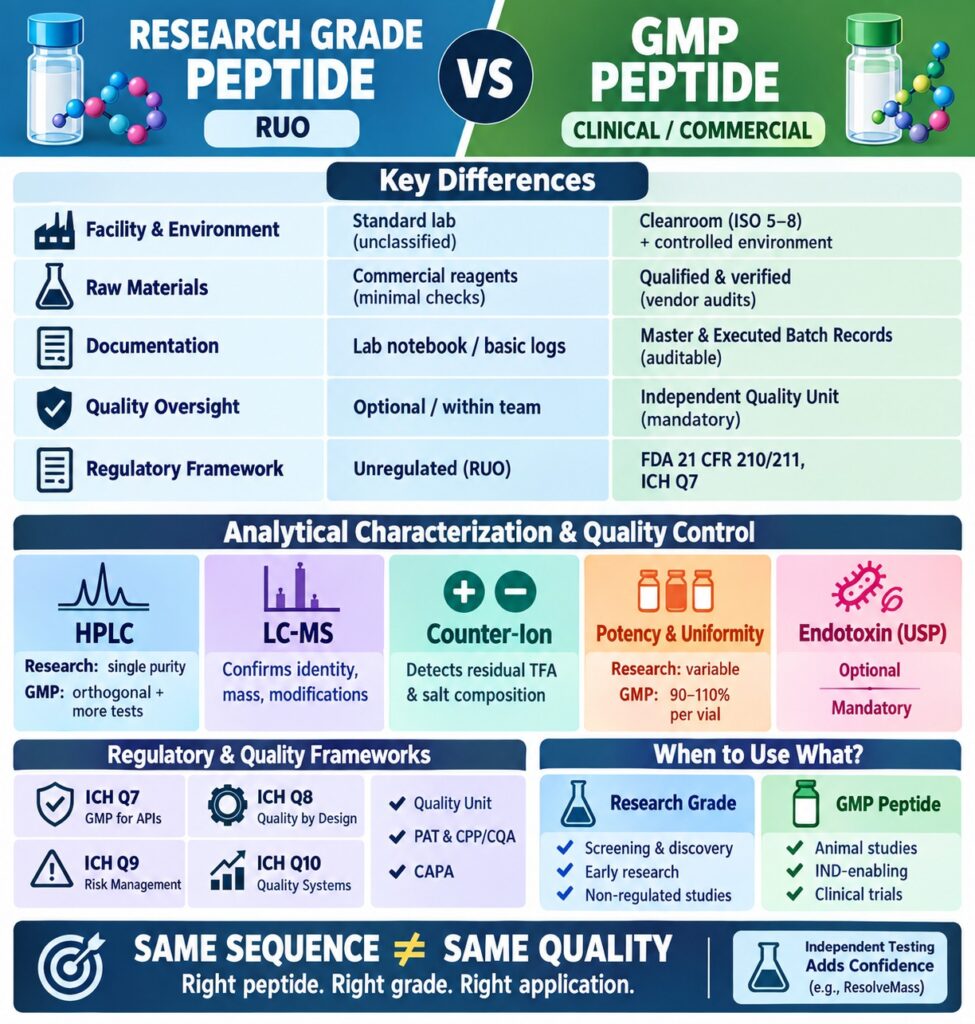
Key Technical Differences in Research Grade vs GMP Peptide Manufacturing
The fundamental technical differences between research-grade and GMP peptide manufacturing begin with facility design, environmental controls, raw material qualification, cleanroom requirements, and controlled batch execution. Research-grade peptides are generally synthesized in conventional laboratory environments designed to support flexible and rapid research activities. In contrast, GMP peptide manufacturing requires appropriately controlled facilities, documented procedures, qualified equipment, and validated manufacturing processes that operate within a formal pharmaceutical quality system.
For research-grade peptide production, solid-phase peptide synthesis (SPPS) may be carried out using commercially available reagents without the extensive supplier qualification, vendor auditing, and raw material verification expected within a GMP manufacturing system. Synthesis, cleavage, and subsequent handling may take place in conventional laboratory areas without classified air-handling systems. Consequently, the material may have greater potential exposure to airborne particulates, environmental bioburden, and cross-contamination from other laboratory activities. Documentation associated with research-grade materials may primarily consist of laboratory notebook entries, electronic records, or synthesizer-generated logs. Such documentation generally does not provide the comprehensive, independently reviewable audit trail expected for regulated pharmaceutical manufacturing.
Explore Custom Peptide Synthesis Services for peptide development and synthesis requirements.
GMP peptide manufacturing, by comparison, is conducted according to established pharmaceutical quality requirements and applicable ICH Q7 principles, with manufacturing activities performed under documented and controlled conditions. Depending on the specific manufacturing stage and application, facilities may incorporate qualified cleanroom areas with appropriate environmental classifications, controlled pressure differentials, High-Efficiency Particulate Air (HEPA) filtration, and ongoing monitoring of viable microorganisms and non-viable particulates. Starting materials, protected amino acids, resins, solvents, and other critical components undergo defined receiving, identification, qualification, and release procedures before they are introduced into production. Manufacturing operations are performed according to an approved Master Batch Record (MBR), with the resulting Executed Batch Record (EBR) documenting the actual production process, including reagent additions, processing conditions, temperature holds, purification operations, and required verification activities.
See how peptide programs can progress from development-scale synthesis toward GMP manufacturing in Scaling a GLP-1 Analog from Preclinical Synthesis to GMP Kilogram-Scale Manufacturing.
| Technical Parameter / Specification | Research-Grade (RUO) Peptide | Good Manufacturing Practice (GMP) Peptide |
|---|---|---|
| Primary Legally Intended Application | In vitro assays, biochemical screening, exploratory R&D | Human clinical trials (IND/NDA), commercial therapeutics, regulated studies |
| Regulatory Framework | Unregulated; designated strictly as Research Use Only (RUO) | FDA 21 CFR Parts 210/211, EMA directives, ICH Q7, ICH Q8–Q10 |
| Quality Unit Oversight | Optional or integrated within synthesis team | Mandated independent Quality Unit with batch release authority |
| Facility Environment | Standard chemical laboratory; unclassified air handling | Qualified Cleanroom Suites (ISO 5–8) with continuous environmental tracking |
| Purity Determination | Single-peak RP-HPLC UV area percent (e.g., ≥95% or ≥98%) | Validated orthogonal HPLC, LC-MS, residual solvent, and salt profiling |
| Endotoxin Testing | Optional, unvalidated, or omitted | Mandatory Bacterial Endotoxins Test per USP with strict limits |
| Dose & Content Uniformity | Potency varies per vial; no uniform fill mandates | Strict content uniformity requirements (typically 90%–110% of label claim) |
| Material Traceability | Basic lot numbering; minimal raw material lineage logging | Complete lot tracking, validated vendor qualification, and auditable records |
Analytical Characterization and Quality Control Metrics
Analytical characterization of GMP peptides involves a comprehensive set of tests designed to establish identity, purity, potency, counter-ion composition, and biological safety. Research-grade peptides, on the other hand, commonly depend on a more limited analytical package, frequently centered on a single purity measurement. A research-grade Certificate of Analysis (CoA) may demonstrate a high HPLC purity value while providing limited information regarding other important quality and safety attributes.
Review Peptide Analytical Testing Services for analytical approaches used to evaluate peptide identity, purity, and related quality attributes.
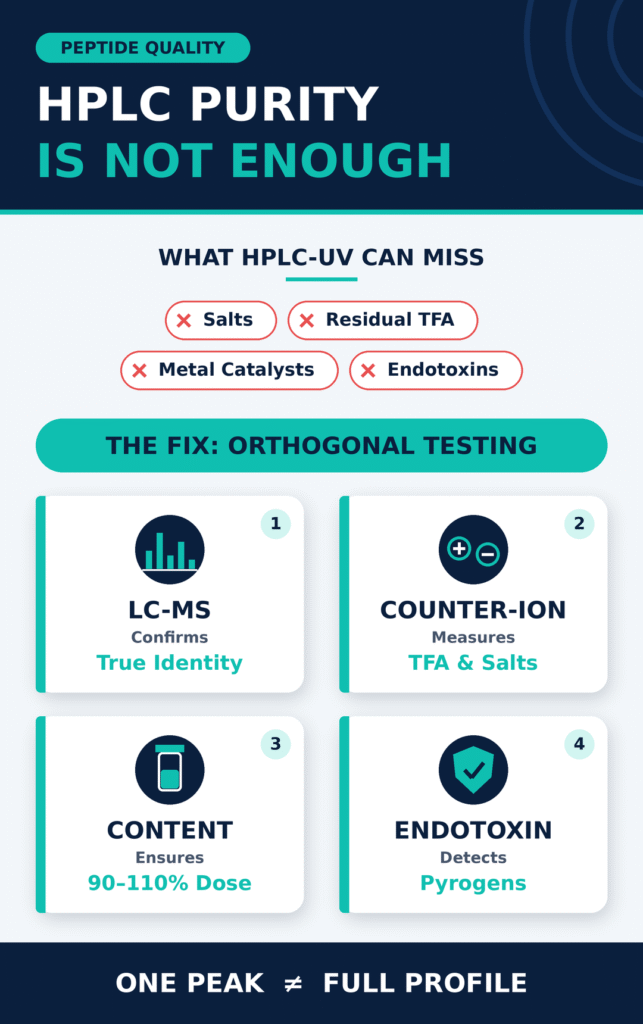
One frequent issue in peptide sourcing is the assumption that High-Performance Liquid Chromatography (HPLC) UV area purity represents the complete quality profile of a peptide. Reversed-phase HPLC (RP-HPLC) with ultraviolet detection determines the relative contribution of the principal peptide peak compared with other UV-absorbing components that elute under the selected chromatographic conditions. These components may include deletion sequences, diastereomers, and related peptide impurities. However, RP-HPLC by itself does not provide comprehensive detection or quantification of non-chromophoric impurities, inorganic salts, heavy metal catalysts, residual trifluoroacetic acid (TFA), or bacterial endotoxins.
To address these analytical limitations, comprehensive peptide characterization programs employ multiple orthogonal analytical techniques. These methods provide complementary information and allow different classes of impurities and quality attributes to be evaluated more effectively:
- Liquid Chromatography-Mass Spectrometry (LC-MS): Confirms molecular mass and isotopic distribution and provides evidence supporting sequence identity. It can also assist in detecting structural or chemical modifications, including oxidation, deamidation, and incorrect disulfide bridging.
- Counter-Ion Exchange and Quantification: Determines the presence and quantity of residual counter-ions associated with solid-phase synthesis and TFA cleavage. Since residual TFA can exhibit cytotoxic effects in certain bioassay systems, GMP-oriented workflows may convert peptides into more suitable salt forms, such as acetate or hydrochloride, followed by quantitative assessment of the final salt composition.
- Content Uniformity and Potency Assays: Verify that individual vials contain an appropriate and consistent quantity of the intended active peptide. The target is typically maintained within 90–110% of the stated amount, depending on the applicable specification. Research-grade products may demonstrate greater vial-to-vial variation in peptide mass, which can introduce substantial uncertainty into quantitative concentration-response experiments.
- Bacterial Endotoxin Quantification (USP): Employs Limulus Amebocyte Lysate (LAL) or recombinant Factor C methodologies to identify pyrogenic lipopolysaccharides originating from bacterial cell walls. When endotoxin levels are not adequately characterized in research peptides, they may interfere with biological experiments by producing inflammatory responses in cell cultures or potentially contributing to severe systemic reactions during in vivo studies.
For a broader overview of analytical considerations, explore Peptide Analytical Testing Services.
Regulatory Compliance and Quality Frameworks: ICH Q7 and 21 CFR 210/211
GMP peptide manufacturing operates within regulatory quality frameworks that require appropriate Quality Unit oversight, controlled and validated manufacturing processes, documented procedures, and ongoing quality risk management. Research-grade peptide production generally does not operate under the same statutory GMP requirements. Consequently, research-grade materials are not automatically suitable for clinical, diagnostic, or other regulated applications merely because they demonstrate an acceptable analytical purity value.
Learn about North American Peptide CDMO Services and the quality infrastructure supporting regulated peptide development and manufacturing.
The ICH Q7 guideline describes GMP principles applicable to the manufacture of active pharmaceutical ingredients (APIs), with increasing controls applied as manufacturing progresses toward later stages, including final API isolation and packaging. An important component of this framework is an independent Quality Unit that functions separately from routine production activities. The Quality Unit is responsible for key quality-related functions, including approval of Standard Operating Procedures (SOPs), evaluation and investigation of Out-of-Specification (OOS) results, review of executed batch documentation, and decisions concerning the release or rejection of finished product lots.
GMP quality systems also incorporate principles associated with Quality by Design (QbD) under ICH Q8, Quality Risk Management under ICH Q9, and Pharmaceutical Quality Systems under ICH Q10. Process Analytical Technology (PAT) can be implemented to monitor Critical Process Parameters (CPPs) and help maintain Critical Quality Attributes (CQAs) within established and validated specification ranges. Corrective and Preventive Action (CAPA) systems provide a structured mechanism for investigating deviations, identifying root causes, and implementing measures intended to prevent recurrence. These formal quality systems are generally absent from conventional research-grade peptide production, where variations between batches may therefore receive considerably less formal monitoring and investigation.
See how quality and regulatory documentation can support pharmaceutical development through CMC Documentation at a CDMO for ANDA.
Practical Application Criteria: Selecting a Research Grade vs GMP Peptide
The appropriate peptide grade depends on the development stage, regulatory requirements, intended biological model, and degree of analytical and manufacturing control required for the study. Choosing a material that does not match the needs of the application can affect scientific reproducibility, increase downstream development requirements, or create regulatory complications.
For exploratory benchtop screening, early-stage hit identification, or basic biochemical binding assays, research-grade peptides can provide a practical material option for laboratory investigations. At these stages, researchers often require rapid access to multiple peptide sequences and variants for preliminary screening, making extensive regulatory documentation less central to the immediate experimental objective.
As development progresses toward animal disease models, IND-enabling toxicology studies, and human clinical trials, the requirements for material quality, traceability, analytical characterization, and manufacturing control become substantially more stringent. Research-grade material that has not undergone appropriate validation and characterization may introduce sources of variability into preclinical or clinical investigations. For example, insufficiently characterized endotoxins can interfere with biological responses, variations in salt composition may affect cell-based assays, and differences in peptide concentration can influence pharmacokinetic and pharmacodynamic evaluations. Independent analytical testing laboratories, including ResolveMass Laboratories Inc., can support this transition by providing purity assessment, mass spectral confirmation, contaminant characterization, and other analytical verification services required for critical development studies.
For programs progressing toward clinical development, explore Clinical Trial Material Supply for Peptide Programs.
Conclusion
A detailed evaluation of Research Grade vs GMP Peptide demonstrates that having an identical chemical structure does not by itself establish equivalent manufacturing quality, analytical control, or suitability for regulated applications. Research-grade peptides can serve as useful reagents for exploratory discovery, preliminary screening, and non-regulated laboratory investigations, while GMP peptides are manufactured within controlled quality systems designed to support applications requiring greater levels of process control, traceability, consistency, and regulatory compliance. Recognizing the differences in cleanroom manufacturing, orthogonal analytical characterization, material traceability, batch documentation, and independent Quality Unit oversight enables researchers to select peptide materials that are appropriate for their specific development stage and intended application. Life science organizations requiring independent verification of peptide purity, identity, composition, and related quality attributes can work with specialized analytical testing facilities such as ResolveMass Laboratories Inc. to obtain additional analytical confidence.
Discover GMP Peptide API Manufacturing Services for controlled peptide API development and manufacturing support.
To discuss specialized analytical characterization services, mass spectrometry testing, or custom quality verification, contact the senior scientific team directly through the ResolveMass Contact Page.
Frequently Asked Questions
Research-grade peptides are designated as Research Use Only (RUO) and are not manufactured as clinical-use materials. They generally lack the validated sterility, endotoxin controls, manufacturing documentation, and regulatory authorization required for administration to human subjects. Clinical investigations require appropriately manufactured and characterized materials that meet applicable regulatory requirements.
An HPLC purity value primarily reflects the chromatographic proportion of detected components under the selected analytical conditions. It does not by itself establish the absence of residual solvents, inorganic salts, heavy metals, endotoxins, or other non-detected impurities. Pharmaceutical-quality assessment therefore requires complementary analytical methods and appropriate quality documentation.
The Quality Unit provides independent oversight of manufacturing and quality activities within the GMP system. Its responsibilities can include approving procedures, reviewing batch documentation, evaluating Out-of-Specification (OOS) results, and overseeing final batch disposition. This independence helps ensure that production decisions remain subject to objective quality review.
Endotoxins are pyrogenic lipopolysaccharides that can activate inflammatory pathways and significantly influence biological assay results. When present in peptide preparations, they may alter cellular responses and create misleading toxicity or activity findings. Appropriate endotoxin testing is therefore important when peptides are used in sensitive biological and in vivo studies.
RUO means Research Use Only, indicating that the material is intended for laboratory research rather than clinical or therapeutic use. This designation indicates that the product has not been established as suitable for human or veterinary administration. Researchers should therefore use RUO materials within the scope specified for non-clinical research applications.
Trifluoroacetic acid (TFA) is commonly used during peptide synthesis, cleavage, and purification and can remain associated with the final peptide as a counter-ion. Elevated residual TFA may interfere with certain sensitive biological assays because of its potential cytotoxic effects. Counter-ion exchange to forms such as acetate or hydrochloride can therefore be considered when appropriate for the intended application.
GMP manufacturing incorporates defined specifications to ensure consistent peptide content across individual units or batches. Depending on the applicable specification, content may commonly be controlled within approximately 90–110% of the stated target. Research-grade materials may not be subject to equivalent content uniformity requirements, potentially introducing variability into quantitative dose-response experiments.
GMP peptide manufacturing requires comprehensive documentation demonstrating controlled production and quality assessment. Depending on the manufacturing process, this may include the Master Batch Record, Executed Batch Record, Certificate of Analysis, raw material traceability records, deviation documentation, and applicable stability data. These records create an auditable history of the material and its manufacturing process.
Research laboratories can use independent analytical testing facilities to evaluate peptide purity and identity through complementary techniques such as RP-HPLC and LC-MS. LAL or other appropriate endotoxin testing can provide additional information about biological safety attributes. Reviewing analytical chromatograms, mass spectra, and test results can help researchers independently assess the quality of purchased peptide material.
Reference:
- International Council for Harmonisation of Technical Requirements for Pharmaceuticals for Human Use. (2015). ICH Q7 guideline: Good manufacturing practice guide for active pharmaceutical ingredients: Questions and answers. ICH Q7 Questions and Answers
- Elsayed, Y. Y., Kühl, T., & Imhof, D. (2025). Regulatory guidelines for the analysis of therapeutic peptides and proteins. Journal of Peptide Science, 31(3), e70001. https://doi.org/10.1002/psc.70001
- E. (2026, April 30). Research peptides vs pharmaceutical grade: Why the difference could harm you. Meto. https://meto.co/blog/research-peptides-vs-pharmaceutical-grade
- Moon, T. M., Tykocki, N. R., Sheehe, J. L., Osborne, B. W., Tegge, W., Brayden, J. E., & Dostmann, W. R. (2015). Synthetic peptides as cGMP-independent activators of cGMP-dependent protein kinase Iα. Cell Chemical Biology, 22(12), 1653–1661. https://doi.org/10.1016/j.chembiol.2015.11.005
- Swietlow, A., & Lax, R. (2004). Quality control in peptide manufacturing: Specifications for GMP peptides. Chimica Oggi–Chemistry Today, 22, 22–24. Source
Get In Touch With Us
About The Author


