


Introduction
Resolving an Out-of-Specification Impurity Result during therapeutic peptide manufacturing requires a systematic analytical and regulatory approach to identify the underlying cause while maintaining product safety, quality, and compliance. An Out-of-Specification (OOS) result identified during the release testing of a synthetic peptide active pharmaceutical ingredient (API) can lead to manufacturing delays, financial exposure, and possible batch rejection when the investigation is not conducted in a controlled and scientifically justified manner.
Synthetic peptides manufactured through Solid-Phase Peptide Synthesis (SPPS) or liquid-phase assembly can develop complex impurity profiles because of the repeated coupling, deprotection, and cleavage stages involved in synthesis. These manufacturing operations may produce structurally related side-products, including deletion sequences, truncated fragments, diastereomers generated through amino acid racemization, and oxidation products. In accordance with 21 CFR 211.192 and Current Good Manufacturing Practice (cGMP) requirements, any analytical result that falls outside an established specification requires a comprehensive and documented investigation covering both laboratory activities and the relevant manufacturing history.
Explore Custom Peptide Synthesis Services for specialized peptide development and synthesis support.
When investigative procedures are aligned with applicable international standards, including ICH Q3A(R2) for organic impurities, ICH Q7 for API manufacturing, and US Food and Drug Administration (FDA) guidance concerning OOS investigations, manufacturers can systematically identify and establish the root cause of an atypical result. This case study illustrates how hyphenated high-resolution mass spectrometry, supported by cross-functional root-cause analysis, can be used for Resolving an Out-of-Specification Impurity Result and recovering high-value peptide batches while maintaining stringent regulatory expectations.
Share via:
Quick Summary:
- OOS impurity results in therapeutic peptide manufacturing require a documented investigation to determine the root cause while maintaining product quality and regulatory compliance.
- Phase I laboratory investigation first checks for analytical errors, including system suitability, calculations, sample preparation, instrument calibration, reagents, and analyst practices. If no assignable error is found, the original OOS result remains valid.
- Phase II cross-functional investigation reviews manufacturing records, process parameters, raw materials, and synthesis conditions. In the case study, an unexpected 45-minute delay during TFA cleavage was identified.
- Advanced structural characterization using UHPLC-HRMS, MS/MS, and NMR established a +15.9949 Da oxidation localized to methionine, confirming formation of methionine sulfoxide (Met-O) at 0.42%.
- Preparative RP-HPLC reprocessing was used to recover the delayed batch. Optimizing the mobile phase to 10 mM ammonium acetate (pH 6.5) and using a phenyl-hexyl column improved separation and reduced the impurity to <0.05%.
- CAPA measures addressed the root cause through redundant transfer lines, an updated scavenger formulation containing 5% ethanedithiol (EDT), and an orthogonal pH-adjusted HPLC method for improved oxidation monitoring.
- After successful reprocessing and complete release testing, the 1.2 kg peptide batch met specifications, demonstrating how structured OOS investigations, advanced mass spectrometry, validated reprocessing, and effective CAPA can support scientifically justified batch recovery and regulatory compliance.
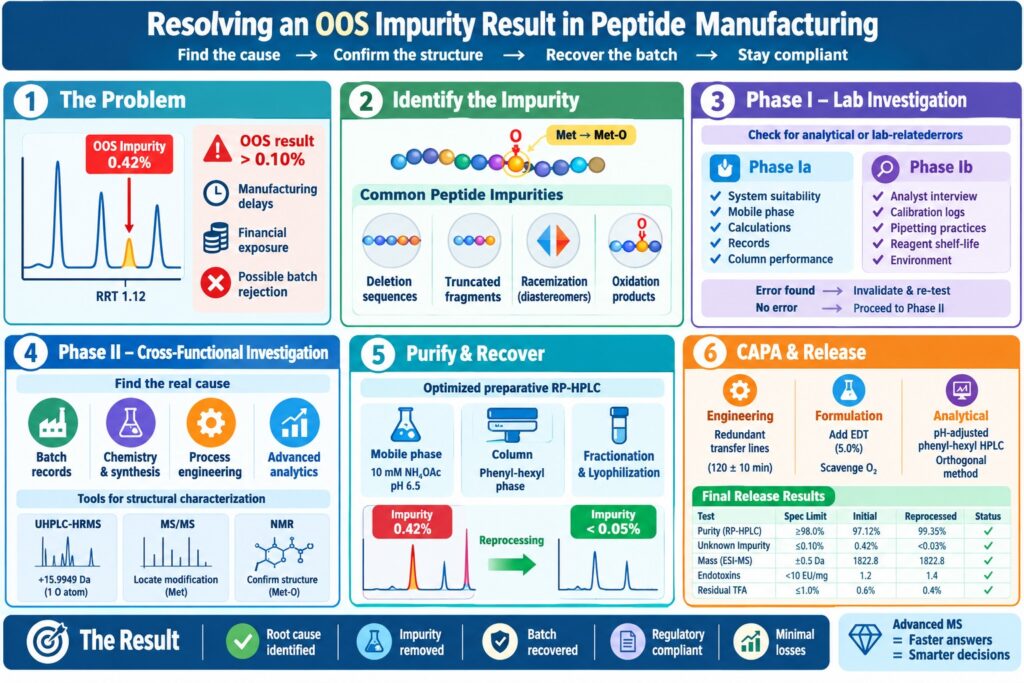
Phase I Laboratory Investigation for Resolving an Out-of-Specification Impurity Result
A Phase I laboratory investigation is conducted to determine whether an out-of-specification result may have originated from analytical error, instrument malfunction, or inconsistencies in sample preparation before a manufacturing investigation is initiated. Once an unexpected analytical result is identified, the Phase I process should begin promptly so that the original test data and sample integrity are preserved while laboratory activities are systematically reviewed.
Learn more about Peptide Analytical Testing Services for analytical characterization and testing support.
The Phase I investigation follows a sequential two-stage framework intended to determine whether the observed OOS result can be attributed to an analytical or laboratory-related issue:
- Phase Ia (Immediate Obvious Error Assessment): The analyst and laboratory supervisor review the raw analytical data, system suitability parameters, mobile phase preparation records, transcription records, calculations, and column performance information to determine whether an obvious operational or documentation error occurred.
- Phase Ib (Comprehensive Laboratory Audit): When Phase Ia does not identify an obvious error, the laboratory supervisor performs a more detailed assessment. This includes structured interviews with the analyst, examination of instrument calibration histories, verification of volumetric pipetting practices, assessment of reagent shelf-lives, and review of environmental conditions present during the analytical procedure.
- Escalation Logic: If a clear and documented laboratory error is established, the original test can be invalidated based on supporting evidence and repeated in accordance with applicable standard operating procedures. If no assignable analytical error is identified, the original result remains valid and the investigation proceeds to a Phase II cross-functional review.
| Investigation Phase | Evaluation Scope | Key Audit Parameters | Regulatory Outcome Criteria |
|---|---|---|---|
| Phase Ia (Immediate Review) | Assessment of obvious analytical errors and system integrity | System suitability parameters, mobile phase pH, transcription accuracy, calculations, and column qualification | Documented evidence of a clear error supports test invalidation and re-analysis |
| Phase Ib (Thorough Audit) | Detailed assessment of analytical procedures and equipment execution | Analyst interviews, instrument calibration logs, volumetric pipetting, reagent purity/shelf-life, and environmental controls | Absence of laboratory error confirms the initial result and requires escalation to Phase II |
During the initial Reverse-Phase High-Performance Liquid Chromatography (RP-HPLC) release assay performed on a 15-amino acid synthetic peptide batch, an uncharacterized impurity peak was detected at a relative retention time (RRT) of 1.12. The impurity represented an integrated area of 0.42%, which exceeded the established release specification for individual unknown impurities of ≤ 0.10%. This result initiated a formal Phase I investigation.
The Phase Ia assessment confirmed that all applicable system suitability requirements were satisfied, including chromatographic resolution, tailing factors, and injection precision. During Phase Ib, the investigation team reviewed mobile phase preparation records, volumetric glassware calibration documentation, HPLC column batch histories, and analyst execution practices. No procedural deviation, sample preparation problem, or standard preparation error was identified.
Under applicable regulatory expectations, an initial OOS result cannot be disregarded or invalidated unless there is clear and scientifically documented evidence demonstrating laboratory error. Retesting solely to obtain a passing result without an assignable cause, as well as averaging an initial failing result with subsequent retest results to conceal analytical variability, is not acceptable under FDA expectations and 21 CFR 211.192. Because the Phase I investigation did not establish an analytical error, the original OOS result was considered valid and the investigation was escalated to a Phase II cross-functional assessment.
Phase II Full-Scale Cross-Functional Investigation and Structural Characterization
A Phase II full-scale investigation evaluates the manufacturing history, batch records, raw material quality, synthetic operations, and molecular structure when the Phase I investigation has excluded laboratory error. This stage requires collaboration among quality assurance, synthetic chemistry, process engineering, and advanced analytical characterization teams to determine the precise mechanism responsible for impurity formation.
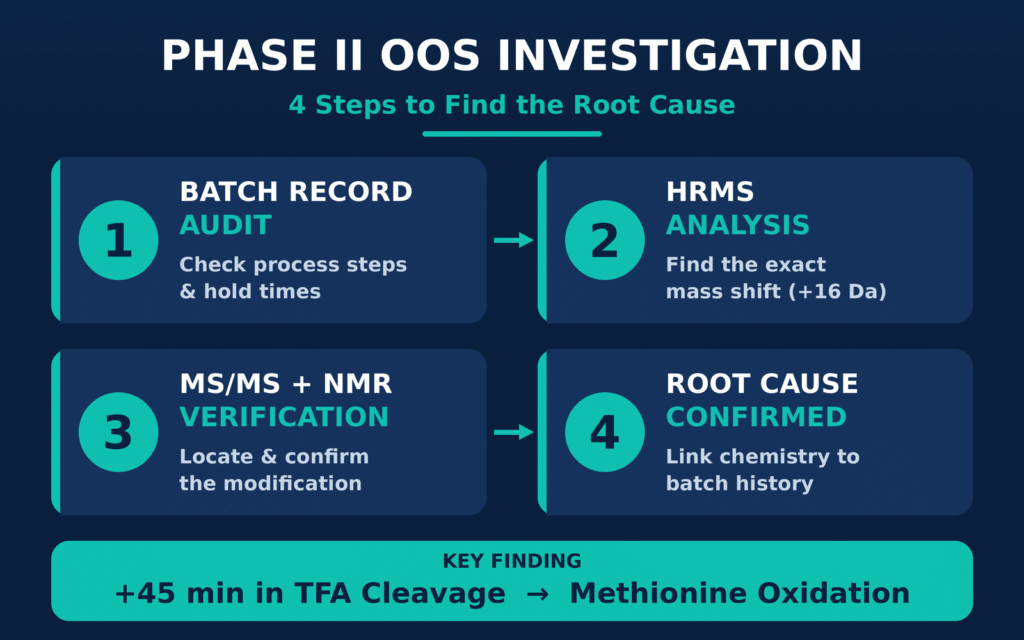
The Phase II investigation followed a structured root-cause assessment that combined manufacturing record evaluation with advanced structural characterization:
- Batch Record and Process Audit: Quality assurance and manufacturing personnel reviewed Critical Process Parameters (CPPs), including coupling cycle durations, temperature profiles during Fmoc-deprotection, reagent lot certificates, and cleavage vessel transfer documentation.
- Advanced Mass Spectrometry Characterization: High-Resolution Mass Spectrometry (HRMS) was used to establish the precise mass shift associated with the unknown impurity, while tandem MS/MS analysis was applied to localize the chemical modification within the peptide backbone.
- Orthogonal Spectroscopic Verification: Nuclear Magnetic Resonance (NMR) spectroscopy was employed to confirm the functional group identity and stereochemical characteristics of the modification and to distinguish it from potentially isobaric structural changes.
- Assignable Cause Confirmation: Findings obtained from the synthesis records and analytical characterization were correlated with documented batch hold times to establish the chemical mechanism responsible for formation of the impurity.
Review Peptide Analytical Testing Services for analytical characterization capabilities.
The review of the batch manufacturing records identified an unexpected delay during the final trifluoroacetic acid (TFA) resin cleavage and global deprotection stage. Because of a mechanical issue involving filter transfer, the crude peptide slurry remained in the cleavage cocktail for an additional 45 minutes at ambient temperature.
To determine how this extended exposure resulted in the 0.42% impurity, advanced hyphenated mass spectrometry techniques were applied:
- Ultra-High Performance Liquid Chromatography-High Resolution Mass Spectrometry (UHPLC-HRMS): Electrospray ionization mass spectrometry (ESI-HRMS) established an accurate monoisotopic mass shift of +15.9949 Da for the impurity observed at RRT 1.12 relative to the target peptide backbone. This mass difference was consistent with the incorporation of a single oxygen atom, represented as CnHmNxOy+1Sz.
- Tandem Mass Spectrometry (LC-MS/MS): Collision-Induced Dissociation (CID) MS/MS fragmentation was used to determine the location of the +16 Da modification. Evaluation of the b- and y-ion series specifically localized the oxidation to a central Methionine (Met) residue.
- Nuclear Magnetic Resonance (NMR) & Orthogonal Analysis: 1D 1H and 2D 1H-13C HSQC NMR spectroscopy confirmed that the methionine thioether sidechain had been converted to a methionine sulfoxide (-S(=O)-) functional group. This orthogonal characterization helped exclude alternative isobaric modifications, including hydroxyproline formation and aromatic hydroxylation.
| Threshold Type | ICH Q3A(R2) Guideline Limit | Observed Case Value | Regulatory Status |
|---|---|---|---|
| Reporting Threshold | 0.05% | 0.42% | Reporting Required |
| Identification Threshold | 0.10% | 0.42% | Structural Identification Mandatory (Met-O Confirmed) |
| Qualification Threshold | 0.15% | 0.42% | Exceeds Threshold; Qualification or Removal Required |
According to ICH Q3A(R2) guidelines concerning organic impurities in drug substances, impurities exceeding the 0.10% identification threshold require unambiguous structural elucidation, whereas impurities above the 0.15% qualification threshold require appropriate toxicological evaluation or operational containment. The cross-functional investigation established the definitive root cause as extended exposure to the TFA cleavage cocktail in the absence of sufficient free-radical scavengers, such as ethanedithiol or triisopropylsilane. This condition permitted atmospheric oxygen to oxidize the labile methionine residue, resulting in the formation of the methionine sulfoxide peptide.
See Impurity Control Strategies Under ICH Q3A for additional information on impurity identification and control considerations.
Scientific Strategy for Rescuing a Delayed Peptide Batch
Rescuing a delayed peptide batch requires the establishment of a scientifically supported assignable root cause, confirmation that the identified impurity does not compromise product safety, and implementation of an appropriate regulatory-compliant purification or reprocessing strategy. Under ICH Q7 Section 14, API manufacturers may subject an out-of-specification lot to validated reprocessing or preparative purification operations when these activities can recover material that subsequently satisfies all established final release requirements.
A clear regulatory distinction must be maintained between reprocessing and reworking an API batch:
| Strategy | Regulatory Definition | Process Integration | Approval Requirement |
|---|---|---|---|
| Reprocessing | Introducing an API or intermediate back into the standard, validated manufacturing process at a predefined processing stage, such as repeating a preparative RP-HPLC step | Integrates with existing manufacturing operations and uses documented unit operations, including secondary chromatography or re-lyophilization | Permissible under internal Quality Management Systems (QMS), subject to appropriate post-execution comparability testing |
| Reworking | Subjecting an API or intermediate to one or more processing operations that differ from the established and validated manufacturing route | May introduce novel chemical steps, unvalidated reagents, or separation principles that are not included in the established process | May require prior regulatory agency approval, filing supplements, and extensive stability validation |
Explore GMP Peptide API Manufacturing Services for GMP-focused peptide API manufacturing support.
To recover the oxidized peptide batch without initiating a complex reworking filing, a reprocessing protocol was developed using the existing preparative RP-HPLC system. Analytical characterization demonstrated that the target peptide and its methionine sulfoxide derivative co-eluted under the standard gradient conditions consisting of water/acetonitrile with 0.1% TFA. However, modification of the mobile phase selectivity provided sufficient chromatographic separation to resolve the two species.
The preparative RP-HPLC reprocessing procedure incorporated two primary process optimizations:
- Mobile Phase Modifier Selection: The standard 0.1% TFA condition at pH 2.1 was replaced with 10 mM ammonium acetate at pH 6.5. This adjustment altered the ionization state of adjacent acidic residues and increased the resolution (Rs) between the native peptide and the methionine sulfoxide derivative from 0.8 to 2.3.
- Stationary Phase Selection: The conventional C18 silica matrix was replaced with a phenyl-hexyl stationary phase. This change enhanced π-π interactions and exploited localized differences in electron density associated with the oxidized sulfur atom.
- Fractionation and Lyophilization: Chromatographic fractions meeting the required purity criteria were collected and pooled. The methionine sulfoxide derivative was reduced to below 0.05%, after which the purified material underwent standard lyophilization cycles.
Reprocessing the crude peptide through the optimized preparative chromatography system reduced the methionine sulfoxide impurity from 0.42% to below the 0.05% reporting threshold. The purified fractions were subsequently pooled, concentrated, and lyophilized according to the registered batch manufacturing procedure. This process successfully recovered the 1.2 kg delayed peptide lot.
Corrective and Preventive Actions (CAPA) and Regulatory Release Logic
A scientifically defensible Corrective and Preventive Action (CAPA) program must address the identified root cause in both the affected batch and future manufacturing operations to maintain regulatory compliance and support continuous process verification. Quality Assurance authorizes batch release only after the applicable CAPA milestones have been completed and comprehensive re-testing confirms compliance with all validated specifications.
The implemented CAPA framework addressed three primary operational areas:
- Engineering and Process Controls: The cleavage reaction vessel transfer procedure was modified through the installation of redundant pneumatic transfer lines. This control was designed to ensure that exposure of the peptide to the cleavage cocktail remained strictly within 120 ± 10 minutes.
- Raw Material and Formulation Specifications: The scavenger cocktail composition was revised from 95% TFA / 2.5% H2O / 2.5% TIS to 90% TFA / 2.5% H2O / 2.5% TIS / 5.0% EDT (ethanedithiol). The revised formulation provided additional free-thiol capacity to quench dissolved oxygen and provide greater protection for labile methionine residues.
- Analytical Control Strategy: The analytical release strategy was updated to include the pH-adjusted phenyl-hexyl HPLC assay as an orthogonal stability-indicating method. This additional analytical control enabled more sensitive detection of trace oxidation during routine quality control testing.
Learn about Nitrosamine Risk Assessment for Peptide APIs to support risk-based impurity assessment strategies.
Before batch release, Quality Assurance performed a comprehensive disposition audit. The reprocessed peptide API underwent complete release testing against all applicable specification criteria:
| Test Parameter | Specification Limit | Initial OOS Result | Reprocessed Batch Result | Disposition Compliance |
|---|---|---|---|---|
| Chromatographic Purity (RP-HPLC) | ≥ 98.0% | 97.12% | 99.35% | Compliant |
| Individual Unknown Impurity | ≤ 0.10% | 0.42% (Met-O) | < 0.03% | Compliant |
| Mass Identification (ESI-MS) | Matches Reference (± 0.5 Da) | 1822.8 Da (Target) | 1822.8 Da (Conforms) | Compliant |
| Bacterial Endotoxins (USP) | < 10 EU/mg | 1.2 EU/mg | 1.4 EU/mg | Compliant |
| Residual TFA Content | ≤ 1.0% | 0.6% | 0.4% | Compliant |
Because all analytical parameters met the validated specification requirements, and the OOS investigation established that the failure was specifically associated with the documented cleavage delay, Quality Assurance formally released the batch for clinical supply.
Explore Sterile Fill-Finish Services for Peptide Injectables for support with sterile peptide injectable manufacturing.
Strategic Value of Advanced Mass Spectrometry in Rescuing API Batches
The use of advanced high-resolution mass spectrometry together with orthogonal structural characterization can accelerate root-cause identification and help prevent unnecessary rejection of valuable pharmaceutical batches. Contract testing laboratories with specialized mass spectrometry capabilities can provide the advanced instrumentation, structural characterization expertise, and regulatory documentation required to investigate complex degradation and impurity-related challenges that may exceed the capabilities of conventional quality control laboratories.
Review Peptide Stability Testing Services for analytical support in evaluating peptide stability and degradation behavior.
By combining high-field Orbitrap or time-of-flight (Q-TOF) mass spectrometry with tandem MS/MS fragment mapping, analytical specialists can rapidly distinguish between structurally related or isobaric peptide modifications, including aspartic acid iso-aspartate rearrangements, deamidation pathways, and different oxidation states. Precise molecular characterization can support scientifically justified batch disposition, reduce unnecessary material losses, shorten investigation timelines, and generate analytical data packages suitable for regulatory review.
Learn more about Extractables and Leachables Testing for Peptide Injectables for product-contact material assessment.
When delayed peptide manufacturing schedules are associated with unassigned analytical peaks, access to advanced analytical testing facilities can support compliant and efficient batch investigations and recovery strategies.
Conclusion: Best Practices in Resolving an Out-of-Specification Impurity Result
Successfully Resolving an Out-of-Specification Impurity Result during therapeutic peptide manufacturing requires an integrated approach that combines rigorous regulatory compliance, structured laboratory investigation, comprehensive manufacturing review, and high-resolution structural characterization. Applying these principles allows manufacturers to determine whether an affected API batch can be scientifically and compliantly recovered or whether rejection is warranted based on documented evidence.
Explore Technology Transfer to GMP CDMO for support with transferring peptide manufacturing processes into GMP environments.
As demonstrated in this case study, determining the precise molecular modification, such as methionine oxidation associated with extended cleavage exposure, provides the scientific basis for developing an appropriate reprocessing strategy under ICH Q7. Optimized preparative chromatography can selectively remove the identified impurity while maintaining the identity, quality, yield, and intended characteristics of the peptide product.
Explore North American Peptide CDMO Services for integrated peptide development and manufacturing support.
Ultimately, robust CAPA systems combined with specialized high-resolution mass spectrometry capabilities can strengthen impurity investigations, support scientifically justified batch disposition, and reduce avoidable disruptions to pharmaceutical manufacturing operations. A systematic approach to OOS investigations also helps maintain regulatory compliance, protect pharmaceutical supply continuity, and optimize development and manufacturing timelines.
To consult with analytical chemists regarding peptide characterization, impurity identification, or OOS investigation support, visit the ResolveMass Laboratories Contact Page.
Frequently Asked Questions
An OOS result occurs when a test value exceeds an established numerical specification and therefore fails the approved acceptance criterion. An Out-of-Trend (OOT) result remains within specification but shows an unexpected deviation from historical batch or stability trends. An atypical or aberrant result is an unusual analytical observation that may require investigation even when no formal specification has been exceeded.
A Phase I OOS investigation should begin promptly after an OOS result is obtained and should preserve the original samples, preparations, and analytical records. The laboratory review generally covers raw data, system suitability, instrument calibration, calculations, volumetric operations, and reagent condition. The original result should only be invalidated when a specific and well-documented laboratory error is demonstrated.
Liquid Chromatography coupled with High-Resolution Mass Spectrometry (LC-HRMS), including Q-TOF and Orbitrap ESI-MS, can establish accurate mass and support elemental composition assessment. Tandem Mass Spectrometry (LC-MS/MS) using Collision-Induced Dissociation (CID) or Electron-Transfer Dissociation (ETD) can localize modifications through peptide fragment ions. NMR spectroscopy and Amino Acid Analysis (AAA) can provide complementary structural information.
ICH Q3A(R2) describes reporting, identification, and qualification thresholds according to the maximum daily dose of the drug substance. The reporting threshold determines when an impurity must be included in batch reporting, while the identification threshold indicates when structural characterization is expected. The qualification threshold addresses impurities requiring toxicological assessment or an appropriate safety justification.
Retesting may be performed when scientifically justified and when the investigation includes a predefined, documented testing approach. During a Phase II investigation, additional testing should follow an approved protocol that establishes the number and nature of replicates before testing begins. Resampling is generally limited to situations where documented evidence shows that the original sample was compromised, incorrectly collected, or not representative of the batch.
Reprocessing involves returning an API or intermediate to an established and validated manufacturing step, such as repeating a qualified preparative RP-HPLC operation. Reworking involves processing through a route or operation that differs from the approved manufacturing process and may introduce new or non-validated steps. Depending on the circumstances, reworking can require regulatory assessment, submission, and additional stability or comparability data.
Common process-related impurities in Solid-Phase Peptide Synthesis (SPPS) can result from incomplete amino acid coupling, incomplete Fmoc-deprotection, and amino acid racemization during activation. Extended TFA cleavage exposure can contribute to oxidation of susceptible residues such as methionine and cysteine or promote tryptophan alkylation. Side reactions, including aspartimide formation, can also generate structurally related impurities.
When a valid OOS result remains unexplained after an appropriate Phase I and Phase II investigation, the original result continues to represent valid product data. A batch generally cannot be released against a specification when a confirmed release result remains outside the approved acceptance criteria. Passing retest results should not be averaged with the original failure simply to obtain a passing value.
High-resolution mass spectrometry (HRMS) provides highly accurate mass measurements that help determine the elemental composition and nature of a chemical modification. Tandem MS/MS generates characteristic peptide fragment ions that can identify where the modification occurs within the sequence. Together, these techniques provide detailed structural evidence that can support root-cause determination and OOS investigation closure.
Reference:
- Bhutnar, A., Khapare, S., Desai, A., & Dsouza, S. (2017). Isolation and characterization of photodegradation impurity in budesonide drug product using LC-MS and NMR spectroscopy. American Journal of Analytical Chemistry, 8(7), 449–461. https://doi.org/10.4236/ajac.2017.87034
- International Council for Harmonisation of Technical Requirements for Pharmaceuticals for Human Use. (2006). ICH harmonised tripartite guideline: Impurities in new drug substances Q3A(R2). ICH Q3A(R2) Guideline PDF
- U.S. Food and Drug Administration. (2006). Guidance for industry: Investigating out-of-specification (OOS) test results for pharmaceutical production. Center for Drug Evaluation and Research. FDA guidance PDF
- U.S. Food and Drug Administration. (2015). Analytical procedures and methods validation for drugs and biologics: Guidance for industry. Center for Drug Evaluation and Research & Center for Biologics Evaluation and Research. FDA guidance document
- U.S. Food and Drug Administration. (2015). Analytical procedures and methods validation for drugs and biologics: Guidance for industry. U.S. Department of Health and Human Services. FDA guidance PDF
Get In Touch With Us
About The Author


