

Introduction
Developing and implementing a scientifically optimized Reversed-Phase HPLC Method Development strategy is a fundamental analytical requirement for accurately determining peptide purity, identifying related impurities, and establishing comprehensive impurity profiles for regulatory submissions. This analytical approach is particularly important because therapeutic peptides are structurally complex and heterogeneous biomolecules that are highly vulnerable to chemical degradation, amino acid deletions, oxidation, deamidation, and isomerization throughout synthesis, purification, and storage. Reliable characterization of these molecules demands highly selective chromatographic separation conditions capable of satisfying the analytical expectations established by the United States Food and Drug Administration (FDA) and Health Canada.
As a specialized contract research organization (CRO) dedicated to regulatory-grade peptide analytical characterization, ResolveMass Laboratories Inc. develops advanced Reversed-Phase HPLC Method Development workflows that produce scientifically robust and regulatory-compliant analytical datasets. These comprehensive characterization studies support peptide identity confirmation, impurity profiling, manufacturing batch comparability assessments, and control strategy justification for Chemistry, Manufacturing, and Controls (CMC) regulatory submissions. Rather than relying solely on conventional quality control testing, this systematic methodology evaluates the underlying physicochemical interactions between peptide molecules, stationary phase chemistries, mobile phase modifiers, and chromatographic system hardware to achieve highly reliable analytical performance.
For a deeper look into our dedicated contract research capabilities, explore our specialized CRO for GLP-1 peptide characterization services.
Share via:
Article Summary:
- Reversed-phase HPLC is essential for peptide characterization, enabling accurate determination of peptide purity, identification of process- and degradation-related impurities, and generation of regulatory-compliant impurity profiles for therapeutic peptides.
- Careful selection of the stationary phase improves separation performance. C18 columns are generally preferred for small peptides, while C8, C4, and phenyl/biphenyl chemistries provide better recovery and selectivity for larger, highly hydrophobic, or stereochemically complex peptides.
- Mobile phase optimization directly affects chromatographic quality and MS compatibility. Trifluoroacetic acid (TFA) delivers superior peak shape for UV detection, whereas difluoroacetic acid (DFA) and formic acid offer improved compatibility with LC-MS workflows by reducing ion suppression.
- Advanced surface technologies minimize peptide loss. Hybrid surface treatments such as MaxPeak HPS reduce non-specific adsorption to metal components, resulting in improved analyte recovery, better peak reproducibility, and more consistent analytical performance.
- Analytical Quality by Design (AQbD) strengthens method robustness. By defining critical method parameters and optimizing them through statistical experimental design, laboratories can establish reliable operating conditions that consistently meet regulatory validation requirements.
- Resolving structurally similar peptide impurities requires advanced chromatographic strategies. Techniques including shallow gradient elution, elevated column temperatures, alternative organic modifiers, and orthogonal HILIC separations significantly improve the resolution of epimers, diastereomers, deletion products, and other sequence-related impurities.
- Comprehensive impurity profiling is critical for regulatory approval. Generic peptide submissions must demonstrate detailed impurity characterization, structural identification, and scientific justification for impurities exceeding regulatory reporting thresholds, supported by high-resolution analytical techniques such as LC-MS/MS.
Column Stationary Phase Chemistries for Reversed-Phase HPLC Method Development
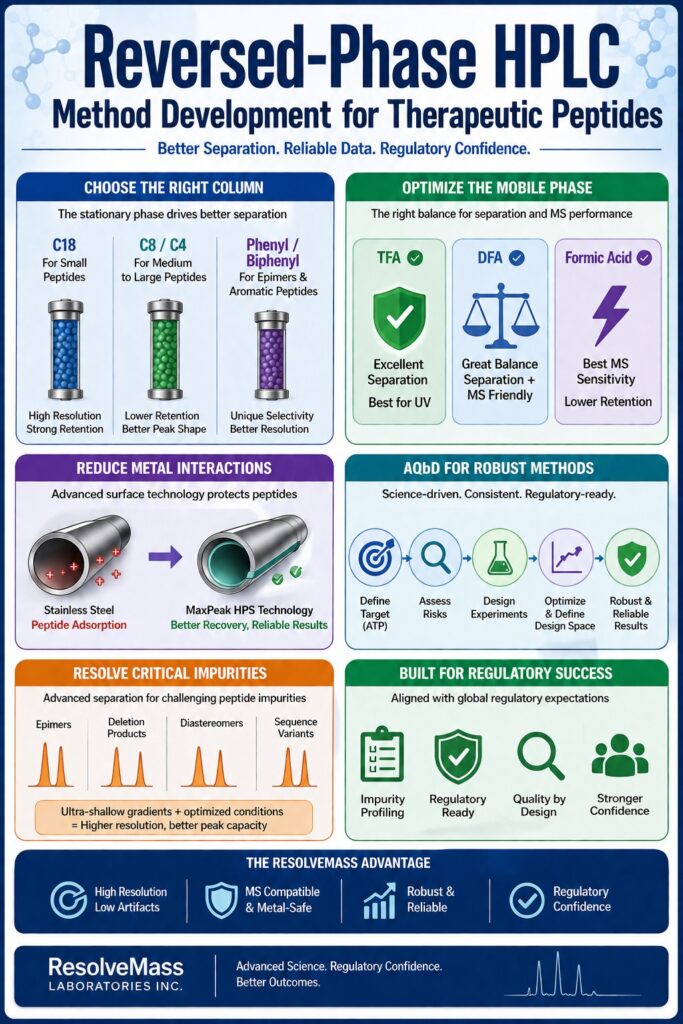
Selecting the most appropriate stationary phase is one of the most critical decisions during Reversed-Phase HPLC Method Development. The optimal column chemistry is determined by carefully aligning the peptide’s molecular weight, hydrophobicity, amino acid sequence, and chain length with the appropriate bonded ligand chemistry and pore size. Although C18 columns with approximately 120 Å pore diameters are generally considered the preferred starting point for conventional peptide separations, highly hydrophobic or larger peptide sequences frequently require C8, C4, or aromatic stationary phases with 300 Å pore sizes to minimize irreversible adsorption while improving mass transfer efficiency.
The separation mechanism of reversed-phase high-performance liquid chromatography (RP-HPLC) is primarily governed by hydrophobic interactions between peptide side chains and the alkyl ligands chemically bonded to silica particles. For relatively small peptides consisting of approximately 2 to 15 amino acid residues (molecular weight < 2,000 Da), octadecylsilane (C18) stationary phases packed with 100 Å to 120 Å pore particles provide exceptional surface area and strong hydrophobic retention. These characteristics enable high-resolution separation of structurally similar impurities, including deletion sequences and closely related synthetic by-products. Conversely, larger or highly hydrophobic polypeptides containing more than 30 amino acid residues often experience excessive retention, broadened chromatographic peaks, or reduced analyte recovery when analyzed using conventional C18 phases. Under these circumstances, octylsilane (C8) or butylsilane (C4) stationary phases, such as Inertsil WP300 C8 or Cogent RP C4, are preferred because they reduce hydrophobic interaction strength and promote more efficient elution under gentler chromatographic conditions.
Separating complex diastereomeric peptide mixtures often exceeds the selectivity achievable with conventional alkyl-bonded stationary phases, making alternative ligand chemistries essential during method development. Stationary phases incorporating polar-embedded functionalities, phenyl-hexyl ligands, or biphenyl chemistries, including InertCore Biphenyl and Zorbax 300-Diphenyl, provide additional selectivity through dipole-dipole and π-π interactions. These complementary interaction mechanisms are particularly valuable because they recognize subtle conformational changes introduced by D-amino acid substitutions, which modify the three-dimensional orientation of hydrophobic peptide side chains and improve the chromatographic resolution of epimers and diastereomers.
Discover how advanced high-resolution techniques elucidate spatial structures in our guide to using 2D NMR for peptide characterization.
| Stationary Phase Ligand | Pore Size | Particle Morphology | Primary Target Analytes | Separation Advantage |
|---|---|---|---|---|
| Octadecylsilane (C18) | 100–120 Å | Superficially Porous (SPP) | Small peptides (2–15 residues, <2,000 Da) | High surface area provides maximum resolution for short peptide sequences and deletion impurities. |
| Octylsilane (C8) | 120–300 Å | Fully Porous (FPP) | Medium peptides (15–30 residues, 2,000–4,000 Da) | Lower hydrophobic retention improves peak symmetry for basic peptide sequences. |
| Butylsilane (C4) | 300 Å | Fully Porous (FPP) | Large peptides/proteins (>30 residues, >4,000 Da) | Reduced hydrophobic retention minimizes denaturation while preventing column fouling. |
| Phenyl-Hexyl / Biphenyl | 120–300 Å | Superficially Porous (SPP) | Epimers, diastereomers, and aromatic-rich peptides | Unique π-π selectivity enhances the separation of chiral conformational variants. |
Optimizing Mobile Phase pH and Ion-Pairing Agents in Reversed-Phase HPLC Method Development
Optimizing mobile phase composition during Reversed-Phase HPLC Method Development requires carefully balancing chromatographic resolution, peak symmetry, and mass spectrometric sensitivity through the selection of appropriate acidic modifiers. Although trifluoroacetic acid (TFA) delivers outstanding chromatographic performance by effectively masking residual silanol activity and improving peak shape for UV detection, alternative modifiers such as difluoroacetic acid (DFA) and formic acid (FA) are frequently selected when compatibility with electrospray ionization mass spectrometry (ESI-MS) is required to minimize ion suppression.
Within acidic mobile phases, basic amino acid residues including lysine, arginine, and histidine become protonated and carry positive charges. The negatively charged counterions supplied by the acidic mobile phase modifier temporarily associate with these protonated sites, forming neutral ion pairs that increase the peptide’s effective hydrophobicity and promote stronger retention on the nonpolar stationary phase. At the same time, lowering the mobile phase pH to approximately 2 suppresses the ionization of residual silanol groups present on the silica surface, thereby reducing undesirable secondary ionic interactions that commonly produce peak tailing and poor chromatographic efficiency.
For ultraviolet (UV) detection, trifluoroacetic acid (TFA) remains the preferred modifier at concentrations ranging from 0.05% to 0.1% (v/v) because its strong acidity (pKa = 0.43) effectively protonates residual silanol groups and consistently produces highly symmetrical chromatographic peaks. However, during electrospray ionization mass spectrometry (ESI-MS), the stable ion pairs generated by TFA frequently persist into the gas phase, resulting in substantial suppression of analyte ionization and reduced mass spectrometric sensitivity. In contrast, formic acid (pKa = 3.75) significantly improves ionization efficiency by eliminating this suppression effect, although its relatively weak ion-pairing capability often leads to broader peaks, reduced chromatographic resolution, and increased peak tailing for basic peptide analytes.
To balance chromatographic performance with mass spectrometric sensitivity, difluoroacetic acid (DFA, pKa = 1.34) has become an effective alternative. DFA provides sufficient acidity to achieve high-resolution separation of closely eluting peptide impurities while simultaneously improving ionization efficiency during ESI-MS analysis.
Another effective strategy involves the use of specialized stationary phases incorporating Charged Surface Hybrid (CSH) technology, such as XSelect Peptide CSH C18 columns. These stationary phases possess a carefully controlled density of positive surface charges that gently repel protonated peptide molecules, reducing secondary interactions with residual silanol groups. Consequently, researchers can obtain exceptional peak symmetry, increased peak capacity, and improved chromatographic reproducibility while using MS-compatible formic acid mobile phases without relying on strong ion-pairing reagents.
Learn how we implement robust validation methodologies for these systems by reading about GLP-1 peptide stability analytical methods.
| Acidic Modifier | pKa | UV Separation Efficiency | ESI-MS Sensitivity | Key Chromatographic Limitation | Primary Application |
|---|---|---|---|---|---|
| Trifluoroacetic Acid (TFA) | 0.43 | Outstanding | Poor (high ion suppression) | System contamination and persistent background ions. | Pure LC-UV assays and routine batch purity profiling. |
| Difluoroacetic Acid (DFA) | 1.34 | Very Good | Good | Minor ESI-MS suppression relative to formic acid. | Combined LC-UV/MS workflows and peptide mapping studies. |
| Formic Acid (FA) | 3.75 | Fair-to-Poor | Outstanding | Significant peak tailing of basic residues on conventional silica columns. | High-sensitivity proteomics and LC-MS/MS peptide characterization. |
Mitigating Non-Specific Metal Adsorption in Peptide Purifications
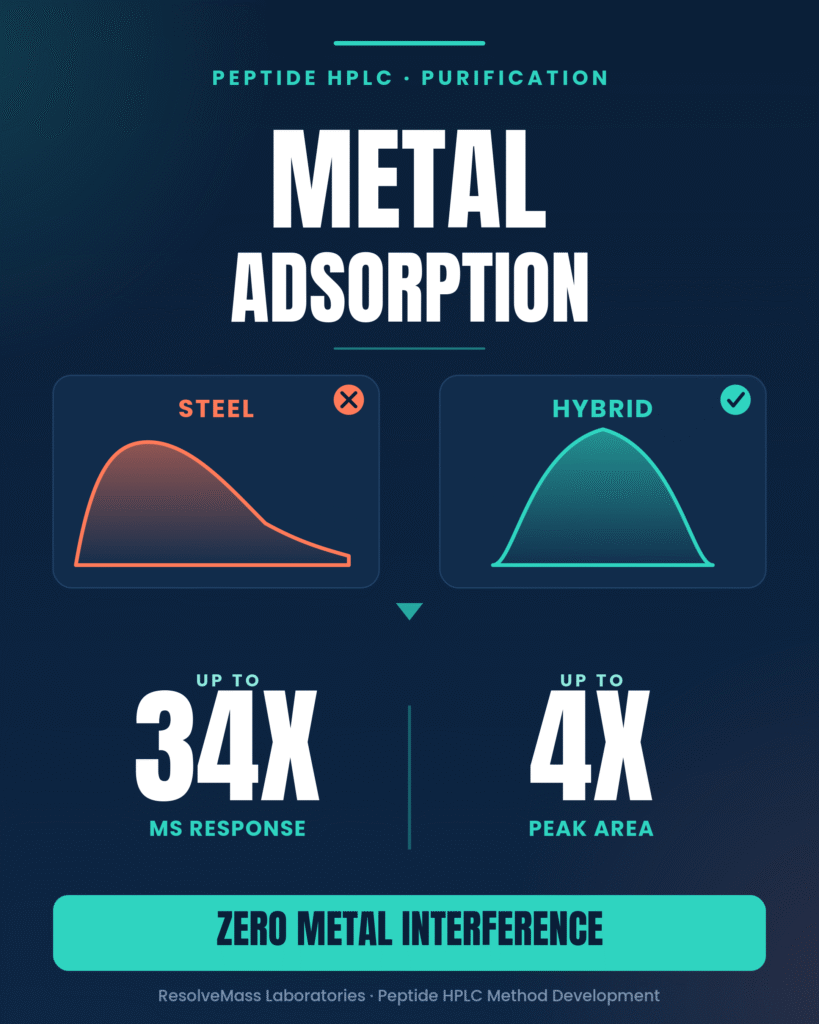
Non-specific adsorption of acidic and phosphorylated peptides to conventional stainless-steel HPLC flow paths can significantly compromise chromatographic performance and analytical recovery. This challenge can be effectively minimized by utilizing chromatographic systems and columns engineered with hybrid organic-inorganic surface barrier technologies. Advanced surface treatments, such as MaxPeak High Performance Surfaces (HPS), prevent interactions between electron-rich peptide functional groups and electron-deficient metal oxide surfaces. As a result, these technologies substantially improve analyte recovery while eliminating the need for extensive column conditioning procedures.
Metal-mediated adsorption primarily occurs through Lewis acid-base interactions. Stainless-steel components, including column walls, frits, and capillary tubing, are naturally coated with a thin oxide layer containing transition metal ions. These metal oxides function as electron-deficient Lewis acids that readily interact with electron-rich functional groups present on peptide molecules. Peptides containing multiple carboxylate groups, such as the acidic T51 peptide enriched with consecutive glutamic acid and aspartic acid residues, or phosphorylated peptides such as the T19p phosphopeptide, behave as strong Lewis bases. Their strong affinity for metal oxide surfaces results in pronounced peak tailing, progressive analyte loss, and substantial injection-to-injection variability.
Historically, chromatographers attempted to overcome this issue by replacing stainless-steel components with titanium or polyether ether ketone (PEEK) hardware. Although PEEK effectively minimizes metal interactions, it possesses several practical limitations. The material lacks the mechanical durability required for ultra-high-pressure applications (≥ 5,000 psi), exhibits greater variability in internal tubing diameters that can alter chromatographic retention times, and demonstrates limited chemical compatibility with important organic solvents such as tetrahydrofuran (THF) and dimethyl sulfoxide (DMSO).
Modern hybrid organic-inorganic surface technologies provide a far more robust solution. Barrier layers based on ethylene-bridged siloxane chemistry, such as those incorporated into Waters ACQUITY Premier systems equipped with MaxPeak HPS, create a chemically stable and highly inert protective surface throughout the chromatographic flow path. Studies evaluating these advanced surface technologies have demonstrated a 10-fold to 34-fold improvement in mass spectrometric response together with a 2-fold to 4-fold increase in chromatographic peak area for metal-sensitive peptides during the initial injection compared with conventional stainless-steel systems. These improvements effectively eliminate the need for lengthy column pre-conditioning while significantly enhancing analytical reproducibility.
For complex therapeutic molecules, managing impurities is critical; learn more about our approach to GLP-1 peptide impurity characterization and control.
Analytical Quality By Design (AQbD) Frameworks for Chromatographic Robustness
Implementing Analytical Quality by Design (AQbD) principles during peptide HPLC method development establishes a scientifically justified Method Operable Design Region (MODR) that ensures consistent analytical performance and stability-indicating capability throughout the product lifecycle. By integrating systematic risk assessments with statistically designed multi-factor optimization studies, AQbD enables a comprehensive understanding of how mobile phase composition, pH, column temperature, flow rate, and other analytical variables collectively influence critical method performance.
Unlike the traditional one-factor-at-a-time (OFAT) optimization strategy, which is time-consuming and incapable of identifying interactions among multiple variables, the AQbD methodology begins by defining an Analytical Target Profile (ATP). The ATP specifies the intended analytical performance requirements, including acceptable limits for detection (LOD), quantitation (LOQ), and chromatographic resolution of critical impurity pairs. Following ATP definition, structured risk assessment tools such as Ishikawa (fishbone) diagrams and Failure Mode and Effects Analysis (FMEA) are employed to identify and prioritize Critical Method Parameters (CMPs) based on their impact on Critical Quality Attributes (CQAs).
For stability-indicating RP-HPLC methods developed for therapeutic peptides, commonly evaluated CMPs include gradient slope, column oven temperature (40°C to 70°C), mobile phase pH, and buffer concentration. Statistical experimental designs such as Central Composite Design (CCD) and Box-Behnken response surface methodology are subsequently applied to evaluate these variables simultaneously while monitoring CQAs including chromatographic resolution (Rs), peak tailing factor (Tf), and theoretical plate number (N). During the development of stability-indicating methods for Leuprolide acetate depot formulations, for example, AQbD optimization identified an analytical design space utilizing 10 mM phosphate buffer at pH 3.0 together with a mixed organic mobile phase consisting of acetonitrile and n-propyl alcohol. Establishing this validated design space ensures that routine analytical operation within the MODR consistently produces high-resolution separations while satisfying the validation expectations outlined in ICH Q2(R2).
To understand how these analytical strategies apply to specific drug targets, review our comprehensive peptide characterization of Lanreotide generic project case study.
Resolving Epimers, Diastereomers, and Sequence-Related Peptide Impurities
Successful separation of structurally similar peptide impurities—including epimers, diastereomers, truncation products, and sequence deletion variants—requires maximizing chromatographic peak capacity through carefully optimized gradient profiles and complementary separation techniques. Because many of these impurities possess identical molecular weights or exhibit hydrophobic characteristics nearly indistinguishable from the parent peptide, conventional reversed-phase separations are frequently supplemented with elevated temperatures, chiral stationary phases, or orthogonal zwitterionic hydrophilic interaction liquid chromatography (HILIC) methods.
During solid-phase peptide synthesis (SPPS), sequence-related impurities such as deletion products, truncated peptides, epimerized amino acids, and deamidated species are unavoidable by-products. Deletion sequences often differ from the target peptide by only a single hydrophobic amino acid residue, causing them to partially co-elute with the principal active pharmaceutical ingredient (API). Diastereomeric impurities generated through D-amino acid substitution, such as peptides containing D-alanine residues, possess identical molecular masses but adopt altered three-dimensional conformations. Consequently, these stereochemical variants interact differently with conventional C18 stationary phases and frequently elute earlier than their all-L counterparts because of modified hydrophobic interaction kinetics.
Several advanced chromatographic strategies are routinely implemented to improve separation of these challenging impurity pairs:
- Ultra-Shallow Gradient Elution: Reducing the organic solvent gradient to approximately 0.5%–1.0% B per minute around the analyte elution window significantly increases chromatographic peak capacity and improves resolution of closely eluting impurities.
- Alternative Organic Modifiers: Partial or complete replacement of acetonitrile with alcohol-based organic solvents such as isopropanol or n-propanol modifies analyte selectivity, changes elution order, and enhances solubility for highly hydrophobic peptide molecules.
- Elevated Column Temperatures: Performing chromatographic separations at 60°C to 70°C lowers mobile phase viscosity, increases analyte diffusion, and sharpens chromatographic peaks by accelerating slow conformational transitions, including cis/trans isomerization of proline-containing peptides.
- Zwitterionic HILIC Orthogonality: Employing zwitterionic stationary phases such as BEH Z-HILIC incorporating sulfoalkylbetaine functionality under acidic conditions (approximately pH 3) introduces an orthogonal polar partition mechanism that effectively separates hydrophilic and highly charged peptide impurities that may co-elute under conventional reversed-phase conditions.
- Centrifugal Partition Chromatography (CPC): CPC utilizes a liquid-liquid partition mechanism without a solid stationary support, eliminating irreversible adsorption while providing high-resolution purification and excellent recovery of stereoisomeric peptide intermediates and complex diastereomeric mixtures.
For projects involving structural confirmation of therapeutic agents, read about our specialized peptide sequencing of GLP-1 peptide workflows.
Regulatory Alignment and Impurity Control Strategies in Generic Peptide ANDAs
Achieving regulatory compliance for generic synthetic peptide products requires detailed comparative impurity characterization against the corresponding recombinant Reference Listed Drug (RLD), including identification and evaluation of impurities present at or above the 0.10% reporting threshold. Regulatory agencies, including the FDA and Health Canada, expect comprehensive impurity profiling within the Chemistry, Manufacturing, and Controls (CMC) package. Any specified or unspecified impurity exceeding established reporting thresholds must be structurally characterized and scientifically assessed for its potential immunogenicity.
For Abbreviated New Drug Applications (ANDAs) referencing recombinant peptide products such as glucagon, liraglutide, nesiritide, teriparatide, and teduglutide, demonstrating active pharmaceutical ingredient sameness requires extensive comparative analytical characterization. Because synthetic manufacturing processes generate impurity profiles that differ from those arising during recombinant cell-culture production, regulatory authorities require rigorous reporting, identification, qualification, and justification of peptide-related impurities.
Find out more about fulfilling compliance expectations in our overview of regulatory requirements for GLP-1 peptide characterization.
| Regulatory Guideline | Reporting Threshold | Identification Threshold | Qualification Threshold | Unspecified Impurity Specification |
|---|---|---|---|---|
| FDA Generic Peptide Guidance | ≥ 0.10% | ≥ 0.10% | ≥ 0.10% | ≤ 0.5% (unless qualified) |
| Ph. Eur. Monograph 2034 | > 0.1% | > 0.5% | > 1.0% | General compendial limits |
When a generic peptide product contains a novel peptide-related impurity between 0.10% and 0.50% that is absent from the reference listed drug, regulatory submissions must include a robust scientific justification supporting its safety. This assessment generally incorporates in silico Major Histocompatibility Complex (MHC) class II binding prediction models together with in vitro T-cell activation assays to demonstrate that the newly identified impurity does not elevate the risk of adaptive or innate immune responses.
To support these regulatory expectations, ResolveMass Laboratories Inc. operates an integrated structural characterization platform specifically designed for advanced peptide analysis. The workflow combines Filter-Assisted Sample Preparation (FASP) under reducing conditions using tris(2-carboxyethyl)phosphine (TCEP) at pH 6.5 with ultra-pure enzymatic digestion using reagents such as SOLu-Trypsin, followed by high-resolution LC-MS/MS sequencing. Comprehensive bioinformatics workflows systematically evaluate key post-translational modifications, including fixed cysteine carboxymethylation (+58.005 Da), dynamic oxidation of methionine and tryptophan (+15.995 Da), and deamidation of asparagine and glutamine (+0.984 Da). This integrated analytical approach ensures structural integrity, impurity characterization, and molecular comparability required to support successful regulatory submissions.
Discover our core methodology for establishing pharmaceutical equivalence in our guide to peptide sameness study for ANDA submissions.
Conclusion
Developing a highly selective and scientifically robust Reversed-Phase HPLC Method Development strategy is essential for accurately characterizing the structural complexity and impurity profiles of therapeutic peptides. Successfully addressing these multidimensional analytical challenges requires the integration of optimized stationary phase selection, mobile phase chemistry, ion-pairing strategies, and advanced chromatographic surface technologies to generate scientifically defensible analytical datasets suitable for global regulatory submissions.
Organizations seeking to establish active ingredient sameness for generic peptide products or to support CMC control strategies for Health Canada and the United States Food and Drug Administration (FDA) benefit from partnering with a CRO possessing extensive expertise in regulatory-grade peptide characterization. ResolveMass Laboratories Inc. delivers this specialized capability by combining high-resolution mass spectrometry, circular dichroism, and advanced hybrid-surface liquid chromatography technologies to produce comprehensive, regulator-ready analytical packages. Operating within established cGMP quality systems, the laboratory’s customized analytical workflows achieve complete baseline separation of critical impurity pairs while minimizing artifacts associated with metal adsorption and electrospray ionization mass spectrometry (ESI-MS) ion suppression.
To see how we apply high-resolution platforms to next-generation biologics, explore our workflows for lc-ms characterization of glp-1 peptides.
For comprehensive peptide analytical characterization services or to discuss a customized Reversed-Phase HPLC Method Development project, contact ResolveMass Laboratories Inc. through the ResolveMass Contact Page.
Frequently Asked Questions
Ion-pairing agents improve peptide separation by interacting with charged amino acid residues under acidic chromatographic conditions. Basic residues such as lysine, arginine, and histidine become protonated and form temporary complexes with negatively charged counter-ions from ion-pairing reagents like trifluoroacetate. This interaction reduces peptide charge polarity, increases hydrophobicity, and enhances retention on reversed-phase stationary phases.
Difluoroacetic acid (DFA) offers a favorable compromise between chromatographic performance and mass spectrometry compatibility. Compared with formic acid, DFA provides stronger acidity and improved peak shape for peptide separations, while producing less ion suppression than trifluoroacetic acid (TFA). This makes DFA particularly useful for LC-MS workflows requiring both high-resolution separation and improved analyte detection sensitivity.
Non-specific metal adsorption occurs when acidic or phosphorylated peptides interact with metal oxide surfaces present in conventional stainless-steel HPLC systems. Electron-rich peptide functional groups act as Lewis bases and bind with electron-deficient metal ions, causing peak tailing, reduced signal intensity, inconsistent retention, and analyte loss. These interactions often require extensive column conditioning and can negatively impact analytical reproducibility.
Hybrid organic-inorganic surface technologies, such as MaxPeak High Performance Surfaces (HPS), create a protective barrier between peptide molecules and metallic flow-path components. This minimizes metal-mediated adsorption and improves analyte recovery, especially for metal-sensitive peptides. These advanced surfaces can significantly enhance mass spectrometry response and increase peak area from the initial injection, improving method reliability and reproducibility.
Increasing column temperature improves peptide separation by reducing mobile phase viscosity and enhancing analyte diffusion through the stationary phase. Elevated temperatures, typically between 60°C and 70°C, can improve peak shape and reduce broadening caused by slow conformational changes. This is especially beneficial for resolving impurities associated with structural transitions, such as cis/trans isomerization of proline-containing peptides.
The Method Operable Design Region (MODR) represents a scientifically established operating range where an analytical method consistently delivers acceptable performance. It is developed through Analytical Quality by Design (AQbD) approaches using statistical modeling of critical method parameters, including pH, temperature, flow rate, and gradient conditions. Operation within the MODR ensures that critical quality attributes remain within predefined acceptance criteria throughout the method lifecycle.
For generic synthetic peptide products, FDA expectations require comprehensive evaluation of peptide-related impurities detected at or above the 0.10% reporting threshold. Impurities exceeding this level must be identified and appropriately characterized, while newly observed impurities absent from the Reference Listed Drug (RLD) require scientific justification. Safety assessments must demonstrate that such impurities do not introduce unacceptable risks, including immunogenicity concerns.
The immunogenic potential of a newly identified peptide impurity is assessed using a combination of computational and experimental approaches. In silico MHC class II binding prediction models evaluate potential interactions with human HLA alleles, while in vitro T-cell activation studies provide functional immune response data. These evaluations help demonstrate that the impurity profile of the generic peptide does not present increased immunogenic risk compared with the RLD.
Reference:
- U.S. Food and Drug Administration. (2021). ANDAs for certain highly purified synthetic peptide drug products that refer to listed drugs of recombinant DNA origin: Guidance for industry. U.S. Department of Health and Human Services. https://www.fda.gov/media/166572/download
- Bai, L., Sheeley, S., & Sweedler, J. V. (2009). Analysis of endogenous D-amino acid-containing peptides in metazoa. Bioanalysis Reviews, 1(1), 7–24. https://doi.org/10.1007/s12566-009-0001-2
- Kumar, N., Sangeetha, D., Reddy, S. J., & Kalayanaraman, L. (2022). Implementation of quality by design methodology in development and validation of a new stability-indicating reverse phase high-performance liquid chromatography method for the rapid estimation of Piribedil in Piribedil prolonged release tablets. Indian Journal of Pharmaceutical Sciences, 84(1), 207–218. https://doi.org/10.36468/pharmaceutical-sciences.902
- Knappe, C., Jaag, S. J., Dema, T., Jaufmann, R., Buckenmaier, S., Gross, H., Grond, S., & Lämmerhofer, M. (2025). Multicolumn two-dimensional liquid chromatography screening platform for stereopeptidomics and application to antimicrobial peptide polyene and lipopeptide. Analytical Chemistry, 97(26), 14048–14057. https://doi.org/10.1021/acs.analchem.5c02658
- U.S. Food and Drug Administration. (2021). ANDAs for certain highly purified synthetic peptide drug products that refer to listed drugs of rDNA origin: Guidance for industry. U.S. Department of Health and Human Services, Center for Drug Evaluation and Research. https://www.fda.gov/media/107622/download
- U.S. Food and Drug Administration. (2021). ANDAs for certain highly purified synthetic peptide drug products that refer to listed drugs of recombinant DNA origin: Guidance for industry. U.S. Department of Health and Human Services, Center for Drug Evaluation and Research. https://www.fda.gov/regulatory-information/search-fda-guidance-documents/andas-certain-highly-purified-synthetic-peptide-drug-products-refer-listed-drugs-rdna-origin
Get In Touch With Us
About The Author


