

Introduction
The Scale Up of Peptide Oligonucleotide Conjugates is an essential step in moving nucleic acid therapeutics from laboratory research to clinical and commercial manufacturing. While small-scale synthesis can produce milligram quantities with acceptable purity, increasing production volumes introduces challenges related to yield, impurity control, purification capacity, and process consistency.
At the research stage, synthesis methods are often optimized for speed and flexibility. However, when transitioning to manufacturing, each step must be carefully validated to ensure reproducibility and product stability. Reaction parameters such as temperature, reagent concentration, and mixing behavior can change significantly at larger scales.
Successful Scale Up of Peptide Oligonucleotide Conjugates requires integrating peptide synthesis, oligonucleotide chemistry, and efficient conjugation strategies within scalable manufacturing systems. Understanding these factors helps researchers improve production reliability and support the development of advanced nucleic acid therapeutics.
Need support for early-stage development? Custom Synthesis for Drug Discovery
Share via:
Summary of Key Insights
- Scale-Up Synthesis of Peptide Oligonucleotide Conjugates requires careful optimization of solid-phase synthesis, conjugation chemistry, purification, and analytical control.
- Coupling efficiency and impurity management are the biggest technical challenges when moving from research scale to gram- or kilogram-scale manufacturing.
- Orthogonal protection strategies and linker chemistry are essential for achieving reproducible conjugation at larger scales.
- Purification bottlenecks (especially HPLC capacity and separation of truncated sequences) often determine the success of the scale-up process.
- Process analytical technologies (PAT) and advanced chromatography enable better yield and consistency during scale-up manufacturing.
- Continuous flow chemistry and improved solid supports are emerging technologies improving scalability and cost efficiency.
- Process intensification strategies such as optimized solvents, improved coupling reagents, and scalable purification platforms significantly improve productivity.
Critical Process Considerations in Scale Up of Peptide Oligonucleotide Conjugates
The success of Scale Up of Peptide Oligonucleotide Conjugates depends on the careful coordination of three major components: synthesis platforms, conjugation chemistry, and purification strategies. Each stage must function efficiently while preserving the stability and structural integrity of both peptides and oligonucleotides.
Unlike standard oligonucleotide synthesis, peptide-oligonucleotide conjugates combine two complex biomolecules with different chemical properties. Peptides require specific protecting groups and coupling reagents for amino acid assembly. Oligonucleotides, on the other hand, are synthesized using phosphoramidite chemistry and controlled deprotection steps.
When these two systems are combined, compatibility between reaction conditions becomes extremely important. Differences in solvent systems, temperature requirements, and chemical reactivity can introduce complications if not properly addressed during process development.
Key factors include:
- Compatibility between peptide and oligonucleotide chemistries
- Stability of linkers during synthesis and cleavage
- Resin loading capacity during solid-phase synthesis
- Scalability of purification techniques
- Analytical characterization of heterogeneous products
In addition, large-scale production must follow strict regulatory standards such as GMP guidelines. Thorough process validation, documentation, and analytical verification are required to ensure that manufacturing processes consistently produce safe and effective therapeutic materials.
Learn more about our full-scale CMC support: CMC Services for Peptide Oligonucleotide Conjugates
Solid-Phase Synthesis Optimization for Scale Up of Peptide Oligonucleotide Conjugates
Efficient solid-phase synthesis provides the foundation for the Scale Up of Peptide Oligonucleotide Conjugates. Solid-phase techniques allow sequential chemical reactions to occur while the growing molecule remains attached to a solid support. This makes it easier to remove excess reagents and by-products through simple washing steps.
Both peptides and oligonucleotides are commonly synthesized using solid-phase methods. However, the chemical reactions involved are different. Peptide synthesis involves forming amide bonds between protected amino acids, while oligonucleotide synthesis relies on phosphoramidite coupling reactions.
As synthesis length and production volume increase, optimizing these reactions becomes increasingly important. Longer sequences require more reaction cycles, which increases the chance of incomplete reactions or side products. Maintaining high coupling efficiency is therefore critical for achieving acceptable yields.
Key Optimization Parameters
| Parameter | Importance in Scale-Up |
|---|---|
| Resin loading | Determines synthesis yield and reaction efficiency |
| Coupling reagent selection | Influences reaction speed and purity |
| Solvent systems | Affects resin swelling and reagent diffusion |
| Reaction time | Longer sequences require optimized cycle times |
| Deprotection conditions | Must avoid degradation of sensitive linkers |
Poor coupling efficiency results in truncated sequences that become harder to remove during purification. As the number of reaction cycles increases, even a small drop in efficiency can significantly reduce the final yield. For long oligonucleotide sequences, coupling efficiencies above 99% per step are typically required to maintain acceptable production yields.
Conjugation Chemistry Strategies in Scale Up of Peptide Oligonucleotide Conjugates
The conjugation stage is one of the most important steps in the Scale Up of Peptide Oligonucleotide Conjugates. This step connects the peptide and oligonucleotide molecules, creating a stable bioconjugate with the desired biological activity.
Choosing the correct conjugation chemistry is essential because it directly affects product purity, stability, and reproducibility. Inefficient conjugation can lead to heterogeneous mixtures that are difficult to purify and analyze. Therefore, scalable and highly selective reactions are preferred for manufacturing applications.
1. Direct Solid-Phase Conjugation
- Peptide synthesized directly on oligonucleotide support
- Minimizes purification steps
- Limited flexibility for complex peptide structures
This method simplifies manufacturing by reducing the number of intermediate purification steps. However, it may not be suitable for larger peptides or sequences that require specialized synthesis conditions.
2. Post-Synthetic Conjugation
- Peptide and oligonucleotide synthesized separately
- Conjugated using chemoselective reactions
Common chemistries include:
- Maleimide-thiol coupling
- Click chemistry (CuAAC or SPAAC)
- Amide bond formation
- Disulfide linkages
| Conjugation Method | Advantages | Limitations |
|---|---|---|
| Click chemistry | High specificity | Copper toxicity concerns |
| Thiol-maleimide | Fast reaction | Hydrolysis of maleimide |
| Amide coupling | Stable bond | Requires activation reagents |
| Disulfide linkage | Redox-responsive | Stability issues |
For industrial manufacturing, chemoselective reactions that generate minimal side products are preferred because they simplify purification and improve overall process consistency.
Explore our specialized synthesis capabilities: Peptide Oligonucleotide Conjugates (POCs) Synthesis Services
Major Manufacturing Challenges in Scale Up of Peptide Oligonucleotide Conjugates
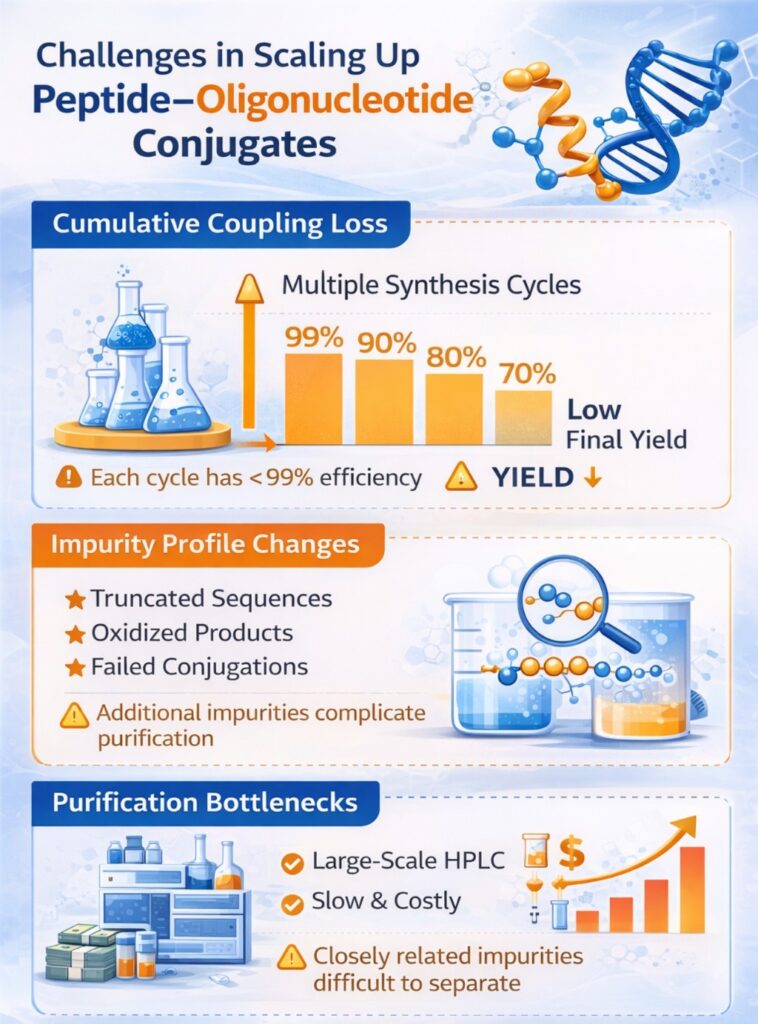
Several technical challenges arise during the Scale Up of Peptide Oligonucleotide Conjugates, particularly when moving from laboratory experiments to large production batches. These challenges include reduced yields, higher impurity levels, and increasing purification complexity.
1. Cumulative Coupling Loss
Each synthesis cycle introduces a small yield loss. Over many cycles, these losses accumulate and significantly reduce the final product yield.
Example:
- 99% coupling efficiency
- 40-mer oligonucleotide
- Final theoretical yield: ~67%
At industrial scale, yield may decrease further due to:
- reagent diffusion limitations
- resin swelling inconsistencies
- incomplete washing cycles
Careful reaction optimization and high-quality reagents are essential to minimize these losses.
2. Impurity Profile Changes
Large-scale synthesis can introduce additional impurities such as:
- truncated sequences
- deletion products
- oxidation products
- incomplete conjugates
These impurities complicate downstream purification and may affect therapeutic performance. Continuous monitoring of impurity profiles is necessary to maintain product quality.
3. Purification Bottlenecks
Purification is often the most expensive and time-consuming stage in the Scale Up of Peptide Oligonucleotide Conjugates. As production volume increases, separating closely related molecules becomes significantly more difficult.
Common purification approaches include:
- Reverse-phase HPLC
- Ion-exchange chromatography
- Size-exclusion chromatography
- Membrane filtration systems
Large-scale HPLC requires expensive equipment, large solvent volumes, and long processing times, which can significantly increase production costs.
Partner with an expert CRO for your conjugation projects: Peptide Oligonucleotide Conjugates CRO
Advanced Purification Strategies for Scalable Manufacturing
To improve efficiency during the Scale Up of Peptide Oligonucleotide Conjugates, modern purification technologies are being adopted. These systems aim to reduce solvent consumption while maintaining high separation performance.
Hybrid Purification Workflows
Combining multiple purification techniques often produces better results than relying on a single method.
Examples include:
- Ultrafiltration
- Precipitation
- Chromatography
This integrated strategy improves product recovery and reduces solvent usage.
Continuous Chromatography
Continuous chromatography offers several benefits for large-scale production:
- Higher productivity
- Reduced solvent consumption
- Improved batch consistency
Continuous systems allow steady processing rather than traditional batch purification.
Membrane-Assisted Purification
Membrane technologies provide efficient removal of truncated sequences and impurities. These systems are easier to scale compared with conventional HPLC and can simplify downstream processing.
Analytical Characterization for Scalable Production
Reliable analytical testing is essential during the Scale Up of Peptide Oligonucleotide Conjugates. Analytical methods confirm the identity, purity, and structural integrity of the final product. Without accurate characterization data, regulatory approval and quality assurance become difficult.
Advanced analytical tools also help monitor reaction progress and detect process deviations early. This allows scientists to correct issues before large production batches are affected.
Critical Analytical Methods
| Technique | Purpose |
|---|---|
| LC-MS | Molecular confirmation |
| HPLC | Purity analysis |
| Capillary electrophoresis | Charge variant detection |
| MALDI-TOF | Mass validation |
| NMR | Structural verification |
Using multiple analytical methods provides a complete understanding of molecular properties such as mass, structure, and charge distribution.
Ensure the quality of your peptide components: Peptide Characterization Service
Emerging Technologies Improving Scale Up of Peptide Oligonucleotide Conjugates
Several new technologies are improving the efficiency and scalability of peptide-oligonucleotide conjugate manufacturing. These innovations help reduce production costs while improving process reliability.
Automated Flow Chemistry
Flow reactors provide:
- precise reagent control
- improved heat transfer
- scalable continuous synthesis
Continuous flow systems reduce reaction variability and allow better control of reaction conditions.
Improved Solid Supports
New resin materials offer:
- higher loading capacity
- improved swelling behavior
- faster reaction kinetics
These materials improve reagent diffusion and increase reaction efficiency during synthesis.
Green Chemistry Approaches
Environmentally friendly solvents and reagents are increasingly used to reduce environmental impact. These methods also help manufacturers meet sustainability and regulatory requirements.
Comprehensive support from synthesis to analysis: POC Synthesis and Characterization
Best Practices for Successful Scale Up of Peptide Oligonucleotide Conjugates
Organizations working on the Scale Up of Peptide Oligonucleotide Conjugates typically follow several best practices to improve manufacturing success. These practices reduce risk and improve process consistency during scale-up development.
Key practices include:
- Early process development during the discovery stage
- Designing purification workflows that can scale efficiently
- Implementation of process analytical technology (PAT)
- Careful selection of linkers and conjugation chemistries
- Continuous process optimization during pilot production
Applying these strategies early helps shorten the transition from research experiments to commercial manufacturing.
Conclusion
The Scale Up of Peptide Oligonucleotide Conjugates is a complex and multidisciplinary process that combines peptide chemistry, oligonucleotide synthesis, and advanced purification technologies. Each step must be carefully optimized to ensure consistent product quality and acceptable manufacturing yields.
Successful Scale Up of Peptide Oligonucleotide Conjugates depends on efficient solid-phase synthesis, reliable conjugation chemistry, and scalable purification workflows. Strong analytical characterization is also essential to confirm structural integrity and maintain regulatory compliance.
As nucleic acid therapeutics continue to grow within the pharmaceutical industry, scalable production platforms for peptide-oligonucleotide conjugates will become increasingly important. These advanced bioconjugates provide new opportunities for targeted drug delivery and improved therapeutic outcomes.
Organizations that invest in early process development, innovative purification systems, and scalable synthesis technologies will be better positioned to produce these complex therapeutic molecules efficiently and reliably.
Access expert conjugation services today: Peptide Oligonucleotide Conjugation Services
Frequently Asked Questions (FAQs)
Yield decreases because each synthesis cycle has a small loss in efficiency. When many cycles are required for long sequences, these losses accumulate and reduce the overall yield. At larger scales, factors such as mixing limitations and reagent diffusion can further impact reaction efficiency.
Click chemistry and thiol-maleimide coupling are widely used because they are highly selective and efficient under mild conditions. These reactions generate fewer side products, which simplifies purification and improves manufacturing consistency.
Common purification methods include reverse-phase HPLC, ion-exchange chromatography, membrane filtration, and ultrafiltration systems. In many cases, a combination of these techniques is used to achieve the desired purity for therapeutic applications.
Purification becomes difficult because many impurities have structures similar to the desired product. High-resolution separation methods are required to remove these impurities, which increases processing time, equipment requirements, and solvent usage.
Resin materials influence reaction kinetics, reagent diffusion, and loading capacity. Choosing the right resin improves reaction efficiency and helps maintain consistent yields during large-scale synthesis.
These conjugates help deliver nucleic acid drugs directly to target cells. The peptide component improves cellular uptake, while the oligonucleotide provides the therapeutic function, making them valuable tools for advanced drug development.
Manufacturers can improve scalability by optimizing synthesis conditions early, selecting robust conjugation chemistries, and designing purification processes that work efficiently at larger volumes. Continuous process monitoring and analytical validation also support consistent large-scale production.
Reference:
- Mannes, M., Chigoho, D., Martin, C., Barlow, T., et al. (2025). Targeted delivery of oligonucleotide–peptide conjugates for enhanced kidney-specific therapy. Journal of Medicinal Chemistry, 68(18). https://doi.org/10.1021/acs.jmedchem.5c01893
- Malinowska, A. L., Huynh, H. L., & Bose, S. (2024). Peptide–oligonucleotide conjugation: Chemistry and therapeutic applications. Current Issues in Molecular Biology, 46(10), 11031–11047. https://doi.org/10.3390/cimb46100655
Get In Touch With Us
About The Author


