

Introduction
Scaling Poly(lactic-co-glycolic acid) PLGA Microsphere Manufacturing from a 1g laboratory bench batch to a 500g cGMP-compliant pilot scale requires a carefully engineered transition from empirical batch agitation to continuous and tightly controlled fluid dynamic and thermodynamic unit operations. Long-acting injectable (LAI) depot formulations use Poly(lactic-co-glycolic acid) (PLGA), an FDA-approved and biocompatible copolymer, as a delivery matrix for small molecules, peptides, and proteins intended for sustained release over periods ranging from several weeks to multiple months. However, reproducing the same physicochemical characteristics during scale-up can be technically challenging. During a 500-fold increase in processing volume, conventional volumetric scaling approaches become inadequate because local shear patterns, solvent extraction behavior, and interfacial effects do not increase or decrease proportionally with vessel volume. ResolveMass Laboratories Inc. uses a Quality by Design (QbD) framework to systematically manage these scale transitions and establish process conditions that allow pilot-scale microparticles to retain their intended particle size distribution, drug loading efficiency, and drug release characteristics.
Learn how advanced formulation design optimizes sustained therapeutic delivery across various administration routes: PLGA Long-Acting Injectable Formulation
Quick Summary:
- Scale-up challenge: Moving from 1g laboratory batches to 500g cGMP pilot production requires controlled fluid dynamics, solvent extraction, and thermodynamic processing—not simple volume-based scaling.
- Quality by Design (QbD): Linking Critical Quality Attributes (CQAs) with Critical Process Parameters (CPPs) helps maintain consistent particle size, drug loading, release behavior, and product quality.
- Particle size control: A target D₅₀ of 25–35 μm and span < 0.85 support syringeability, reduce needle occlusion risk, and improve release consistency.
- Drug loading & burst release: Stable emulsification and controlled phase separation help achieve encapsulation efficiency >85% and **initial burst release
Critical Quality Attributes and Process Parameters in Scaling Poly(lactic-co-glycolic acid) PLGA Microsphere Manufacturing
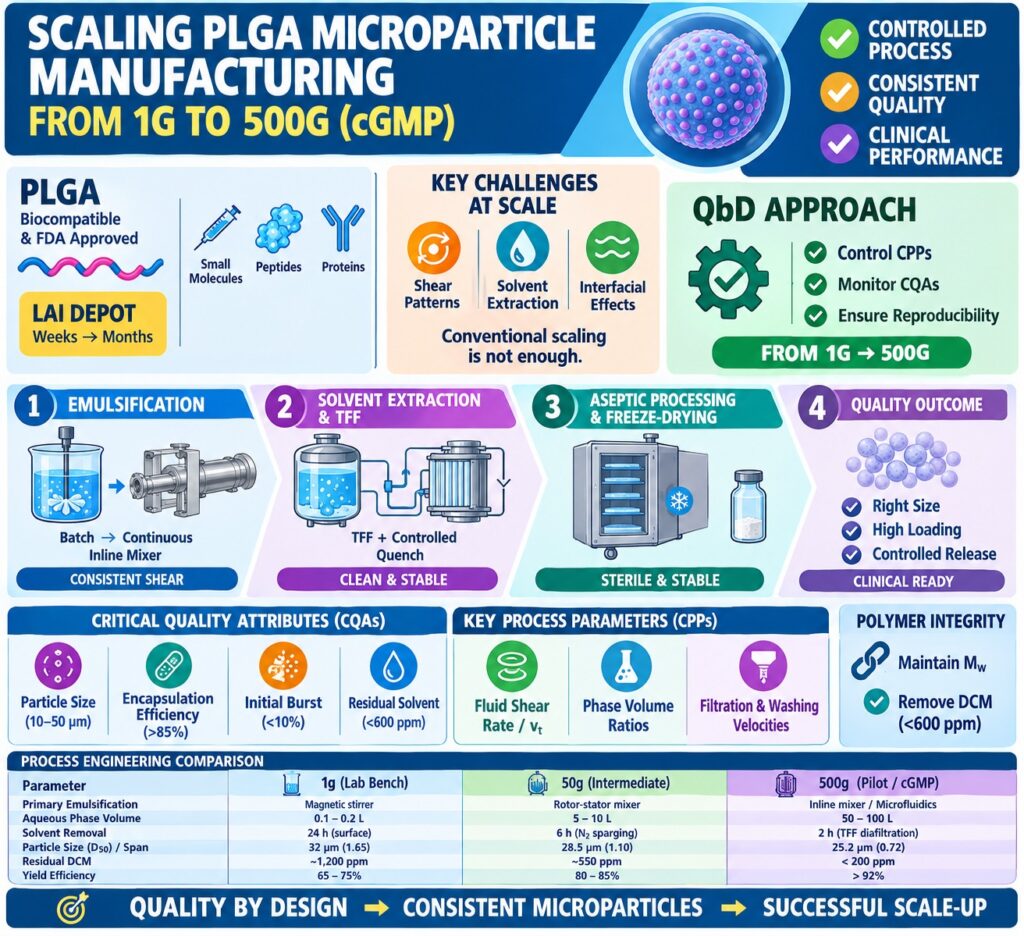
Critical Quality Attributes (CQAs), including particle size distribution, encapsulation efficiency, initial burst release, and residual solvent concentration, are strongly influenced by Critical Process Parameters (CPPs) such as fluid shear rate, phase volume ratios, and continuous filtration and washing velocities during scale-up. Defining the mathematical, physical, and thermodynamic relationships between these CPPs and CQAs within a Quality by Design (QbD) framework helps minimize the risk of product performance failure as manufacturing progresses from small laboratory volumes to pilot-scale processing vessels.
Discover key strategies for engineering controlled release profiles for complex therapeutics: PLGA Depot Formulation
Particle Size Distribution and Syringeability Mechanics
Maintaining a median particle diameter (D₅₀) within the range of 10 μm to 50 μm is important for achieving acceptable parenteral syringeability through fine-gauge needles, including 23G–27G needles, while also limiting excessively rapid phagocytic clearance following administration. Particle size distribution can be quantitatively characterized using laser light scattering (LLS). Product distribution uniformity can be described using the span metric:
Span=D90−D10D50\text{Span} = \frac{D_{90} – D_{10}}{D_{50}}
During 1g laboratory-scale production, intense localized shear around magnetic stirrers can produce a relatively broad particle distribution, with span values greater than 1.5 and consequently high polydispersity. At pilot scale, the manufacturing process must instead maintain a substantially narrower particle distribution, with a target span below 0.85, to support reproducible polymer degradation behavior and minimize the possibility of needle occlusion resulting from oversized microspheres.
Review polymer specifications, polydispersity index (PDI) controls, and equivalence requirements for drug applications: PLGA Polymer Sameness for ANDA
Encapsulation Efficiency, Drug Loading, and Initial Burst Control
Encapsulation efficiency (EE%) and drug loading (DL%) describe the amount of active pharmaceutical ingredient (API) successfully incorporated into the PLGA polymer matrix. During scale-up, uncontrolled mass transfer or delayed polymer precipitation can allow a portion of the drug payload to migrate from the organic phase into the aqueous continuous phase. Such partitioning can substantially decrease the final drug loading and overall encapsulation efficiency. In addition, API that migrates toward the particle surface during slow or poorly controlled phase separation can remain near the external matrix interface. This surface-associated drug can subsequently produce an excessive initial burst release during the first 24 hours, potentially creating clinical safety concerns, including dose dumping.
Address critical formulation hurdles when trapping hydrophilic or hydrophobic molecules into microspheres: Encapsulating Hydrophilic vs Hydrophobic APIs in PLGA
Polymer Integrity and Residual Solvent Compliance
Maintaining the molecular weight (M_w) of the PLGA polymer matrix while effectively removing organic solvents such as dichloromethane (DCM) is essential for satisfying pharmaceutical quality and regulatory requirements. Dichloromethane is commonly selected as a PLGA solvent because of its strong polymer solvency and relatively low boiling point. Nevertheless, residual DCM concentrations must be reduced to below 600 ppm to satisfy the applicable ICH Q3C regulatory requirements. During scale-up, extended exposure to excessive shear, elevated temperatures, or aqueous processing conditions can also accelerate ester backbone hydrolysis. This reduction in polymer molecular weight may subsequently increase matrix erosion and contribute to premature drug release.
Mitigate burst release, low entrapment efficiency, and phase separation issues during scale-up: Challenges in PLGA Microsphere Development
| Critical Quality Attribute (CQA) | Target Specification | Impact of Scale-Up Failure | Primary Driving Process Parameter (CPP) |
|---|---|---|---|
| Particle Size (D₅₀) | 25.0 – 35.0 μm | Needle occlusion, altered tissue retention | Impeller tip speed (v_t), local dissipation rate (ε) |
| Polydispersity / Span | < 0.85 | Irregular release kinetics, high batch variance | Fluid shear field homogeneity, surfactant ratio |
| Encapsulation Efficiency | > 85.0% | Payload loss, elevated manufacturing costs | Primary emulsion stability, solvent extraction rate |
| Initial Burst (24h Release) | < 10.0% | Dose dumping toxicity, reduced shelf life | Matrix surface porosity, initial skin formation speed |
| Residual Dichloromethane | < 600 ppm | Cytotoxicity, regulatory release failure | Secondary extraction temperature, TFF diafiltration |
| Residual Polyvinyl Alcohol | < 0.5% w/w | Immunogenicity, matrix plasticization | Aqueous wash volume, membrane cut-off size |
Implement proven isolation protocols to meet ICH guidelines for residual organic solvents: Residual Solvent Control in PLGA Microsphere Manufacturing
Hydrodynamic Shear Mechanics in Scaling Poly(lactic-co-glycolic acid) PLGA Microsphere Manufacturing
Hydrodynamic scale-up of PLGA microemulsions requires appropriate control of the continuous volumetric energy dissipation rate (ε) or impeller tip speed (v_t), rather than simply maintaining the same vessel rotational speed or applying a straightforward volumetric scaling factor. Establishing comparable fluid shear conditions across different processing scales helps minimize droplet coalescence and provides greater control over particle polydispersity.
Fluid Dynamics of Emulsion Droplet Breakup
The generation of oil-in-water (O/W) or water-in-oil-in-water (W₁/O/W₂) emulsion droplets is determined by the competition between hydrodynamic forces that deform and break droplets and the restorative force generated by interfacial tension (σ). This relationship can be represented by the Capillary number (Ca):
Ca=ηm⋅γ˙⋅d2σCa = \frac{\eta_m \cdot \dot{\gamma} \cdot d}{2 \sigma}
where η_m denotes the viscosity of the continuous phase, γ̇ represents the average shear rate, and d corresponds to the droplet diameter. Within conventional stirred-tank systems, the local shear rate is closely associated with the impeller tip speed (v_t), which can be expressed as:
vt=π⋅D⋅Nv_t = \pi \cdot D \cdot N
where D represents the impeller diameter and N denotes the rotational frequency. Increasing a 1g vessel with an impeller diameter of D = 0.03 m to a 500g vessel with D = 0.25 m while retaining the same RPM can generate substantially different hydrodynamic conditions. Such an approach may create excessive turbulence and break droplets into sub-micron fragments that are unsuitable for the intended microsphere product. In contrast, simply maintaining a constant power input per unit volume (P/V) can produce insufficiently mixed, low-shear regions close to the vessel walls. These dead zones may promote droplet coalescence and ultimately result in a broader particle size distribution.
Learn how surfactant choice impacts droplet stability and particle size during mixing: Surfactants and Emulsifiers in PLGA Microsphere Fabrication
Transitioning to Continuous Inline Emulsification Technologies
To overcome non-uniform shear conditions associated with larger batch vessels, pilot-scale process development can transition from conventional batch agitation toward continuous inline emulsification technologies.
- Continuous Dynamic High-Shear Mixers: These systems continuously introduce organic and aqueous streams into a compact, fixed-volume rotor-stator mixing head, typically approximately 10–50 mL. Since the working volume within the mixing head remains essentially constant, local shear conditions and energy dissipation rate (ε) can remain highly consistent when production increases from 1g to 500g. This allows production throughput to be increased without proportionally changing the local mixing environment.
- Membrane Emulsification and Microfluidics: In these approaches, the polymer solution is introduced through micro-channel arrays or uniformly sized porous membranes into the continuous phase. This configuration enables the formation of droplets with a highly controlled and narrow size distribution. It also minimizes vessel dead zones and can reduce excessive shear exposure, which is particularly beneficial when processing sensitive biologic payloads.
Mass Transfer Kinetics in Solvent Extraction, Evaporation, and Continuous Tangential Flow Filtration
Solvent removal during 500g pilot-scale manufacturing requires precise management of two-stage mass transfer behavior, beginning with relatively rapid extraction from the particle surface and progressing to a diffusion-limited stage within the polymer matrix. Continuous Tangential Flow Filtration (TFF) can be incorporated into this operation to facilitate solvent removal while minimizing particle coalescence and sintering. Scale-up also requires handling substantially larger quantities of aqueous extraction medium, increasing from approximately 100 mL at laboratory scale to approximately 50–100 L at pilot scale, while maintaining controlled phase separation and solvent extraction conditions.
Phase Behavior and Solvent Extraction Dynamics
Dichloromethane has a relatively low aqueous solubility limit of approximately 1.3% w/v at 20°C. During 1g laboratory-scale processing, DCM can rapidly partition into an excess volume of bulk water. This promotes relatively rapid formation of the polymer skin and subsequent hardening of the microsphere matrix. At the 500g scale, however, introducing the entire batch into an inadequately sized or poorly optimized quench volume can rapidly increase DCM concentration in the aqueous phase toward saturation. This condition can slow microsphere solidification and increase the likelihood of particle aggregation, API leaching, and development of an excessively porous matrix.
The extraction flux of DCM (J) can be described using Fick’s first law of diffusion:
J=−DsdCdxJ = -D_s \frac{dC}{dx}
where D_s represents the diffusion coefficient of DCM in water and dC/dx describes the concentration gradient between the internal droplet region and the surrounding aqueous phase. Sustaining an adequate concentration gradient is therefore important for efficient solvent extraction. This can be supported through vacuum-assisted degasification, controlled temperature ramping, or continuous replacement of the aqueous quench medium.
Compare surface vs. bulk degradation dynamics during matrix formation and erosion: Bulk Erosion vs Surface Erosion in PLGA
Tangential Flow Filtration (TFF) vs. Classical Batch Isolation
At pilot scale, recovering microspheres through conventional dead-end filtration or high-speed centrifugation can introduce several processing problems, including irreversible particle cake compaction, membrane blinding, and mechanical damage to the microsphere structure. Tangential Flow Filtration (TFF), particularly when implemented with hollow-fiber membrane modules having pore sizes ranging from 0.2 μm to 1.2 μm, provides an alternative approach for handling these challenges.
During TFF processing, the microsphere suspension flows parallel to the membrane surface while Transmembrane Pressure (TMP) and cross-flow rates are maintained within controlled operating ranges. Dissolved DCM and unbound polyvinyl alcohol (PVA) emulsifier can pass through the membrane into the permeate stream, whereas the hardened microspheres remain concentrated within the retentate loop. Because the particles are not forced directly against the membrane in the same manner as conventional dead-end filtration, the process reduces mechanical compaction and helps preserve particle structural integrity.
Downstream Aseptic Processing, Freeze-Drying Kinetics, and Pilot Validation
Pilot-scale downstream isolation requires closed-system aseptic processing combined with validated freeze-drying cycles that maintain product temperatures below the plasticized glass transition temperature (T_g) and associated collapse limits. These controls are necessary to prevent cake collapse, particle fusion, and undesirable changes to the polymer matrix. Terminal sterilization approaches such as autoclaving or gamma irradiation can cause PLGA polymer chain degradation and may modify drug release kinetics. Consequently, aseptic processing within ISO 5 cleanroom environments is required when the formulation and product strategy necessitate sterile microsphere manufacturing.
Lyophilization Thermal Profiles and Plasticization Behavior
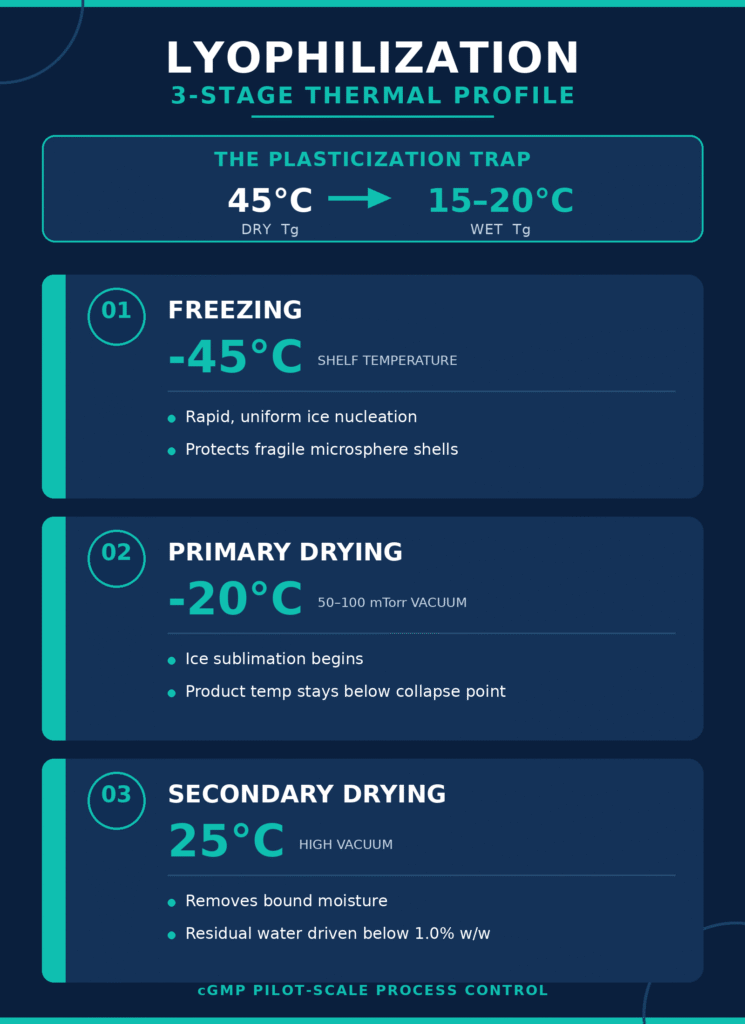
Residual water and organic solvents can function as plasticizers and substantially decrease the glass transition temperature (T_g) of wet PLGA microspheres. Under these conditions, the effective T_g can decrease from approximately 45°C to approximately 15°C–20°C. If the product temperature (T_p) exceeds the plasticized glass transition or collapse temperature (T_c) during primary drying, the polymer matrix may undergo structural collapse. Such collapse can close internal pores and produce permanent changes in the drug release characteristics of the microspheres.
For 500g pilot-scale batches, optimized freeze-drying cycles can be structured into three controlled thermal stages:
- Freezing Phase: The shelves are rapidly cooled to approximately -45°C to promote relatively uniform ice crystal nucleation. Controlled freezing helps minimize phase separation while reducing the risk of damage to delicate microsphere shells.
- Primary Drying: Chamber pressure is reduced to approximately 50–100 mTorr, while shelf temperatures are maintained around -20°C. These conditions facilitate ice sublimation while keeping the product temperature below the relevant collapse threshold, maintaining the condition T_p < T_c.
- Secondary Drying: Shelf temperature is gradually increased to approximately 25°C under high-vacuum conditions to remove bound moisture. This controlled desorption step can reduce total residual water to below 1.0% w/w while avoiding excessive softening or deformation of the PLGA polymer matrix.
Review methodologies for evaluating polymers and biologics under storage conditions: Shelf Life of PLGA PLA PCL
Engineering Parameter Comparison Across Scale Transitions in Scaling Poly(lactic-co-glycolic acid) PLGA Microsphere Manufacturing
Moving from 1g laboratory batches to 500g cGMP pilot-scale manufacturing requires substantial changes in process engineering. Key operating parameters must transition from manually controlled stirred-tank procedures toward automated and continuous unit operations capable of maintaining reproducible process conditions throughout production.
| Operating Parameter / Metric | 1g Laboratory Bench Scale | 50g Intermediate Pilot Scale | 500g cGMP Pilot Scale |
|---|---|---|---|
| Primary Emulsification Method | Open beaker with magnetic stirrer | Batch high-shear rotor-stator mixer | Continuous inline dynamic mixer / Microfluidic array |
| Aqueous Phase Volume | 0.1 – 0.2 L | 5.0 – 10.0 L | 50.0 – 100.0 L (Closed-loop quench vessel) |
| Shear Control Metric | Rotational speed (N = 800 RPM) | Tip speed (v_t = 5.2 m/s) | Energy dissipation rate (ε = 1.2 × 10⁴ W/kg) |
| Solvent Removal Method | Surface evaporation (24 h) | Heated vessel nitrogen sparging (6 h) | Vacuum-assisted TFF diafiltration (2 h) |
| Particle Isolation Method | Manual centrifugation & decanting | Pressure filtration funnel | Automated Tangential Flow Filtration (TFF) |
| Sterilization Strategy | Non-sterile research grade | Low bioburden execution | Closed aseptic processing inside ISO 5 isolators |
| Batch Yield Efficiency | 65.0 – 75.0% | 80.0 – 85.0% | > 92.0% (Minimal dead-volume holdup) |
| Median Size (D₅₀) & Span | 32.0 μm (Span: 1.65) | 28.5 μm (Span: 1.10) | 25.2 μm (Span: 0.72) |
| Residual DCM Level | ~1,200 ppm | ~550 ppm | < 200 ppm (Strict ICH Q3C compliance) |
Conclusion
Successful Scaling Poly(lactic-co-glycolic acid) PLGA Microsphere Manufacturing from 1g laboratory formulations to 500g cGMP pilot batches requires a transition away from empirical batch mixing toward controlled fluid dynamics, predictable solvent extraction kinetics, and aseptic TFF-based downstream processing. Addressing hydrodynamic scale-up limitations through continuous inline emulsification and continuous TFF washing can improve particle size consistency, preserve encapsulation efficiency, and provide greater control over initial burst release behavior. Applying Quality by Design (QbD) engineering principles throughout these scale transitions enables ResolveMass Laboratories Inc. to support pilot formulations that retain their intended clinical performance, manufacturing consistency, and regulatory quality requirements.
Discover analytical testing services for characterization and batch release verification: Characterization of Long-Acting Biologics
For technical inquiries related to process analytical technology (PAT), long-acting injectable formulation development, or customized cGMP scale-up solutions, contact ResolveMass Laboratories Inc.:
- Website Contact Portal: https://resolvemass.ca/contact/
Frequently Asked Questions (FAQs)
Initial burst release can become more pronounced when solvent extraction is slower and the encapsulated API has more time to migrate toward the microsphere surface. At larger manufacturing scales, inadequate aqueous-phase volume can increase solvent saturation and delay solidification. This may result in greater surface porosity and increased drug diffusion during the initial release period.
Tangential Flow Filtration (TFF) provides a controlled approach for concentrating and washing PLGA microsphere suspensions at larger manufacturing scales. The suspension flows parallel to the membrane surface, reducing particle compaction while allowing dissolved DCM and unbound polyvinyl alcohol (PVA) to enter the permeate. The microspheres remain in the retentate stream for further processing.
Residual DCM can be reduced through controlled solvent extraction, temperature-assisted processing, and closed-loop TFF diafiltration. Additional solvent removal can be achieved during low-pressure secondary lyophilization, allowing DCM to diffuse from the polymer matrix. These operations are carefully controlled to achieve the required residual solvent specification without compromising PLGA integrity.
Several PLGA characteristics influence the behavior of the formulation during scale-up, particularly molecular weight (M_w), lactide-to-glycolide (L/G) ratio, and ester or carboxyl end-group chemistry. These properties affect polymer solubility, solution viscosity, degradation behavior, and hydrolysis rate. Higher intrinsic viscosity can increase resistance to droplet deformation and may require adjustment of the applied energy input.
Temperature affects solvent extraction behavior, aqueous-phase solubility, polymer solidification, and the glass transition temperature (T_g) of the developing microspheres. Increasing temperature can accelerate DCM removal, but excessive heating may soften the polymer droplets. If the processing temperature becomes too high relative to T_g, particle adhesion, agglomeration, and changes in morphology may occur.
Microsphere agglomeration can be minimized by controlling the product temperature during primary drying so that it remains below the plasticized collapse temperature (T_c). Lyoprotectants such as mannitol, sucrose, or trehalose may also be incorporated to provide physical separation between particles. Proper freezing and drying conditions help preserve particle structure and reduce matrix fusion.
Batch emulsification processes the formulation within a single vessel, where shear conditions can vary depending on the location of the droplets relative to the impeller and vessel walls. Continuous inline mixing instead passes the organic and aqueous streams through a defined high-shear mixing zone. This provides more consistent exposure to controlled shear conditions and can improve particle size uniformity.
Maintaining encapsulation efficiency during scale-up requires control of the organic-to-aqueous phase ratio, primary emulsion stability, solvent extraction rate, and surfactant concentration. Rapid and consistent formation of the polymer matrix helps minimize API migration into the continuous phase. These parameters must remain within an established design space to achieve reproducible drug loading and encapsulation efficiency.
cGMP scale-up requires appropriate control of aseptic processing or validated terminal sterilization, bioburden, endotoxin, residual solvent levels, and batch-to-batch product performance. Drug release profiles and critical quality attributes must demonstrate consistent manufacturing performance. Product-contact equipment should also be appropriately qualified and constructed from compatible materials, such as 316L stainless steel or suitable single-use fluoropolymer systems.
Reference:
- Butreddy, A., Gaddam, R. P., Kommineni, N., Dudhipala, N., & Voshavar, C. (2021). PLGA/PLA-based long-acting injectable depot microspheres in clinical use: Production and characterization overview for protein/peptide delivery. International Journal of Molecular Sciences, 22(16), 8884. https://doi.org/10.3390/ijms22168884
- Su, Y., Liu, J., Tan, S., Liu, W., Wang, R., & Chen, C. (2022). PLGA sustained-release microspheres loaded with an insoluble small-molecule drug: Microfluidic-based preparation, optimization, characterization, and evaluation in vitro and in vivo. Drug Delivery, 29(1), 1437–1446. https://doi.org/10.1080/10717544.2022.2072413
- Hua, Y., Su, Y., Zhang, H., Liu, N., Wang, Z., Gao, X., Gao, J., & Zheng, A. (2021). Poly(lactic-co-glycolic acid) microsphere production based on quality by design: A review. Drug Delivery, 28(1), 1342–1355. https://doi.org/10.1080/10717544.2021.1943056
- Desai, N., Rana, D., Patel, M., Bajwa, N., Prasad, R., & Vora, L. K. (2025). Nanoparticle therapeutics in clinical perspective: Classification, marketed products, and regulatory landscape. Small, 21(29), 2502315. https://doi.org/10.1002/smll.202502315
- Lee, J. W., Park, J. H., Yu, G. W., You, J. W., Han, M. J., Kang, M. J., & Ho, M. J. (2025). Sustained-release intra-articular drug delivery: PLGA systems in clinical context and evolving strategies. Pharmaceutics, 17(10), 1350. https://doi.org/10.3390/pharmaceutics17101350
- Yang, J., Zeng, H., Luo, Y., Chen, Y., Wang, M., Wu, C., & Hu, P. (2024). Recent applications of PLGA in drug delivery systems. Polymers, 16(18), 2606. https://doi.org/10.3390/polym16182606
Get In Touch With Us
About The Author


