

Introduction:
Semaglutide Peptide Mapping is a critical analytical technique used to verify the structural integrity and sequence accuracy of semaglutide, a GLP-1 receptor agonist widely used in diabetes and obesity treatment. This process plays a vital role in biopharmaceutical development, quality control, and regulatory submissions. For deeper insights into sequencing strategies, explore peptide sequencing of GLP-1 peptide and peptide sequencing of GLP-1 drugs.
Semaglutide is a complex peptide with modifications such as fatty acid chains and amino acid substitutions, making its characterization more challenging than standard peptides. As a result, peptide mapping becomes essential for ensuring product consistency, detecting impurities, and confirming molecular identity. Learn more about analytical characterization of GLP-1 peptide drugs and LC-MS characterization of GLP-1 peptides.
Share via:
Summary:
- Semaglutide Peptide Mapping is essential for confirming sequence integrity, structural accuracy, and regulatory compliance.
- The process involves enzymatic digestion, chromatographic separation, and mass spectrometry analysis.
- Key challenges include peptide stability, complex fragmentation patterns, and post-translational modifications (PTMs).
- Advanced techniques like LC-MS/MS improve accuracy—see GLP-1 peptide sequencing analytical technique.
- A robust analytical workflow ensures reproducibility, sensitivity, and compliance with global regulatory standards.
1: What is Semaglutide Peptide Mapping and Why is it Important?
Semaglutide peptide mapping is an analytical technique that enzymatically digests semaglutide into smaller peptide fragments and analyzes them using advanced methods like LC-MS/MS to confirm its amino acid sequence and structural integrity. It serves as a critical tool for verifying the identity and quality of this complex therapeutic peptide. For accuracy insights, refer to de novo GLP-1 peptide sequencing accuracy.
Why It Matters
- Confirms amino acid sequence accuracy
Ensures the primary structure of semaglutide matches the intended design, which is essential for therapeutic efficacy. - Detects impurities and degradation products– see GLP-1 peptide impurity characterization
Identifies unwanted variants, contaminants, or breakdown products that may affect safety and performance. - Identifies post-translational modifications (PTMs)
Enables detection of modifications such as oxidation or deamidation that can impact stability and biological activity. - Supports regulatory compliance (ICH, FDA, EMA)– read regulatory requirements for GLP-1 peptide characterization
Provides essential characterization data required for regulatory submissions and approvals. - Ensures batch-to-batch consistency
Confirms reproducibility in manufacturing, ensuring each production lot meets quality standards.
In simple terms, Semaglutide Peptide Mapping acts as a molecular “fingerprint,” confirming that the drug substance is precisely structured, consistent, and safe for use.
2: Analytical Workflow for Semaglutide Peptide Mapping
The Semaglutide Peptide Mapping workflow is a systematic, multi-step process designed to ensure high accuracy, reproducibility, and comprehensive structural characterization. Each step plays a critical role in generating reliable and regulatory-compliant analytical data.
The workflow ensures high accuracy and reproducibility. For a related approach, see peptide mapping GLP-1 peptides and GLP-1 enzymatic digestion mapping.
1. Sample Preparation
Sample preparation ensures that semaglutide is clean, stable, and ready for precise analytical evaluation.
Proper preparation is critical. Stability considerations are discussed in GLP-1 peptide stability analytical methods.
Key Steps:
- Desalting to remove buffer salts that interfere with ionization
- Reduction and alkylation (if required) to stabilize disulfide bonds
- Removal of interfering substances such as excipients or contaminants
Importance:
Improper sample preparation can result in:
- Poor enzymatic digestion efficiency
- Signal suppression in mass spectrometry
- Inaccurate or misleading analytical results
2. Enzymatic Digestion
Semaglutide is enzymatically cleaved into smaller, manageable peptide fragments for detailed analysis.
Optimized digestion improves sequence coverage. Learn more in GLP-1 analog peptide sequencing workflow.
Common Enzymes:
- Trypsin (most widely used for predictable cleavage)
- Chymotrypsin (targets aromatic residues)
- Glu-C (cleaves at acidic residues)
Challenges:
- Incomplete digestion leading to reduced sequence coverage
- Overdigestion causing excessively small fragments
- Missed cleavage sites affecting data interpretation
3. Chromatographic Separation
Peptide fragments are separated using high-resolution techniques such as HPLC or UHPLC to reduce complexity before detection.
Key Benefits:
- Improves separation of closely related peptide fragments
- Minimizes signal overlap in mass spectrometry
- Enhances detection sensitivity and reproducibility
4. Mass Spectrometry Analysis
Mass spectrometry (LC-MS/MS) identifies and characterizes peptide fragments with high precision.
High-resolution LC-MS/MS enables precise identification. Explore LC-MS characterization of GLP-1 peptides.
Capabilities:
- Accurate mass measurement for precise identification
- Sequence confirmation through fragmentation patterns
- PTM identification such as oxidation or deamidation
5. Data Analysis and Interpretation
Advanced bioinformatics tools analyze spectral data to confirm the peptide structure and detect variations.
Key Outputs:
- Sequence coverage (extent of peptide sequence identified)
- Fragment identification and mapping
- Impurity profiling and detection of structural variants
Workflow Summary Table
| Step | Purpose | Key Outcome |
|---|---|---|
| Sample Preparation | Clean and stabilize sample | Reliable starting material |
| Enzymatic Digestion | Break peptide into fragments | Improved analyzability |
| Chromatographic Separation | Separate complex mixtures | Enhanced resolution |
| Mass Spectrometry | Identify fragments | Accurate structural data |
| Data Analysis | Interpret results | Confirmed sequence & impurities |
A well-optimized Semaglutide Peptide Mapping workflow ensures high-confidence results, enabling accurate structural characterization, impurity detection, and regulatory compliance in pharmaceutical development.
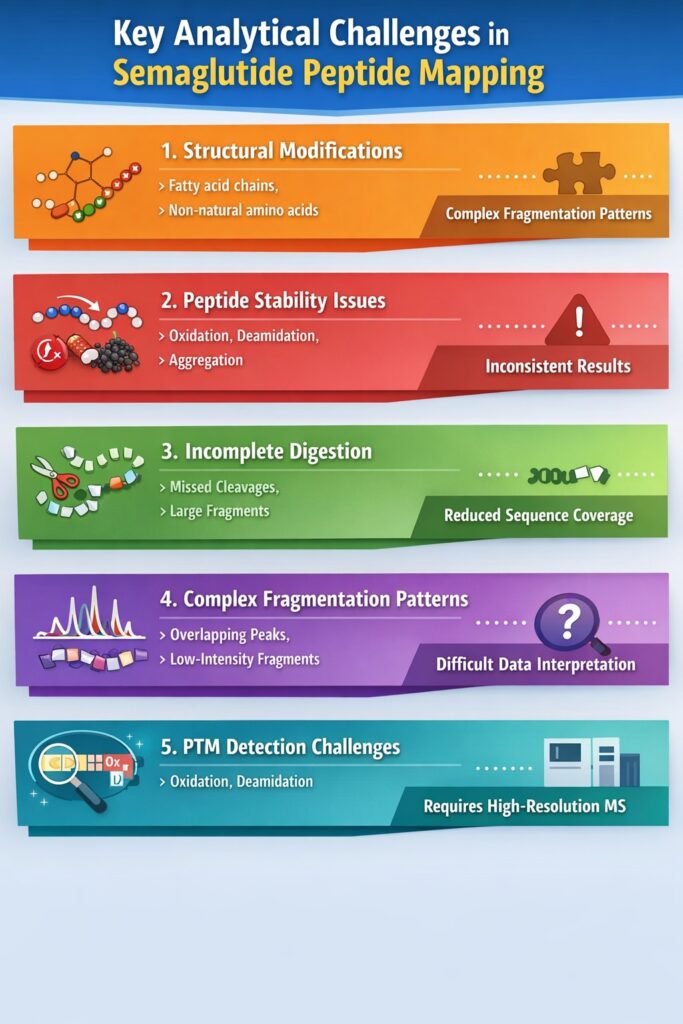
3: Key Analytical Challenges in Semaglutide Peptide Mapping
Semaglutide Peptide Mapping presents multiple analytical challenges due to the molecule’s structural complexity, chemical modifications, and susceptibility to degradation. Understanding these challenges is essential for developing robust and reliable analytical methods.
Challenges arise due to structural complexity. For more details, visit GLP-1 peptide sequencing challenges.
1. Structural Modifications
Semaglutide contains unique structural features that complicate analytical characterization.
Key Factors:
- Fatty acid side chains (lipophilic modification)
- Non-natural amino acid substitutions
Impact:
These modifications:
- Alter peptide fragmentation behavior
- Reduce predictability in MS/MS spectra
- Complicate sequence confirmation and data interpretation
2. Peptide Stability Issues
Semaglutide is prone to chemical and physical degradation under certain conditions.
Common Degradation Pathways:
- Oxidation (e.g., methionine residues)
- Deamidation (asparagine or glutamine residues)
- Aggregation due to hydrophobic interactions
Impact:
- Generates multiple degradation products
- Leads to variability in analytical results
- Makes it difficult to distinguish true impurities from artifacts
3. Incomplete Enzymatic Digestion
Efficient enzymatic cleavage is critical but often challenging.
Causes:
- Steric hindrance from structural modifications
- Suboptimal digestion conditions
- Enzyme specificity limitations
Impact:
- Missed cleavage sites
- Formation of larger, complex peptide fragments
- Reduced sequence coverage and mapping confidence
4. Complex Fragmentation Patterns
Semaglutide generates intricate MS/MS fragmentation profiles.
Characteristics:
- Overlapping chromatographic peaks
- Low-abundance or low-intensity fragment ions
- Multiple charge states
Impact:
- Increased difficulty in spectral interpretation
- Higher risk of misidentification
- Requires advanced analytical expertise and software tools
5. Detection of Post-Translational Modifications (PTMs)
PTMs in semaglutide are often subtle and difficult to detect.
Examples:
- Oxidation
- Deamidation
- Minor chemical modifications
Impact:
- Small mass shifts can be easily overlooked
- Requires high-resolution and high-sensitivity instruments
- Critical for ensuring product quality and stability
Challenge Summary Table
| Challenge | Root Cause | Analytical Impact |
|---|---|---|
| Structural modifications | Fatty acid chain, non-natural residues | Complex fragmentation patterns |
| Stability issues | Oxidation, deamidation, aggregation | Inconsistent results |
| Incomplete digestion | Enzyme limitations | Reduced sequence coverage |
| Complex spectra | Overlapping peaks, low intensity ions | Difficult interpretation |
| PTM detection | Subtle modifications | Requires high-resolution MS |
Impurity-related challenges are further explained in GLP-1 peptide impurity sequencing analysis.
Addressing these challenges in Semaglutide Peptide Mapping requires advanced instrumentation, optimized workflows, and deep analytical expertise to ensure accurate, reproducible, and regulatory-compliant results.
4: Solutions to Overcome Analytical Challenges
Semaglutide Peptide Mapping challenges can be effectively addressed using advanced analytical strategies, optimized workflows, and state-of-the-art instrumentation. Implementing these solutions ensures higher accuracy, reproducibility, and regulatory compliance.
Advanced strategies improve accuracy and reliability. Many CROs specialize in these services—see CRO for GLP-1 peptide characterization and outsource GLP-1 peptide sequencing services.
1. Optimized Enzymatic Digestion
Carefully optimized digestion protocols improve sequence coverage and fragment quality.
Key Strategies:
- Use multiple enzymes (e.g., Trypsin + Glu-C) for comprehensive cleavage
- Optimize pH, temperature, and incubation time
- Maintain proper enzyme-to-substrate ratios
Outcome:
- Reduces missed cleavages
- Prevents overdigestion
- Enhances overall mapping accuracy
2. High-Resolution Mass Spectrometry
Advanced MS platforms significantly improve detection sensitivity and accuracy.
Recommended Systems:
- Orbitrap
- Q-TOF (Quadrupole Time-of-Flight)
Benefits:
- High mass accuracy and resolution
- Improved detection of low-abundance fragments
- Precise identification of PTMs and impurities
3. Advanced Chromatographic Techniques
Efficient peptide separation is critical for reducing analytical complexity.
Best Practices:
- Use UHPLC (Ultra-High Performance Liquid Chromatography)
- Optimize mobile phase gradients
- Select specialized peptide columns
Outcome:
- बेहतर separation of complex peptide mixtures
- Reduced signal overlap
- Enhanced reproducibility and sensitivity
4. Robust Sample Preparation Protocols
Proper sample handling minimizes degradation and ensures reliable results.
Key Approaches:
- Minimize exposure to heat, light, and oxygen
- Use stabilizing agents to prevent degradation
- Maintain controlled environmental conditions
Outcome:
- Reduced oxidation and deamidation
- Improved sample integrity
- Consistent analytical performance
5. Advanced Data Analysis Tools
Modern software solutions streamline interpretation and improve confidence in results.
Technologies Used:
- Automated peptide mapping software
- AI-driven spectral interpretation tools
- PTM-specific detection algorithms
Outcome:
- Faster and more accurate data processing
- Improved identification of complex fragments
- Enhanced detection of subtle modifications
Solutions Summary Table
| Solution | Key Benefit | Impact on Analysis |
|---|---|---|
| Optimized digestion | Better cleavage efficiency | Higher sequence coverage |
| High-resolution MS | Accurate mass detection | Reliable identification |
| Advanced chromatography | Improved separation | Reduced complexity |
| Robust sample prep | Stable samples | Consistent results |
| Data analysis tools | Faster interpretation | Higher confidence |
For specialized services, explore GLP-1 peptide sequencing CRO services.
By integrating these solutions, laboratories can significantly enhance the reliability and precision of Semaglutide Peptide Mapping, ensuring accurate structural characterization and meeting stringent regulatory expectations.

5: Comparison of Challenges vs Solutions
In Semaglutide Peptide Mapping, aligning each analytical challenge with a targeted solution is essential to achieve accurate, reproducible, and high-confidence results. The table below provides a clear comparison to help quickly identify how specific issues can be effectively addressed.
Mapping challenges to solutions ensures analytical success. This aligns with best practices in analytical characterization of GLP-1 peptide drugs.
Challenges vs Solutions Overview
| Challenge | Impact on Analysis | Recommended Solution |
|---|---|---|
| Structural modifications | Complex fragmentation patterns | Use high-resolution mass spectrometry (Orbitrap/Q-TOF) |
| Peptide instability | Formation of degradation products | Implement controlled and robust sample preparation protocols |
| Incomplete digestion | Poor sequence coverage | Apply optimized enzymatic digestion strategies |
| Complex spectra | Difficult data interpretation | Utilize advanced data analysis software and AI tools |
| PTM detection | Missed or undetected modifications | Perform targeted MS/MS analysis with high sensitivity |
Key Insight
The success of Semaglutide Peptide Mapping depends on directly matching each analytical challenge with a precise technological or methodological solution.
By integrating advanced instrumentation, optimized workflows, and intelligent data analysis, laboratories can significantly reduce errors, improve sequence coverage, and ensure regulatory-grade analytical performance.
6: Regulatory Considerations for Semaglutide Peptide Mapping
Semaglutide Peptide Mapping must meet stringent regulatory requirements to demonstrate the drug’s safety, efficacy, and consistent quality. Regulatory agencies expect comprehensive analytical data that confirms structural integrity and detects any variability or impurities.
Regulatory compliance is essential. Learn more in GLP-1 peptide characterization regulatory requirements.
Key Guidelines
Regulatory frameworks provide clear expectations for peptide characterization:
- ICH Q6B
Defines specifications for biotechnological products, including structural characterization and purity assessment. - FDA Guidelines
Emphasize detailed peptide mapping, impurity profiling, and method validation for regulatory submissions. - EMA Requirements
Focus on structural confirmation, batch consistency, and stability-indicating methods.
Regulatory Expectations
To achieve compliance, Semaglutide Peptide Mapping must deliver:
- High sequence coverage (>95%)
Ensures nearly complete confirmation of the peptide’s primary structure. - Reproducible analytical methods
Demonstrates consistency across multiple runs, analysts, and instruments. - Comprehensive impurity profiling
Identifies and quantifies degradation products, variants, and contaminants. - Validated analytical workflows
Confirms that methods are accurate, precise, robust, and suitable for their intended purpose.
Why Compliance Matters
Meeting regulatory expectations is critical because it:
- Ensures patient safety and product efficacy
- Supports successful regulatory approvals
- Minimizes risks of product recalls or batch failures
- Strengthens quality assurance and manufacturing consistency
By aligning Semaglutide Peptide Mapping workflows with global regulatory standards, laboratories can ensure compliance, enhance data credibility, and support the successful development and commercialization of peptide therapeutics.
7: Best Practices for Accurate Semaglutide Peptide Mapping
Achieving reliable and reproducible results in Semaglutide Peptide Mapping requires a combination of validated methodologies, strict quality standards, and technical expertise. Following industry best practices ensures high data integrity and regulatory compliance.
Best practices ensure high-quality results and compliance. These align with industry standards discussed in GLP-1 peptide sequencing analytical technique.
Core Best Practices
1. Use Validated Analytical Methods
- Ensure all methods are fully validated for accuracy, precision, specificity, and robustness
- Follow ICH and regulatory guidelines for method validation
- Regularly review and update methods as technologies evolve
2. Maintain Strict Quality Control Procedures
- Implement system suitability tests before analysis
- Use reference standards and control samples
- Monitor performance through routine QC checks
3. Regularly Calibrate Instruments
- Perform scheduled calibration and maintenance of LC-MS/MS systems
- Ensure mass accuracy and detector sensitivity remain within acceptable limits
- Document calibration records for audit readiness
4. Employ Experienced Analysts
- Utilize trained professionals with expertise in peptide mapping and mass spectrometry
- Ensure proper interpretation of complex fragmentation patterns
- Reduce risk of analytical errors and misinterpretation
5. Implement Robust Documentation Practices
- Maintain detailed SOPs (Standard Operating Procedures)
- Record all experimental parameters and observations
- Ensure data traceability and audit compliance
Key Insight
Consistent application of these best practices in Semaglutide Peptide Mapping ensures high-quality, reproducible, and regulatory-compliant analytical outcomes.
By integrating technical expertise with robust operational controls, laboratories can confidently deliver precise peptide characterization results essential for pharmaceutical development.
8: Future Trends in Peptide Mapping
Semaglutide Peptide Mapping is rapidly advancing with the integration of cutting-edge technologies, enabling faster, more accurate, and highly automated analytical workflows. These innovations are transforming how peptide characterization is performed in modern laboratories.
Emerging innovations such as AI and automation are transforming peptide mapping workflows. These advancements build upon modern sequencing approaches like GLP-1 analog peptide sequencing workflow.
Emerging Trends
1. AI-Driven Data Analysis
- Artificial Intelligence (AI) and machine learning are revolutionizing spectral interpretation
- Enables automated peak identification and sequence validation
- Reduces manual errors and accelerates data processing
Impact:
Faster, more accurate, and scalable peptide mapping analysis.
2. Integration with LC-MS/MS Automation
- Fully automated LC-MS/MS workflows are becoming standard
- Reduces human intervention and variability
- Enhances throughput for high-volume sample analysis
Impact:
Improved reproducibility, efficiency, and consistency across batches.
3. Real-Time Peptide Monitoring
- Advanced systems now enable real-time monitoring of peptide profiles
- Supports continuous process verification during manufacturing
- Facilitates rapid detection of deviations or impurities
Impact:
Better process control and faster decision-making in quality assurance.
4. Green Analytical Chemistry Approaches
- Focus on reducing solvent consumption and hazardous waste
- Adoption of eco-friendly reagents and energy-efficient instruments
- Development of sustainable analytical protocols
Impact:
Environmentally responsible peptide mapping with reduced operational costs.
Key Insight
The future of Semaglutide Peptide Mapping lies in automation, intelligence, and sustainability.
As these technologies continue to evolve, laboratories will benefit from enhanced analytical precision, reduced turnaround times, and improved compliance with both regulatory and environmental standards.
Conclusion:
Semaglutide Peptide Mapping is a powerful analytical tool essential for ensuring the structural integrity, safety, and regulatory compliance of semaglutide-based therapeutics. Despite challenges such as complex modifications, stability issues, and intricate fragmentation patterns, modern analytical techniques and optimized workflows provide reliable solutions.
By leveraging high-resolution mass spectrometry, advanced chromatography, and robust data analysis tools, laboratories can achieve accurate and reproducible peptide mapping results. As the pharmaceutical industry continues to evolve, adopting innovative approaches will be key to maintaining analytical excellence.
Frequently Asked Questions:
Semaglutide Peptide Mapping is an analytical technique used to break down semaglutide into smaller peptide fragments and analyze them using LC-MS/MS. This process helps confirm the amino acid sequence, structural integrity, and overall identity of the molecule. It is widely used in pharmaceutical development and quality control. The technique ensures that the drug meets required specifications for safety and efficacy. It also plays a key role in regulatory submissions.
Peptide mapping is essential because semaglutide is a complex modified peptide with structural variations. It helps confirm sequence accuracy, detect impurities, and identify degradation products. This ensures consistent product quality across batches. It also supports compliance with regulatory guidelines such as ICH, FDA, and EMA. Without peptide mapping, it is difficult to verify the authenticity and stability of the drug.
The primary techniques include enzymatic digestion, high-performance liquid chromatography (HPLC or UHPLC), and mass spectrometry (LC-MS/MS). These methods work together to separate, detect, and identify peptide fragments. High-resolution mass spectrometry such as Orbitrap or Q-TOF is often used for precise analysis. Advanced software tools are also used for data interpretation. Together, these techniques provide accurate and detailed structural information.
Key challenges include structural modifications, peptide instability, incomplete digestion, complex fragmentation patterns, and detection of subtle PTMs. These factors can affect sequence coverage and data accuracy. The presence of fatty acid chains and non-natural amino acids adds complexity. Additionally, degradation pathways like oxidation and deamidation can complicate analysis. Overcoming these challenges requires optimized workflows and advanced instrumentation.
Challenges can be addressed by optimizing enzymatic digestion conditions, using high-resolution mass spectrometry, and applying advanced chromatographic techniques. Proper sample preparation is also critical to maintain peptide stability. AI-driven data analysis tools improve interpretation of complex spectra. Using multiple enzymes can enhance sequence coverage. These strategies collectively improve accuracy and reproducibility.
LC-MS/MS plays a central role by separating peptide fragments and identifying them based on their mass-to-charge ratios. It provides high sensitivity and specificity for detecting even low-abundance fragments. The technique enables sequence confirmation and identification of PTMs. It is considered the gold standard for peptide characterization. Accurate mass measurement ensures reliable analytical results.
Regulatory agencies such as FDA, EMA, and ICH require detailed peptide mapping data for drug approval. This includes high sequence coverage, validated analytical methods, and comprehensive impurity profiling. Methods must demonstrate reproducibility and robustness. Documentation and data integrity are also critical for compliance. Meeting these requirements ensures product safety and quality.
Reference
- Kim SH, Kim SS, Kim HJ, Park EJ, Na DH. Peptide mapping analysis of synthetic semaglutide and liraglutide for generic development of drugs originating from recombinant DNA technology. Journal of Pharmaceutical and Biomedical Analysis. 2025 Apr 15;256:116682.https://www.sciencedirect.com/science/article/pii/S0731708525000238
- Giri T, Sakharwade S, Subbappa P, Chinnakadoori SR, Sharma N. Regulatory Considerations in Synthetic Peptide Characterization: Techniques and Compliance. Separation Science Plus. 2025 Jun;8(6):e70057.https://analyticalsciencejournals.onlinelibrary.wiley.com/doi/abs/10.1002/sscp.70057
- Pereira AJ, de Campos LJ, Xing H, Conda-Sheridan M. Peptide-based therapeutics: challenges and solutions. Medicinal Chemistry Research. 2024 Aug;33(8):1275-80.https://link.springer.com/article/10.1007/s00044-024-03269-1
- Mansour NM, El-Masry AA, El-Sherbiny DT, Moustafa MA. White analytical insight for sensitive fluorescent determination of semaglutide and tirzepatide in pharmaceuticals and biological matrices. Spectrochimica Acta Part A: Molecular and Biomolecular Spectroscopy. 2024 May 15;313:124159.https://www.sciencedirect.com/science/article/pii/S1386142524003251
- De Groot AS, Mattei A, Gabriel B, Calderini J, Roberts BJ, Lelias S, McAllister M, Boyle C, Martin W, Richard G. Immunogenicity of generic peptide impurities: current orthogonal approaches. Pharmaceutical research. 2025 May;42(5):805-18.https://link.springer.com/article/10.1007/s11095-025-03843-1
About the Author


