

Evaluating and controlling the shelf life of PLGA, PLA, and PCL is essential for preserving the physicochemical stability, mechanical properties, and therapeutic release characteristics of biodegradable polyesters used in both clinical and industrial settings. These synthetic aliphatic polyesters are widely employed as customizable matrices in drug delivery platforms, long-acting injectable depots, and temporary implantable medical devices. Because these materials are specifically engineered to undergo controlled hydrolytic degradation within the body, they are naturally sensitive to environmental factors such as moisture, temperature variations, and atmospheric exposure during storage.
For developers working on these platforms, understanding the foundational aspects of polymer equivalence is vital. Learn more about Q1/Q2 polymer equivalence assessments
Improper storage conditions can trigger premature ester bond hydrolysis, resulting in molecular weight reduction, elevated initial burst release of therapeutic agents, and structural failure of implantable devices. This report explores the fundamental chemical and thermodynamic mechanisms that influence polymer stability, outlines validated storage recommendations, and presents safe handling practices designed to preserve polymer integrity throughout the intended shelf life.
Share via:
Article Summary:
- PLGA, PLA, and PCL are biodegradable polymers widely used in drug delivery systems, injectable depots, and implantable medical devices, where maintaining shelf life is essential for ensuring consistent performance and stability.
- Moisture is the primary cause of polymer degradation. Water initiates hydrolysis of ester bonds, leading to reduced molecular weight, altered drug-release profiles, and potential loss of mechanical strength.
- Polymer structure strongly influences stability. PLGA generally degrades the fastest due to its hydrophilic nature, PLA offers moderate stability, while PCL provides the longest shelf life because of its hydrophobicity and semi-crystalline structure.
- Crystallinity and stereochemistry affect resistance to hydrolysis. Highly crystalline polymers such as PLLA and PCL restrict water penetration more effectively, resulting in slower degradation and improved storage stability.
- Storage conditions must be tightly controlled. Recommended practices include low humidity environments, refrigerated storage for PLGA and PLA, nitrogen-purged packaging, and minimizing exposure to air and moisture during handling.
- Proper handling procedures help prevent premature degradation. Materials should be allowed to reach room temperature before opening, processed in low-humidity or inert-gas environments, and stored in moisture-resistant containers with desiccants.
- Analytical testing is critical for shelf-life validation. Techniques such as GPC, Karl Fischer titration, HPLC, DSC, and TGA are used to monitor molecular weight, moisture content, residual impurities, and thermal properties to ensure long-term polymer stability and quality.
Understanding the Core Physical and Chemical Drivers Governing the Shelf Life of PLGA, PLA, and PCL
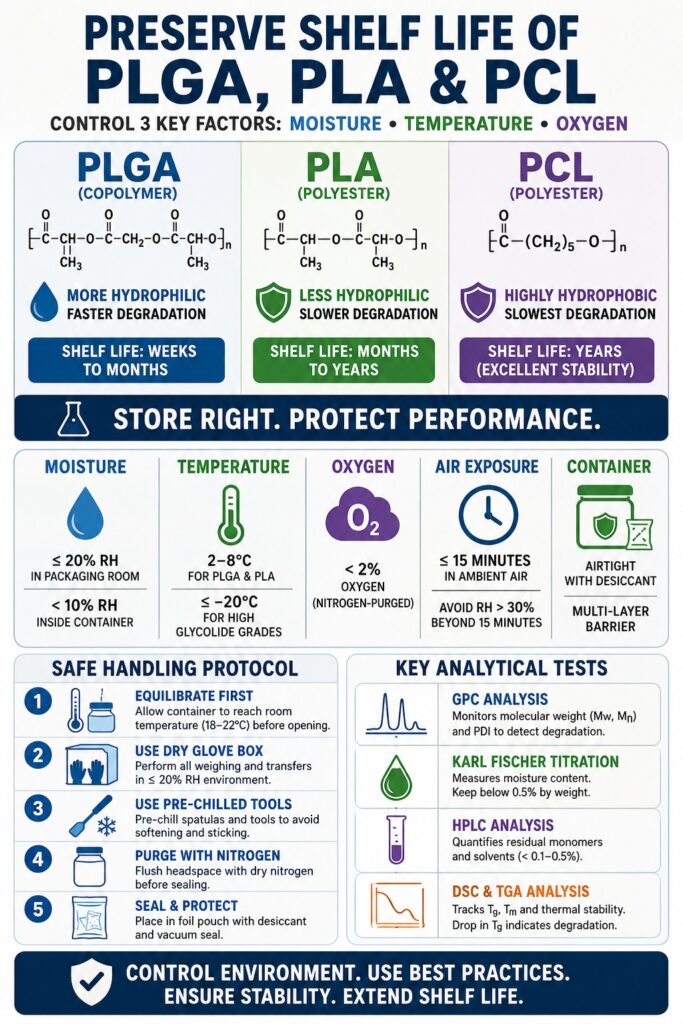
The shelf life of biodegradable polyesters is primarily influenced by their chemical composition, stereochemistry, and molecular weight, all of which determine their vulnerability to moisture-driven hydrolysis. The ester linkages present in PLGA, PLA, and PCL degrade at different rates, creating distinct storage requirements and performance characteristics.
      PLGA (Copolymer)                       PLA (Polyester)                      PCL (Polyester)

  O                 O                    O                    O               O
  ||                ||                   ||                   ||              ||
[-C-CH-O-C-CH2-O-C-CH-O-]n           [-C-CH-O-C-CH-O-]n           [-C-(CH2)5-O-]n
     |                 |                  |         |
     CH3               CH3                CH3       CH3

(Hydrophilic Glycolide Units          (Hydrophobic Methyl Units         (Five Hydrophobic Methylene
 Accelerate Hydrolysis)                Inhibit Hydrolysis)               Groups Restrict Water)
When designing long-acting injectable depots, careful selection of the polymer carrier is essential for performance. Explore PLGA long-acting injectable formulation strategies
Hydrolytic cleavage of ester bonds within these polymers proceeds through a pseudo-first-order kinetic mechanism under moisture-saturated conditions and can be described by the following rate equation:
d[E]/dt = -k[E][H₂O]
where [E] represents the concentration of ester linkages, [H₂O] denotes the concentration of water within the polymer matrix, and k is the hydrolysis rate constant.
The hydrolysis rate constant is temperature dependent and follows the Arrhenius relationship:
k = A exp(-Ea / RT)
where Ea is the activation energy for hydrolysis, R is the universal gas constant, T is the absolute temperature, and A is the pre-exponential factor. Polymers exhibiting lower activation energies, often due to increased hydrophilic monomer content or specific end-group chemistries, generally demonstrate reduced storage stability under ambient conditions.
| Polymer Type | Inherent Viscosity (dL/g) | Typical Average Molecular Weight (Mw, Da) | End-Group Chemistry | In Vivo Degradation Timeframe | Sourced Catalog Specifications |
|---|---|---|---|---|---|
| RESOMER® RG 501 H | 0.08–0.16 | 7,000–15,000 | Acid-Terminated | < 3 Months | 50:50 Poly(D,L-lactide-co-glycolide) |
| RESOMER® RG 502 | 0.16–0.24 | 15,000–25,000 | Ester-Terminated | < 3 Months | 50:50 Poly(D,L-lactide-co-glycolide) |
| RESOMER® RG 503 H | 0.32–0.44 | 25,000–40,000 | Acid-Terminated | < 3 Months | 50:50 Poly(D,L-lactide-co-glycolide) |
| LACTEL® 50:50 DL-PLGE | 0.55–0.75 | 40,000–75,000 | Ester-Terminated | < 3 Months | 50:50 Poly(D,L-lactide-co-glycolide) |
| RESOMER® RG 752 H | 0.14–0.22 | 10,000–20,000 | Acid-Terminated | < 6 Months | 75:25 Poly(D,L-lactide-co-glycolide) |
| RESOMER® R 205 S | 0.55–0.75 | 50,000–80,000 | Ester-Terminated | < 18 Months | Poly(D,L-lactide) |
| RESOMER® L 206 S | 0.80–1.30 | 80,000–120,000 | Ester-Terminated | > 48 Months | Poly(L-lactide) (PLLA) |
| RESOMER® C 212 | 0.80–1.38 | 80,000–110,000 | Ester-Terminated | > 24 Months | Polycaprolactone (PCL) |
Effective formulation often hinges on the precise control of polymer characteristics, such as the polydispersity index (PDI). Read about the importance of PDI in pharmaceutical applications
Stereochemistry and Crystallinity Effects on Hydrolysis
Crystallinity serves as a physical barrier against water penetration and therefore plays a direct role in determining the rate of hydrolytic degradation during storage. Crystalline regions are characterized by tightly packed molecular chains that restrict water diffusion and reduce hydrolytic attack.
Poly-L-lactide (PLLA), composed exclusively of stereochemically pure L-lactide units, is a highly semi-crystalline polymer with a melting temperature (Tm) of 150–160°C. This highly ordered crystalline structure limits water ingress, resulting in degradation times that can extend over several years in vivo while also providing excellent shelf-life stability under appropriate storage conditions.
In contrast, poly-D,L-lactic acid (PDLLA) is an amorphous polymer formed from a racemic mixture of D- and L-enantiomers. The random arrangement of monomer units disrupts crystalline packing, creating a more open structure that is significantly more susceptible to hydrolytic attack.
Polycaprolactone (PCL) is a semi-crystalline aliphatic polyester exhibiting crystallinity levels of approximately 20–33%, a glass transition temperature (Tg) near -60°C, and a melting point (Tm) between 58–61°C. Its molecular structure contains five hydrophobic methylene (-CH₂-) groups for every ester linkage, limiting water accumulation around hydrolysis-sensitive ester bonds.
Because of its hydrophobic character and relatively high crystallinity, bulk PCL degrades primarily through slow, surface-controlled erosion rather than rapid autocatalytic bulk erosion. As a result, PCL demonstrates excellent storage stability and can maintain a shelf life extending several years when stored under suitable ambient conditions.
To better understand how these polymers behave, it is useful to compare their specific degradation mechanisms. Compare bulk erosion vs. surface erosion in PLGA
Influence of Polymer End-Groups and Copolymer Ratios
The terminal chemistry and monomer composition of PLGA and PLA significantly influence overall hydrophilicity and, consequently, susceptibility to hydrolytic degradation during storage.
PLGA is synthesized as a random copolymer of lactic acid (LA) and glycolic acid (GA). Increasing the glycolic acid content generally accelerates degradation because glycolic acid lacks the hydrophobic methyl side group present in lactic acid. As a result, glycolide-rich polymer segments exhibit greater hydrophilicity and absorb moisture more readily.
The most rapid degradation is typically observed in PLGA 50:50 formulations. This composition combines low crystallinity with high hydrophilicity, facilitating rapid water uptake and leading to accelerated degradation and a shorter baseline shelf life.
Lactic Acid (LA) Monomer Unit       Glycolic Acid (GA) Monomer Unit

         CH3                                    H
         |                                      |
   [-O-CH-C-]                             [-O-CH-C-]
          ||                                     ||
          O                                      O

(Hydrophobic Methyl Group              (Lacks Methyl Group;
 Limits Water Uptake)                  Highly Hydrophilic)
Polymer end-group chemistry also plays a major role in hydrolysis kinetics. Ester-terminated polymers contain alkyl-capped chain ends that provide enhanced resistance to hydrolysis.
By comparison, acid-terminated polymers contain free terminal carboxylic acid groups (-COOH), making them significantly more hydrophilic. These acidic groups serve as internal proton sources capable of catalyzing ester bond cleavage through autocatalytic mechanisms. Consequently, acid-terminated grades such as RESOMER® RG 502 H degrade more rapidly than ester-terminated alternatives like RESOMER® RG 502 when exposed to identical environmental conditions.
Establishing polymer sameness is a critical step in regulatory approval processes. Learn about PLGA polymer sameness for ANDA
Critical Storage Parameters That Preserve the Shelf Life of PLGA, PLA, and PCL
Preserving the molecular weight, polydispersity index, and critical quality attributes of PLGA, PLA, and PCL requires strict control of environmental conditions throughout storage. Variations in temperature, humidity, and atmospheric composition can initiate premature hydrolysis and compromise polymer performance.
| Environmental Parameter | Recommended Limit / Specification | Physical Rationale & Chemical Impact | Action Threshold for Stability Failure |
| Relative Humidity (RH) | ≤ 20% in packaging room; < 10% inside sealed containers | Minimizes water adsorption and suppresses ester hydrolysis | Moisture content > 0.5% by weight |
| Bulk Storage Temperature | 2–8°C for standard PLGA/PLA; ≤ -20°C for high-glycolide grades | Reduces hydrolysis kinetics and maintains Tg stability | > 25°C for more than 48 hours |
| Secondary Packaging Temperature | ≤ 25°C during assembly | Prevents thermal stress and premature softening | > 30°C during packaging |
| Oxygen Concentration | < 2% (nitrogen-purged) | Reduces oxidative chain scission | > 5% oxygen inside primary packaging |
| Ambient Air Exposure Limit | ≤ 15 minutes | Limits moisture uptake from the environment | RH > 30% for longer than 15 minutes |
Temperature and Thermal Transition Thresholds
Lower temperatures reduce molecular mobility and slow hydrolytic degradation, helping preserve polymer stability and glass transition characteristics.
When amorphous polymers such as PLGA or PDLLA are stored near or above their glass transition temperatures (approximately 40–60°C for PLGA and 50–65°C for PLA), they transition from a rigid glassy state to a softer rubbery state. This transition increases free volume and chain mobility, enabling water molecules to diffuse more readily into the polymer matrix and accelerate hydrolysis.
To minimize degradation, bulk PLGA and amorphous PLA should be stored in temperature-controlled refrigeration systems maintained between 2–8°C. Highly hydrophilic and rapidly degrading formulations, including PLGA 50:50 grades, should be stored at -20°C.
PCL exhibits an exceptionally low Tg of approximately -60°C and therefore remains in a rubbery state at room temperature. Nevertheless, its relatively high crystallinity and melting temperature provide substantial resistance to moisture diffusion. As a result, PCL can generally be stored safely in cool, dry environments maintained between 15–25°C.
                    Increasing Temperature

Deep Freeze (-20°C) ---> Refrigerated (2-8°C) ---> Room Temp (25°C) ---> Softening (Tg)
        |                          |                     |                     |
 [Maximum Stability]       [Standard Storage]     [PCL Stable]       [Rubbery State Begins]
For specialized applications, understanding degradation rates across different polymers is crucial for stability. Understand the degradation rates comparison for PLGA, PLA, and PCL
Humidity Control and Atmospheric Isolation Standards
Water functions not only as a reactant but also as a plasticizer within aliphatic polyesters, making strict moisture control essential for preserving shelf life.
Water absorbed into amorphous regions lowers the glass transition temperature by plasticizing the polymer matrix. As Tg decreases, the polymer may transition into a more mobile state under normal storage conditions, facilitating additional moisture diffusion and accelerating hydrolytic ester bond cleavage.
In addition to moisture-related degradation, trace levels of atmospheric oxygen may contribute to oxidative chain scission, particularly under light exposure. To minimize these risks, primary packaging should be purged with high-purity nitrogen gas to reduce oxygen concentrations below 2% before hermetic sealing.
This inert environment helps prevent both oxidative degradation and moisture ingress throughout long-term storage.
Strategic Handling and Repackaging Protocols to Prevent Degradation
Maintaining the long-term integrity of biodegradable polyesters requires carefully controlled handling and repackaging procedures designed to minimize environmental moisture exposure. Due to their hygroscopic nature, even brief exposure to ambient air can introduce sufficient moisture to initiate irreversible degradation processes.
INCORRECT OPENING PROCESS (Condensation Risk)

[Cold Container at 2-8°C] --> Immediate Opening --> Moisture Condensation --> Accelerated Hydrolysis

CORRECT OPENING PROCESS (Thermal Equilibrium)

[Cold Container at 2-8°C] --> Equilibrate to Room Temperature --> Open in Dry Glove Box --> Minimal Hydrolysis Risk
To ensure safe handling, laboratories should implement the following procedures:
Thermal Equilibration Prior to Opening
Containers removed from refrigerated storage should never be opened immediately. Instead, they must be allowed to equilibrate to room temperature (18–22°C) before breaking the hermetic seal. Opening a cold container in humid ambient air causes condensation to form directly on the polymer surface, initiating hydrolysis before resealing.
Low-Humidity Glove Box Environments
All weighing, aliquoting, and repackaging activities should be performed inside an inert-gas glove box or controlled laminar-flow environment equipped with active moisture control systems capable of maintaining relative humidity at ≤ 20%.
Pre-Chilled Handling Implements
Metal spatulas, funnels, and transfer tools should be pre-chilled before contact with low-Tg polymers. This reduces the likelihood of polymer softening, adhesion to tools, and heat transfer during handling.
Multi-Layer Primary Barrier Selection
Repackaged materials should be stored in high-density polyethylene (HDPE) containers fitted with desiccant-lined closures or Type I borosilicate glass vials equipped with fluoropolymer-coated stoppers to minimize contamination and leachable compounds.
Nitrogen Inertion and Secondary Foil Sealing
Before sealing, container headspace should be purged with dry nitrogen gas. The primary container should then be enclosed within a vacuum-sealed aluminum laminate pouch containing a molecular sieve desiccant packet to provide additional moisture protection.
For specialized applications, understanding degradation rates across different polymers is crucial for stability. Understand the degradation rates comparison for PLGA, PLA, and PCL
Key Analytical Specifications and Testing Methods to Validate the Shelf Life of PLGA, PLA, and PCL
Determining the shelf stability of PLGA, PLA, and PCL requires a comprehensive analytical testing program capable of monitoring physical and chemical changes throughout storage. Stability studies evaluate critical quality attributes to ensure that each polymer batch remains within validated specifications.
STABILITY EVALUATION WORKFLOW

+-------------------------------------------------------+
|              Biodegradable Polymer Batch              |
+-------------------------------------------------------+
                           |
      +--------------------+--------------------+
      |                    |                    |
      v                    v                    v
 +----------+         +----------+         +----------+
 |   GPC    |         |   DSC    |         | Karl F.  |
 | Analysis |         | Analysis |         |Titration |
 +----------+         +----------+         +----------+
      |                    |                    |
      v                    v                    v

[Molecular Weight]   [Glass Transition]   [Residual Moisture]
Gel Permeation Chromatography (GPC)
GPC is the primary analytical technique used to assess polymer degradation through measurement of weight-average molecular weight (Mw), number-average molecular weight (Mn), and polydispersity index (PDI = Mw/Mn).
Hydrolytic ester cleavage converts long polymer chains into shorter oligomeric fragments, causing molecular weight reduction and broadening of the molecular weight distribution.
Medical-grade PLGA typically requires a narrow PDI range of approximately 1.2–1.5 to ensure predictable drug release behavior and minimize the risk of dose dumping. Any downward shift in molecular weight distribution indicates hydrolytic instability and potential shelf-life failure.
Karl Fischer Titration
Karl Fischer coulometric titration is the preferred analytical method for quantifying trace moisture content within hydrophobic polymer matrices.
To prevent solid-state hydrolysis during long-term storage, residual moisture levels in PLA, PLGA, and PCL should remain below 0.5% by weight. Elevated moisture concentrations can accelerate autocatalytic degradation and significantly shorten shelf life.
High-Performance Liquid Chromatography (HPLC)
HPLC is used to quantify residual monomers such as lactic acid, glycolic acid, and caprolactone, along with residual solvents originating from synthesis and processing.
Because free monomers contain hydrophilic carboxyl groups that promote degradation, pharmaceutical-grade specifications typically limit residual monomer concentrations to less than 0.1–0.5% by mass.
Differential Scanning Calorimetry (DSC) and Thermogravimetric Analysis (TGA)
DSC evaluates critical thermal properties including glass transition temperature (Tg), melting temperature (Tm), and enthalpy of fusion. TGA measures weight loss as a function of temperature and is used to assess thermal stability.
Solid-state hydrolysis generates low-molecular-weight oligomers that plasticize the polymer matrix and produce measurable decreases in Tg.
A reduction in Tg indicates that the material is becoming increasingly susceptible to moisture diffusion due to enhanced chain mobility. TGA also monitors the onset of thermal decomposition, which should generally remain above 300–350°C for high-purity PLA and PCL materials.
Conclusion: Achieving Analytical Precision and Preserving the Shelf Life of PLGA, PLA, and PCL
Preserving the shelf life of PLGA, PLA, and PCL requires stringent environmental control, validated barrier packaging systems, and continuous analytical monitoring to prevent premature degradation. These aliphatic polyesters are highly sensitive to moisture exposure, temperature fluctuations, and catalytic impurities, making disciplined storage practices essential for maintaining polymer performance and formulation reliability.
Establishing and maintaining a validated shelf life requires a comprehensive strategy that begins with high-purity polymer synthesis and extends through nitrogen-purged packaging systems, controlled transportation, and cleanroom handling procedures. Collaborating with a specialized Contract Research Organization (CRO) that offers advanced material characterization and stability testing can help ensure that polymer batches retain their critical quality attributes throughout their intended storage period.
For expert support in ensuring your biologics meet stability requirements, consider professional characterization services. Learn more about the characterization of long-acting biologics
For detailed inquiries regarding custom polymer synthesis, stability validation, and advanced analytical testing, please visit the ResolveMass Laboratories Inc. scientific team at the ResolveMass Laboratories Contact Page.
Frequently Asked Questions
Medical-grade PLGA generally maintains its stability for approximately 12 to 24 months when stored under controlled refrigerated conditions between 2°C and 8°C. To achieve this shelf life, the polymer should remain in hermetically sealed, moisture-resistant packaging that limits exposure to humidity. More hydrolysis-sensitive grades, particularly PLGA 50:50 formulations with higher glycolide content, often require storage at -20°C to further suppress moisture-induced degradation. Proper temperature management is critical for preserving molecular weight and formulation performance.
PLA can typically be stored at room temperature, usually within the range of 15°C to 25°C, without significant degradation when protected from moisture. The polymer should remain in unopened barrier packaging that maintains very low internal humidity levels. Although room-temperature storage is acceptable for many applications, refrigerated storage between 2°C and 8°C is often preferred for high-molecular-weight medical-grade PLA. Cooler storage conditions help preserve molecular integrity and minimize gradual hydrolytic changes over time.
PCL demonstrates superior storage stability because its molecular structure is significantly more hydrophobic than that of PLGA and PLA. The presence of multiple methylene (-CH₂-) groups between ester linkages reduces water uptake and slows hydrolytic reactions. In addition, its semi-crystalline structure creates densely packed regions that limit moisture diffusion throughout the polymer matrix. These characteristics collectively contribute to slower degradation rates and extended shelf-life performance.
Nitrogen purging is an important protective measure used to create an inert environment inside storage containers. By replacing atmospheric air with dry nitrogen, both oxygen and moisture levels are significantly reduced. This helps prevent oxidative chain degradation while also limiting water vapor exposure that can initiate hydrolysis. As a result, nitrogen-purged packaging enhances long-term polymer stability and helps preserve critical material properties.
Yes, terminal sterilization methods such as gamma irradiation and electron-beam sterilization can influence polymer stability. These processes may induce chain scission within the polymer structure, causing an immediate reduction in average molecular weight and changes in molecular weight distribution. As a consequence, the material may become more susceptible to hydrolytic degradation during storage. Careful evaluation of post-sterilization properties is therefore essential when establishing shelf-life specifications.
During labeling, packaging, and assembly operations, the processing environment should ideally remain at or below 25°C. Elevated temperatures can increase polymer chain mobility and may cause softening in amorphous PLGA grades that possess relatively low glass transition temperatures. Maintaining a controlled temperature environment helps prevent handling difficulties, material deformation, and unwanted changes in polymer characteristics. Consistent thermal control also supports overall product quality and stability.
Residual monomers can negatively impact polymer shelf stability because they often contain free carboxylic acid functionalities that attract moisture. These acidic species can lower the local pH within the polymer matrix and promote hydrolytic cleavage of nearby ester bonds. As degradation progresses, molecular weight declines and the polymer becomes less stable during storage. Minimizing residual monomer content is therefore an important quality requirement for pharmaceutical and medical-grade materials.
Before a polymer is incorporated into a formulation, several analytical evaluations should be conducted to confirm its stability and quality. Gel Permeation Chromatography (GPC) is commonly used to determine molecular weight and polydispersity index, while Karl Fischer titration measures residual moisture content. Differential Scanning Calorimetry (DSC) is also performed to assess thermal properties, including the glass transition temperature (Tg). Together, these tests provide critical information regarding polymer integrity and storage suitability.
Reference:
- Kim, H., Kim, J., Lee, J., & Park, S. (2025). Advances in PCL, PLA, and PLGA-based technologies for anticancer drug delivery. Pharmaceutics, 17(11), Article 1570. https://doi.org/10.3390/pharmaceutics17111570
- Chłopek, J., Morawska-Chochół, A., & Borysiak, S. (2022). Thermal stability of polycaprolactone grafted densely with maleic anhydride analysed using the Coats–Redfern equation. Materials, 15(19), 6846. https://doi.org/10.3390/ma15196846
- Makadia, H. K., & Siegel, S. J. (2011). Poly(lactic-co-glycolic acid) (PLGA) as biodegradable controlled drug delivery carrier. Polymers, 3(3), 1377–1397. https://doi.org/10.3390/polym3031377
- Kim, H., Kim, J., Lee, J., & Park, S. (2024). Advances in PCL, PLA, and PLGA-based technologies for anticancer drug delivery. Pharmaceutics, 16(11), 1570. https://doi.org/10.3390/pharmaceutics16111570
- Kim, Y., Kwak, J., Lim, M., Lim, S. Y., Chae, S., Ha, S.-J., Won, Y.-W., Kim, H.-O., & Lim, K. S. (2025). Advances in PCL, PLA, and PLGA-based technologies for anticancer drug delivery. Pharmaceutics, 17(10), 1354. https://doi.org/10.3390/pharmaceutics17101354
- Kim, H. J., Lee, J. H., Kim, Y. H., Park, S. H., & Kim, G. H. (2024). Fabrication and evaluation of PCL/PLGA/β-TCP spiral-structured scaffolds for bone tissue engineering. Bioengineering, 11(7), 732. https://doi.org/10.3390/bioengineering11070732
Get In Touch With Us
About The Author


