

Introduction
Single-Use Systems and GMP Extractables and Leachables (E&L) Testing establishes the analytical foundation necessary for detecting, identifying, quantifying, and controlling chemical impurities that may migrate from polymeric equipment into biopharmaceutical drug substances and products. Assessing potential chemical migrants before commercial manufacturing enables biopharmaceutical manufacturers to protect therapeutic protein stability, biological potency, and patient safety from unintended chemical contamination. The shift from conventional fixed stainless-steel vessels toward flexible polymer-based single-use systems (SUTs)—including biocontainers, silicone transfer tubing, sterile filter cartridges, chromatography columns, connectors, and single-use sensors—has added significant material science considerations to good manufacturing practice (GMP) processes. Polymeric materials typically consist of complex combinations of structural base polymers, primary and secondary antioxidants, plasticizers, slip additives, vulcanization accelerators, and photoinitiators. During bioprocessing, these additives and their chemical degradation products may migrate from the polymeric materials into process streams, biological drug substances, and finished formulations.
Explore options for Low-Leachables Packaging Materials
As regulatory expectations continue to become more stringent worldwide through mandatory compendial standards such as United States Pharmacopeia (USP) Chapter , USP Chapter , the draft International Council for Harmonisation (ICH) Q3E guidance, and European Union Good Manufacturing Practice (EU GMP) Annex 1 (Section 8.126), biopharmaceutical manufacturers must establish sophisticated analytical testing programs. Chemical characterization requires specialized laboratory approaches that can detect contaminants at trace concentrations within complex biological matrices while minimizing the possibility of analytical artifacts. Organizations with expertise in high-resolution mass spectrometry workflows, such as ResolveMass Laboratories Inc., offer the analytical sensitivity, advanced instrumentation, and toxicological risk assessment capabilities necessary to define scientifically defensible safety thresholds and support compliant biomanufacturing operations.
Learn more about Outsourcing E&L Testing Services
Share via:
Quick Summary:
- Single-use systems (SUS) require robust E&L testing to detect, identify, quantify, and control chemical migrants that could affect protein stability, biological potency, product quality, and patient safety.
- Regulatory expectations are increasingly risk-based, with frameworks such as USP, BPOG, draft ICH Q3E, and EU GMP Annex 1 guiding extractables characterization, leachables assessment, and lifecycle control.
- Risk assessment depends on three key factors: process-fluid chemistry, operating conditions (temperature/time/surface-area-to-volume), and component proximity to the final drug product.
- AET (Analytical Evaluation Threshold) establishes when detected compounds require identification and toxicological evaluation. It incorporates SCT, maximum daily dose, batch volume, component surface area, extraction volume, and analytical uncertainty.
- Advanced mass spectrometry enables comprehensive characterization: GC-MS targets volatile/semi-volatile compounds, LC-HRMS identifies non-volatile organic migrants and oligomers, while ICP-MS detects elemental impurities and trace metals.
- Lifecycle management follows five stages: material & supplier qualification → process risk assessment → analytical characterization → real-time leachables/stability monitoring → change control & re-evaluation.
- Proactive controls strengthen biopharmaceutical safety, including pre-conditioning flushes, upstream/downstream risk differentiation, compatibility & adsorption studies, supplier oversight, and specialized analytical support to maintain GMP compliance and protect product quality.
Regulatory Frameworks Governing Single-Use Systems and GMP Extractables and Leachables (E&L) Testing
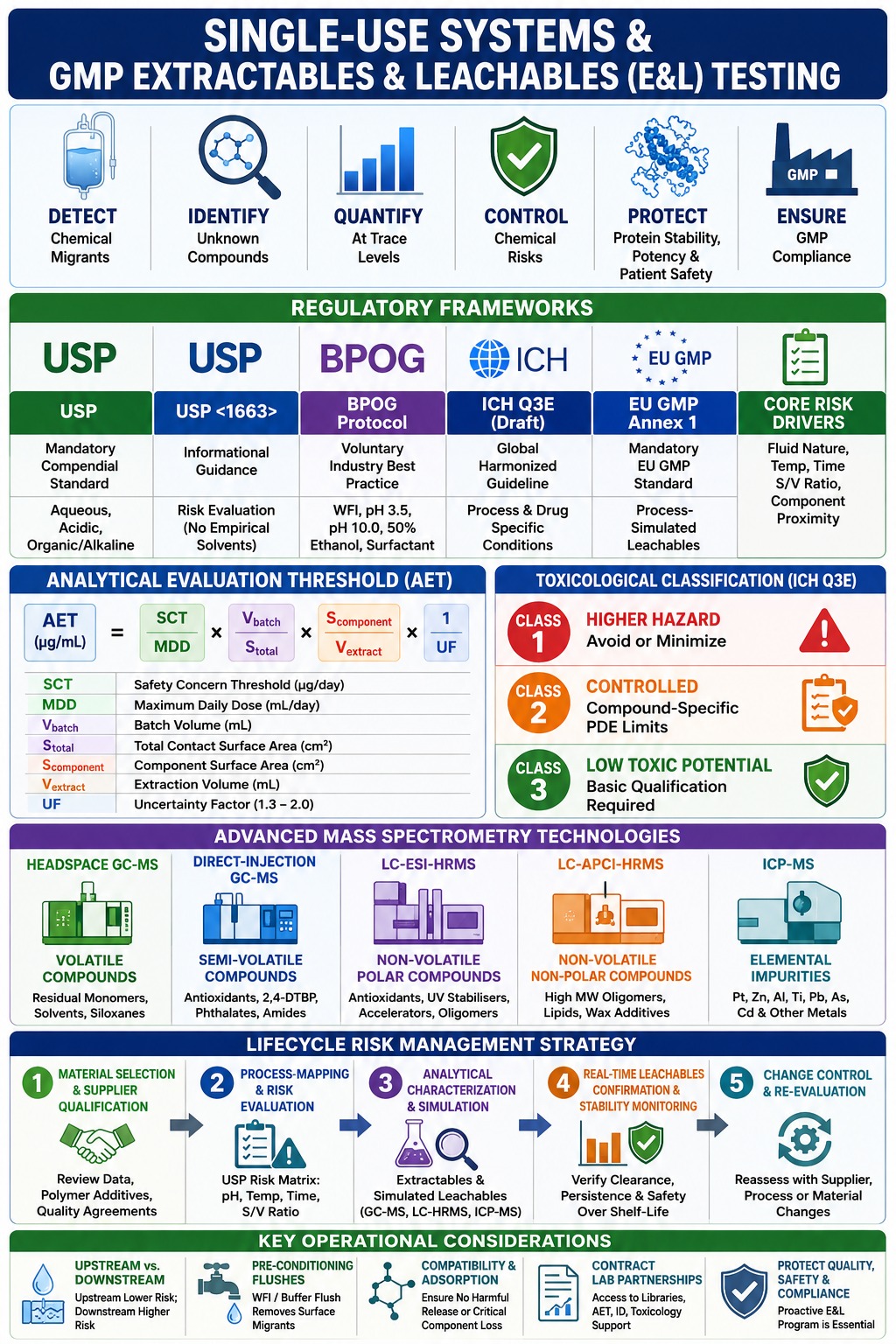
Regulatory expectations associated with Single-Use Systems and GMP Extractables and Leachables (E&L) Testing are established through mandatory compendial standards such as USP , guidance documents including USP and ICH Q3E, and regional requirements such as EU GMP Annex 1. Collectively, these frameworks provide expectations for standardized extraction approaches, risk-based testing thresholds, chemical characterization, and lifecycle control of components used throughout biopharmaceutical manufacturing.
USP and USP Compendial Requirements
USP establishes standardized chemical characterization expectations for plastic components that come into direct contact with biopharmaceutical manufacturing streams, while USP provides a structured risk evaluation approach for classifying materials used in bioprocessing applications. Effective May 1, 2026, these standards establish requirements for extractables characterization of polymer-based components utilized in the manufacture of drug substances and human drug products.
The risk-based framework described in USP considers three major drivers that influence the potential for chemical migration:
- Process Fluid Character: Assessing the chemical aggressivity of the process fluid, including its organic solvent content, surfactant concentration, and extreme pH conditions.
- Operational Parameters: Evaluating processing temperature, duration of contact, and the surface-area-to-volume ratios associated with the contact components.
- Component Proximity to Final Drug Product: Considering the location of the component within the manufacturing process, its proximity to the final drug substance or product, and the ability of downstream processing steps to remove potential contaminants.
Components determined to represent a high level of risk require chemical characterization under standardized extraction conditions. In contrast, components categorized as lower risk may be qualified through a scientifically justified assessment, supplier-generated historical information, or other appropriate supporting data.
Review criteria for Solvents for Extractables Studies
BioPhorum Operations Group (BPOG) Protocol Alignment
BioPhorum (BPOG) standardized extractables protocols represent an industry-developed, multi-solvent extraction strategy intended to assess potential chemical migration under challenging conditions that can represent different bioprocessing environments. BPOG extractables datasets supplied by single-use component manufacturers are frequently used as important inputs for preliminary risk assessments and baseline chemical characterization.
The BPOG protocol established an industry-consensus approach involving representative solvents, including water for injection (WFI), low pH conditions (pH 3.5), high pH conditions (pH 10.0), 50% ethanol/water, and surfactant-containing matrices. Components are exposed to these extraction environments over multiple time points extending to 21 days. Although USP has simplified baseline testing around a three-solvent framework involving WFI, acidic conditions, and organic/alkaline matrices according to the application, BPOG data generated by single-use component suppliers continues to provide valuable information for preliminary E&L risk assessments.
Global Regulatory Harmonization: ICH Q3E and EU GMP Annex 1
The draft ICH Q3E guideline and EU GMP Annex 1 (Section 8.126) support a globally harmonized, lifecycle-based approach to the control of extractables and leachables in biopharmaceutical manufacturing. These regulatory frameworks expect manufacturers to establish evidence that chemical migrants originating from polymeric materials do not adversely affect drug stability, promote protein aggregation, reduce biological activity, or create unacceptable patient safety risks.
The draft ICH Q3E guideline, which has been issued for public consultation, is intended to harmonize expectations for extractables and leachables across regulatory regions, including the FDA, EMA, PMDA, and Health Canada. ICH Q3E incorporates E&L assessment into broader quality risk management principles described in ICH Q9 and established impurity control frameworks, including ICH Q3A–D and M7. In addition, EU GMP Annex 1 specifically addresses the use of single-use systems under Section 8.126. It requires manufacturers to assess extractable profiles and conduct appropriate leachable studies for high-risk components to minimize risks such as polymer-mediated protein aggregation, loss of biological activity, and other quality impacts.
| Regulatory Framework / Standard | Legal / Enforcement Status | Target Application Scope | Primary Testing Solvents / Matrices | Core Risk Assessment Drivers |
|---|---|---|---|---|
| USP | Mandatory Compendial Standard | Plastic components contacting bioprocess streams | Baseline extractions: Aqueous, acidic, and organic/alkaline solutions | Fluid chemical nature, temperature, contact duration, surface-area-to-volume ratio |
| USP | Informational Guidance Chapter | Plastic components used in bioprocessing | Risk-evaluation scoring framework (no empirical solvents) | Process fluid aggressivity, component function, downstream processing location |
| BPOG Protocol | Voluntary Industry Best Practice | Single-use components across biomanufacturing | WFI, 0.1 M HCl, 0.1 M NaOH, 50% Ethanol, Polysorbate 80 | Extended time points (up to 21 days), worst-case organic/aqueous solvent exposure |
| ICH Q3E (Draft) | Global Harmonized Guideline | Full lifecycle E&L control in pharmaceuticals & biologics | Derived based on target drug formulation and process contact conditions | Toxicological concern thresholds (SCT/TTC), lifecycle re-evaluation, safety margins |
| EU GMP Annex 1 | Mandatory European GMP Standard | Sterility assurance and SUT in sterile drug manufacturing | Process-simulated leachables studies | Polymer-mediated protein aggregation, particle formation, adsorption, toxicity |
Analytical Evaluation Threshold (AET) Derivation and Toxicological Safety Evaluation
The Analytical Evaluation Threshold (AET) represents the concentration level above which an extractable or leachable compound requires structural identification and subsequent toxicological assessment. Based on dose-related Safety Concern Thresholds (SCT), the AET translates clinical exposure information, component contact characteristics, and analytical uncertainty into a practical reporting threshold for laboratory testing.
Understand key calculations for AET for Extractables and Leachables Studies
Calculation of the AET incorporates several factors, including toxicological safety limits, the daily clinical dose volume, the total surface-area-to-volume relationship of the manufacturing components, and the Analytical Uncertainty Factor (UF). The uncertainty factor accounts for potential differences in chromatographic and mass spectrometric response factors when unknown compounds are quantified using surrogate reference standards.
The standardized mathematical expression used to calculate the AET, expressed in μg/mL, for a single-use manufacturing component stream is:
AET = SCT⁄MDD × Vbatch⁄Stotal × Scomponent⁄Vextract × 1⁄UF
Where:
- SCT (Safety Concern Threshold): The absolute daily intake threshold below which a leachable is considered to present negligible mutagenic or toxicological concern (typically 1.5 μg/day for mutagenic impurities based on ICH M7 principles, or higher thresholds for qualified non-mutagenic compounds).
- MDD (Maximum Daily Dose): The maximum volume or quantity of the final drug product administered to a patient within a 24-hour period (mL/day).
- V_batch: The total volume of the production batch (mL).
- S_total: The combined surface area of all components that come into contact with the manufacturing process stream (cm²).
- S_component: The surface area of the individual component being evaluated (cm²).
- V_extract: The volume of extraction solvent used during the laboratory extraction procedure (mL).
- UF (Analytical Uncertainty Factor): A numerical factor, typically ranging from 1.3 to 2.0, that accounts for variations in detector response factors across different chemical species during mass spectrometric analysis.
Extractable or leachable compounds detected above the calculated AET are subjected to further toxicological evaluation. Such assessments may incorporate structure-activity relationship (SAR) modeling, computational toxicology platforms, and Permissible Daily Exposure (PDE) limits obtained from established toxicological databases. Under ICH Q3E principles, leachables can be classified into Class 1, comprising compounds associated with higher hazards that should be avoided or minimized as far as practicable; Class 2, comprising compounds controlled according to compound-specific PDE limits; and Class 3, comprising compounds considered to have low toxicological potential and therefore requiring basic qualification.
Discover strategies for Toxicological Qualification of Leachables
Advanced Mass Spectrometry Technologies in Single-Use Systems and GMP Extractables and Leachables (E&L) Testing
Comprehensive chemical characterization within Single-Use Systems and GMP Extractables and Leachables (E&L) Testing depends on complementary mass spectrometry platforms, including GC-MS, LC-HRMS, and ICP-MS. Together, these high-resolution analytical technologies support the detection, identification, structural characterization, and quantitative assessment of volatile, semi-volatile, non-volatile, and elemental chemical migrants.
Gas Chromatography-Mass Spectrometry (GC-MS) for Volatile and Semi-Volatiles
Gas chromatography-mass spectrometry (GC-MS) is used primarily to investigate volatile and semi-volatile organic compounds that may originate from polymer degradation, residual monomers, processing materials, and additives incorporated into single-use components. Static headspace and direct-injection GC-MS approaches allow laboratories to screen for low-boiling solvents, plasticizers, residual processing chemicals, and degradation products generated from antioxidants.
Static headspace GC-MS provides an effective approach for isolating low-boiling compounds—including residual monomers such as vinyl chloride and butadiene, residual solvents, and low-molecular-weight siloxanes—without requiring conventional solvent extraction. Direct-injection GC-MS, using electron ionization (EI) and chemical ionization (CI) modes, can characterize semi-volatile migrants such as antioxidant degradation products, including 2,4-di-tert-butylphenol (2,4-DTBP), phthalate and non-phthalate plasticizers, and fatty acid amides such as erucamide and oleamide.
Compare methodologies in GC-MS vs LC-MS in E&L Testing
Liquid Chromatography-High Resolution Mass Spectrometry (LC-HRMS) for Non-Volatile Organic Extractables
Liquid chromatography coupled with high-resolution accurate mass spectrometry (LC-HRMS) is applied to the characterization of non-volatile organic extractables, higher-molecular-weight additives, and polymer-derived oligomers. With ESI and APCI ionization sources, LC-HRMS provides accurate mass information and fragmentation data that are essential for elucidating the structures of complex and previously unknown chemical migrants.
By employing electrospray ionization (ESI) and atmospheric pressure chemical ionization (APCI) in both positive and negative polarity modes, LC-HRMS platforms, including Orbitrap and Time-of-Flight mass spectrometers, can detect and characterize higher-molecular-weight species. Important target analytes include primary antioxidant degradation products associated with materials such as Irganox 1010 and Irgafos 168, light stabilizers such as Tinuvin series compounds, vulcanization accelerators such as 2-mercaptobenzothiazole from elastomeric gaskets, and polymer oligomers. Accurate mass determination with a mass error of ≤ 2 ppm, together with MS/MS fragmentation information, supports confident compound assignment and structural characterization.
Inductively Coupled Plasma-Mass Spectrometry (ICP-MS) for Elemental Impurities
Inductively coupled plasma-mass spectrometry (ICP-MS) provides highly sensitive detection of elemental extractables, trace metals, and catalyst residues that may migrate from single-use polymeric components and elastomeric seals. ICP-MS analysis is important for supporting compliance with ICH Q3D requirements and for identifying elemental contaminants that could potentially catalyze oxidative reactions involving biological molecules.
Single-use polymers and elastomeric materials may contain or be manufactured using metal catalysts, such as platinum in addition-cured silicone tubing and zinc or titanium catalysts associated with polyolefin materials. They may also contain inorganic fillers, including silica and calcium stearate. ICP-MS screening allows elemental migrants across a broad portion of the periodic table to be monitored and evaluated against ICH Q3D elemental impurity limits. Such monitoring also helps assess the potential for metal-catalyzed protein oxidation in biologic formulations.
Explore applications for ICP-MS in E&L Testing
| Analytical Technique | Target Impurity Class | Volatility / Polarity Range | Key Example Analytes Identified | Primary Extraction / Sample Prep Matrix |
|---|---|---|---|---|
| Headspace GC-MS | Volatile Organic Compounds (VOCs) | High volatility / Non-polar to medium polarity | Residual monomers, low-boiling solvents, short-chain siloxanes | Direct thermal desorption, sealed vial static headspace |
| Direct-Injection GC-MS | Semi-Volatile Organic Compounds (SVOCs) | Medium volatility / Non-polar to moderate polarity | 2,4-DTBP, phthalates, erucamide, organophosphates | Dichloromethane, hexane, or ethanol concentrated extracts |
| LC-ESI-HRMS | Non-Volatile Organic Compounds (NVOCs) | Low volatility / Moderate to high polarity | Irganox 1010/1076, Irgafos 168 oxide, photoinitiators, oligomers | Isopropanol, ethanol/water mixtures, aqueous buffers |
| LC-APCI-HRMS | Non-Volatile / Non-Polar Compounds | Low volatility / Low to non-polar species | High-molecular-weight polyolefin oligomers, lipids, wax additives | Non-polar organic reconstitutions, alcoholic extracts |
| ICP-MS | Inorganic / Elemental Impurities | Non-volatile / Ionized elements | Platinum, zinc, aluminum, titanium, lead, arsenic, cadmium | Nitric acid digestion, acidic aqueous extraction matrices |
Lifecycle Risk Management and Single-Use Implementation Strategies
Effective lifecycle risk management for single-use bioprocessing requires the integration of raw material qualification, operational risk assessment, pre-conditioning procedures, analytical characterization, and continued stability monitoring. Maintaining these controls throughout the component lifecycle helps ensure that supplier changes, manufacturing modifications, or post-approval process changes do not introduce previously uncharacterized leachable risks.
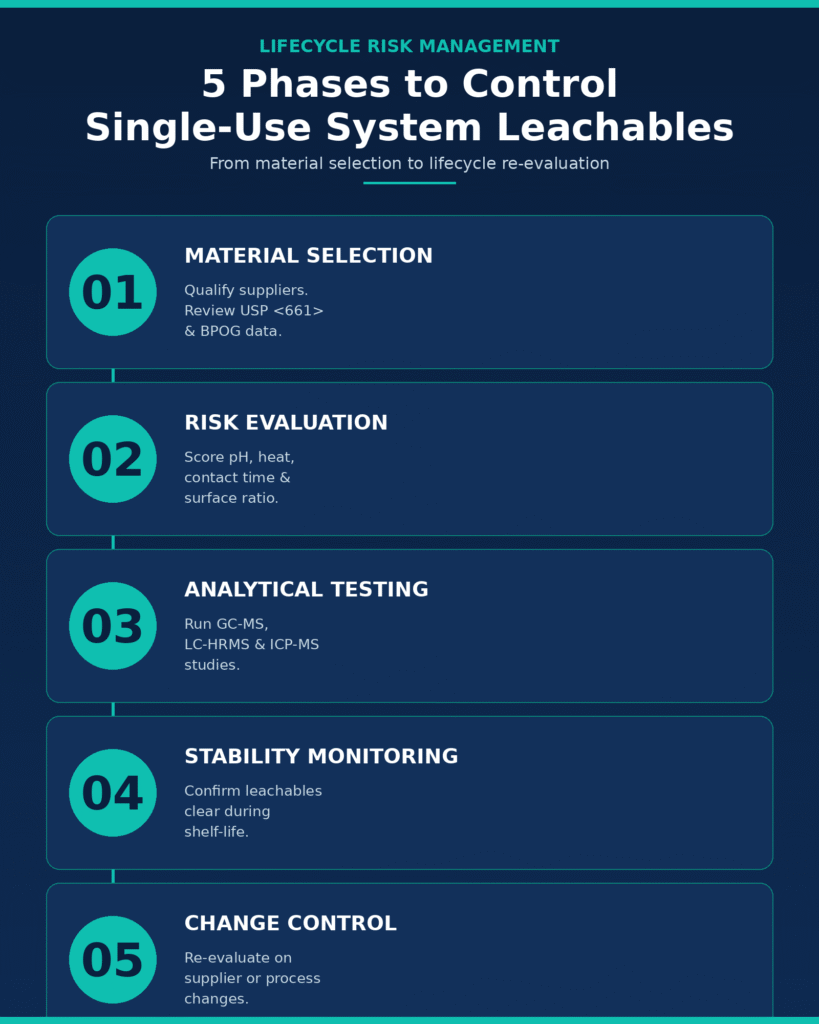
A comprehensive lifecycle control strategy can be organized into five distinct operational phases:
- Phase 1: Material Selection and Supplier Qualification. Reviewing vendor-generated USP and BPOG testing packages, assessing polymer additive compositions, evaluating supplier controls, and establishing appropriate binding quality agreements.
- Phase 2: Process Mapping and Risk Evaluation. Applying USP risk-assessment matrices to establish risk scores according to factors such as pH, temperature, exposure duration, and component surface-area-to-volume ratio.
- Phase 3: Analytical Characterization and Simulation Studies. Performing application-specific extractables and simulated leachables studies using GC-MS, LC-HRMS, and ICP-MS platforms and using the resulting data to establish compound-specific AETs.
- Phase 4: Real-Time Leachables Confirmation and Stability Monitoring. Evaluating target leachables in drug substance or drug product stability samples to verify their clearance, persistence, and safety throughout the anticipated clinical shelf-life.
- Phase 5: Lifecycle Change Control and Re-Evaluation. Reassessing E&L profiles when suppliers modify raw material resins, gamma irradiation doses, manufacturing processes, or other parameters that could alter the chemical profile of the single-use component.
Learn how to structure Leachables Monitoring During Stability Studies
Several additional operational considerations can further strengthen this lifecycle-based strategy:
- Upstream vs. Downstream Differentiation: Upstream components, including media bags and bioreactor liners, may present comparatively lower leachable risks because subsequent downstream purification operations can provide substantial contaminant clearance through processes such as ultrafiltration/diafiltration and chromatography. Conversely, downstream components such as sterile filters and fill-finish assemblies come into contact with highly purified drug substance and therefore require more direct and comprehensive leachables qualification.
- Pre-conditioning Flushes: Introducing appropriate flushing procedures using WFI or buffer solutions before initiating bioprocessing can remove a portion of surface-associated organic migrants. This approach can help reduce the initial release or burst of extractable compounds into the process stream.
- Physicochemical Compatibility and Adsorption Analysis: Single-use polymeric materials can interact with active pharmaceutical ingredients (APIs), target proteins, and formulation preservatives such as benzyl alcohol through adsorption or absorption mechanisms. Compatibility testing must therefore establish that the selected components neither release potentially harmful chemicals nor remove critical formulation constituents from the drug product.
- Contract Laboratory Partnerships: Collaborating with specialized analytical laboratories, such as ResolveMass Laboratories Inc., can provide access to validated mass spectrometry spectral libraries, accurate AET calculations, advanced chemical identification capabilities, and toxicological risk modeling needed to support regulatory submissions and global approval strategies.
Read requirements for Method Validation for Leachables Testing
Conclusion
Implementing a comprehensive Single-Use Systems and GMP Extractables and Leachables (E&L) Testing program is critical for addressing evolving regulatory expectations while maintaining the quality, safety, and performance of biopharmaceutical products. Biopharmaceutical developers need to incorporate risk-based chemical characterization, validated high-resolution mass spectrometry methods, and lifecycle management strategies to adequately protect patients from potential chemical contaminants. Compliance with compulsory standards such as USP requires manufacturers to move beyond passive dependence on supplier documentation and establish proactive analytical characterization programs.
Developing scientifically justified Analytical Evaluation Thresholds (AETs), applying high-resolution GC-MS, LC-HRMS, and ICP-MS technologies, and performing appropriate toxicological assessments can help protect therapeutic proteins from leachable-associated aggregation, degradation, and other adverse effects. For expert guidance, analytical protocol development, and comprehensive USP /ICH Q3E testing support, visit our Contact Us page to consult directly with our analytical team.
Frequently Asked Questions
USP provides an informational, risk-based framework for evaluating plastic and polymeric components used during bioprocessing. It considers factors such as process fluid characteristics, component function, contact conditions, and downstream processing. The resulting risk classification helps determine the appropriate extent of testing required under USP .
An extractable is a chemical substance that can be released from a polymer under deliberately aggressive laboratory conditions, such as elevated temperatures or strong extraction solvents. A leachable is a chemical compound that migrates into a process stream, drug substance, or drug product during actual manufacturing or storage conditions. This distinction is fundamental to E&L risk assessment.
The BPOG protocol is an industry-developed approach that uses multiple solvents and extended exposure periods, including testing for up to 21 days. In comparison, USP applies a more streamlined, risk-based extraction strategy designed around bioprocess contact conditions. BPOG data can nevertheless provide useful supporting information for initial E&L risk assessments.
The draft ICH Q3E guideline is intended to establish a harmonized approach for E&L assessment across major regulatory jurisdictions, including the FDA, EMA, PMDA, and Health Canada. It addresses toxicological thresholds, chemical risk evaluation, and lifecycle management. Its implementation is expected to promote greater consistency in global E&L strategies.
Higher temperatures can increase molecular mobility within polymeric materials and accelerate the movement of chemical constituents into contacting fluids. Longer contact periods provide additional time for additives and degradation products to migrate from the material. Consequently, both temperature and exposure duration can significantly influence the concentration and profile of leachables.
Yes, the scope of USP can include polymeric, plastic, and elastomeric components that come into contact with bioprocessing fluids. Examples include O-rings, gaskets, tubing, filter cassettes, biocontainers, and single-use sensor assemblies. Their inclusion depends on their intended use and contact within the manufacturing process.
An E&L assessment may require re-evaluation when changes could alter the chemical profile or migration behavior of a single-use component. Examples include changes in polymer resin suppliers, manufacturing processes, gamma sterilization doses, drug formulation, or clinical dosing. Lifecycle reassessment helps ensure that previously established E&L conclusions remain scientifically valid.
Reference:
- Henderson, T. J. (2026). Leachables and extractables in single-use bioprocessing: A compliance guide. Drug Discovery News. https://www.drugdiscoverynews.com/leachables-and-extractables-in-single-use-bioprocessing-a-compliance-guide-17221
- International Council for Harmonisation of Technical Requirements for Pharmaceuticals for Human Use. (2025). Q3E guideline for extractables and leachables (Draft version). U.S. Food and Drug Administration. FDA document
- Ding, W., Madsen, G., Mahajan, E., O’Connor, S., & Wong, K. (2014). Standardized extractables testing protocol for single-use systems in biomanufacturing. Pharmaceutical Engineering, 34(6). ResearchGate
- Jenke, D., & Baeten, J. (2024, February 1). Proper calculation of the uncertainty factors and its application to the analytical evaluation threshold and for quantitation [Webinar]. Biopharma Webinars. https://biopharmawebinars.com/webinars/proper-calculation-of-the-uncertainty-factors-and-its-application-to-the-analytical-evaluation-threshold-and-for-quantitation/
Get In Touch With Us
About The Author


