

Introduction
Developing therapeutic peptides within a regulated environment requires selecting a synthetic strategy that effectively balances chemical scalability with stringent regulatory compliance. The selection among Solid-Phase vs Liquid-Phase vs Hybrid Peptide Synthesis directly influences the impurity profile, manufacturing efficiency, and environmental sustainability of the final drug substance. As therapeutic peptides continue to grow in complexity—including long-acting glucagon-like peptide-1 (GLP-1) receptor agonists, cyclic peptide frameworks, and advanced peptide-oligonucleotide conjugates (POCs)—conventional linear synthesis methods frequently encounter significant thermodynamic and physical constraints. Simultaneously, regulatory agencies such as the United States Food and Drug Administration (USFDA) and Health Canada have strengthened their oversight of peptide-related impurities and aggregation profiles by implementing increasingly rigorous acceptance criteria that directly affect the commercial viability of both innovative and generic peptide therapeutics. As a result, overcoming modern peptide development challenges demands not only a comprehensive understanding of synthetic organic chemistry but also access to sophisticated analytical characterization technologies capable of supporting process development from early discovery through commercial manufacturing validation.
Explore specialized development capabilities: Partner with a specialized peptide CDMO for end-to-end drug development solutions tailored to complex molecules.
For biopharmaceutical organizations navigating this highly regulated landscape, collaboration with an experienced Contract Research Organization (CRO) and Contract Development and Manufacturing Organization (CDMO) is essential. ResolveMass Laboratories Inc.—operating under a Health Canada Drug Establishment Licence (DEL 3-002945-A), USFDA registration (Establishment Identifier 3042696771), and an ISO 9001:2015-certified Quality Management System—offers high-resolution mass spectrometry, custom peptide synthesis, and regulatory-compliant analytical validation services that support efficient and successful market authorization.
Evaluate your outsourcing strategy: Understand the key distinctions between a peptide CDMO vs CRO to choose the right partner for your project stage.
Share via:
Article Summary:
- Peptide manufacturing requires careful selection between solid-phase, liquid-phase, and hybrid synthesis because the chosen method affects scalability, purity, impurity control, production cost, and regulatory compliance.
- Solid-phase peptide synthesis (SPPS) is well suited for automated production and medium-length peptides, offering rapid development and straightforward scale-up. However, longer sequences may face aggregation, steric hindrance, and incomplete coupling.
- Liquid-phase peptide synthesis (LPPS) provides excellent reaction monitoring and high intermediate purity, making it useful for shorter peptides and specialized building blocks. Its major drawbacks are repeated isolation, purification, higher labor requirements, and longer processing times.
- Hybrid synthesis combines SPPS and LPPS by producing protected peptide fragments on a resin and subsequently coupling them in solution. This approach is particularly valuable for long, complex, or aggregation-prone peptides.
- Peptide length, molecular complexity, production scale, and cost of goods are key factors in selecting the most appropriate manufacturing strategy. Short peptides may favor LPPS, medium-length sequences often suit SPPS, while longer and more complex molecules may benefit from hybrid approaches.
- Green chemistry is becoming increasingly important in peptide manufacturing, with alternative solvents and solvent mixtures being explored to reduce reliance on hazardous solvents such as DMF while maintaining synthesis performance and product quality.
- Advanced analytical characterization is essential for GMP peptide manufacturing, particularly for identifying low-level impurities, sequence variants, oxidation, deamidation, and conformational species. HRMS, peptide mapping, HILIC, IMS, and advanced chromatographic technologies support impurity control and regulatory submissions.
- Overall, hybrid and convergent manufacturing strategies can offer major advantages for complex commercial peptides, helping improve purity, yield, process efficiency, and manufacturing economics while supporting increasingly stringent regulatory expectations.
Comparative Mechanics of Solid-Phase vs Liquid-Phase vs Hybrid Peptide Synthesis
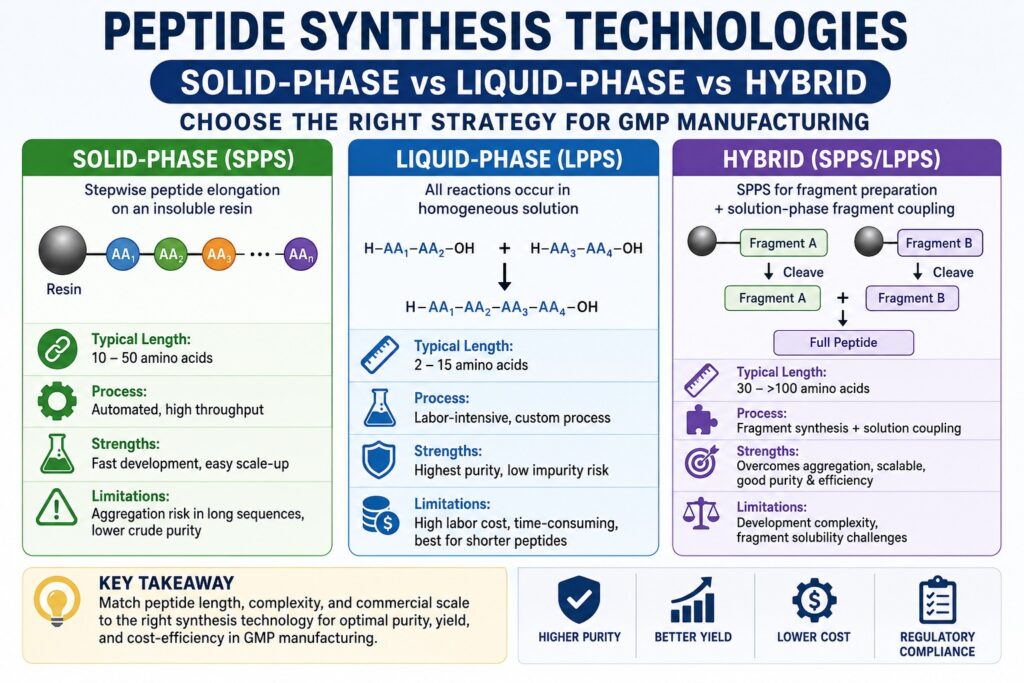
The primary distinction among Solid-Phase vs Liquid-Phase vs Hybrid Peptide Synthesis lies in the physical environment in which peptide chain elongation occurs, ultimately influencing purification strategies, manufacturing scalability, and overall process efficiency. In solid-phase synthesis, the peptide remains attached to an insoluble resin throughout chain assembly. Liquid-phase synthesis performs all reactions within a homogeneous solution, while hybrid synthesis integrates solid-phase fragment preparation with solution-phase fragment coupling.
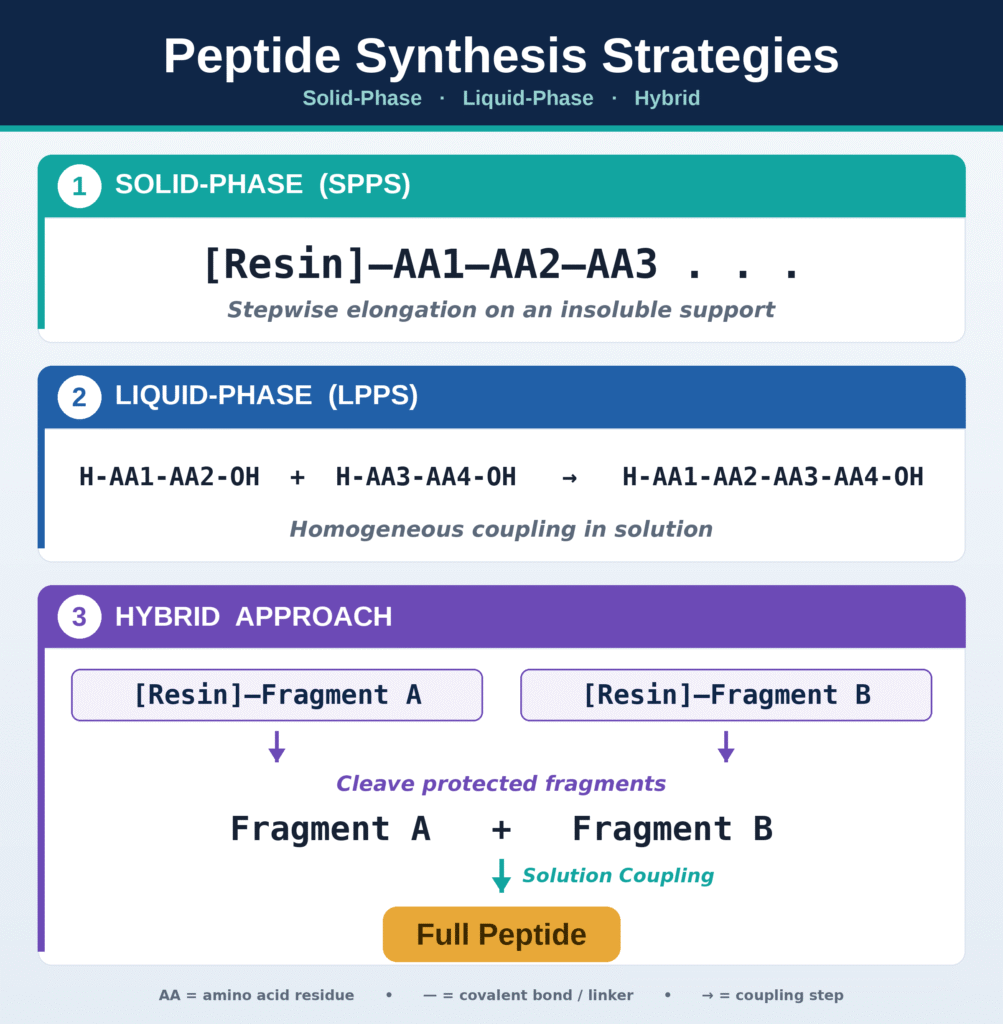
At industrial Good Manufacturing Practice (GMP) scale, peptide synthesis technologies are fundamentally governed by factors including mass transfer, steric hindrance, and reaction thermodynamics. Solid-Phase Peptide Synthesis (SPPS) follows a heterogeneous reaction mechanism in which the elongating peptide chain is covalently attached to an insoluble polymer support, commonly cross-linked polystyrene or polyethylene glycol (PEG)-based resins. This heterogeneous design allows large molar excesses of protected amino acids and coupling reagents to be employed, thereby driving coupling reactions toward completion. Any unreacted reagents can then be efficiently removed through straightforward filtration and washing procedures. Nevertheless, as peptide chains become longer, resin-bound sequences increasingly experience aggregation, steric crowding, and secondary structure formation, particularly beta-sheet formation. These structural effects reduce accessibility to the terminal free amine, resulting in incomplete coupling reactions, truncated peptide sequences, and the generation of closely related deletion impurities that are extremely challenging to separate during downstream preparative high-performance liquid chromatography (prep-HPLC).
Liquid-Phase Peptide Synthesis (LPPS) represents the traditional homogeneous synthesis strategy in which both coupling and deprotection reactions occur entirely in solution. Operating within a homogeneous reaction medium enables continuous monitoring of reaction progress using analytical HPLC while allowing intermediate peptide fragments to be isolated, characterized, and purified through crystallization-based techniques. This approach significantly limits the accumulation of low-level deletion impurities and consistently produces crude peptide products with exceptionally high purity. However, because every synthesis cycle requires repeated isolation, extraction, and purification, LPPS is considerably more labor-intensive and time-consuming, making it most suitable for relatively short peptides, generally ranging from 2 to 15 amino acid residues, or for the preparation of specialized peptide building blocks.
The hybrid synthesis strategy combines the strengths of both SPPS and LPPS. Initially, protected peptide fragments are synthesized using SPPS and subsequently cleaved under carefully controlled conditions that preserve side-chain protecting groups. These purified protected fragments are then assembled in solution using LPPS chemistry to generate the complete therapeutic peptide. By dividing long peptide sequences into smaller, more manageable fragments, the hybrid approach effectively avoids the aggregation and chain-folding limitations commonly associated with long-chain SPPS while simultaneously eliminating the need for repetitive intermediate purification after every individual coupling step, as required in conventional LPPS.
Scale your manufacturing efficiently: Learn how you can outsource peptide manufacturing to a CDMO to optimize yields and reduce cost of goods.
| Technical Parameter | Solid-Phase Peptide Synthesis (SPPS) | Liquid-Phase Peptide Synthesis (LPPS) | Hybrid Synthesis (SPPS/LPPS) |
|---|---|---|---|
| Typical Sequence Length | 10 to 50 amino acids | 2 to 15 amino acids | 30 to >100 amino acids |
| Reaction Phase | Heterogeneous (solid support) | Homogeneous (solution) | Solid-phase fragments / Solution assembly |
| Intermediate Purification | None (washing/filtration only) | Crystallization, extraction, isolation | Isolation of protected fragments |
| Reagent Stoichiometry | High excess (typically 3–5 equivalents) | Low excess (close to stoichiometry) | Moderate excess during solution coupling |
| Solvent Consumption | Exceptionally high (extensive washing) | Low to moderate | Optimized (lower than linear SPPS) |
| Automation Potential | Very high (standardized software platforms) | Low to moderate (custom process design required) | High for fragment synthesis; lower for solution assembly |
| Typical Crude Purity | 30% to 80% (sequence dependent) | 90% to 98% | 80% to 95% |
| Primary Risk Factors | Aggregation, batch failure, high cost of goods (COGS) at scale | High labor costs, molecule-specific optimization | Development complexity, poor fragment solubility |
Critical Parameters in Technology Selection: Length, Scale, and Economics
The selection of an appropriate peptide manufacturing platform is largely determined by peptide sequence length, anticipated commercial production volume, and acceptable cost-of-goods limitations. Choosing the most suitable synthesis methodology early in development helps prevent yield losses while minimizing the likelihood of expensive process redevelopment during late-stage validation.
Among all decision-making factors, peptide sequence characteristics serve as the primary determinant of technology selection. For relatively short peptides containing fewer than 15 amino acids, LPPS is often the preferred commercial manufacturing strategy because the higher initial investment in customized process development is compensated by eliminating expensive resin supports and substantially reducing solvent consumption and amino acid reagent usage. Peptides ranging from approximately 15 to 40 amino acids continue to be predominantly manufactured using SPPS because of its rapid development timelines, standardized workflows, and predictable scale-up during clinical manufacturing. However, once peptide sequences extend beyond approximately 40 amino acid residues, or contain highly hydrophobic regions that promote aggregation on solid supports, the efficiency of conventional linear SPPS declines dramatically.
Under these demanding circumstances, convergent hybrid synthesis provides the most reliable manufacturing solution. Independent high-purity peptide fragments are synthesized in parallel and subsequently coupled in solution, thereby overcoming steric limitations associated with long-chain assembly while simultaneously reducing overall manufacturing timelines through parallelized fragment production.
Accelerate your development pipeline: Discover how to leverage CDMO capabilities to accelerate generic drug development in the US and Canada for faster time-to-market.
Solvent Selection and Green Engineering in Solid-Phase vs Liquid-Phase vs Hybrid Peptide Synthesis
Implementing green chemistry principles in peptide synthesis focuses on replacing hazardous organic solvents such as dimethylformamide (DMF) with environmentally sustainable alternatives that preserve excellent coupling efficiency and resin-swelling performance. These environmentally responsible solvent systems reduce process toxicity while helping manufacturers comply with increasingly stringent global environmental regulations.
The substantial solvent requirements associated with traditional linear SPPS have attracted considerable regulatory attention, particularly under the European Chemicals Agency’s (ECHA) REACH legislation, which classifies DMF as a Substance of Very High Concern (SVHC) because of its reproductive toxicity. Consequently, process development scientists are increasingly evaluating greener solvent systems during manufacturing optimization. Several renewable and bio-based alternatives have emerged as practical substitutes for DMF.
Cyrene™ (Dihydrolevoglucosenone): Produced from cellulose waste through a two-step renewable manufacturing process, Cyrene™ demonstrates approximately 96% lower acute toxicity than DMF. It maintains highly effective peptide coupling performance, although concentrations typically need to be increased by approximately 15% to 20% to compensate for its unique polarity characteristics.
Gamma-Valerolactone (GVL): Derived from renewable biomass, GVL consistently produces peptide purities exceeding 98% while remaining compatible with conventional polystyrene and PEG-based resins. Nevertheless, careful optimization of reaction conditions is necessary because elevated temperatures may promote undesirable esterification, resulting in N-terminal capping of the peptide.
N-Octyl-2-Pyrrolidone (NOP) and N-Butyl-2-Pyrrolidone (NBP): NOP provides a cost-effective alternative, typically costing approximately 1 to 2 dollars per kilogram, while reducing reaction viscosity when combined with dimethyl carbonate. NBP serves as a non-carcinogenic, non-mutagenic, and non-reprotoxic (non-CMR) substitute for NMP, although its relatively high cost may limit its practicality for large-scale manufacturing unless efficient solvent recovery systems are implemented.
Binary Solvent Mixtures: Combining less hazardous solvents such as 7:3 butyl acetate (BtOAc)/DMSO or ethyl acetate (EtOAc)/DMSO has been shown to achieve resin-swelling behavior and viscosity characteristics closely comparable to DMF. Modern automated peptide synthesizers employing these solvent mixtures have demonstrated reductions in overall solvent consumption exceeding 50% while maintaining crude peptide purity comparable to conventional DMF-based processes.
| Solvent System | Environmental / Safety Status | Relative Viscosity (mPa·s) | Resin Swelling Capacity | Purity Performance |
|---|---|---|---|---|
| DMF | Restricted (ECHA REACH SVHC, Reprotoxic) | Low (0.92) | Excellent (polystyrene & PEG) | Baseline (>95% typical) |
| Cyrene™ | Bio-based, non-toxic, biodegradable | High (requires dilution) | Moderate to Good | Equivalent to DMF (>98%) |
| Gamma-Valerolactone (GVL) | Renewable biomass-derived | Low | Good (polystyrene) | Excellent (>98%) |
| 7:3 BtOAc / DMSO | Green binary mixture, low volatility | Moderate | Good | Excellent (within 5% of DMF) |
| N-Butyl-2-pyrrolidone (NBP) | Non-CMR, chemically stable | High (requires heating) | Excellent | High purity (requires elevated temperature) |
Impurity Profiling and Regulatory Compliance in GMP Manufacturing
Demonstrating active pharmaceutical ingredient (API) sameness while establishing comparable impurity profiles is a mandatory regulatory requirement for synthetic generic peptide ANDA submissions to both the USFDA and Health Canada. As regulatory expectations continue to evolve, manufacturers are required to structurally characterize and appropriately qualify every process-related peptide impurity present above 0.10%.
Simplify compliance pathways: Access specialized regulatory support for generic drugs in the US and Canada to ensure seamless submission approval.
For synthetic generic peptides developed as alternatives to recombinant reference products—including glucagon, liraglutide, nesiritide, teriparatide, and teduglutide—the regulatory approval pathway is largely determined by the impurity characteristics of the drug substance itself. According to finalized FDA guidance, the abbreviated approval pathway remains appropriate only when manufacturers can demonstrate that the proposed synthetic generic peptide contains no new specified peptide-related impurity above 0.5% and that every impurity present at or above 0.10% has been fully identified and structurally characterized. In addition, any impurity detected in both the proposed generic product and the Reference Listed Drug (RLD) must be present at an equivalent or lower concentration within the generic formulation. These rigorous regulatory expectations are specifically intended to minimize immunogenicity risks that may arise from subtle sequence variants or trace levels of peptide aggregation products.
Advanced Analytical Characterization and Chromatographic Innovations
Orthogonal analytical platforms that combine high-resolution mass spectrometry (HRMS) with advanced multidimensional chromatography are indispensable for detecting trace synthesis-related deletions and conformational diastereomers. These complementary technologies generate compliance-ready analytical data that support drug substance release testing and regulatory submissions.
Ensure product purity: Utilize state-of-the-art peptide analytical characterization services to resolve complex impurities and structural variants.
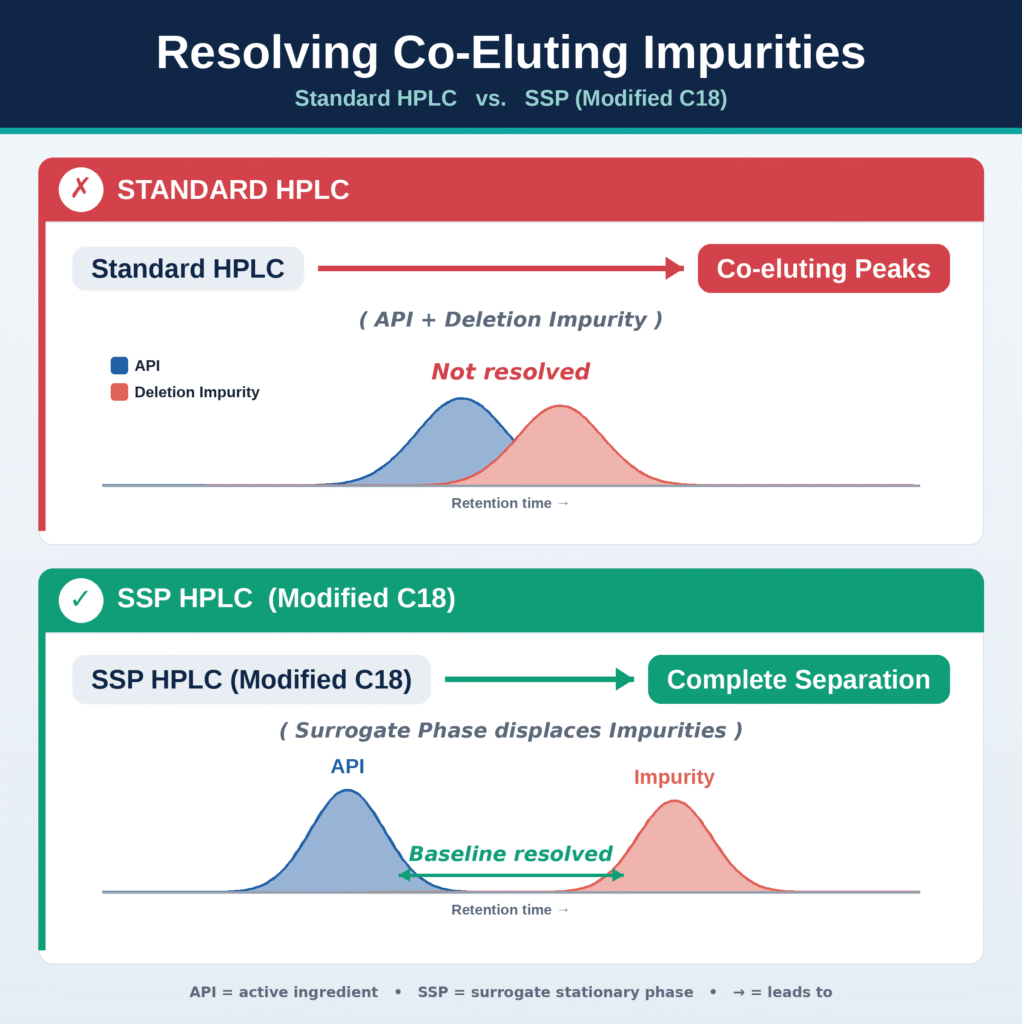
Conventional reversed-phase HPLC using C18 columns with UV detection may be unable to adequately resolve important peptide-related impurities, including species that differ from the target peptide by a single amino acid deletion or a stereochemical inversion. Modern analytical strategies therefore incorporate High-Resolution Mass Spectrometry (HRMS) using Q-TOF or Orbitrap systems to provide accurate-mass confirmation of peptide sequences and comprehensive fragment ion mapping. Importantly, conformational isomers that cannot be separated by conventional liquid chromatography can be differentiated using Ion Mobility Spectrometry (IMS), which separates molecular species according to their collisional cross-section.
To overcome the limitations associated with preparative chromatography, downstream purification strategies have been further enhanced through Neuland’s surrogate stationary phase (SSP) HPLC technology. Through the use of modified C18 chemistry, SSP HPLC can increase preparative column loading capacity by approximately 7 to 10 times, substantially lowering solvent requirements while enhancing the separation of closely eluting deletion sequences.
In a practical example involving these advanced analytical workflows, ResolveMass Laboratories Inc. addressed a significant stability and impurity-related challenge for a client developing a 29-amino-acid clinical-stage peptide drug candidate. Initial accelerated stability testing at 40 degrees Celsius / 75% RH demonstrated substantial degradation, along with the accumulation of unknown impurities representing approximately 2.3% in total. By applying a multilayered analytical strategy that incorporated ultra-sensitive HRMS, targeted peptide mapping following enzymatic digestion, HILIC, and IMS, ResolveMass successfully identified and localized two previously unknown mass variants, Delta +16 Da and Delta -18 Da. These variants were confirmed to correspond to methionine-15 oxidation and asparagine-22 deamidation, respectively, with the latter occurring at pH values above 7.0. Based on these high-resolution analytical findings, the client optimized the manufacturing process and formulation, reducing unknown impurities to less than 0.2%, successfully completing the 6-month stability program, and resubmitting the regulatory filing.
Examine a real-world case study: Read our detailed generic peptide drug analytical characterization case study to see how HRMS resolves challenging impurities.
Commercial Case Studies: Industrial Scaling of Blockbuster Peptides
Commercial manufacturing case studies demonstrate that high-volume peptide therapeutics frequently require customized convergent or hybrid synthetic strategies to achieve economically sustainable industrial production. Moving away from purely linear synthetic pathways toward fragment-based or biosynthetic manufacturing approaches is often essential for optimizing long-term production efficiency and manufacturing economics.
Enfuvirtide: The Landmark of Convergent Hybrid Synthesis
Enfuvirtide (Fuzeon), a 36-amino-acid peptide that functions as an HIV-1 fusion inhibitor by binding to the gp41 subunit of the viral envelope glycoprotein, represents a classic example of the successful application of hybrid peptide synthesis.
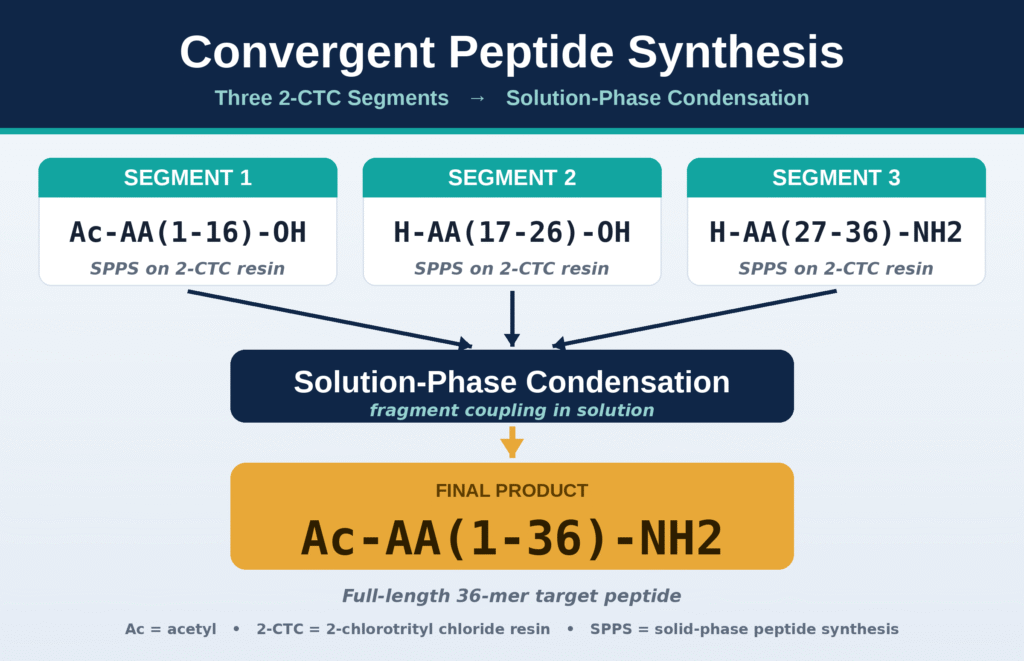
Early attempts to manufacture enfuvirtide using linear SPPS on Rink amide resin produced crude peptide purities of only 30% to 40%, with overall isolated yields ranging from 6% to 8%. These results were commercially unacceptable. To overcome these limitations, a convergent hybrid manufacturing process was developed. The target peptide was divided into three separate segments, each of which was synthesized on super-acid-labile 2-chlorotrityl chloride (2-CTC) resin. Cleavage using 1% TFA in dichloromethane preserved the side-chain protecting groups during fragment release. The resulting high-purity protected fragments were subsequently coupled sequentially in a homogeneous solution phase using HBTU/HOBt/DIEA chemistry, followed by global deprotection in the final stage. This process transition increased crude peptide purity, reduced racemization during loading, and approximately doubled the overall chemical yield, ultimately lowering commercial manufacturing costs by more than 50%.
Tirzepatide: Continuous Process Innovation
Tirzepatide is a 39-amino-acid dual GIP/GLP-1 receptor agonist that contains two non-canonical aminoisobutyric acid (Aib) residues and a di-acid C20 fatty acid side chain. Its structural complexity, combined with the steric hindrance associated with the Aib residues, makes conventional stepwise linear SPPS particularly challenging and introduces substantial risks of sequence truncation and manufacturing batch failure.
To address these challenges at multi-kilogram GMP scale, Eli Lilly developed a hybrid SPPS/LPPS manufacturing process incorporating continuous manufacturing principles. Four protected peptide intermediate fragments are produced through automated SPPS and subsequently coupled continuously in solution. Real-time analytical monitoring enables accurate control of reaction kinetics, while specialized nanofiltration membranes are used to purify intermediates. This approach avoids conventional precipitation steps that can reduce yield and supports the consistent production of high-purity API batches.
Access top-tier manufacturing in North America: Partner with a premier peptide CDMO in the United States to scale up your complex peptide synthesis.
Semaglutide: Recombinant-Chemical Hybrid Architecture
The commercial production of semaglutide is primarily supported by a hybrid biological-chemical manufacturing strategy designed to reduce the solvent intensity and high raw material requirements associated with fully chemical synthesis. Novo Nordisk uses a yeast (Saccharomyces cerevisiae) expression system to produce the core Arg34-GLP-1(9-37) peptide backbone through recombinant technology.
Deep dive into GLP-1 analytics: Explore advanced methodologies for GLP-1 peptide analytical characterization to support complex generic ANDA filings.
Following expression and purification, the precursor undergoes chemical modification in solution using Alloc-chemistry to attach the 18-carbon fatty acid side chain through a glutamic acid spacer and two amino ethoxy ethoxyacetic acid (AEEA) spacers at the lysine-26 residue. The N-terminal fragment, which contains the unnatural aminoisobutyric acid at position 8, is subsequently incorporated through solution-phase chemistry. Alternative prokaryotic expression strategies using E. coli produce the precursor as inclusion bodies. These inclusion bodies undergo on-column refolding, followed by enzymatic cleavage with recombinant enterokinase (rEK) to remove the solubility-enhancing fusion tag at the specific DDDDK recognition site. This approach generates a highly scalable and cost-effective raw material for subsequent manufacturing steps.
Review a Semaglutide benchmark: Check out our peptide characterization case study of Semaglutide for insights on structure validation and impurity profiling.
Conclusion
Selecting the appropriate technology among Solid-Phase vs Liquid-Phase vs Hybrid Peptide Synthesis is a strategic decision that directly influences the cost structure, purity profile, manufacturing efficiency, and regulatory risk of a GMP peptide development program. For late-stage development programs and high-volume commercial products, convergent hybrid chemistry often provides the most robust manufacturing pathway by combining the automated speed and flexibility of solid-phase fragment synthesis with the efficient assembly and intermediate purity control offered by solution-phase chemistry.
Partner with leading peptide experts: Work with the best peptide CDMO to navigate process development, regulatory filings, and commercial manufacturing.
As regulatory expectations from Health Canada and the USFDA continue to increase the requirements for active ingredient sameness and comprehensive impurity characterization, manufacturers can no longer depend solely on legacy synthetic and analytical workflows. Collaboration with an experienced and appropriately certified CRO/CDMO is therefore essential for successfully translating complex peptide molecules from research and development into validated commercial drug substances. ResolveMass Laboratories Inc.—supported by ISO 9001:2015 certification, USFDA registration, and a Health Canada GMP Drug Establishment Licence—combines advanced analytical characterization capabilities, including LC-MS/MS, quantitative NMR, and high-resolution mass spectrometry, with tailored organic and polymer synthesis services to help ensure that peptide drug development programs meet stringent international quality expectations.
Discover full-spectrum CDMO capabilities: Explore comprehensive pharmaceutical CDMO services in the US and Canada to support your complete drug development lifecycle.
To learn how advanced analytical characterization and regulatory-compliant impurity profiling can accelerate your peptide drug development program, contact the scientific experts at ResolveMass Laboratories Inc. through the ResolveMass Contact Us Page.
Frequently Asked Questions
Solid-phase peptide synthesis (SPPS) requires substantial quantities of solvents and reagents because repeated washing and filtration are performed after coupling and deprotection cycles. The use of solvents such as dimethylformamide (DMF) and N-methyl-2-pyrrolidone (NMP), which present reprotoxic and environmental concerns, further increases the sustainability challenges associated with conventional SPPS. These concerns have encouraged the development and adoption of greener solvent systems and waste-reduction strategies.
In a conventional linear SPPS process, an unsuccessful coupling event near the end of a long synthesis can compromise the entire peptide batch. Hybrid synthesis reduces this exposure by dividing the target sequence into multiple shorter fragments that can be manufactured and purified separately. If one fragment fails to meet specifications, only that individual segment generally needs to be repeated, reducing material waste, financial losses, and overall manufacturing risk.
For synthetic peptide ANDAs, the USFDA places significant emphasis on newly observed peptide-related impurities that are not present in the Reference Listed Drug. A new impurity above 0.5% may prevent the product from qualifying for the abbreviated regulatory pathway unless additional evidence is generated to address its safety and potential immunogenicity. Therefore, controlling and thoroughly characterizing new impurities is essential for supporting regulatory approval.
Leucine and isoleucine have the same elemental composition and monoisotopic mass, so conventional mass spectrometry cannot reliably distinguish them based on mass alone. Differentiation requires advanced approaches, such as evaluating characteristic immonium ions generated through low-energy collision-induced dissociation (CID) during high-resolution mass spectrometry (HRMS). Differences in the fragmentation behavior and b and y ion patterns can also provide valuable structural information.
Green binary solvent systems, including combinations of dimethyl sulfoxide (DMSO) with ethyl acetate (EtOAc) or butyl acetate (BtOAc), are designed to provide solvent properties suitable for peptide synthesis while reducing dependence on DMF. These mixtures can support resin swelling, reagent dissolution, and efficient coupling reactions in automated SPPS processes. Their use can help manufacturers reduce hazardous solvent usage, waste-treatment requirements, and overall environmental impact.
Peptide manufacturing and stability studies can produce conformational isomers and diastereomers that have identical molecular masses and may not be separated by conventional reverse-phase chromatography. Ion mobility spectrometry (IMS) provides an additional separation dimension by differentiating ions according to their gas-phase mobility and collisional cross-section. This capability enables the detection and characterization of structurally similar impurities that may otherwise remain hidden.
Peptide manufacturing can have a very high process mass intensity (PMI), with the total mass of solvents, reagents, and other raw materials potentially reaching several hundred to several thousand times the mass of the final peptide API. PMI can be reduced by improving reagent stoichiometry, minimizing solvent volumes during resin washing, implementing more sustainable binary solvent systems, and improving process efficiency through hybrid synthesis. These changes can lower waste generation and improve overall manufacturing sustainability.
Synthetic peptide APIs are frequently isolated as trifluoroacetate (TFA) salts because TFA is commonly used during peptide synthesis and purification. However, residual or excessive TFA may present biocompatibility concerns for certain biological applications and parenteral formulations. Depending on the intended use, conversion to alternative salt forms such as acetate or hydrochloride (HCl) may improve formulation suitability, stability, and compatibility for clinical administration.
Recombinant enterokinase (rEK) is a sequence-specific proteolytic enzyme that recognizes the DDDDK cleavage motif and cleaves at the corresponding site. In biosynthetic and hybrid peptide manufacturing processes, including those used for semaglutide-related production strategies, rEK can remove an N-terminal solubility-enhancing fusion tag from a recombinantly expressed precursor. This controlled cleavage releases the desired peptide backbone while preserving the sequence required for subsequent chemical modification.
Reference:
- U.S. Food and Drug Administration. (2017). Emergency use authorization of medical products and related authorities: Guidance for industry and other stakeholders. https://www.fda.gov/media/107622/download
- Kuppanna, A., Komma Reddy, M. B. R., & Datta, D. (2011). An improved process for the preparation of enfuvirtide (Patent No. WO2011095989A2). World Intellectual Property Organization. Patent record
- Jain, K. K. (2012). An overview of drug delivery systems. Methods in Molecular Biology, 901, 1–54. https://doi.org/10.1007/978-1-61779-
- Li, Y. (2022, September 20). Common deficiencies associated with comparative peptide impurity profile studies and qualification of impurity levels and proposed limits [Presentation]. U.S. Food and Drug Administration. FDA presentation
- Meldal, M., & Jensen, K. J. (2003). Multi-component solid-phase synthesis of peptide libraries. Chemical Society Reviews, 32(2), 97–107. https://doi.org/10.1039/B208875H
- Nanjing Hanxin Pharmaceutical Technology Co., Ltd. (2022). Synthesis method of semaglutide (Chinese Patent No. CN115322250A). China National Intellectual Property Administration. https://patents.google.com/patent/CN115322250A/en
Get In Touch With Us
About The Author


