


Introduction:
When you decide to outsource peptide characterization, the quality of your results depends less on which CRO you choose and more on how clearly you communicate your needs from day one. Providing the right specifications to provide when outsourcing peptide characterization to a CRO eliminates ambiguity, prevents costly re-runs, and ensures the analytical data returned to you is scientifically defensible and fit for purpose — whether that purpose is regulatory submission, research publication, or quality control release.
At ResolveMass Laboratories Inc., we’ve worked with research teams across drug discovery, bioconjugate development, and proteomics — and the projects that run smoothest are always the ones where clients come prepared. This guide walks you through every document, data point, and specification you should be ready to share before the first sample is shipped.
Summary:
- Providing complete and accurate specifications to provide when outsourcing peptide characterization to a CRO is the single most important factor in getting fast, reliable, and publication-ready results.
- Essential documents include peptide sequence data, purity expectations, analytical method preferences, regulatory context, and sample preparation details.
- Missing or incomplete documentation causes delays, repeat analyses, and miscommunication between your team and the CRO.
- ResolveMass Laboratories Inc. has deep hands-on expertise in mass spectrometry-based peptide characterization, helping biotech, pharma, and academic clients get actionable data — the first time.
- A structured documentation checklist, shared upfront, ensures the CRO can design the right analytical workflow for your project.
1. Start With a Project Brief: Define the “Why” Before the “What”
The project brief tells the CRO what scientific question you are trying to answer, which directly determines the analytical approach they will select.
Before diving into technical specifications, write a short (one-page) project overview that answers:
- What is the peptide? (therapeutic candidate, research tool, biomarker, synthetic standard)
- What stage is the project at? (early discovery, lead optimization, IND-enabling studies, QC release)
- What decision will be made based on this data? (go/no-go on synthesis, regulatory filing, publication)
- What is the turnaround requirement? (standard, expedited, or phased delivery)
This context shapes everything from instrument selection to the level of documentation the CRO provides in the final report. A CRO that understands your goals can flag potential issues proactively — not after the analysis is complete.
2. Peptide Sequence and Structural Information
Provide the complete amino acid sequence, including all non-standard residues, modifications, and stereochemical configurations — this is the single most critical technical document.
Your sequence documentation should include:
| Information | Details to Include |
|---|---|
| Primary sequence | Full one-letter or three-letter amino acid code |
| Modifications | Phosphorylation, acetylation, PEGylation, fluorescent labels, linkers |
| Non-standard amino acids | D-amino acids, beta-amino acids, unnatural residues |
| Terminal groups | Free acid vs. amide at C-terminus; free amine vs. acetyl at N-terminus |
| Disulfide bonds | Location, oxidation state expected |
| Molecular formula | If known, to assist in mass accuracy verification |
| Theoretical molecular weight | Monoisotopic and average mass |
| CAS number or internal compound ID | For traceability |
If your peptide contains isotopically labeled residues (e.g., ¹³C, ¹⁵N for stable isotope dilution assays), specify the labeling positions explicitly. Omitting this information is one of the most common causes of misidentified masses at the CRO level.
3. Sample Information and Preparation Details
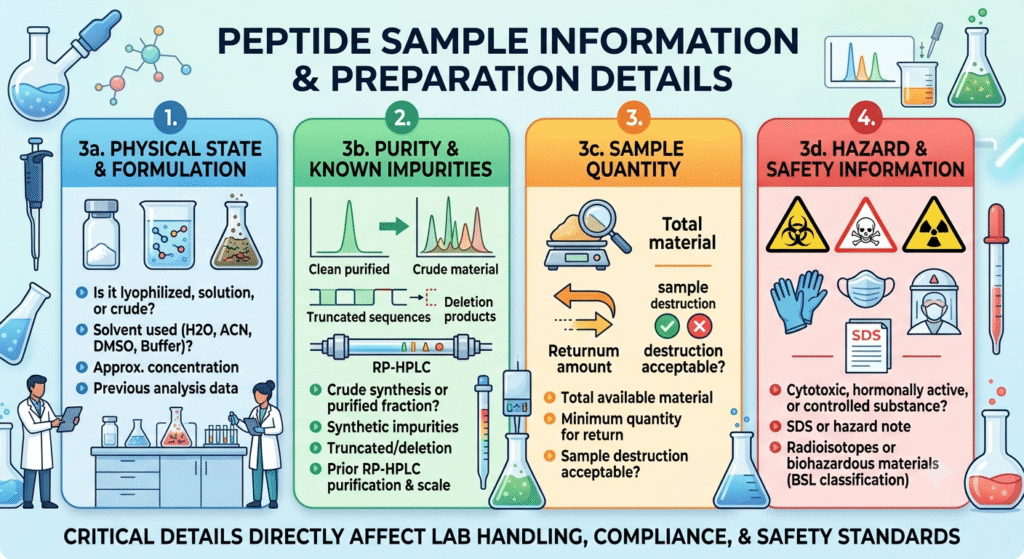
Describe the physical state of each sample and how it was prepared — this determines storage conditions, solubility strategy, and instrument compatibility before the CRO even opens the vial.
3a. Physical State and Formulation
- Is the sample a lyophilized powder, solution, or crude reaction mixture?
- What solvent was used (water, acetonitrile, DMSO, buffer)?
- What is the approximate concentration?
- Has the sample been previously analyzed? If so, provide prior data.
3b. Purity and Known Impurities
- Is this a crude synthesis product or a purified fraction?
- Are there known synthetic impurities, truncated sequences, or deletion products?
- Has any RP-HPLC purification been performed? At what scale?
3c. Sample Quantity
- How much material is available in total?
- What is the minimum quantity acceptable for return after analysis?
- Is any sample destruction acceptable?
3d. Hazard and Safety Information
- Is the peptide cytotoxic, hormonally active, or a controlled substance?
- Provide Safety Data Sheets (SDS) or a brief hazard note if applicable.
- Declare any radioisotopes or biohazardous materials (BSL classification).
This information is not bureaucratic box-checking — it directly affects how your samples are handled in the laboratory and ensures compliance with institutional and regulatory safety standards.
4. Analytical Method Preferences and Prior Method Information
Specify any existing analytical methods, instrument platforms, or regulatory-approved methods that the CRO must follow or reference — this prevents the CRO from developing a new method when one already exists.
What to include:
- Preferred analytical techniques: LC-MS/MS, MALDI-TOF, NMR, amino acid analysis, CD spectroscopy, etc.
- Instrument platform preference: If your regulatory submission references data generated on a specific instrument type, note this.
- Existing in-house methods: If you have a validated HPLC method, share the gradient, column chemistry, and mobile phase composition.
- Compendial methods: Specify if USP, EP, or ICH guidelines apply (e.g., ICH Q6B for peptide characterization).
- Method validation requirements: Are you requesting a validated method, a qualified method, or a research-grade analysis?
| Scenario | Method Requirement Level |
|---|---|
| Early research | Fit-for-purpose, exploratory |
| Lead optimization | Semi-quantitative, method qualified |
| IND/BLA regulatory filing | Fully validated per ICH Q2(R1) |
| QC release testing | Validated, with system suitability criteria |
If you don’t have an existing method, describe the analytical goal (e.g., identity confirmation, purity profiling, sequence verification, quantitation) and let the CRO propose an approach — but confirm it before analysis begins.
5. Acceptance Criteria and Purity Specifications
Define your pass/fail thresholds upfront — without them, the CRO cannot tell you whether your sample meets specification, only what the numbers are.
Document the following:
- Target purity (%): By what method? (e.g., ≥95% by RP-HPLC UV at 214 nm)
- Mass accuracy tolerance: For MS confirmation (e.g., ±5 ppm for high-resolution instruments)
- Allowable impurities: Maximum limits for individual impurities, total impurities, and any specific related substances
- Sequence coverage target: For peptide mapping experiments (e.g., ≥90% sequence coverage)
- Disulfide bond confirmation: Reduced vs. non-reduced conditions both required?
- Quantitation limits: Required LOQ and LOD for trace-level impurity detection
These criteria also allow ResolveMass Laboratories Inc. to flag out-of-specification results immediately, rather than delivering a report that leaves you uncertain about next steps.
6. Regulatory and Compliance Context
Clearly state the regulatory framework your project operates within — this determines documentation requirements, data integrity standards, and audit trail expectations that cannot be retrofitted after analysis.
Include the following regulatory context:
- GMP or non-GMP: Is this work performed under current Good Manufacturing Practice?
- Applicable guidelines: ICH Q6B, ICH Q2(R1), USP <1045>, FDA guidance on peptide drug products
- 21 CFR Part 11 compliance: Is electronic data integrity required?
- GLP requirements: Is the study GLP-compliant (OECD or FDA GLP)?
- Applicable pharmacopoeia: USP, EP, JP?
- Study phase: Pre-IND, Phase I/II, NDA/BLA submission, post-approval
Without this information, a CRO may deliver excellent scientific data in a format that is unusable for your regulatory filing — which means repeat work, delays, and cost.
7. Deliverables and Reporting Requirements
State exactly what you need in the final report — this is often overlooked and is the most common source of post-project disputes between sponsors and CROs.
Be specific about:
- Report format: PDF, Word document, electronic raw data files
- Raw data access: Do you require original instrument files (e.g., .raw, .wiff, .d)?
- Chromatograms and spectra: Full-range or zoomed; annotated or unannotated
- Certificate of Analysis (CoA): Required for QC release samples
- Statistical summary: Mean, SD, %RSD across replicates
- Traceability documentation: Instrument qualification records, column lots, reagent batch numbers
- Chain of custody records: Required if samples have regulatory or forensic significance
- Turnaround timeline for draft vs. final report
At ResolveMass Laboratories Inc., our reports are structured to be immediately usable in regulatory submissions, patent applications, and peer-reviewed publications — because we ask these questions before analysis begins, not after.
8. Intellectual Property and Confidentiality Provisions
Before sending any sequence data or proprietary structural information, confirm that a Mutual Non-Disclosure Agreement (MNDA) or Confidentiality Agreement (CDA) is in place.
Documents to prepare on your side:
- Non-Disclosure Agreement (NDA/MNDA): Cover all compound structures, sequences, and internal project codes
- Material Transfer Agreement (MTA): If samples are sent for characterization and return
- IP ownership clause: Confirm that all analytical data generated belongs exclusively to the sponsor
- Data storage and destruction policy: How long will the CRO retain your data and samples?
This is not merely a legal formality — it protects your patent position, competitive advantage, and regulatory exclusivity. Reputable CROs will have standard agreements ready; do not proceed without one.
9. A Practical Checklist: What to Send Before Outsourcing Peptide Characterization
Use this checklist when preparing your documentation package:
Structural and Sample Documents
- Complete amino acid sequence with modifications
- Molecular formula and theoretical MW (monoisotopic + average)
- Physical state, solvent, and concentration
- Sample quantity and return requirements
- Safety data and hazard classification
Analytical Specifications
- Preferred analytical techniques and instrument platforms
- Existing methods or compendial method references
- Acceptance criteria and purity thresholds
- Quantitation requirements (LOQ/LOD)
Regulatory and Compliance
- GMP/non-GMP declaration
- Applicable ICH, USP, or FDA guidelines
- GLP or 21 CFR Part 11 requirements
Deliverables
- Required report format and data files
- CoA requirement
- Turnaround expectation
Legal
- Signed MNDA/CDA
- MTA (if applicable)
- IP and data ownership confirmation
10. Why Choosing the Right CRO Matters as Much as the Documents You Provide
Even the most complete documentation package will underperform if the CRO lacks the specialized expertise to execute the analysis correctly. Peptide characterization — particularly for complex modified peptides, large cyclic peptides, stapled peptides, or multi-chain constructs — requires deep mass spectrometry expertise, not just instrument access.
ResolveMass Laboratories Inc. specializes in mass spectrometry-based characterization of complex peptides, proteins, and biotherapeutics. Our team combines academic-level analytical expertise with the operational rigor expected in pharmaceutical and biotech environments. We work with:
- Synthetic peptide manufacturers and CMOs
- Biotech and pharmaceutical companies at all clinical stages
- Academic research groups requiring publication-ready analytical data
- Regulatory affairs teams preparing IND and BLA submissions
Our approach is built on transparency — you know exactly what tests are being run, what the data means, and what your next step should be. That’s not just good science; it’s the kind of partnership that earns trust over time.
Conclusion:
Knowing the right specifications to provide when outsourcing peptide characterization to a CRO is what separates a smooth, first-pass analytical engagement from a frustrating cycle of follow-up questions, re-runs, and delayed timelines. The documents covered in this guide — from your peptide sequence and sample details to your regulatory context, acceptance criteria, and IP protections — form a complete communication package that any qualified CRO needs to deliver reliable, actionable results.
The more clearly you define your needs before the project starts, the faster you get data you can trust, and the stronger your scientific and regulatory position becomes.
ResolveMass Laboratories Inc. is ready to be that trusted partner. Whether you’re characterizing a single peptide or managing a complex characterization campaign, our team brings the expertise, instrumentation, and scientific rigor your project deserves.
Frequently Asked Questions:
When outsourcing peptide characterization, you should provide the peptide sequence, molecular weight, structural details, purity requirements, storage conditions, and analytical objectives. Information about modifications, reference standards, and previous analytical data is also valuable. The more complete the documentation, the easier it is for the CRO to select appropriate analytical methods. This helps reduce delays and improves data quality. Comprehensive project information ultimately leads to more reliable characterization results.
The peptide sequence is essential because it serves as the basis for identity confirmation and molecular weight calculations. Analytical techniques such as LC-MS/MS and peptide mapping rely heavily on accurate sequence information. It helps scientists predict fragmentation patterns and identify impurities or sequence variants. Without the correct sequence, data interpretation becomes significantly more difficult. Providing complete sequence details improves the accuracy of the characterization process.
You should clearly define the target purity level and acceptance criteria before testing begins. Different applications require different purity thresholds, such as research-grade versus clinical-grade peptides. It is also important to specify impurity limits and reporting thresholds. These requirements help the CRO choose suitable analytical methods and detection limits. Clear purity specifications ensure the generated data meets your project’s expectations.
Yes, all known peptide modifications should be disclosed before characterization begins. Modifications such as phosphorylation, acetylation, PEGylation, amidation, or fluorescent labeling can significantly affect analytical results. Providing modification details helps scientists interpret mass spectrometry data accurately. It also assists in confirming molecular identity and expected mass shifts. Transparency regarding modifications reduces the risk of analytical errors.
Peptide characterization commonly involves techniques such as LC-MS, LC-MS/MS, high-resolution mass spectrometry (HRMS), HPLC purity analysis, and peptide mapping. The choice of technique depends on the analytical objective and peptide complexity. These methods help determine identity, purity, molecular weight, and impurity profiles. Advanced characterization may also include structural elucidation studies. A qualified CRO will recommend the most appropriate analytical approach.
The required sample quantity depends on the complexity of the study and the number of tests requested. Basic identity confirmation may require only a small amount of material, while impurity profiling or stability studies may need larger quantities. It is important to consult with the CRO before shipment. Providing sufficient sample ensures all required analyses can be completed. Sending extra material can also be beneficial if repeat testing becomes necessary.
Reference
- Lakings DB. Working with a Contract Research Organization (CRO). InNew Drug Approval Process 2016 Apr 19 (pp. 42-55). CRC Press.https://www.taylorfrancis.com/chapters/edit/10.3109/9781420088502-6/working-contract-research-organization-cro-duane-lakings
- Abberley L. Outsourcing of bioanalysis at GSK: a hybrid approach with a robust support model. Bioanalysis. 2017 Aug 1;9(15):1139-44.https://www.tandfonline.com/doi/full/10.4155/bio-2017-0062
- Verhaeghe T. Bioanalytical outsourcing strategy at Janssen Research and Development. Bioanalysis. 2014 May 1;6(10):1321-7.https://www.tandfonline.com/doi/abs/10.4155/bio.14.105
- Lakings DB, Lakings AL. Outsourcing of Pharmaceuticals. InEncyclopedia of Pharmaceutical Science and Technology, Six Volume Set (Print) 2013 Jul 1 (pp. 2390-2408). CRC Press.https://api.taylorfrancis.com/content/chapters/edit/download?identifierName=doi&identifierValue=10.1081/E-EPT4-120050316&type=chapterpdf
- Spooner N, Cape S, Summerfield S. Outsourcing strategies in bioanalysis. Bioanalysis. 2017 Aug 1;9(15):1125-6.https://www.tandfonline.com/doi/full/10.4155/bio-2017-4986
About the Author


