

Introduction
Selecting between Spray Drying vs Solvent Evaporation for poly(lactic-co-glycolic acid) (PLGA) microsphere fabrication requires careful consideration of processing throughput, encapsulation efficiency, and long-term release kinetics. While emulsion solvent evaporation can provide low initial burst release and facilitate the formation of dense polymer matrices, continuous spray drying enables rapid, single-step processing with strong potential for industrial scalability. Poly(lactic-co-glycolic acid) remains the preeminent biodegradable polymer approved by global regulatory agencies for long-acting parenteral injectables (LAIs).
For a deeper understanding of regulatory chemistry standards, review our guide on residual solvent control in PLGA microsphere manufacturing.
The technical selection of a fabrication route directly influences the Critical Quality Attributes (CQAs) of the finished microspheres. These attributes include particle size distribution (PSD), drug encapsulation efficiency (EE), matrix porosity, glass transition temperature (Tg), and residual organic solvent levels.
Learn more about physical property standards via our resource on polymer sameness for ANDA.
A comprehensive evaluation of Spray Drying vs Solvent Evaporation requires rigorous consideration of drying thermodynamics, phase separation kinetics, and specialized analytical testing, including quantitative NMR (qNMR), modulated differential scanning calorimetry (mDSC), and surface depth profiling, to meet global regulatory expectations for generic and novel drug products.
Share via:
Article Summary:
- Spray drying and solvent evaporation are two major methods for fabricating PLGA microspheres, with different effects on yield, scalability, particle structure, encapsulation, and drug release.
- Solvent evaporation uses emulsion-based processing and gradual solvent removal, producing dense, less-porous microspheres with better control of initial burst release and sustained drug delivery.
- Spray drying rapidly atomizes the feed into heated gas, enabling seconds-level drying and continuous processing. It can produce porous or hollow particles and is highly attractive for industrial scale-up.
- Yield and scalability differ: solvent evaporation can achieve 75–95% laboratory yields but becomes more complex at large scale, while spray drying may give 40–70% lab-scale yield but can exceed 85–92% commercially with optimized collection systems.
- Product quality is strongly influenced by processing: solvent evaporation generally provides lower burst release (5–20%), whereas spray drying may show higher burst release (30–85%) due to surface drug enrichment and porous morphology.
- Residual solvent control is another key consideration. Spray drying enables efficient solvent removal during primary drying, while solvent evaporation often requires additional extraction, washing, and lyophilization to meet ICH Q3C requirements.
- Method selection depends on the product goal: solvent evaporation is preferable for low burst release and long-acting injectable depots, while spray drying is advantageous when rapid processing, continuous manufacturing, scalability, efficient drying, or dry-powder applications are priorities.
Technical Fundamentals of Spray Drying vs Solvent Evaporation Mechanics
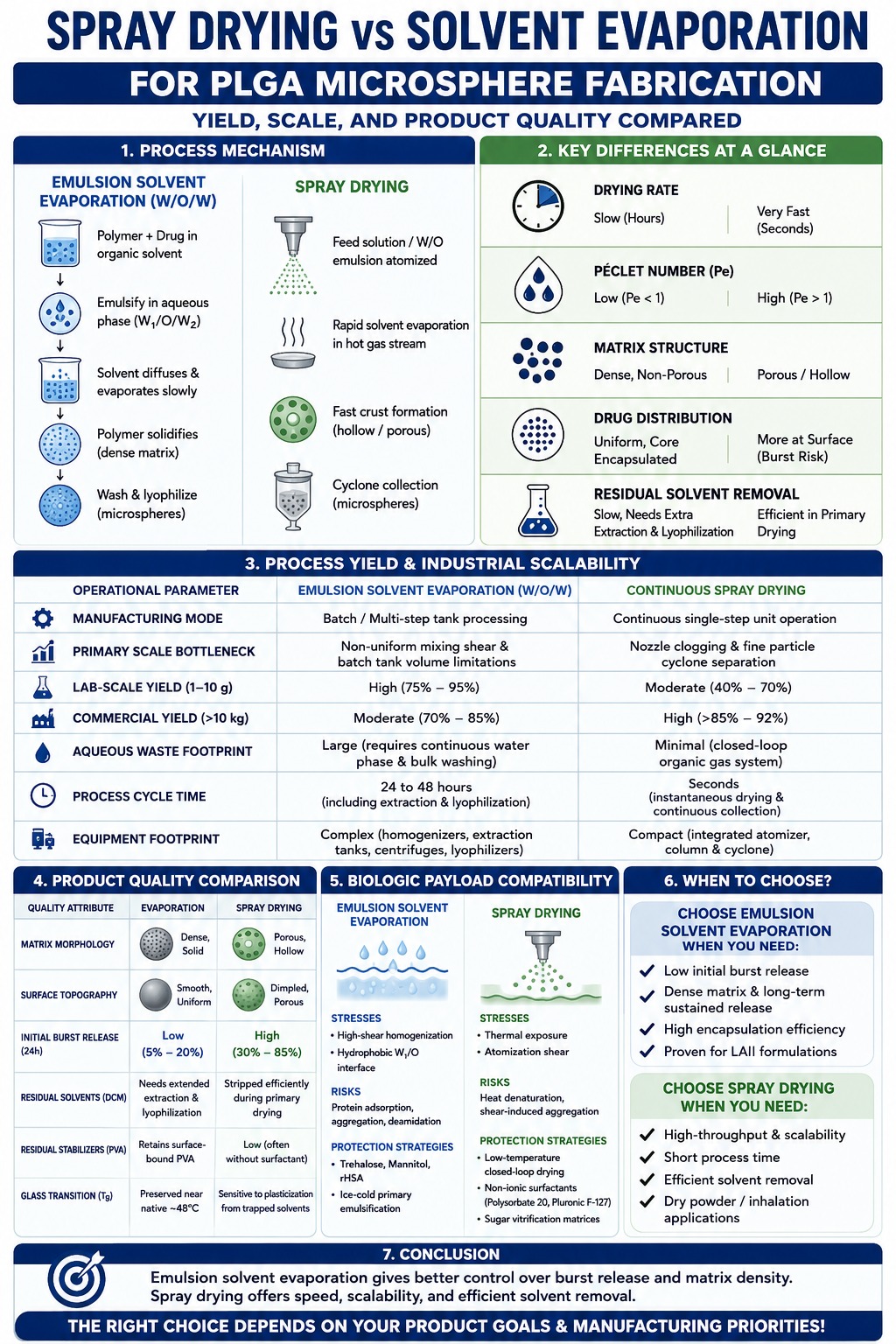
The fundamental mechanics distinguishing Spray Drying vs Solvent Evaporation involve thermal convective evaporation from atomized droplet streams compared with liquid-phase solvent extraction across immiscible aqueous boundaries. This thermodynamic difference influences the rate of polymer phase separation, pore formation mechanisms, and the distribution of active pharmaceutical ingredient (API) near the particle surface.
Emulsion Solvent Evaporation Mechanism and Kinetics
Emulsion solvent evaporation produces microspheres by dispersing an organic polymer solution into an external aqueous phase and removing the volatile solvent to initiate coacervation. The relatively slow extraction kinetics allow PLGA polymer chains to gradually consolidate, resulting in dense microparticles with comparatively low initial porosity.
Review critical processing hurdles outlined in our overview on challenges in PLGA microsphere development.
The process begins with the preparation of either a single oil-in-water (O/W) emulsion for hydrophobic APIs or a primary water-in-oil (W1/O) emulsion that is subsequently homogenized into a continuous aqueous phase containing a stabilizer. This produces a double water-in-oil-in-water (W1/O/W2) emulsion.
Polyvinyl alcohol (PVA) functions as the primary emulsion stabilizer, positioning itself at the organic-aqueous interface to minimize droplet coalescence. The volatile organic solvent, typically Dichloromethane (DCM) or Ethyl Acetate, diffuses across the aqueous boundary layer and subsequently evaporates at the air-water interface.
As solvent is removed from the dispersed organic phase, the concentration of PLGA increases beyond its solubility threshold. This initiates liquid-liquid phase separation (coacervation), followed by progressive hardening of the polymeric matrix.
The process kinetics generally follow a diffusion-controlled mass transfer regime:
- Primary Emulsification: The drug and polymer are dissolved in DCM and subsequently subjected to high-shear mixing (10,000–15,000 rpm) into the W1 or W2 phase.
- Solvent Diffusion: The organic solvent partitions into the continuous aqueous phase according to its equilibrium solubility.
- Polymer Solidification: Gradual polymer precipitation allows polymer chain relaxation and progressive matrix consolidation.
- Washing and Isolation: Unabsorbed PVA is removed through multi-stage filtration, followed by vacuum lyophilization for particle isolation and drying.
Because matrix consolidation occurs gradually over several hours, PLGA chains have sufficient time to pack more densely. This reduces the formation of internal micro-voids and limits premature migration of the drug toward the outer particle shell.
For guidance on active compound selection, consult our resource on encapsulating hydrophilic vs hydrophobic APIs in PLGA.
Spray Drying Mechanics and Wet-Bulb Kinetics
Spray drying produces microspheres by atomizing a liquid feed into a heated gas stream, where rapid solvent evaporation occurs according to wet-bulb temperature kinetics. The high drying rate promotes the development of a solid surface crust during the falling-rate drying period and can consequently generate hollow or porous particle morphologies.
The liquid feed may consist of a single-phase organic solution or a W/O emulsion. It is atomized through a two-fluid, ultrasonic, or rotary nozzle into a drying column supplied with heated nitrogen. Atomization produces micro-droplets with a high surface area, allowing rapid or flash solvent evaporation.
Drying behavior is influenced by the Péclet number (Pe), which describes the relationship between the rate of solvent evaporation and the diffusion rate of solutes, including PLGA and API, within the droplet core:
$$Pe_i = \frac{\kappa}{8D_i}$$
Where κ represents the evaporation rate constant and Di denotes the solute diffusion coefficient. High inlet temperatures combined with rapid evaporation rates produce elevated Péclet numbers (Pe > 1). Under high Pe conditions, PLGA solute molecules cannot diffuse toward the interior rapidly enough to compensate for the receding droplet boundary, resulting in rapid accumulation of polymer at the particle surface.
Once the surface reaches saturation, a rigid polymer crust develops, indicating the beginning of the falling-rate drying stage. Solvent vapor retained beneath this crust can generate internal pressure, which may result in shell expansion, internal void formation, or surface dimpling during the final stages of drying.
Process Yield and Industrial Scalability in Spray Drying vs Solvent Evaporation
From an industrial manufacturing perspective, continuous spray drying generally offers greater throughput because processing capacity can be increased through operating time rather than relying solely on vessel volume. This approach also avoids some of the complex fluid dynamic and shear-related challenges associated with scaling solvent evaporation tanks. However, at the bench scale, spray drying can produce lower material recovery than small-scale emulsion solvent evaporation because of cyclone collection limitations and electrostatic deposition on equipment surfaces.
During laboratory development, double emulsion solvent evaporation can routinely achieve encapsulation yields between 75% and 95% because the processing steps are performed within a contained mixing vessel. Nevertheless, scaling emulsion solvent evaporation to commercial manufacturing introduces significant mechanical and fluid dynamic considerations.
When mixing tanks are scaled up, maintaining comparable volumetric power input (P/V) and tip speeds is necessary to preserve consistent droplet shear characteristics across vessels containing thousands of liters. Differences in local shear conditions can broaden the particle size distribution (SPAN), influence drug loading efficiency, and contribute to batch-to-batch variations in release profiles. In addition, emulsion extraction requires substantial quantities of purified water and surfactants, which can generate significant liquid waste streams requiring downstream treatment and handling.
Spray drying operates as an inline continuous unit operation. Manufacturing capacity can be increased by extending the operating duration or by implementing industrial multi-nozzle drying columns rather than substantially redesigning vessel dimensions.
At smaller development scales, spray drying yields may be lower, generally ranging from 40% to 70%, because microparticles can adhere to drying column walls and sub-2 µm particles may exhibit lower collection efficiency in conventional cyclones. At industrial scale, spray drying systems can reduce these losses through electrostatic wall sweepers, advanced cyclone configurations, and secondary bag-filter arrays, allowing total product yields to increase above 85% to 92%.
| Operational Parameter | Emulsion Solvent Evaporation (W/O/W) | Continuous Spray Drying |
|---|---|---|
| Manufacturing Mode | Batch / Multi-step tank processing | Continuous single-step unit operation |
| Primary Scale Bottleneck | Non-uniform mixing shear and batch tank volume limitations | Nozzle clogging and fine particle cyclone separation |
| Lab-Scale Yield (1–10g) | High (75% – 95%) | Moderate (40% – 70%) |
| Commercial Yield (>10kg) | Moderate (70% – 85%) | High (>85% – 92%) |
| Aqueous Waste Footprint | Large (requires continuous water phase and bulk washing) | Minimal (closed-loop organic gas system) |
| Process Cycle Time | 24 to 48 hours (including extraction and lyophilization) | Seconds (instantaneous drying and continuous collection) |
| Equipment Footprint | Complex (homogenizers, extraction tanks, centrifuges, lyophilizers) | Compact (integrated atomizer, column, and cyclone) |
Product Quality Attributes: Burst Release, Porosity, and Residual Solvents in Spray Drying vs Solvent Evaporation
Product quality attributes can differ substantially between Spray Drying vs Solvent Evaporation. Spray-dried microparticles commonly exhibit greater initial burst release and more pronounced hollow or porous structures, whereas solvent evaporation generally produces denser matrices with improved control over initial drug release. In contrast, spray drying can remove volatile residual solvents considerably more efficiently within a single primary processing operation.
Burst Release Kinetics and Surface Morphology
Initial burst release from spray-dried microspheres is largely associated with enrichment of the drug near the particle surface during rapid skin formation. In comparison, solvent evaporation can reduce burst release because slower matrix consolidation allows the active drug to remain more uniformly distributed throughout the polymeric core.
Surface characterization techniques, including X-ray Photoelectron Spectroscopy (XPS) and Time-of-Flight Secondary Ion Mass Spectrometry (ToF-SIMS), indicate that rapid solvent vaporization can produce an active ingredient concentration gradient near the exterior of the particle.
During spray drying, thermodynamic forces can promote migration of hydrophilic therapeutics toward the evaporating surface interface. This process can concentrate the payload immediately beneath the developing PLGA shell.
When these particles are introduced into an aqueous dissolution medium or administered parenterally, water can rapidly penetrate the outer layer. This facilitates dissolution of drug domains located close to the surface and can produce an initial burst release of 40% to 85% within 24 hours. In addition, rapid drying can trap solvent vapor within the hardening polymer matrix, producing sponge-like or hollow particle morphologies.
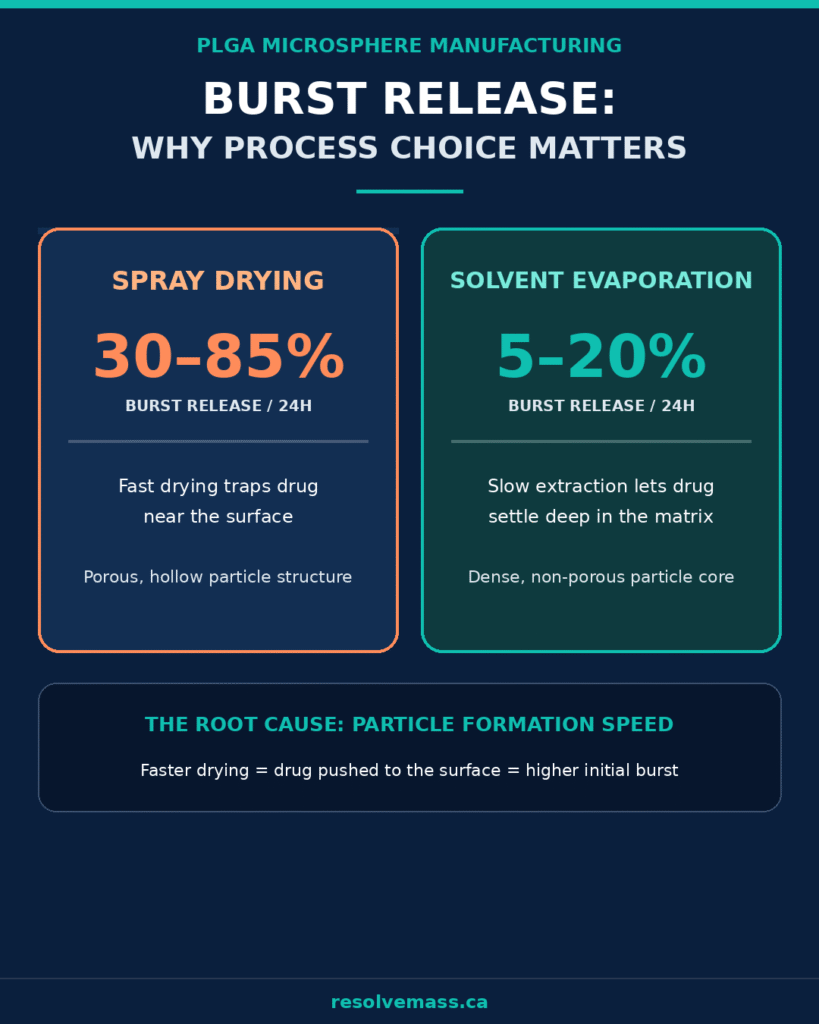
Emulsion solvent evaporation generally operates under low Péclet number conditions. The prolonged solvent extraction period provides additional time for PLGA molecules to rearrange and consolidate into comparatively dense, non-porous micro-architectures.
The therapeutic payload remains encapsulated within deeper hydrophobic polymer domains. This morphology can limit the initial burst release to <15–20% and support sustained, erosion-controlled release kinetics extending over weeks to months.
Read about structural degradation paths in our technical summary on bulk erosion vs surface erosion in plga.
Residual Solvent Control and ICH Q3C Regulatory Compliance
Spray drying can achieve efficient removal of residual solvents through continuous exposure of the atomized droplets to heated drying gas. Emulsion solvent evaporation, by comparison, requires additional downstream operations, including in-water extraction, washing, and prolonged lyophilization, to reduce residual Dichloromethane (DCM) below the 600 ppm ICH Q3C threshold.
Dichloromethane (DCM) is classified as an ICH Q3C Class 2 solvent and has a strict regulatory limit of 600 ppm. Residual organic solvents can act as plasticizers within PLGA, potentially reducing the polymer’s glass transition temperature (Tg) below body temperature (37°C).
A reduced Tg increases polymer chain mobility and can consequently accelerate matrix degradation, drug leakage, and instability during storage.
During spray drying, direct contact between atomized micro-droplets and heated drying gas promotes rapid removal of volatile organic solvents. The high drying efficiency can reduce residual DCM concentrations to compliant levels within the primary collection process, although minor secondary vacuum drying may still be required depending on the formulation and process conditions.
In emulsion solvent evaporation, DCM removal is influenced by its partitioning behavior between the organic phase and the bulk aqueous phase. Because DCM has limited water solubility (~2% v/v), complete solvent removal may require large phase-volume ratios, controlled temperature ramping during in-water drying, and extended vacuum lyophilization.
When secondary extraction conditions are appropriately controlled, emulsion-based processes can achieve residual DCM levels below 1 ppm, supporting stringent regulatory requirements for long-acting injectables.
| Quality Attribute | Emulsion Solvent Evaporation | Continuous Spray Drying |
|---|---|---|
| Matrix Morphology | Dense, solid interior with tortuous pore networks | Porous, hollow core, or wrinkled thin-shell structures |
| Surface Topography | Smooth, uniform polymeric exterior | Dimpled, porous, or highly textured exterior |
| Initial Burst Release (24h) | Low (5% – 20%) | High (30% – 85% without process modification) |
| Residual Solvents (DCM) | Requires extended in-water extraction and lyophilization | Stripped efficiently during primary drying cycle |
| Residual Stabilizers | Retains surface-bound PVA requiring extensive washing | Low (often processed without surfactant additions) |
| Glass Transition (Tg) | Preserved near native polymer baseline (~48°C) | Sensitive to plasticization from fast-trapped solvents |
Biologic Payload Compatibility in Spray Drying vs Solvent Evaporation
Encapsulating biologics using Spray Drying vs Solvent Evaporation exposes sensitive active payloads to different degradation stresses, including thermal and interfacial shear during atomization and hydrophobic interfacial unfolding at organic-aqueous boundaries. Protecting protein and peptide secondary structures therefore requires carefully selected excipients, optimized formulation conditions, or low-temperature processing strategies.
Biologics such as therapeutic proteins, recombinant peptides, and mRNA vaccines are susceptible to physical and chemical degradation during microencapsulation.
During double emulsion solvent evaporation (W1/O/W2), the primary stress factors include high-shear homogenization and exposure to extensive hydrophobic organic-aqueous interfaces (W1/O). Proteins can adsorb at the DCM-water interface, exposing hydrophobic regions of their structures and initiating irreversible aggregation or deamidation.
To reduce interfacial denaturation, formulations may incorporate protective excipients, such as trehalose, mannitol, or recombinant human albumin. Alternatively, ice-cold processing conditions can be employed during primary emulsification to help preserve native tertiary structures.
In spray drying, the principal stress factors arise from thermal exposure and air-liquid surface shear during atomization. Although droplet evaporation takes place within milliseconds, exposure to elevated drying gas temperatures can denature heat-sensitive biologics when the wet-bulb temperature exceeds the protein unfolding threshold.
Furthermore, atomization generates a high interfacial surface area, which can contribute to shear-induced aggregation.
To protect heat-sensitive biomolecules during spray drying, process engineers may use closed-mode low-temperature drying loops, feed emulsions stabilized with non-ionic surfactants such as Polysorbate 20 or Pluronic F-127, and sugar vitrification matrices that help stabilize protein conformations during rapid moisture removal.
Discover formulation strategies in our whitepaper on characterization of long acting biologics.
Conclusion: Strategic Selection of Spray Drying vs Solvent Evaporation
Strategic selection between Spray Drying vs Solvent Evaporation depends on balancing critical product quality attributes, including control of initial burst release, against manufacturing scalability and throughput requirements. Emulsion solvent evaporation remains an established approach for extended-release parenteral depots that require tight control of initial burst release and dense internal matrix structures.
Read more about clinical translation in our summary on plga long acting injectable formulation.
In contrast, spray drying provides an efficient continuous processing technology suitable for rapid manufacturing, dry powder inhalation formulations, and applications in which continuous operation provides economic and scaling advantages.
Learn about advanced routes in our report on plga based ocular drug delivery.
Assessing these tradeoffs requires robust process engineering and comprehensive analytical testing to maintain product consistency and support regulatory compliance.
To discuss formulation development, analytical characterization, or technical testing requirements for long-acting injectables, visit the ResolveMass Laboratories Inc. Contact Us Page.
Frequently Asked Questions
Spray drying may reduce the glass transition temperature (Tg) of PLGA when residual organic solvent becomes entrapped within the rapidly solidifying polymer matrix. These residual solvents can function as plasticizers and increase polymer chain mobility. A lower Tg relative to the typical 45°C–50°C range may adversely affect the physical stability and storage performance of the microspheres.
Emulsion solvent evaporation is often selected for multi-month depot injectables because gradual solvent removal promotes progressive consolidation of the PLGA matrix. The resulting particles can have a dense internal structure with reduced porosity, which restricts water penetration and drug diffusion. This architecture can help minimize the initial burst and support prolonged, erosion-controlled drug release.
ICH Q3C establishes solvent classifications according to their potential safety risks and specifies concentration limits applicable to pharmaceutical products. Dichloromethane (DCM) is designated as a Class 2 solvent, with a permitted concentration limit of 600 ppm. Residual solvent levels in PLGA microspheres are typically assessed using validated Headspace Gas Chromatography (GC-HS) methods.
Yes, spray drying can be performed using a single-phase organic feed containing PLGA and a hydrophobic API dissolved in a suitable organic solvent, such as DCM or acetone. Because the feed can be directly atomized into the drying chamber, an external aqueous phase and stabilizers such as PVA may not be required. This can simplify downstream processing by reducing the need for extensive washing and surfactant removal.
Protein denaturation during double emulsion processing can be minimized by incorporating protective excipients such as trehalose or sucrose into the primary aqueous phase. Processing at reduced temperatures, including the use of ice baths, can further decrease stress on sensitive biomolecules. Lower homogenization intensity and protective proteins such as serum albumin may also help reduce exposure to damaging interfaces.
The lactide-to-glycolide (L) ratio affects the hydrophobicity, solvent behavior, water uptake, and hydrolytic degradation characteristics of PLGA. A 50:50 composition generally undergoes faster degradation, whereas polymers containing greater proportions of lactide tend to degrade more slowly because of their increased hydrophobicity. Consequently, higher lactide compositions such as 75:25 or 85:15 may be advantageous for longer-duration depot formulations.
Dichloromethane (DCM) is commonly selected for PLGA microsphere production because it dissolves PLGA effectively and has a relatively low boiling point of approximately 40°C. Its limited water solubility of about 2% v/v also supports formation of stable organic droplets during emulsion-based processing. When alternative solvents such as Ethyl Lactate are introduced, the formulation and drying conditions may require optimization because of differences in boiling point and water miscibility.
In spray drying, particle size distribution is strongly influenced by factors such as atomization gas pressure, nozzle orifice diameter, feed viscosity, and feed flow rate. For emulsion solvent evaporation, particle dimensions are primarily affected by homogenizer shear speed, impeller configuration, continuous phase viscosity, and surfactant concentration. Controlling these parameters consistently is essential for maintaining a reproducible particle size distribution (SPAN).
Characterization equivalence for generic PLGA microspheres requires a comprehensive analytical package covering polymer composition, molecular properties, thermal behavior, moisture, residual solvents, particle characteristics, and drug release. Quantitative NMR (qNMR), gel permeation chromatography (GPC), modulated DSC, Karl Fischer titration, Headspace GC, and laser diffraction can assess these critical attributes. USP apparatus testing is additionally used to compare in vitro release kinetics and establish similarity between the test and reference products.
Reference:
- Butreddy, A., Gaddam, R. P., Kommineni, N., Dudhipala, N., & Voshavar, C. (2021). PLGA/PLA-based long-acting injectable depot microspheres in clinical use: Production and characterization overview for protein/peptide delivery. International Journal of Molecular Sciences, 22(16), 8884. https://doi.org/10.3390/ijms22168884
- Michaelides, K., Al Tahan, M. A., Zhou, Y., Trindade, G. F., Cant, D. J. H., Pei, Y., Dulal, P., & Al-Khattawi, A. (2024). New insights on the burst release kinetics of spray-dried PLGA microspheres. Molecular Pharmaceutics, 21(12), 6245–6256. https://doi.org/10.1021/acs.molpharmaceut.4c00686
- Park, H., Ha, E.-S., Kim, J.-S., & Kim, M.-S. (2023). Injectable sustained-release poly(lactic-co-glycolic acid) (PLGA) microspheres of exenatide prepared by supercritical fluid extraction of emulsion process based on a design of experiment approach. Bioengineering & Translational Medicine, 8(3), e10485. https://doi.org/10.1002/btm2.10485
- Lee, H., Kim, J., Shin, E., Kim, S., Seol, E., Baek, M., Baek, M., Chae, Y., & Choi, H. (2007). Method for producing sustained-release microspheres with improved dispersibility and injection dose (South Korean Patent No. KR100722607B1). Korean Intellectual Property Office. Google Patents
Get In Touch With Us
About The Author


