

Introduction
High-yield Sterile Fill-Finish Services for Peptide Injectables demand stringent engineering controls and sophisticated aseptic processing approaches to protect sensitive therapeutic peptides against chemical, physical, and mechanical degradation throughout commercial manufacturing operations. Therapeutic peptides, ranging from short linear synthetic sequences to structurally complex cyclic peptides and long-acting GLP-1 receptor agonists, possess delicate secondary and tertiary structures. These macromolecular configurations can make them particularly susceptible to hydrodynamic shear stress, interfacial adsorption, silicone oil-induced aggregation, and extractable/leachable (E&L) interactions.
The selection of an appropriate primary container closure configuration, including liquid or lyophilized vials, ready-to-use (RTU) prefilled syringes (PFS), and multi-dose pen cartridges, fundamentally determines the fill-finish fluid dynamics and long-term drug-container compatibility profile required for the product. In addition, contemporary regulatory frameworks, including the updated EU GMP Annex 1 guidelines, require comprehensive contamination control strategies (CCS), automated processing within Restricted Access Barrier Systems (RABS) or isolators, and fully validated single-use fluid paths. Addressing these technical requirements effectively demands an end-to-end understanding of fluid metering physics, surface chemistry, and elastomeric barrier technology.
Learn more about specialized synthetic workflows for complex targets by visiting ResolveMass Custom Peptide Synthesis Services.
Quick Summary:
- Peptide injectables require stringent aseptic processing to protect sensitive molecules from shear stress, aggregation, and chemical degradation.
- Primary container selection—vials, prefilled syringes, or cartridges—affects dose accuracy, silicone oil exposure, drug stability, and delivery-device compatibility.
- Single-use peristaltic pumps provide gentle, low-shear dispensing and help minimize peptide aggregation and particulate generation.
- Baked-on siliconization, cross-linked coatings, and silicone-free polymers reduce silicone oil migration and protect peptide stability.
- Fluoropolymer barrier films such as ETFE and PTFE prevent direct rubber-drug contact and minimize extractable and leachable contamination.
- Compliance with EU GMP Annex 1, ISO standards, and USP/EP requirements ensures contamination control, container closure integrity, and particulate monitoring.
- Integrated engineering, automated aseptic processing, and validated quality controls support stable peptide products, improved manufacturing yield, and reliable scale-up from clinical to commercial production.
Primary Container Closure Selection in Sterile Fill-Finish Services for Peptide Injectables
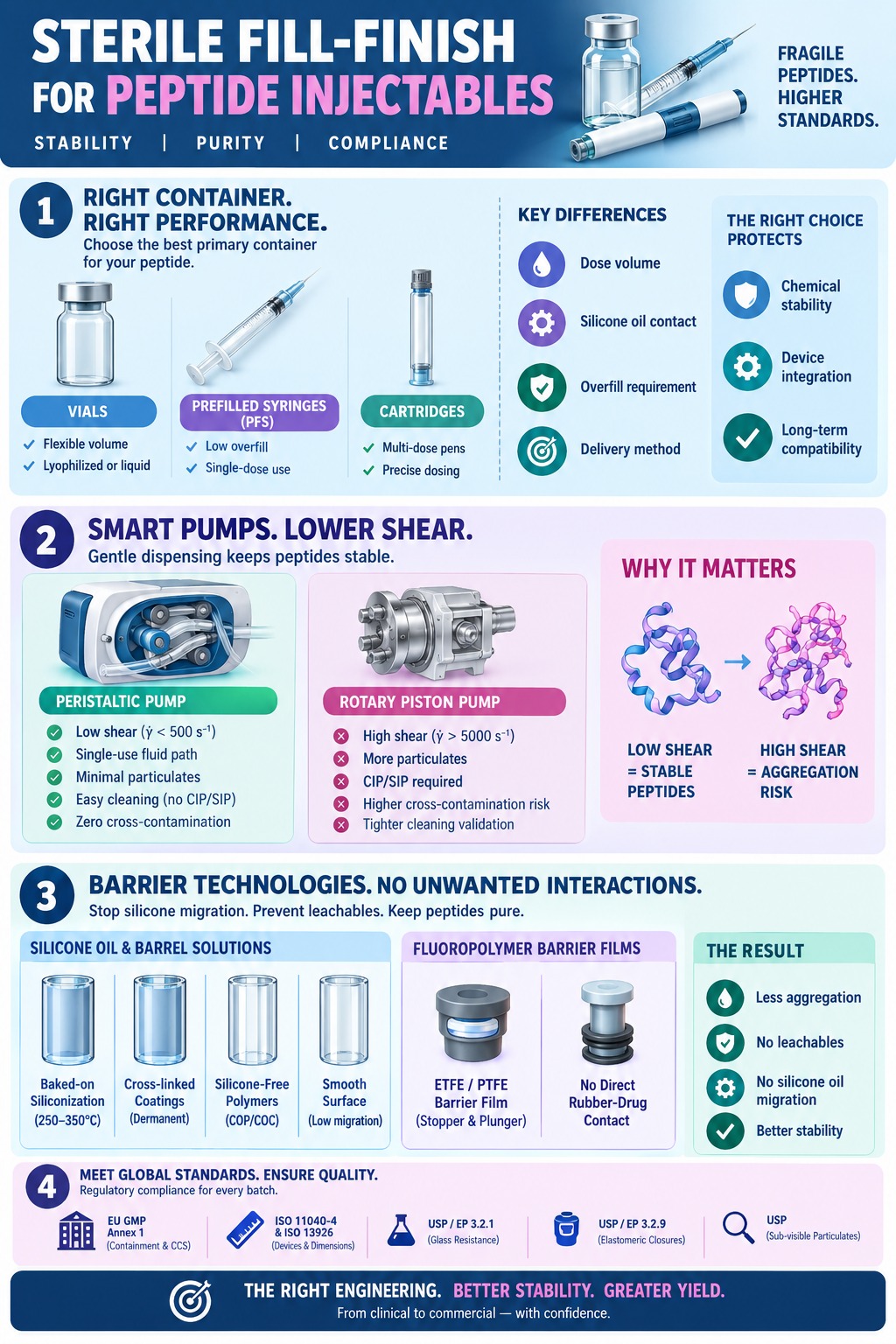
Primary container closure selection plays a critical role in determining the long-term chemical stability, device integration potential, and processing parameters of peptide parenteral products. The selection among vials, prefilled syringes (PFS), and cartridges is influenced by several factors, including dose volume, shear sensitivity, user compliance requirements, and tolerance to silicone oil.
The manufacturing workflow progresses from bulk peptide solution formulation through aseptic volumetric metering and ultimately into one of three primary container formats. Vials provide considerable volumetric flexibility and limited silicone oil contact, making them suitable for clinical supplies as well as freeze-dried (lyophilized) formulations. Prefilled syringes substantially reduce overfill requirements and facilitate single-dose self-administration; however, they require thermal or cross-linked siliconization to reduce the potential for particle formation. Cartridges require highly controlled dimensional tolerances for integration with multi-dose auto-injector pen systems and employ dual elastomeric seals together with specialized internal surface coatings.
For a detailed analysis of structural differences impacting dosage design, see Differences Between a Peptide and a Small Molecule Drug.
Architectural and Operational Comparison of Vials, Prefilled Syringes, and Cartridges
Glass vials continue to serve as a benchmark container format for lyophilized and early-phase liquid peptide therapeutics. They can accommodate fill volumes ranging from 2.0 mL to more than 100.0 mL while providing limited contact with siliconized glass surfaces because only the elastomeric stopper generally requires surface treatment. However, liquid formulations packaged in vials require greater fill allowances, typically involving 10% to 20% overfill, to ensure that the intended withdrawal volume can be accurately obtained. This can contribute to the loss of valuable active pharmaceutical ingredients (APIs).
Discover strategies for stabilizing delicate lyophilized cake structures at Formulating a Lyophilized Peptide Injectable.
Prefilled Syringes (PFS) and Pen Cartridges reduce user dosing errors, minimize dead volume, and support direct integration with automated pen injectors and body-worn delivery systems. Standard cartridges with capacities of 1.0 mL, 1.5 mL, and 3.0 mL require stringent dimensional control in accordance with ISO 13926 to maintain consistent internal bore diameters. Such precision is essential for accurate micro-dosing through mechanical dial clicks in auto-injectors.
| Operational & Quality Parameter | Liquid / Lyophilized Vials | Prefilled Syringes (PFS) | Multi-Dose Cartridges |
|---|---|---|---|
| Primary Dosing Volumes | 2.0 mL – 100.0 mL | 0.5 mL – 3.0 mL | 1.0 mL, 1.5 mL, 3.0 mL |
| Relevant ISO Standards | ISO 8362 | ISO 11040-4 | ISO 13926 |
| Target Delivery Method | Manual syringe withdrawal / clinical reconstitution | Single-dose self-administration / auto-injectors | Multi-dose pen injectors / wearable pumps |
| Silicone Oil Contact Risk | Low (stopper coating only) | Moderate to High (barrel lubrication) | High (inner barrel lubrication) |
| Drug Overfill Requirement | High (10% – 20% volume loss) | Low (1% – 3% volume loss) | Minimal (exact volumetric delivery) |
| Primary Closure Mechanism | Stopper + Aluminum Crimp Seal | Integrated Staked Needle/Luer + Plunger Stopper | Elastomeric Disc Crimp + Plunger Stopper |
| Break-Loose & Glide Force Impact | Not Applicable | Critical for auto-injector actuation | Critical for incremental dosing accuracy |
Dosing System Dynamics and Shear Stress Mitigation in Sterile Fill-Finish Services for Peptide Injectables
The selection of the dosing pump directly influences hydrodynamic shear stress, friction, and the generation of sub-visible particulates during liquid volumetric dispensing. Peristaltic pumps equipped with single-use fluid paths can mitigate shear-induced peptide aggregation more effectively than mechanical rotary piston pumps.
Within a peristaltic pumping architecture, the fluid moves through a flexible, pharmaceutical-grade platinum-cured silicone or thermoplastic tube. Rotating rollers externally compress the tubing and displace the fluid in a controlled manner without exposing the formulation to direct mechanical contact, internal clearances, or high-velocity recirculation regions. In contrast, rotary piston pumps employ a reciprocating and rotating ceramic or stainless-steel piston positioned inside a tight-tolerance cylinder. The formulation moves through narrow internal orifices and recirculation gaps, which can generate increased friction, localized temperature elevations, and shear forces that may compromise fragile peptide structures.
Hydrodynamic Shear Analysis and Particle Generation
Therapeutic peptides contain delicate tertiary hydrophobic interactions that can become disrupted when exposed to elevated shear rates (γ̇). Such disruption may expose hydrophobic domains and subsequently promote self-assembly into irreversible sub-visible aggregates or amyloid fibrils.
Mechanical rotary piston pumps operate with tight internal clearances between the rotating piston and the cylinder wall. Computational Fluid Dynamics (CFD), when combined with Lagrangian particle tracking, demonstrates that rotary piston pumps can generate internal fluid recirculation zones. Within these regions, localized shear rates can exceed critical thresholds, exposing peptide molecules to increased friction, energy dissipation, and surface contact. These conditions can substantially increase sub-visible particle counts in the >2 µm to >10 µm range.
By comparison, peristaltic dispensing pumps use external rotating rollers to compress flexible tubing. The peptide solution remains completely enclosed within the single-use fluid path, preventing direct exposure to mechanical pump surfaces. Peristaltic pump performance can be further optimized through design features such as multi-roller configurations, lower motor rotation speeds (rpm), and dual pump-head arrangements. These approaches help reduce volumetric pulsation and maintain lower fluid velocity gradients.
Read about transitioning active molecules to larger volumetric processing batches at Peptide CDMO Scale-Up Services.
| Engineering Evaluator | Peristaltic Pump Technology | Rotary Piston Pump Technology |
|---|---|---|
| Fluid Contact Interface | Disposable tubing interior (Platinum-cured silicone) | Machine-cut Ceramic / Stainless-Steel Cylinder |
| Shear Profile & Stress Level | Uniform low shear (γ̇ < 500 s⁻¹) | Extreme localized shear (γ̇ > 5000 s⁻¹) |
| Sub-Visible Particulate Generation | Exceptionally low particulate generation | Higher counts due to mechanical contact |
| Cleaning & Sterilization Validation | Eliminates CIP/SIP (100% Single-Use Fluid Path) | Requires extensive CIP/SIP and cleaning validation |
| Cross-Contamination Risk | Zero (complete fluid path isolation) | Managed via stringent multi-batch cleaning protocols |
| Dosing Accuracy Range | ±0.5% down to microliter dosing volumes | ±0.1% for highly viscous solutions |
Surface Chemistry, Silicone Oil Aggregation, and Barrier Technologies in Sterile Fill-Finish Services for Peptide Injectables
Interfacial adsorption of peptides onto lubricating silicone oil droplets within syringes and cartridges represents an important contributor to sub-visible particle formation and immunogenic aggregation. Technologies including thermally cured baked-on silicone, cross-linked coatings, silicone-free polymers, and fluoropolymer-barrier stoppers can reduce these interfacial risks.
Conventional siliconized barrels use a liquid silicone oil layer that can migrate into the liquid formulation in the form of free sub-visible droplets. These droplets can attract surface-active peptides and facilitate aggregation. More advanced primary container designs replace free liquid silicone oil with thermally fixed silicone, baked-on at 250°C to 350°C, or with silicone-free cyclic olefin polymers, thereby reducing free oil migration. At the same time, traditional uncoated rubber plungers, which can permit leachables to migrate into the formulation, can be replaced with continuous fluoropolymer (ETFE/PTFE) barrier film laminates. These barrier systems prevent direct contact between rubber and the drug product and can eliminate the requirement for liquid silicone lubrication on the plunger.
Silicone Oil Migration Mechanisms and Mitigation Strategies
Conventional prefilled syringes and cartridges use liquid silicone oil, specifically polydimethylsiloxane (PDMS), sprayed onto the internal glass barrel surface to achieve low break-loose and gliding forces during administration. However, this liquid silicone oil can migrate into aqueous peptide formulations. Free silicone oil micro-droplets function as hydrophobic nucleation sites where peptide molecules can rapidly adsorb at the silicone oil-water interface. This interaction can promote structural denaturation and the formation of both sub-visible and visible aggregates. The aggregation process may become more pronounced during transportation as a result of agitation and headspace movement.
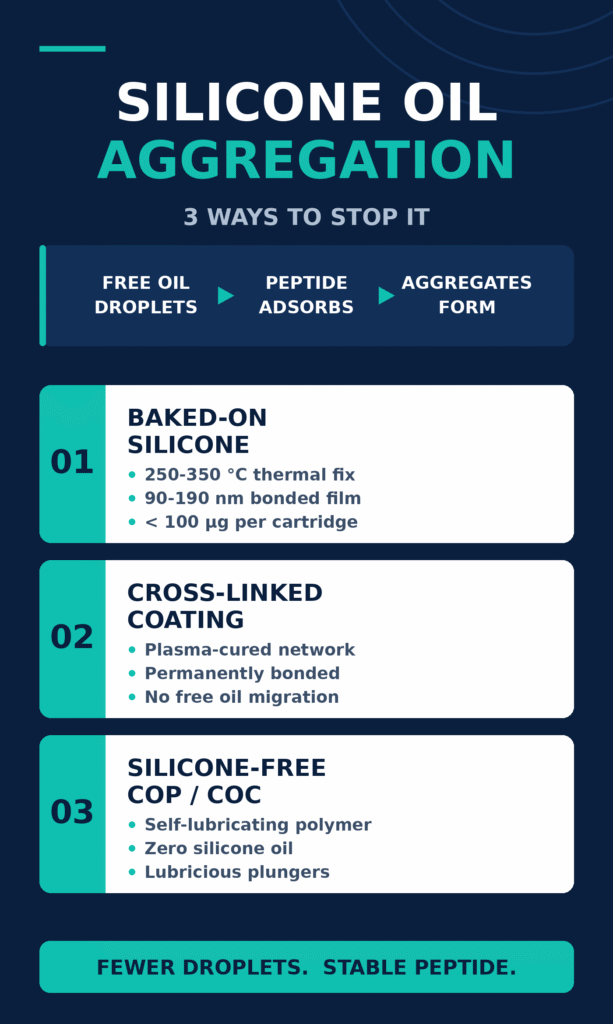
To maintain peptide stability, advanced fill-finish lines incorporate three primary mitigation technologies:
- Baked-On Siliconization: The silicone oil emulsion applied to the glass barrel undergoes thermal fixation inside a heating tunnel at temperatures ranging from 250°C to 350°C. This process covalently attaches a micro-thin silicone layer, approximately 90 nm to 190 nm thick, to the borosilicate glass surface. Thermally baked-on silicone reduces free oil droplets and maintains silicone levels below 100 µg per cartridge while retaining low gliding forces.
- Cross-Linked Covalent Coatings: Plasma-treated or cross-linked silicone networks generate an insoluble and permanently bonded lubricious barrier. This configuration reduces the potential for free silicone oil to migrate into the drug product.
- Silicone-Free Container Systems: Alternative barrel materials, including Cyclic Olefin Polymer (COP) and Cyclic Olefin Copolymer (COC), provide inherent surface lubricity. When combined with specially designed lubricious plungers, these container systems can eliminate silicone oil completely and thereby reduce the potential for oil-induced peptide aggregation.
Fluoropolymer Barrier Films for Elastomeric Closures
Conventional elastomeric plungers and stoppers contain materials such as vulcanizing agents, zinc accelerators, antioxidants, and processing aids. These components may leach into sensitive peptide formulations. Direct contact between untreated rubber and liquid peptides can contribute to chemical degradation, including oxidation and disulfide exchange reactions.
Applying a continuous fluoropolymer barrier film, such as Ethylene Tetrafluoroethylene (ETFE) or Polytetrafluoroethylene (PTFE), to the drug-facing surfaces of stoppers and plungers provides an important protective barrier:
- Zero Direct Rubber-Drug Contact: The fluoropolymer film functions as an inert chemical barrier, preventing organic extractables and inorganic ions from migrating into the liquid peptide matrix.
- Elimination of Plunger Siliconization: Fluoropolymer films reduce the surface energy of the elastomer, facilitating smooth gliding without requiring liquid silicone oil lubrication on the plunger stopper.
- Low Break-Loose Force Consistency: The barrier film supports consistent break-loose and extrusion forces throughout the drug product’s shelf life, thereby reducing the possibility of plunger stalling in spring-driven auto-injectors.
Review strategies for managing degradation profiles under Impurity Control Strategies Under ICH Q3A.
Regulatory Compliance and Quality Assurance in Sterile Fill-Finish Services for Peptide Injectables
Regulatory compliance for sterile peptide injectables requires rigorous adherence to international standards governing sterility assurance, container closure integrity, and particulate limits. Manufacturing facilities must establish comprehensive Contamination Control Strategies (CCS) that align with EU GMP Annex 1 guidelines and applicable global pharmacopeial requirements.
Key regulatory standards and technical benchmarks include:
- EU GMP Annex 1 Compliance: Requires physical separation of operators from the aseptic filling area through the use of automated isolators or Restricted Access Barrier Systems (RABS). Continuous monitoring of total micro-particulate and viable environmental conditions must be maintained within Grade A zones.
- ISO 11040-4 & ISO 13926 Standards: Establish physical dimensions, mechanical tolerances, flange geometries, and plunger stopper interfaces for prefilled syringes and cartridges, supporting reliable integration with auto-injectors and pen delivery systems.
- USP & EP 3.2.1 (Glass Surface Chemical Resistance): Address the hydrolytic resistance of Type I borosilicate glass barrels to minimize the potential for glass flake formation (delamination) associated with aggressive peptide buffer formulations.
- USP & EP 3.2.9 (Elastomeric Closures for Injections): Establish stringent limits for extractable acidity, alkalinity, heavy metals, and volatile organic compounds associated with primary rubber stoppers and plungers.
- USP & USP (Sub-visible Particulate Matter): Establish particulate limits applicable to therapeutic injectables and require analytical techniques, including Flow Imaging Microscopy and Light Obscuration, to differentiate proteinaceous aggregates from silicone oil droplets.
Explore regulatory preparation requirements at CMC Documentation at a CDMO for ANDA and analytical support options at One-Stop CDMO Analytical Services for ANDA.
Conclusion: Optimizing Sterile Fill-Finish Services for Peptide Injectables
Developing robust Sterile Fill-Finish Services for Peptide Injectables requires an integrated engineering approach that connects shear-sensitive fluid mechanics, surface chemistry, and automated isolator-based processing. The use of single-use peristaltic pumping systems instead of high-shear rotary piston pumps can help preserve tertiary peptide structures while also reducing cleaning validation requirements. At the same time, the implementation of baked-on siliconization and fluoropolymer-coated elastomeric closures can address silicone-induced aggregation and the migration of leachables.
As biopharmaceutical pipelines increasingly incorporate complex cyclic peptides, high-concentration formulations, and multi-dose auto-injector cartridges, fill-finish operations must adopt automated processing platforms capable of preserving product stability and maximizing manufacturing yield. Implementing these engineering and containment technologies supports the transition from clinical manufacturing to commercial delivery while maintaining stringent regulatory compliance.
Compare regional outsourcing models by reviewing Canadian vs US Peptide CDMOs or examine service scope variations at Peptide CDMO vs CMO to identify the ideal partner for your injectable pipeline.
For specialized technical consultation, regulatory filling line strategies, and advanced sterile manufacturing solutions, contact the engineering team at ResolveMass Contact Services.
Frequently Asked Questions
The type of pump used during aseptic filling influences the hydrodynamic shear stress (γ̇), friction, and fluid velocity gradients experienced by the peptide formulation. Excessive shear can disturb non-covalent interactions within peptide structures and promote hydrophobic exposure, aggregation, or amyloid fibril formation. Low-shear peristaltic pumping provides gentler fluid handling and helps maintain the physical stability of sensitive peptide formulations.
Peristaltic pumps maintain the formulation within a pre-sterilized, single-use tubing assembly, avoiding direct exposure to internal mechanical components, seals, and metal or ceramic surfaces. Rotary piston pumps can generate localized high-shear regions and recirculation zones that may increase particulate generation. Peristaltic systems also simplify contamination control by reducing cross-contamination concerns and minimizing CIP/SIP cleaning and sterilization validation requirements.
Liquid silicone oil is commonly used to provide lubrication inside prefilled syringes and cartridges, but free silicone oil droplets can migrate into aqueous peptide formulations. Peptide molecules may adsorb at the hydrophobic silicone oil-water interface, resulting in conformational changes and subsequent nucleation of aggregates. Mechanical agitation, vibration, and movement during transportation can further promote the formation of sub-visible and visible particles.
Baked-on siliconization involves applying a silicone emulsion to the internal glass surface followed by thermal treatment at approximately 250°C to 350°C. The heating process firmly anchors the silicone layer to the borosilicate glass, substantially reducing the presence of freely mobile silicone oil droplets. This approach maintains the necessary lubrication for device operation while limiting silicone-mediated interactions with the peptide formulation.
Fluoropolymer-coated plungers use barrier films such as ETFE or PTFE to separate the elastomeric material from direct contact with the peptide formulation. This configuration helps limit the migration of organic extractables, inorganic components, and curing-related substances from the underlying rubber. The low-friction surface can also support consistent plunger movement and reduce the dependence on liquid silicone lubrication.
Multi-dose cartridges are designed specifically for integration with pen-injector systems and therefore require precise dimensional control in accordance with ISO 13926. Their internal bore dimensions must remain consistent to support accurate dose delivery through mechanical dial mechanisms. Unlike many prefilled syringes, cartridges incorporate a neck-end elastomeric disc with an aluminum crimp seal and a separate sliding plunger stopper, requiring controlled sealing operations at both ends.
Primary container closure components are evaluated against applicable standards such as ISO 11040-4 for prefilled syringes, ISO 13926 for cartridges, and ISO 8362 for vials. Additional requirements address glass hydrolytic resistance, elastomeric closure compatibility, extractables, and sub-visible particulate matter through relevant USP and EP standards. Sterile filling operations must also comply with EU GMP Annex 1 requirements and operate under an established Contamination Control Strategy.
Single-use fluid paths typically incorporate pre-sterilized disposable tubing, manifolds, filter assemblies, and fill needles that keep the drug product isolated from reusable processing equipment. Eliminating permanent stainless-steel product-contact piping reduces the potential for cross-contamination between manufacturing campaigns. These systems can also reduce CIP/SIP requirements, simplify cleaning validation, and shorten equipment changeover and turnaround times.
High-value peptide products benefit from highly controlled dosing systems, including calibrated peristaltic pumps combined with real-time gravimetric or in-line checkweighing systems. Using pre-sterilized Ready-to-Use (RTU) nested syringes or cartridges can reduce handling-related defects and container rejection rates. Prefilled syringes and cartridges can also minimize the additional fill volume typically required with vials, helping maximize the number of usable doses obtained from each batch.
Reference:
- Funke, S., Matilainen, J., Nalenz, H., Bechtold-Peters, K., Mahler, H.-C., & Friess, W. (2016). Silicone migration from baked-on silicone layers: Particle characterization in placebo and protein solutions. Journal of Pharmaceutical Sciences, 105(12), 3520–3531. https://doi.org/10.1016/j.xphs.2016.08.031
- Gerhardt, A., Nguyen, B. H., Lewus, R., Carpenter, J. F., & Randolph, T. W. (2015). Effect of the siliconization method on particle generation in a monoclonal antibody formulation in pre-filled syringes. Journal of Pharmaceutical Sciences, 104(5), 1601–1609. https://doi.org/10.1002/jps.24387
- Majumdar, S., Ford, B. M., Mar, K. D., Sullivan, V. J., Ulrich, R. G., & D’souza, A. J. M. (2011). Evaluation of the effect of syringe surfaces on protein formulations. Journal of Pharmaceutical Sciences, 100(7), 2563–2573. https://doi.org/10.1002/jps.22515
- Dreckmann, T., Boeuf, J., Ludwig, I.-S., Lümkemann, J., & Huwyler, J. (2020). Low volume aseptic filling: Impact of pump systems on shear stress. European Journal of Pharmaceutics and Biopharmaceutics, 147, 10–18. https://doi.org/10.1016/j.ejpb.2019.12.006
Get In Touch With Us
About The Author


