

Introduction
The structural integrity and long-term stability of biopharmaceutical drug products depend heavily on the chemical inertness of their primary container-closure systems (CCS). In this Sulfur-Containing Leachables Case Study, we examine a critical investigation in which an unexpected chemical migration event compromised an advanced biologic formulation during a routine real-time shelf-life study.
Extractables and leachables (E&L) evaluations are essential components of regulatory submissions under FDA 21 CFR Parts 210 and 211, ensuring that container materials do not interact with or degrade the therapeutic product (Zhou et al., 2011). While standard E&L programs are effective at identifying expected migrants such as plasticizers and antioxidants, unexpected or non-intentionally added substances (NIAS) may bypass routine screening and introduce chemically reactive functional groups into the formulation matrix.
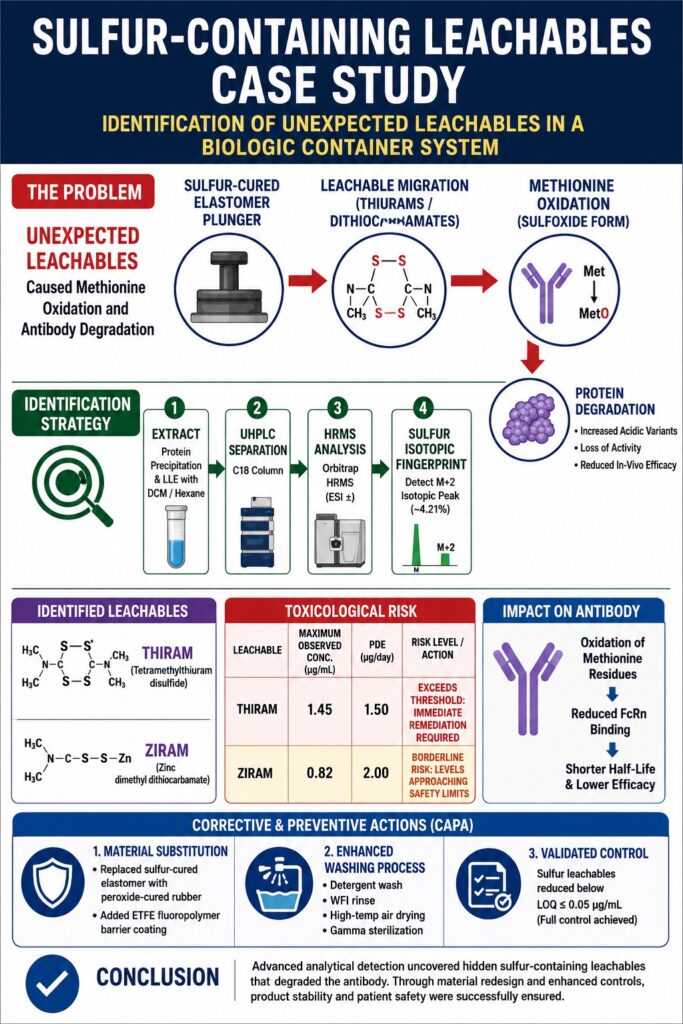
[Container System Interaction] —> [Leachable Migration (Thiurams/Dithiocarbamates)]
|
v
[Protein Degradation] <— [Methionine Oxidation (Sulfoxide Form)]
In the present investigation, a therapeutic monoclonal antibody (mAb) formulated in a prefilled syringe system showed an unusual degradation pattern within six months of storage at 2–8°C. This case study outlines the analytical strategy used to resolve this complex chemical issue, identify the hidden contaminants, and implement a robust mitigation approach.
For specifics on these container types, see our resources on EL testing for pre-filled syringes.
Share via:
Article Summary:
- The case study investigates unexpected sulfur-containing leachables originating from a container-closure system (CCS) used for a monoclonal antibody formulation, which led to protein degradation during stability studies.
- Routine extractables and leachables (E&L) testing failed to detect these non-intentionally added substances (NIAS), highlighting the limitations of standard screening methods for ultra-trace contaminants.
- During real-time stability testing, the biologic showed increased acidic variants due to methionine oxidation (Met252 and Met428), despite proper storage conditions and formulation safeguards.
- Investigation traced the issue to sulfur-cured elastomeric plunger components, which released thiuram and dithiocarbamate-based compounds into the drug product over time.
- Advanced UHPLC-HRMS analysis, combined with sulfur-specific isotopic pattern recognition, enabled identification of low-level organosulfur leachables such as tetramethylthiuram disulfide and zinc dimethyldithiocarbamate.
- Toxicological evaluation revealed that some leachables exceeded or approached permissible daily exposure limits and directly contributed to antibody oxidation, reduced stability, and impaired therapeutic function.
- The issue was resolved by replacing sulfur-cured elastomers with peroxide-cured materials and adding inert barrier coatings, along with improved washing processes to eliminate residual contamination risks.
The Analytical Challenge and Material Specifications
The core challenge involved detecting ultra-trace, chemically reactive organic contaminants that altered a complex biological matrix without causing visible particulate formation or immediate changes in pH. The drug product, an IgG1 monoclonal antibody, was contained in a single-use prefilled syringe system composed of a Type I borosilicate glass barrel, a specialized stainless-steel needle, and an elastomeric plunger tip.
If you are early in your product development phase, it is vital to understand the root causes of failed extractables and leachables (EL) studies to avoid these pitfalls.
CCS Configuration and Initial Stability Deviation
The initial material characterization and manufacturing specifications for the container-closure system are summarized in Table 1 below:
CCS Components and Initial Analytical Deviations
| Component | Material Specification | Initial Extraction Status | Observed Analytical Deviation |
|---|---|---|---|
| Syringe Barrel | Type I Borosilicate Glass | Compliant (USP <660>) | No issues detected; normal surface profile, no glass delamination |
| Needle Assembly | 316L Stainless Steel | Compliant (USP <1>) | No abnormal leaching of iron, nickel, or chromium detected |
| Plunger / Closure | Sulfur-cured Chlorobutyl Elastomer | Compliant (USP <381>) | Critical failure: accelerated oxidation of Met residues; altered charge-variant distribution |
During month six of real-time stability studies, routine capillary zone electrophoresis (CZE) and reversed-phase high-performance liquid chromatography (RP-HPLC) revealed a marked increase in the acidic variant fraction of the protein. Concurrent peptide mapping confirmed that two highly conserved methionine residues (Met252 and Met428) in the Fc region of the antibody had undergone significant oxidation to methionine sulfoxide.
This modification is particularly critical because oxidation of sulfur atoms within methionine side chains can alter protein conformation, promote aggregation, and significantly reduce biological in-vivo activity (Girard-Perier et al., 2020).
Since the formulation was protected from light exposure and oxygen, and already included an optimized surfactant system, a chemical migrant originating from the elastomeric plunger closure was strongly suspected as the primary source of oxidative stress.
For a deeper look into the toxicological implications of such findings, consult our article on the toxicological qualification of leachables.
Advanced Trace Analysis Methodology
Isolating and identifying unknown, non-intentional sulfur-containing migrants in a complex protein-based matrix requires a highly advanced orthogonal analytical platform capable of managing extreme chemical complexity. To clearly distinguish background matrix components from trace leachables, a comprehensive extraction and mass spectrometry workflow was implemented. When designing your study, consider how you approach solvents for extractables studies to ensure the best recovery of unknown migrants.
+————————————+
| Biologic Formulation Sample Extract |
+————————————+
|
v
+————————————+
| UHPLC Separation (C18 Column) |
+————————————+
|
v
+————————————+
| High-Resolution Mass Spectrometry |
+————————————+
|
v
+————————————+
| Accurate Mass & Isotopic Matching |
| (Isotopic M+2 Shift for Sulfur) |
+————————————+
1. Matrix Pre-fractionation and Extraction
To prevent fouling of analytical instruments by the high-concentration monoclonal antibody, the biologic drug product was first subjected to protein precipitation. Liquid-liquid extraction (LLE) was performed using high-purity, MS-grade dichloromethane (DCM) and hexane under carefully controlled low-temperature conditions. This approach effectively separated lipophilic organic leachables into the organic phase while the precipitated protein remained in the aqueous fraction.
2. UHPLC-HRMS Characterization
The concentrated organic extracts were analyzed using Ultra-High Performance Liquid Chromatography coupled with an Orbitrap High-Resolution Mass Spectrometer (UHPLC-HRMS).
Chromatographic Separation: Conducted on a sub-2 μm reversed-phase C18 column using a fully optimized linear mobile phase gradient consisting of 0.1 percent formic acid in water (A) and 0.1 percent formic acid in acetonitrile (B).
Mass Spectrometry Parameters: The HRMS system operated in both positive and negative electrospray ionization (ESI ±) modes with a resolving power of 140,000 at m/z 200. This ultra-high resolution enabled elemental composition assignment within a strict 3 ppm mass accuracy window.
For guidance on selecting the right platform, review the comparison between GC-MS vs LC-MS in extractables and leachables testing.
3. Exploiting the Sulfur Isotopic Fingerprint
A key breakthrough in this Sulfur-Containing Leachables Case Study came from recognizing distinct isotopic patterns. Sulfur has a characteristic natural abundance profile, particularly its stable isotope S-34, which has a natural abundance of approximately 4.21 percent compared to S-32 at 95.02 percent.
Any molecule containing a single sulfur atom produces a distinctive M+2 isotopic peak that is significantly more pronounced than compounds composed only of carbon, hydrogen, nitrogen, and oxygen. Using automated data-processing tools, analysts identified spectral doublets exhibiting a consistent m/z +1.9958 spacing, narrowing thousands of detected features down to a small group of sulfur-rich candidates.
If you need assistance defining your testing strategy, our team can help determine the appropriate AET for extractables and leachables studies.
Root Cause Analysis and Chemical Identification
Through accurate mass measurements, MS/MS fragmentation analysis, and comparison with certified reference standards, two primary low-molecular-weight organosulfur compounds were identified as migrating into the drug product.
The first compound, observed with a protonated ion [M+H]+ at m/z 241.0284, matched the empirical formula C6H12N2S4 (calculated m/z 241.0275, deviation 3.7 ppm). Fragment ions at m/z 120.03 and m/z 88.00 confirmed its identity as Tetramethylthiuram disulfide (Thiram). The second compound was identified as Zinc dimethyldithiocarbamate (Ziram).
CH3 S S CH3
\ // \ /
N–C–S–S–C–N
/ \
CH3 CH3
[Tetramethylthiuram disulfide (Thiram)]
Evaluating the cost of extractables and leachables testing early in the cycle can help budget for the necessary advanced analytical work required to catch these issues.
Vulcanization Chemistry Context
These compounds are well-known accelerators used in elastomer vulcanization processes (Carter, 2005). During rubber manufacturing, elemental sulfur is used to cross-link polymer chains, providing elasticity, sealing capability, and thermal stability. Thiuram and dithiocarbamate accelerators increase the speed of this cross-linking reaction.
If the curing process is not fully optimized, residual unreacted accelerators or their breakdown products may remain trapped within the rubber matrix. Over time, these lipophilic species can migrate to the surface of the plunger and partition into aqueous biopharmaceutical formulations, where they act as strong oxidizing agents targeting sensitive amino acid residues.
Toxicological Assessment and Product Impact
Once the chemical identities of the sulfur-containing leachables were confirmed, a detailed toxicological risk assessment and product impact evaluation were conducted to determine implications for patient safety and drug performance.
1. Safety Qualification Thresholds
Both Thiram and Ziram are known to exhibit localized cytotoxic effects and may act as systemic irritants at elevated exposure levels. Permitted Daily Exposure (PDE) limits for these vulcanization residues were calculated using guidance from the Product Quality Research Institute (PQRI) and ICH Q3D principles. The results are summarized in Table 2.
Quantitative Toxicological Evaluation of Identified Leachables
| Identified Leachable | Maximum Observed Concentration (μg/mL) | Calculated Permitted Daily Exposure (PDE) | Toxicological Risk Level / Action Status |
|---|---|---|---|
| Tetramethylthiuram disulfide (Thiram) | 1.45 μg/mL | 1.50 μg/day | Exceeds threshold: immediate material remediation required |
| Zinc dimethyldithiocarbamate (Ziram) | 0.82 μg/mL | 2.00 μg/day | Borderline risk: levels approaching safety limits |
2. Impact on Biologic Mechanism of Action (MoA)
Beyond safety considerations, the primary concern was degradation of the active pharmaceutical ingredient (API). Peptide mapping confirmed that accumulated organosulfur compounds directly promoted oxidation of methionine residues within the antibody.
The resulting methionine sulfoxide modifications disrupted binding affinity of the mAb to the neonatal Fc receptor (FcRn). This impairment significantly reduces the antibody’s circulation half-life in vivo, ultimately diminishing therapeutic efficacy and increasing the risk of variable patient response.
Corrective and Preventive Actions (CAPA)
Addressing this critical quality issue required a comprehensive redesign of the container-closure system and validation of enhanced processing controls.
Component Material Substitution
The primary corrective measure involved replacing the sulfur-cured chlorobutyl elastomer plunger with a peroxide-cured chlorobutyl rubber formulation. Peroxide curing uses organic peroxide compounds to cross-link elastomer chains, eliminating the need for sulfur, thiuram, or dithiocarbamate accelerators.
Additionally, the redesigned plunger incorporated a co-extruded, continuous fluoropolymer barrier coating (ethylene tetrafluoroethylene, ETFE) across all product-contact surfaces. This inert layer serves as a physical barrier, preventing migration of internal additives into the biologic formulation.
Enhanced Detergent Pre-Washing Validation
To minimize surface contamination risks during manufacturing, a validated multi-stage washing protocol was implemented. Plunger components undergo the following sequence:
- An alkaline surfactant-based detergent wash to remove organic residues
- A high-purity Water for Injection (WFI) rinse
- High-temperature air drying followed by gamma irradiation sterilization
Subsequent extractables testing using aggressive solvent reflux confirmed that sulfur-related residues were reduced below the analytical Limit of Quantitation (LOQ ≤ 0.05 μg/mL), ensuring full control of the packaging system.
Additionally, we ensured all data generated during our mitigation studies met stringent requirements, as data integrity in extractables and leachables testing is a cornerstone of regulatory compliance.
Conclusion
This Sulfur-Containing Leachables Case Study highlights that primary packaging selection for advanced therapeutics cannot rely solely on standard material compliance criteria. When unexpected chemical species contribute to biologic degradation, highly sensitive analytical screening approaches become essential for protecting patient safety and ensuring product quality.
Through advanced trace-level extraction methods and high-resolution UHPLC-HRMS analysis, investigators can uncover hidden degradation pathways, replace reactive elastomeric materials, and implement stronger manufacturing controls. Ensuring the stability of sensitive therapeutic proteins requires deep analytical insight and predictive material science, supporting safety from laboratory development through to patient administration.
For specialized testing support or consultation with an advanced analytical engineering team regarding container-closure system validation programs, visit the Contact Us page.
Frequently Asked Questions
Sulfur-containing leachables are reactive organosulfur compounds that can migrate from packaging materials into a drug product during storage. They are most commonly released from elastomer-based container-closure components such as stoppers, gaskets, and syringe plungers. These components often contain sulfur-based chemicals used during vulcanization or as curing accelerators. Over time, small residual amounts of these substances may diffuse into the formulation, especially under long-term storage conditions.
Sulfur leachables can significantly destabilize biologic drugs by triggering oxidative damage within the formulation. They are capable of promoting oxidation of sensitive amino acids like methionine and cysteine, which are essential for protein structure and function. This can lead to changes in charge variants, altered molecular binding behavior, and reduced biological activity. In severe cases, these reactions result in measurable loss of therapeutic potency.
Thiurams, dithiocarbamates, and related compounds are widely used because they efficiently accelerate the rubber vulcanization process. This ensures that elastomer components achieve the required elasticity, durability, and sealing performance needed for pharmaceutical packaging. However, small residual amounts may remain trapped in the rubber matrix after curing. These remnants are considered non-intentionally added substances (NIAS) and require strict control to minimize leaching risks.
The most effective analytical approach involves UHPLC coupled with High-Resolution Mass Spectrometry (UHPLC-HRMS), which provides high sensitivity and precise mass identification. Gas Chromatography-Mass Spectrometry (GC-MS) is also useful for detecting more volatile compounds. High-resolution systems such as Orbitrap instruments help determine exact molecular formulas and identify sulfur-specific isotopic patterns. The characteristic S-34 isotope pattern is especially important for confirming sulfur-containing species.
Extractables are chemical substances that can be forced out of packaging materials under harsh laboratory conditions such as high heat, strong solvents, or extreme pH. They represent a worst-case chemical profile of the material. Leachables, on the other hand, are the compounds that actually migrate into the drug product during normal storage and real-world conditions. Leachables therefore represent the true patient exposure risk.
A fluoropolymer coating such as ETFE or PTFE forms a chemically inert barrier over the elastomer surface. This barrier physically separates the drug product from the underlying rubber material. As a result, it blocks the diffusion of additives, oligomers, and residual curing agents into the formulation. This significantly reduces the risk of contamination and improves overall product stability.
Extractables and leachables studies are regulated under FDA requirements, particularly 21 CFR Parts 210 and 211, which govern pharmaceutical manufacturing quality. Additional guidance comes from USP chapters such as <661>, <381>, <1663>, and <1664>. International frameworks from the European Pharmacopoeia and recommendations from the Product Quality Research Institute (PQRI) also play a key role. Together, these guidelines ensure consistent safety evaluation of packaging systems.
Yes, sulfur-containing leachables can contribute to both visible and sub-visible particle formation in biologics. They may induce protein unfolding and aggregation by promoting oxidative modifications in the drug molecule. These aggregates can grow over time and become detectable as particulate matter. In some cases, sulfur compounds can also react with metal ions, leading to insoluble salt formation that further increases particle load.
Reference:
- Zhou, S., Schöneich, C., & Singh, S. K. (2011). Biologics formulation factors affecting metal leachables from stainless steel. AAPS PharmSciTech, 12(1), 411–421. https://doi.org/10.1208/s12249-011-9592-3
- Zhang, Z., Li, Y., Wang, Y., & Wang, Z. (2020). Identification of potential extractables and leachables in cosmetic plastic packaging by microchambers-thermal extraction and pyrolysis-gas chromatography-mass spectrometry. Journal of Pharmaceutical and Biomedical Analysis, 186, 113310. https://pmc.ncbi.nlm.nih.gov/articles/PMC7248719/
- Richards, T. P., Lisco, D., Bianchi, T., Shahine, G., Nyugen, H., Simmons, N., Dufresne, S., & Opie, D. (2022). Nitrogen dioxide sterilization follows log-linear microbial inactivation kinetics using Geobacillus stearothermophilus biological indicators. PDA Journal of Pharmaceutical Science and Technology, 76(3), 278–? https://doi.org/10.5731/pdajpst.2024.012997
- The European Society of Medicine. (2023). Eradication of antibiotic-resistant E. coli, S. aureus, K. pneumoniae, S. pneumoniae, A. baumannii, and P. aeruginosa with chlorine dioxide in vitro. Medical Research Archives. https://doi.org/10.18103/mra.v11i
- Higgins, J. P. T., Altman, D. G., Gøtzsche, P. C., Jüni, P., Moher, D., Oxman, A. D., Savović, J., Schulz, K. F., Weeks, L., & Sterne, J. A. C. (2011). The Cochrane Collaboration’s tool for assessing risk of bias in randomised trials. BMJ, 343, d5928. https://doi.org/10.1136/bmj.d5928
Get In Touch With Us
About The Author


