


Introduction
Supporting a poorly soluble generic API requires an integrated Chemistry, Manufacturing, and Controls (CMC) framework that combines systematic reference-listed drug (RLD) deformulation, biopredictive formulation screening, and validated, ANDA-ready analytical methods. More than 70% to 90% of active pharmaceutical ingredients (APIs) currently progressing through development pipelines demonstrate low aqueous solubility, placing many of them within Biopharmaceutics Classification System (BCS) Class II or Class IV categories. When developing a generic product containing a poorly soluble API, generic drug developers encounter substantial bioequivalence (BE) risks associated with slow dissolution kinetics, incomplete gastrointestinal absorption, and variable plasma concentration profiles.
To address these formulation challenges and support Abbreviated New Drug Application (ANDA) approval from regulatory agencies such as the U.S. FDA and Health Canada, generic sponsors must implement a science-based development strategy grounded in Quality by Design (QbD) principles. This comprehensive case study describes how reverse engineering, solubilization platform assessment—including amorphous solid dispersions and thermal processing—biopredictive dissolution method development under USP and USP , and analytical method validation according to ICH Q2(R1)/Q2(R2) can be integrated to support regulatory approval of challenging generic drug products.
Explore solutions for outsourcing generic drug development in Canada.
Share via:
Summary: Supporting a Poorly Soluble Generic API
- Integrated CMC strategy: Successful development combines RLD reverse engineering, formulation optimization, biopredictive dissolution, analytical validation, and stability assessment to reduce BE and regulatory risks.
- Q1/Q2/Q3 equivalence: RLD deformulation establishes qualitative, quantitative, and microstructural similarity using techniques such as HPLC-CAD, LC-MS, GC-MS, XRPD, DSC, and particle-size analysis.
- Advanced solubilization: Poorly soluble APIs can be optimized using Amorphous Solid Dispersions (ASDs), Hot-Melt Extrusion (HME), KinetiSol®, SMEDDS, and nanosuspensions/micronization to improve dissolution and absorption.
- Biopredictive dissolution: Physiologically relevant media such as FaSSIF and FeSSIF, combined with USP dissolution apparatuses, provide better prediction of in-vivo performance than overly aggressive conventional methods.
- Dissolution similarity: Comparative profiles are assessed using f₁ and f₂ statistics, with f₁ ≤ 15 and f₂ ≥ 50 generally indicating comparable dissolution behavior.
- ANDA-ready analytical validation: Methods should comply with ICH Q2(R1)/Q2(R2) and demonstrate specificity, linearity, precision, accuracy, LOD/LOQ, robustness, solution stability, and filter compatibility.
- Regulatory readiness: Integrating formulation, dissolution, analytical, and stability programs under QbD principles strengthens the ANDA package, reduces development uncertainty, and supports successful regulatory approval.
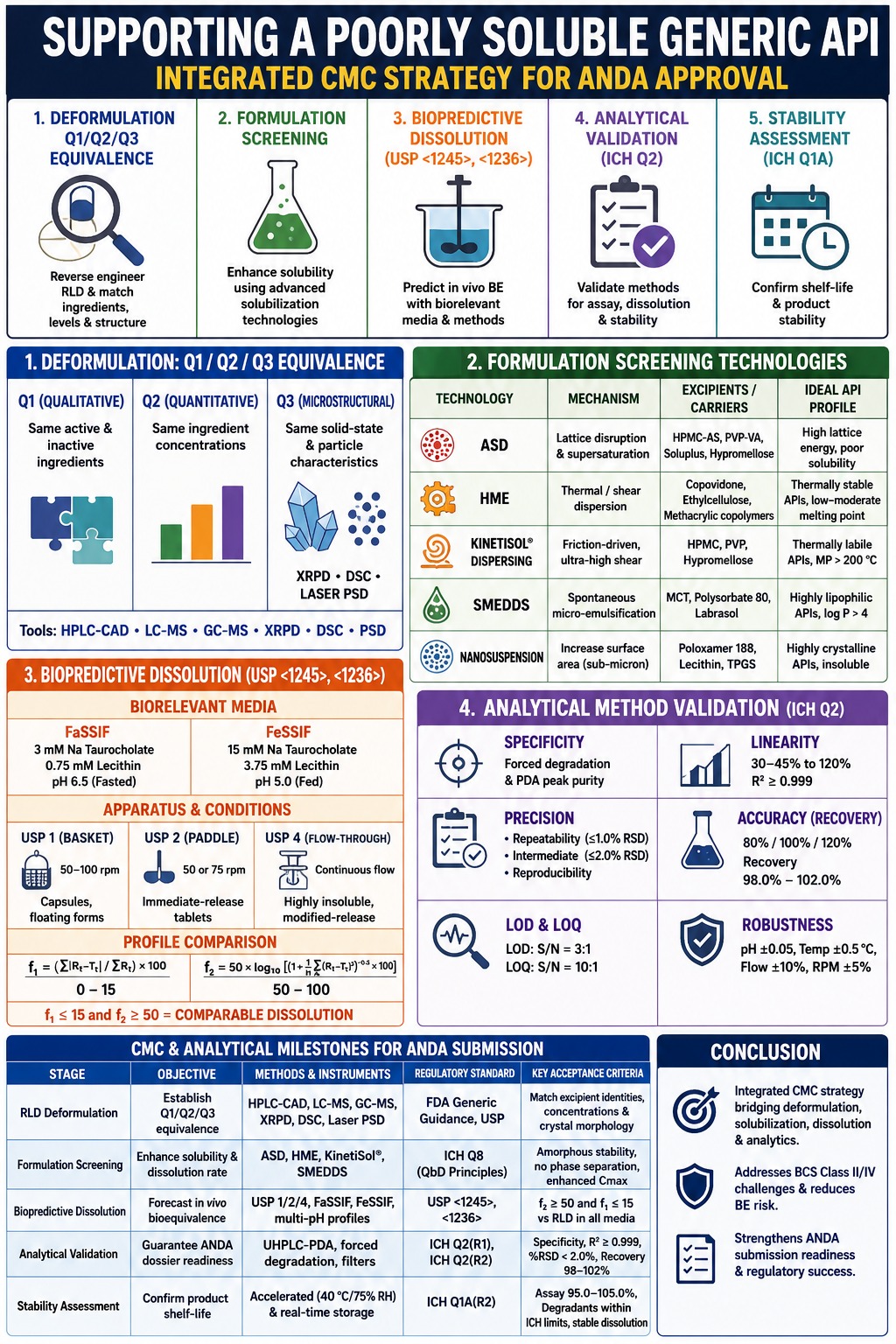
Deformulation and Q1/Q2/Q3 Equivalence for Supporting a Poorly Soluble Generic API
Deformulation of the reference-listed drug (RLD) establishes qualitative (Q1), quantitative (Q2), and microstructural (Q3) equivalence and provides the structural foundation required for supporting a poorly soluble generic API. Through systematic reverse engineering of the innovator formulation, generic scientists can identify critical material attributes (CMAs) associated with the drug substance and critical quality attributes (CQAs) associated with the finished drug product. This scientific strategy reduces unnecessary trial-and-error experimentation, minimizes the risk of excipient incompatibility, and helps ensure that the drug release mechanism of the generic product is comparable to that of the innovator product.
Learn more about selecting the right pharmaceutical CDMO in the US and Canada.
Qualitative (Q1) and Quantitative (Q2) Deformulation
Qualitative (Q1) equivalence requires the generic formulation to contain the same active and inactive ingredients as the RLD, whereas quantitative (Q2) equivalence requires these components to be present at equivalent concentrations. Identification and quantification of non-active excipients require the use of complementary and orthogonally paired analytical separation techniques. Polymeric binders, surfactants, disintegrants, and lubricants can be isolated and quantified using high-performance liquid chromatography with charged aerosol detection (HPLC-CAD), gas chromatography-mass spectrometry (GC-MS), and liquid chromatography-mass spectrometry (LC-MS). Accurate Q1/Q2 deformulation is particularly important because even relatively small changes in excipient ratios can modify the solubilization microenvironment, influence drug precipitation kinetics, and ultimately affect oral bioavailability.
Discover options for partnering with a specialized CDMO for generic projects in Canada.
Microstructural (Q3) Equivalence and Solid-State Characterization
For poorly soluble APIs, establishing Q3 similarity requires evaluation of the physical arrangement, crystal habit, polymorphic form, and particle size distribution of the API relative to the innovator drug matrix. X-ray powder diffraction (XRPD) and differential scanning calorimetry (DSC) are used to characterize crystal lattice structures and thermal phase transitions and to determine whether the API is present as a particular polymorph, solvate, or amorphous form. Laser diffraction particle size analysis determines the particle size distribution (PSD), allowing critical parameters such as d₁₀, d₅₀, and d₉₀ to be compared with those of the RLD. Matching these physical characteristics helps minimize solvent-mediated recrystallization and supports consistent dissolution performance.
Read our technical evaluation on choosing a CDMO vs CRO for generic drug development.
Formulation Screening Technologies when Supporting a Poorly Soluble Generic API
Formulation screening technologies address poor thermodynamic solubility by converting crystalline APIs into higher-energy amorphous states or stabilizing micro-emulsions that can maintain supersaturation within the gastrointestinal tract. Conventional oral solid dosage form manufacturing approaches, including direct compression and standard wet granulation, may frequently be inadequate for achieving the dissolution performance required for poorly soluble APIs. Therefore, specialized solubilization technologies must be evaluated systematically to support the development of a bioequivalent generic product.
Amorphous Solid Dispersions (ASDs) and Polymer Screening
Amorphous solid dispersions disrupt the organized crystalline lattice of an API and convert the drug into a disordered amorphous state that is molecularly dispersed within a hydrophilic polymer matrix. Polymers such as hydroxypropyl methylcellulose acetate succinate (HPMC-AS), polyvinylpyrrolidone-vinyl acetate (PVP-VA), and Copovidone function as crystallization inhibitors. These polymers help sustain drug supersaturation within intestinal fluids by limiting nucleation and subsequent crystal growth after dissolution.
Thermal and High-Shear Processing Methods
- Hot-Melt Extrusion (HME): Continuous HME processing combines thermal energy with mechanical shear generated by co-rotating twin screws to melt the API and distribute it uniformly within a molten polymer matrix. The process does not require organic solvents and can be integrated with Process Analytical Technology (PAT), while producing stable solid solutions suitable for poorly soluble APIs.
- KinetiSol® Dispersing: When heat-sensitive or high-melting-point APIs with melting points above 200 °C are susceptible to thermal degradation, KinetiSol® Dispersing provides an alternative processing approach. The technology uses ultra-high shear mixing over sub-second residence times to generate rapid dispersions. This fast, non-thermal transition can produce stable amorphous solid dispersions while reducing the likelihood of chemical degradation.
Lipid-Based Formulations and Particle Size Reduction
- Self-Microemulsifying Drug Delivery Systems (SMEDDS): SMEDDS are isotropic mixtures containing oils, surfactants, and co-solvents that spontaneously generate fine oil-in-water microemulsions when they encounter aqueous gastrointestinal fluids. By delivering the API in a pre-solubilized liquid state, SMEDDS can bypass the conventional solid-state dissolution step and improve the conditions for enterocyte absorption.
- Nanosuspensions and Micronization: Nanocrystallization reduces API particle dimensions to the sub-micron range, increasing the specific surface area and accelerating dissolution according to the Noyes-Whitney equation:
dC/dt = (D × A/h) (Cs − C)
Where dC/dtdC/dt represents the dissolution rate, DD is the diffusion coefficient, AA is the specific surface area, hh is the diffusion layer thickness, CsC_s is the saturation solubility, and CC represents the drug concentration in the bulk dissolution medium.
| Solubilization Technology | Primary Mechanism of Action | Common Polymeric / Excipient Carriers | Ideal API Physical Profile |
|---|---|---|---|
| Amorphous Solid Dispersions (ASD) | Lattice energy disruption and maintenance of supersaturation | HPMC-AS, PVP-VA, Soluplus, Hypromellose | High lattice energy, poor aqueous solubility |
| Hot-Melt Extrusion (HME) | Thermal/shear molecular dispersion within a molten polymer | Copovidone, Ethylcellulose, Methacrylic copolymers | Thermally stable APIs with low-to-moderate melting points |
| KinetiSol® Dispersing | Friction-driven, sub-second ultra-high shear fusion | HPMC, PVP, Hypromellose | Thermally labile APIs with high melting points above 200 °C |
| SMEDDS | Spontaneous micro-emulsification in GI fluid | Medium-chain triglycerides, Polysorbate 80, Labrasol | Highly lipophilic APIs with log P > 4 |
| Nanosuspensions | Expansion of specific surface area through sub-micron particle-size reduction | Poloxamer 188, Lecithin, TPGS | Highly crystalline APIs that are insoluble in water and organic solvents |
Understand how top teams accelerate generic drug development in the US and Canada.
Biopredictive Dissolution and Method Development under USP and USP
Biopredictive dissolution methods developed under USP and USP are designed to establish physiologically relevant testing conditions that can relate in vitro drug release behavior to in vivo bioequivalence performance. Conventional quality control dissolution methods may employ elevated surfactant concentrations or non-physiological pH conditions that can conceal meaningful performance differences between generic formulations and the reference product. In contrast, biopredictive dissolution testing incorporates physiologically representative media and hydrodynamic conditions to support formulation optimization and improve the assessment of product performance.
Media Selection, Sink Conditions, and Biorelevant Testing
Method development according to USP begins with characterization of API solubility across the physiological pH range from pH 1.2 to 6.8. Maintaining sink conditions, in which the volume of dissolution medium is approximately three to ten times the volume required to produce a saturated solution of the administered drug dose, is essential for obtaining dependable dissolution profiles.
When aqueous solubility is inadequate to maintain sink conditions, surfactants may be incorporated into the dissolution medium. The selection and concentration of surfactants, such as Sodium Lauryl Sulfate (SLS) and Polysorbate 80, should be scientifically justified according to the Critical Micelle Concentration (CMC). This helps prevent excessive solubilization from masking meaningful differences between formulations.
- Fasted State Simulated Intestinal Fluid (FaSSIF): FaSSIF contains 3 mM sodium taurocholate and 0.75 mM lecithin at pH 6.5 and is designed to represent the fluid environment and solubilization capacity of the upper small intestine during fasted conditions.
- Fed State Simulated Intestinal Fluid (FeSSIF): FeSSIF contains 15 mM sodium taurocholate and 3.75 mM lecithin at pH 5.0, providing a model of intestinal solubilization conditions following food intake and the associated lipid digestion environment.
Review capabilities for analytical development for generic drugs in Canada.
Apparatus Selection and Hydrodynamic Control
- USP Apparatus 1 (Basket): Operated at 50 to 100 rpm, USP Apparatus 1 is commonly selected for capsules, floating dosage forms, and formulations that require continuous containment during dissolution testing.
- USP Apparatus 2 (Paddle): Typically operated at 50 or 75 rpm, USP Apparatus 2 is widely used for immediate-release tablets. Hydrodynamic conditions should be carefully controlled because cone formation beneath the paddle can artificially reduce the observed dissolution rate.
- USP Apparatus 4 (Flow-Through Cell): USP Apparatus 4 is particularly suitable for highly insoluble APIs, modified-release dosage forms, and implants. The continuous flow of dissolution medium through the system helps maintain sink conditions without requiring excessive concentrations of surfactants.
Mathematical Profile Comparison: f₁ and f₂ Statistics
Comparative dissolution profiles generated from the generic test candidate (Tₜ) and the reference product (Rₜ) across 12 individual dosage units can be mathematically assessed using the difference factor (f₁) and similarity factor (f₂):
f1 = ∑t=1n |Rt − Tt| ∑t=1n Rt × 100
f2 = 50 × log10[ 1 + 1 n ∑t=1n (Rt − Tt)2 −0.5 × 100 ]
An f₁ value from 0 to 15 and an f₂ value from 50 to 100 are generally considered indicative of comparable dissolution profiles, supporting the conclusion that the generic product demonstrates dissolution performance suitable for subsequent regulatory bioequivalence assessment.
Examine specialized testing in our generic peptide drug analytical characterization case study.
ANDA-Ready Analytical Method Validation under ICH Q2(R1) and ICH Q2(R2)
ANDA-ready analytical validation demonstrates that stability-indicating chromatographic procedures have the specificity, precision, accuracy, and other performance characteristics necessary to support regulatory dossier submissions and commercial batch release. Analytical procedures used for API assay, dissolution testing, and stability assessment must be appropriately validated against applicable international regulatory expectations.
Learn more about navigating regulatory support for generic drugs in the US and Canada.
Core Validation Parameters per ICH Guidelines
- Specificity and Forced Degradation Studies: The analytical procedure must be capable of distinguishing the API from excipients, synthetic impurities, and degradation products. Forced degradation studies expose the drug substance or product to acid and base hydrolysis, oxidation, thermal stress, and photolysis to establish method selectivity. Photodiode Array (PDA) peak purity analysis can be used to assess chromatographic peak homogeneity.
- Linearity and Operational Range: Linearity is established over an appropriate concentration range, extending from approximately 30%–45% up to 120% of the target analytical concentration. Linear regression analysis should demonstrate a coefficient of determination (R²) of at least 0.999.
- Precision Evaluation: Precision is evaluated at three levels in accordance with ICH Q2(R2) expectations:
- Repeatability: Assessed using 6 consecutive replicates at 100% of the test concentration, with %RSD ≤ 1.0%.
- Intermediate Precision: Evaluated across different days, analysts, and instruments, with %RSD ≤ 2.0%.
- Reproducibility: Established through appropriate inter-laboratory validation protocols.
- Accuracy (Recovery): Accuracy is assessed at three concentration levels—80%, 100%, and 120%—by adding known quantities of API to placebo matrices. Mean recovery results are expected to fall within 98.0% to 102.0%.
- Limit of Detection (LOD) and Limit of Quantitation (LOQ): LOD and LOQ can be established using signal-to-noise ratios of 3:1 and 10:1, respectively, or through statistical approaches based on response slope and standard deviation.
- Method Robustness: Robustness determines the ability of the analytical procedure to withstand small, deliberate changes in operating conditions. Typical variables may include mobile phase pH (± 0.05 units), column temperature (± 0.5 °C), flow rate (± 10%), and agitation speed (± 5 rpm).
Solution Stability, Filter Compatibility, and Deaeration
Poorly soluble APIs may adsorb onto syringe filter membranes, potentially producing inaccurate analytical concentration measurements. Filter compatibility studies therefore assess different membrane materials, including PTFE, PVDF, Nylon, and PES, across pore sizes ranging from 0.2 µm to 0.45 µm. These studies confirm adequate analyte recovery, typically ≥ 98%, while ensuring that filter-related leachables do not interfere with analytical measurements. In addition, dissolution media deaeration using vacuum filtration or helium sparging is performed according to USP to minimize air micro-bubbles that could interfere with dosage-unit wetting during dissolution testing.
Explore full-service options from a generic pharmaceutical CDMO in Canada.
CMC and Analytical Milestones for Target Submissions
| Development Stage | Operational Objective | Core Methodologies & Instrumentation | Applicable Regulatory Standard | Key Acceptance Criteria |
|---|---|---|---|---|
| RLD Deformulation | Establish Q1/Q2/Q3 equivalence | HPLC-CAD, LC-MS, GC-MS, XRPD, DSC, Laser PSD | FDA Generic Guidance, USP | Matching excipient identities, concentrations, and crystal morphology |
| Formulation Screening | Enhance solubility and dissolution rate | ASD screening, Hot-Melt Extrusion, KinetiSol®, SMEDDS | ICH Q8 (QbD Principles) | Amorphous physical stability, no phase separation, enhanced Cmax |
| Biopredictive Dissolution | Forecast in vivo bioequivalence | USP Apparatus 1/2/4, FaSSIF, FeSSIF, multi-pH profiles | USP , USP | f₂ ≥ 50 and f₁ ≤ 15 against RLD in all discriminatory media |
| Analytical Validation | Guarantee ANDA dossier readiness | UHPLC-PDA, forced degradation, filter compatibility | ICH Q2(R1), ICH Q2(R2) | Confirmed specificity, R² ≥ 0.999, precision %RSD < 2.0%, recovery 98–102% |
| Stability Assessment | Confirm product shelf-life | Accelerated (40 °C/75% RH) and real-time storage | ICH Q1A(R2) | Assay within 95.0–105.0%, degradants within ICH limits, stable dissolution |
Find comprehensive solutions for peptide drug development with a dedicated CDMO.
Conclusion: Strategic Framework for Supporting a Poorly Soluble Generic API
Successfully supporting a poorly soluble generic API requires an integrated development strategy that connects innovator product reverse engineering, high-throughput solubilization screening, biopredictive dissolution assessment, and ICH-compliant analytical method validation. Addressing the physical and chemical limitations associated with BCS Class II and Class IV active substances requires a systematic CMC framework that evaluates formulation performance from both material and product perspectives.
Establishing Q1/Q2/Q3 equivalence during the early deformulation phase allows generic developers to understand the critical characteristics of the RLD before progressing into formulation optimization. Selecting suitable solubilization technologies, including amorphous solid dispersions, thermal processing approaches, lipid-based systems, and particle-size reduction strategies, can address dissolution limitations associated with poorly soluble APIs. At the same time, optimizing biopredictive dissolution methods under USP and provides a more physiologically relevant basis for evaluating formulation performance and mitigating bioequivalence risks.
Validation of stability-indicating analytical procedures according to ICH Q2(R1)/Q2(R2) further strengthens the regulatory package by demonstrating that the analytical methods used for assay, dissolution, impurity, and stability assessment are fit for their intended purpose. When these formulation, dissolution, analytical, and stability activities are integrated into a unified CMC strategy, generic drug sponsors can reduce development uncertainty and improve the readiness of their ANDA submission.
Discover dedicated peptide analytical characterization services.
To optimize complex drug formulations, address persistent solubility bottlenecks, and execute ANDA-ready analytical validation for your generic development pipeline, contact our team of experts directly through the ResolveMass Laboratories Contact Us Page.
Frequently Asked Questions (FAQs)
Q1 equivalence focuses on confirming that the generic contains the same active and inactive ingredients as the RLD. Q2 equivalence addresses whether those ingredients are present at comparable quantities or concentrations. Q3 equivalence evaluates physical and microstructural characteristics, including solid-state properties, particle size, and physical arrangement.
Amorphous Solid Dispersions (ASDs) convert a crystalline API into a higher-energy amorphous form within a suitable polymeric matrix. This approach can increase apparent solubility and promote faster dissolution compared with the crystalline drug. Polymers also help maintain supersaturation and reduce the risk of recrystallization after dissolution.
KinetiSol® Dispersing uses ultra-high shear processing with very short residence times to generate amorphous solid dispersions. Because the process minimizes prolonged exposure to elevated temperatures, it can be advantageous for heat-sensitive or high-melting-point APIs. This approach may reduce the potential for thermally induced chemical degradation during processing.
USP provides requirements and general considerations for dissolution apparatus, media, and testing procedures used for pharmaceutical products. USP provides guidance related to developing and validating discriminatory dissolution procedures. Together, these compendial frameworks support scientifically justified dissolution testing during generic drug development.
FaSSIF and FeSSIF are particularly useful during formulation development and biopredictive dissolution studies when physiological gastrointestinal conditions need to be represented. These media incorporate bile-related components such as sodium taurocholate and lecithin. Their use can provide insight into how formulation performance may change under fasted and fed intestinal conditions.
The difference factor (f1) measures the percentage difference between the test and reference dissolution profiles, while the similarity factor (f2) evaluates the closeness of the profiles. An f1 value of 0 to 15 and an f2 value of 50 to 100 are commonly used as criteria for demonstrating similarity. These calculations help determine whether the dissolution behavior of the generic product is comparable to the RLD.
ICH Q2(R2) validation typically considers parameters such as specificity, linearity, range, accuracy, precision, LOD, LOQ, and robustness, depending on the analytical procedure’s intended purpose. Forced degradation studies can support specificity and demonstrate the stability-indicating capability of the method. The selected validation characteristics should be scientifically justified for the method and its intended application.
Filter compatibility studies are conducted to determine whether the API interacts with the selected filter membrane during sample preparation. Materials such as PTFE, PVDF, Nylon, and PES can be evaluated along with appropriate pre-wetting procedures. The objective is to achieve consistent API recovery, typically ≥98%, while avoiding interference from filter-related leachables.
Surfactants can improve the apparent solubility of poorly soluble APIs and help maintain sink conditions during dissolution testing. However, excessive surfactant concentrations may artificially enhance drug release and conceal meaningful differences between formulations. Therefore, surfactant type and concentration should be scientifically justified with consideration of the Critical Micelle Concentration (CMC).
Reference:
- Tambe, S., Jain, D., Meruva, S. K., Rongala, G., Juluri, A., Nihalani, G., Mamidi, H. K., Nukala, P. K., & Bolla, P. K. (2022). Recent advances in amorphous solid dispersions: Preformulation, formulation strategies, technological advancements and characterization. Pharmaceutics, 14(10), 2203. https://doi.org/10.3390/pharmaceutics14102203
- Cleary, H., Fotaki, N., Persoons, T., & D’Arcy, D. M. (2026). Using PBPK to simulate target biopredictive dissolution profiles for long-acting injectables—Where to begin with critical bioavailability attributes? CPT: Pharmacometrics & Systems Pharmacology, 15(3), e70212. https://doi.org/10.1002/psp4.70212
- Tan, D. K., Davis, D. A., Miller, D. A., Williams, R. O., III, & Nokhodchi, A. (2020). Innovations in thermal processing: Hot-melt extrusion and KinetiSol® dispersing. AAPS PharmSciTech, 21, 312. https://doi.org/10.1208/s12249-020-01854-2
- U.S. Food and Drug Administration. (n.d.). Compilation of FDA guidance and resources for in vitro dissolution testing of immediate release solid oral dosage forms. https://www.fda.gov/animal-veterinary/new-animal-drug-applications/compilation-fda-guidance-and-resources-in-vitro-dissolution-testing-immediate-release-solid-oral-dosage
- Nurhikmah, W., Sumirtapura, Y. C., & Pamudji, J. S. (2016). Dissolution profile of mefenamic acid solid dosage forms in two compendial and biorelevant (FaSSIF) media. Scientia Pharmaceutica, 84(1), 181–190. https://doi.org/10.3797/scipharm.ISP.2015.09
- International Council for Harmonisation of Technical Requirements for Pharmaceuticals for Human Use. (2022). ICH harmonised guideline Q2(R2): Validation of analytical procedures (Step 2 draft version). https://database.ich.org/sites/default/files/ICH_Q2-R2_Document_Step2_Guideline_2022_0324.pdf
Get In Touch With Us
About The Author


