

Introduction:
Surface Functionalization of Cyclodextrin-Based Dendrimers is a rapidly evolving strategy in nanomedicine that enhances the ability of dendrimer systems to selectively deliver drugs, genes, and imaging agents to specific tissues or cells. By modifying the outer surface of cyclodextrin dendrimers with functional molecules, researchers can improve targeting precision, circulation time, therapeutic performance, and safety profiles.
When surface functionalization is introduced, these nanocarriers become highly adaptable platforms for targeted delivery applications in oncology, gene therapy, diagnostics, and controlled-release formulations.
As pharmaceutical development increasingly focuses on personalized and precision medicine, functionalized cyclodextrin dendrimers are emerging as important candidates for advanced drug delivery systems.
Summary:
- Surface Functionalization of Cyclodextrin-Based Dendrimers improves targeted drug delivery by modifying dendrimer surfaces with ligands, polymers, antibodies, peptides, and imaging agents.
- Functionalized cyclodextrin dendrimers can enhance drug solubility, cellular uptake, biodistribution, and therapeutic efficacy.
- Surface engineering helps reduce toxicity and improves biocompatibility for pharmaceutical and biomedical applications.
- These systems are being widely investigated for cancer therapy, gene delivery, imaging, and controlled drug release.
- Advanced analytical characterization is essential to confirm surface chemistry, stability, and targeting efficiency.
- Cyclodextrin-based dendrimers represent a promising platform for next-generation nanomedicine and precision therapeutics.
1: What Is Surface Functionalization in Cyclodextrin-Based Dendrimers?
Surface functionalization refers to the chemical modification of the outer surface groups of dendrimers to impart specific biological or physicochemical properties.
In cyclodextrin-based dendrimers, functionalization typically aims to:
- Improve targeting ability
- Increase biocompatibility
- Reduce cytotoxicity
- Enhance cellular uptake
- Improve circulation half-life
- Enable imaging or theranostic applications
- Achieve stimulus-responsive drug release
The dendrimer surface contains multiple reactive groups that can be conjugated with targeting ligands or protective coatings.
2: Structure of Cyclodextrin-Based Dendrimers
Cyclodextrin dendrimers generally contain:
| Structural Component | Function |
|---|---|
| Cyclodextrin core | Drug encapsulation and solubility enhancement |
| Branched dendritic arms | High drug loading and multivalency |
| Terminal surface groups | Functionalization and targeting |
| Internal cavities | Guest molecule accommodation |
This architecture enables simultaneous drug encapsulation and surface engineering, making these nanocarriers highly versatile.
3: Why Surface Functionalization Is Important for Targeted Delivery
Surface functionalization directly determines how dendrimers interact with biological systems.
Major Advantages:
1. Improved Cellular Targeting
Functional ligands can selectively bind receptors overexpressed on diseased cells.
Examples include:
- Folate receptors
- Transferrin receptors
- HER2 receptors
- Integrins
This improves drug accumulation at target sites while minimizing off-target toxicity.
2. Enhanced Biocompatibility
PEGylation and neutral surface coatings help reduce:
- Hemolysis
- Immune recognition
- Protein adsorption
- Cytotoxicity
3. Increased Drug Stability
Surface modifications can improve:
- Colloidal stability
- Serum stability
- Controlled release behavior
4. Prolonged Circulation Time
Hydrophilic coatings reduce rapid clearance by the reticuloendothelial system (RES).
5. Multifunctionality
Surface-engineered dendrimers can simultaneously carry:
- Therapeutic agents
- Imaging probes
- Targeting ligands
- Stimuli-responsive groups
4: The Role of Surface Functionalization in Targeted Delivery
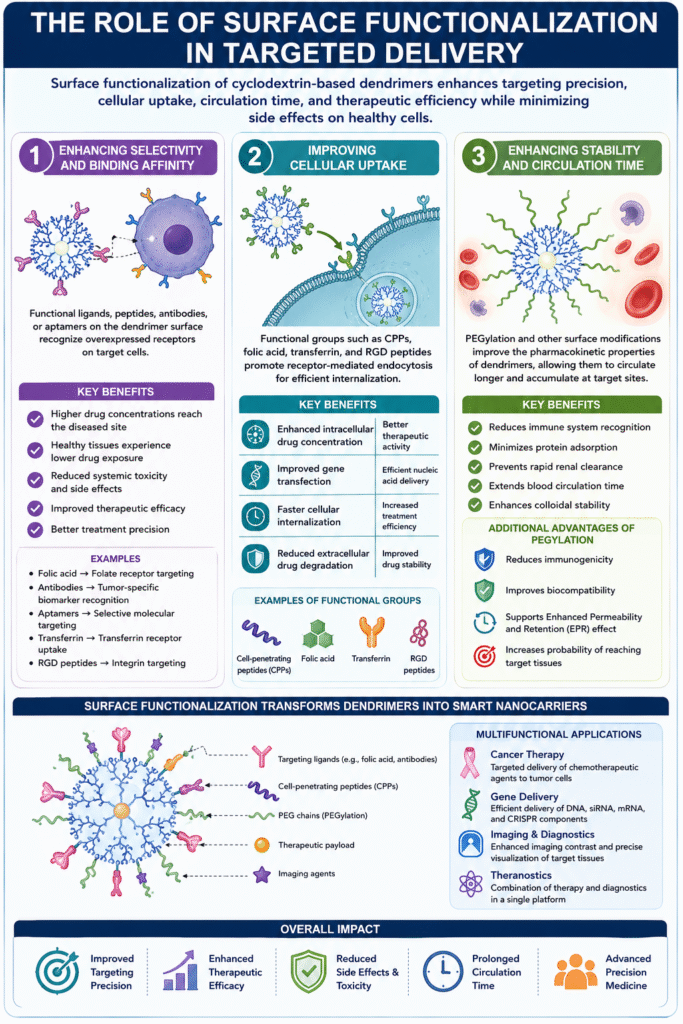
Surface functionalization is one of the most important strategies used to improve the performance of cyclodextrin-based dendrimers in targeted drug delivery. By modifying the outer surface of these nanocarriers with ligands, antibodies, polymers, or bioactive molecules, researchers can enhance targeting precision, cellular uptake, circulation time, and therapeutic efficiency. These modifications allow dendrimers to interact more selectively with diseased tissues while minimizing unwanted effects on healthy cells.
1. Enhancing Selectivity and Binding Affinity
One of the primary advantages of surface functionalization is its ability to improve the selectivity of cyclodextrin-based dendrimers toward target cells. Functional molecules such as ligands, peptides, antibodies, or aptamers can be attached to the dendrimer surface to recognize receptors or antigens that are overexpressed on diseased cells, particularly cancer cells.
This targeted interaction increases the binding affinity between the dendrimer and the target tissue, resulting in more efficient drug localization. As a result:
- Higher drug concentrations reach the diseased site
- Healthy tissues experience lower drug exposure
- Systemic toxicity and side effects are reduced
- Therapeutic efficacy is improved
For example, folic acid-functionalized dendrimers are widely studied because many cancer cells overexpress folate receptors. Similarly, antibody-functionalized systems can recognize tumor-specific biomarkers for highly selective delivery.
2. Improving Cellular Uptake
Efficient cellular internalization is essential for successful targeted delivery. Surface functionalization enhances the ability of cyclodextrin-based dendrimers to cross cellular membranes and deliver encapsulated therapeutics directly into target cells.
Functional groups such as:
- Cell-penetrating peptides (CPPs)
- Folic acid
- Transferrin
- RGD peptides
can promote receptor-mediated endocytosis, enabling dendrimers to be actively transported into cells.
Improved cellular uptake offers several benefits:
| Benefit | Impact |
|---|---|
| Enhanced intracellular drug concentration | Better therapeutic activity |
| Improved gene transfection | Efficient nucleic acid delivery |
| Faster cellular internalization | Increased treatment efficiency |
| Reduced extracellular drug degradation | Improved drug stability |
This property is especially valuable in gene delivery applications where nucleic acids must enter cells efficiently to achieve therapeutic effects.
3. Enhancing Stability and Circulation Time
Surface functionalization also improves the pharmacokinetic properties of dendrimers. One widely used approach is PEGylation, where polyethylene glycol (PEG) chains are attached to the dendrimer surface.
PEGylation provides several important advantages:
- Reduces immune system recognition
- Minimizes protein adsorption
- Prevents rapid renal clearance
- Extends blood circulation time
- Enhances colloidal stability
Longer circulation times increase the probability that the dendrimers will accumulate at the target site, especially in tumors through the Enhanced Permeability and Retention (EPR) effect.
In addition, PEGylation can reduce immunogenicity and improve overall biocompatibility, making the nanocarriers safer for systemic administration.
5: Techniques for Surface Functionalization
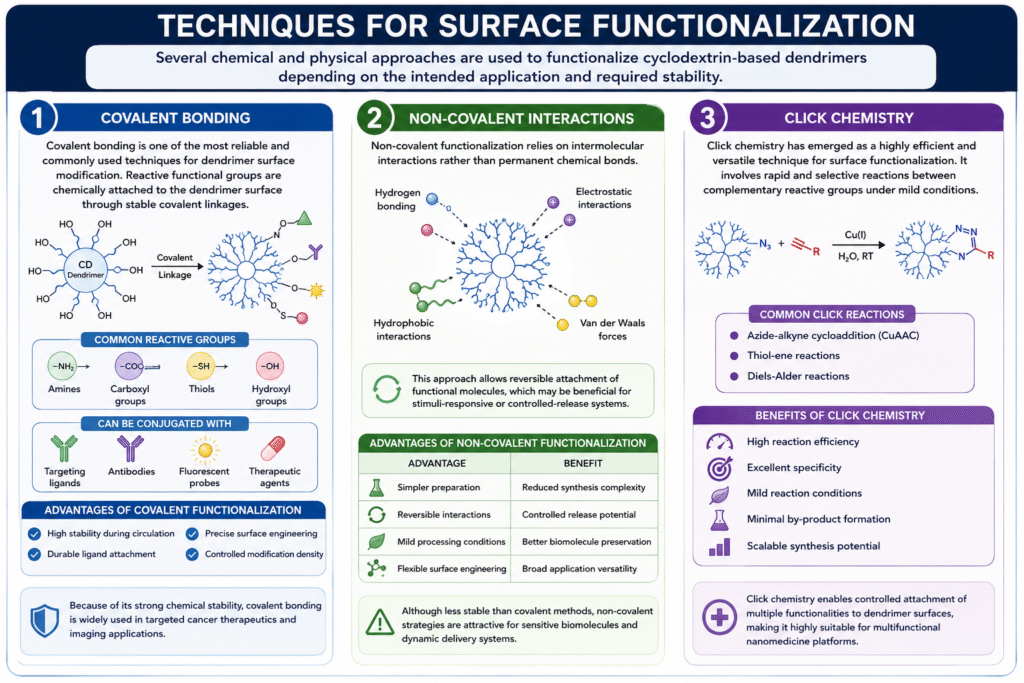
Several chemical and physical approaches are used to functionalize cyclodextrin-based dendrimers depending on the intended application and required stability.
1. Covalent Bonding
Covalent bonding is one of the most reliable and commonly used techniques for dendrimer surface modification. In this approach, reactive functional groups are chemically attached to the dendrimer surface through stable covalent linkages.
Common reactive groups include:
- Amines
- Carboxyl groups
- Thiols
- Hydroxyl groups
These groups can then be conjugated with:
- Targeting ligands
- Antibodies
- Fluorescent probes
- Therapeutic agents
Advantages of Covalent Functionalization
- High stability during circulation
- Durable ligand attachment
- Precise surface engineering
- Controlled modification density
Because of its strong chemical stability, covalent bonding is widely used in targeted cancer therapeutics and imaging applications.
2. Non-Covalent Interactions
Non-covalent functionalization relies on intermolecular interactions rather than permanent chemical bonds.
Common non-covalent interactions include:
- Hydrogen bonding
- Electrostatic interactions
- Hydrophobic interactions
- Van der Waals forces
This approach allows reversible attachment of functional molecules, which may be beneficial for stimuli-responsive or controlled-release systems.
Advantages of Non-Covalent Functionalization
| Advantage | Benefit |
|---|---|
| Simpler preparation | Reduced synthesis complexity |
| Reversible interactions | Controlled release potential |
| Mild processing conditions | Better biomolecule preservation |
| Flexible surface engineering | Broad application versatility |
Although less stable than covalent methods, non-covalent strategies are attractive for sensitive biomolecules and dynamic delivery systems.
3. Click Chemistry
Click chemistry has emerged as a highly efficient and versatile technique for surface functionalization. It involves rapid and selective reactions between complementary reactive groups under mild conditions.
Common click chemistry reactions include:
- Azide-alkyne cycloaddition
- Thiol-ene reactions
- Diels-Alder reactions
Benefits of Click Chemistry
- High reaction efficiency
- Excellent specificity
- Mild reaction conditions
- Minimal by-product formation
- Scalable synthesis potential
Click chemistry enables controlled attachment of multiple functionalities to dendrimer surfaces, making it highly suitable for multifunctional nanomedicine platforms.
6: Common Surface Functionalization Strategies
1. PEGylation
PEGylation involves attaching polyethylene glycol (PEG) chains to the dendrimer surface.
Benefits
- Improves water solubility
- Reduces immunogenicity
- Extends systemic circulation
- Minimizes aggregation
PEGylated cyclodextrin dendrimers are widely investigated for intravenous drug delivery systems.
2. Ligand Conjugation
Targeting ligands are attached to enhance receptor-mediated uptake.
Common Ligands
| Ligand | Target |
|---|---|
| Folic acid | Folate receptors |
| Transferrin | Transferrin receptors |
| RGD peptides | Integrins |
| Antibodies | Tumor-specific antigens |
| Aptamers | Specific biomolecular targets |
These systems improve selective accumulation in diseased tissues.
3. Surface Charge Modification
Surface charge significantly influences biodistribution and toxicity.
Positively Charged Dendrimers
Advantages:
- Enhanced membrane interaction
- Efficient gene delivery
Limitations:
- Higher cytotoxicity
Neutral or Slightly Negative Surfaces
Advantages:
- Improved biocompatibility
- Reduced nonspecific interactions
4. Stimuli-Responsive Functionalization
Stimuli-responsive systems release drugs under specific biological conditions.
Trigger Mechanisms
- pH-sensitive release
- Redox-responsive release
- Enzyme-triggered degradation
- Temperature-sensitive release
These systems are particularly useful in tumor-targeted therapies.
7: Applications of Surface Functionalized Cyclodextrin Dendrimers
1. Cancer Targeted Drug Delivery
Cancer therapy is one of the most important applications of functionalized dendrimers.
Benefits in Oncology
- Enhanced permeability and retention (EPR) effect
- Tumor-specific targeting
- Reduced systemic toxicity
- Controlled chemotherapy release
Drugs commonly studied include:
- Doxorubicin
- Paclitaxel
- Cisplatin
- Methotrexate
Functionalized systems can improve therapeutic outcomes while reducing adverse effects.
2. Gene Delivery
Cyclodextrin dendrimers can deliver:
- siRNA
- mRNA
- DNA plasmids
- CRISPR components
Surface engineering improves:
- Nucleic acid protection
- Cellular internalization
- Endosomal escape
- Gene transfection efficiency
Cationic functional groups are particularly important in gene delivery systems.
3. Imaging and Theranostics
Functionalized dendrimers can incorporate imaging probes such as:
- Fluorescent dyes
- MRI contrast agents
- Radioisotopes
This enables simultaneous:
- Diagnosis
- Drug delivery
- Treatment monitoring
Such systems are known as theranostic nanocarriers.
4. Brain-Targeted Delivery
Crossing the blood-brain barrier (BBB) remains a major challenge in CNS drug delivery.
Surface-modified dendrimers with targeting peptides or transferrin ligands can improve brain uptake of therapeutic agents.
Potential applications include:
- Alzheimer’s disease
- Parkinson’s disease
- Glioblastoma treatment
- Neuroinflammation
8: Analytical Characterization of Surface Functionalized Dendrimers
Comprehensive characterization is critical to ensure quality, reproducibility, and regulatory compliance.
Important Analytical Parameters
| Parameter | Analytical Technique |
|---|---|
| Particle size | Dynamic Light Scattering (DLS) |
| Surface charge | Zeta potential analysis |
| Surface chemistry | FTIR / NMR spectroscopy |
| Drug loading | HPLC / LC-MS |
| Morphology | TEM / SEM |
| Conjugation efficiency | UV-Vis / Fluorescence spectroscopy |
| Stability | Stability studies |
| Drug release | In vitro dissolution studies |
Proper analytical characterisation supports formulation optimization and clinical translation.
9: Challenges in Surface Functionalization of Cyclodextrin-Based Dendrimers
Although promising, several challenges remain.
1. Synthetic Complexity
Surface engineering often requires:
- Multi-step synthesis
- Precise stoichiometric control
- Extensive purification
This can increase manufacturing complexity.
2. Toxicity Concerns
Highly cationic dendrimers may cause:
- Membrane disruption
- Hemolysis
- Inflammatory responses
Surface modifications must balance efficacy with safety.
3. Scalability Issues
Large-scale production remains difficult due to:
- Batch variability
- Costly synthesis
- Complex characterization requirements
4. Regulatory Challenges
Nanomedicine products require extensive evaluation for:
- Toxicology
- Stability
- Immunogenicity
- Pharmacokinetics
Regulatory pathways are still evolving for advanced nanocarrier systems.
10: Future Perspectives
The future of Surface Functionalization of Cyclodextrin-Based Dendrimers is highly promising.
Emerging research areas include:
- AI-assisted nanocarrier design
- Personalized nanomedicine
- Multifunctional theranostics
- Smart stimuli-responsive systems
- Biodegradable dendrimer platforms
- Targeted biologic delivery
Advances in analytical technologies and pharmaceutical nanotechnology are expected to accelerate clinical translation.
11: Role of Specialized Analytical Laboratories
The development of advanced dendrimer systems requires robust analytical expertise.
Specialized laboratories can support:
- Nanocarrier characterization
- Surface chemistry analysis
- Drug release studies
- Stability testing
- Bioanalytical method development
- Regulatory-compliant analytical services
Accurate analytical evaluation is essential for ensuring product quality, safety, and therapeutic performance.
Conclusion:
Surface Functionalization of Cyclodextrin-Based Dendrimers plays a critical role in advancing targeted drug delivery and precision nanomedicine. By engineering dendrimer surfaces with targeting ligands, polymers, and responsive functionalities, researchers can significantly improve therapeutic efficacy, drug stability, biodistribution, and patient safety.
These functionalized nanocarriers offer immense potential in cancer therapy, gene delivery, imaging, and controlled-release applications. Despite current challenges related to synthesis, scalability, and regulatory evaluation, ongoing innovation continues to push the field toward broader clinical applications.
As pharmaceutical nanotechnology evolves, surface-functionalized cyclodextrin dendrimers are expected to become increasingly important tools in the development of safer and more effective advanced therapeutics.
Frequently Asked Questions:
Cyclodextrin-based dendrimers can deliver anticancer drugs directly to tumor cells through receptor-mediated targeting. Functional molecules such as folic acid or antibodies help recognize tumor-specific receptors, increasing drug localization at the cancer site. This targeted approach reduces systemic toxicity and improves chemotherapy effectiveness.
Common surface functionalization methods include:
-Covalent bonding
-Non-covalent interactions
-Click chemistry
-PEGylation
-Ligand conjugation
Each method offers different advantages depending on the required stability, targeting capability, and biomedical application.
PEGylation involves attaching polyethylene glycol (PEG) chains to the dendrimer surface. It improves circulation time, reduces immune system recognition, minimizes aggregation, and enhances biocompatibility. PEGylated dendrimers are widely used for intravenous drug delivery applications.
Surface-modified dendrimers can interact more effectively with cell membranes through receptor-mediated endocytosis. Functional groups such as cell-penetrating peptides (CPPs) and folic acid facilitate efficient internalization into target cells, improving intracellular drug delivery and therapeutic response.
Yes. Surface-functionalized cyclodextrin dendrimers are widely investigated for gene delivery applications involving DNA, siRNA, mRNA, and CRISPR systems. Functionalization improves nucleic acid protection, cellular uptake, and endosomal escape, enhancing gene transfection efficiency.
Future applications include:
-Precision oncology
-Theranostics
-Smart drug delivery systems
-Personalized medicine
-Brain-targeted delivery
-Stimuli-responsive nanocarriers
Ongoing research continues to expand their role in advanced pharmaceutical and biomedical technologies.
Reference
- Topuz F, Uyar T. Recent advances in cyclodextrin‐based nanoscale drug delivery systems. Wiley Interdisciplinary Reviews: Nanomedicine and Nanobiotechnology. 2024 Nov;16(6):e1995.https://wires.onlinelibrary.wiley.com/doi/abs/10.1002/wnan.1995
- Hussein I, Krabicová I, Hoti G, Er-Rahmani S, Matencio A, Caldera F, Trotta F. Cyclodextrin-based carriers for targeted drug delivery. Expert Opinion on Drug Delivery. 2026 Mar 4;23(3):537-55.https://www.tandfonline.com/doi/abs/10.1080/17425247.2025.2596707
- Yin JJ, Zhou ZW, Zhou SF. Cyclodextrin-based targeting strategies for tumor treatment. Drug delivery and translational research. 2013 Aug;3(4):364-74.https://link.springer.com/article/10.1007/s13346-013-0140-4
- Park IK, Von Recum HA, Jiang S, Pun SH. Supramolecular assembly of cyclodextrin-based nanoparticles on solid surfaces for gene delivery. Langmuir. 2006 Sep 26;22(20):8478-84.https://pubs.acs.org/doi/abs/10.1021/la061757s
- Siriviriyanun A, Tsai YJ, Voon SH, Kiew SF, Imae T, Kiew LV, Looi CY, Wong WF, Lee HB, Chung LY. Cyclodextrin-and dendrimer-conjugated graphene oxide as a nanocarrier for the delivery of selected chemotherapeutic and photosensitizing agents. Materials Science and Engineering: C. 2018 Aug 1;89:307-15.https://www.sciencedirect.com/science/article/pii/S0928493117329739
- Hu QD, Tang GP, Chu PK. Cyclodextrin-based host–guest supramolecular nanoparticles for delivery: from design to applications. Accounts of chemical research. 2014 Jul 15;47(7):2017-25.https://pubs.acs.org/doi/abs/10.1021/ar500055s

