

Introduction to Interfacial Dynamics of Surfactants and Emulsifiers in PLGA Microsphere Fabrication
The primary function of surfactants and emulsifiers in PLGA microsphere fabrication is to reduce interfacial tension at immiscible phase boundaries, thereby preventing the thermodynamic instability and collapse of multiple water-in-oil-in-water (W₁/O/W₂) emulsions. These surface-active compounds create a protective interfacial barrier that minimizes droplet coalescence, ultimately influencing microsphere size, morphology, and encapsulation efficiency.
Hydrophilic active pharmaceutical ingredients (APIs), including proteins, peptides, and highly water-soluble small molecules, often demonstrate poor encapsulation efficiency when processed through single-emulsion techniques because they readily diffuse into the surrounding aqueous phase. The water-in-oil-in-water (W₁/O/W₂) double emulsion approach addresses this limitation by confining these compounds within an internal aqueous compartment (W₁), which is emulsified into a polymer-solvent phase (O) and subsequently dispersed into a secondary aqueous phase (W₂).
Despite its effectiveness, this process is inherently unstable. During the evaporation of organic solvents such as dichloromethane or ethyl acetate, droplets undergo complex structural transitions, including phase inversion and consolidation. High-shear homogenization and microfluidic technologies provide the kinetic energy necessary to generate the emulsion; however, in the absence of suitable surfactants, rapid droplet coalescence occurs. The selection and optimization of surfactants within both internal and external phases significantly influence thin-film rupture behavior, drug localization, and the resulting controlled-release characteristics of the microspheres.
Learn how to design robust long-acting injectables using optimized polymer systems by reading our comprehensive guide on PLGA Long Acting Injectable Formulation.
Article Summary:
- Surfactants and emulsifiers are essential in PLGA microsphere fabrication because they lower interfacial tension, stabilize water-in-oil-in-water (W₁/O/W₂) emulsions, and help prevent droplet coalescence, ultimately improving particle quality and drug encapsulation.
- The double-emulsion technique is particularly valuable for encapsulating hydrophilic drugs, proteins, and peptides, as it reduces drug loss to the external aqueous phase and supports higher encapsulation efficiency than single-emulsion methods.
- Emulsion stability depends on both thermodynamic and kinetic factors. Surfactants reduce the energy required to form droplets while providing steric and electrostatic barriers that minimize drug leakage and emulsion breakdown.
- Surfactant selection is strongly influenced by Hydrophilic-Lipophilic Balance (HLB). Low-HLB surfactants effectively stabilize primary emulsions, while highly hydrophilic surfactants can enhance drug retention by strengthening the external interfacial barrier.
- Polyvinyl alcohol (PVA) remains the most widely used stabilizer for PLGA microspheres, with its molecular weight and degree of hydrolysis significantly affecting droplet stability, particle size distribution, residual surface coverage, and final microsphere structure.
- Alternative stabilizers such as Poloxamers, Tweens, and DMAB provide specialized benefits, including enhanced protein protection, controlled pore formation, improved release profiles, and the production of ultra-small nanoparticles for targeted delivery applications.
- Surfactant concentration and interfacial behavior directly impact particle size, polydispersity, porosity, and release kinetics. Well-controlled formulations can reduce burst release, improve uniformity, and extend drug release duration.
- Successful scale-up requires careful management of interfacial instabilities, osmotic pressure effects, residual stabilizer removal, and solvent levels. Optimized purification and analytical testing are critical for ensuring product performance, regulatory compliance, and long-term stability.
Thermodynamics and Stabilization Kinetics in Double Emulsion Systems
Surfactants stabilize multiple emulsions by lowering interfacial tension at liquid-liquid interfaces, thereby reducing the Gibbs free energy associated with droplet formation and dispersion. In addition, they generate steric and electrostatic repulsive forces that prevent rupture of the thin organic film separating the internal and external aqueous phases, which would otherwise lead to substantial drug leakage.
The thermodynamics governing emulsion formation can be described by the Gibbs free energy equation:
ΔG = γΔA − TΔS
where γ represents interfacial tension, ΔA denotes the change in surface area, T is temperature, and ΔS is entropy. Since the formation of micro- and nanoscale droplets dramatically increases surface area (ΔA ≫ 0), the system naturally tends toward minimizing this energy through droplet coalescence. Surfactants localize at the oil-water interface, orienting their hydrophilic heads toward the aqueous phase and their hydrophobic tails toward the organic phase. This arrangement significantly decreases γ and reduces the energetic barrier required for stable droplet formation.
From a kinetic perspective, double emulsions typically deteriorate through two principal pathways: (i) coalescence between internal W₁ droplets and the external W₂ phase across the thin organic membrane, resulting in immediate drug leakage, and (ii) fusion of internal W₁ droplets within the organic globule, leading to increased droplet size and altered pore architecture. The rate of thin-film rupture is strongly influenced by the concentration and effectiveness of hydrophilic surfactants present at the external interface.
For a deeper look into how structural changes alter the degradation mechanics of the matrix, explore the differences between Bulk Erosion vs Surface Erosion in PLGA.
Interestingly, PLGA itself may exhibit weak surface activity under specific conditions. When no primary surfactants are present, PLGA can partially stabilize the W₁/O interface if the internal aqueous phase is highly alkaline (pH ≥ 11–12). Basic salts such as Na₃PO₄ and Na₂CO₃ deprotonate terminal carboxylic acid groups on PLGA chains, increasing polymer hydrophilicity and interfacial activity. This reduction in interfacial tension can facilitate microcapsule formation even in the absence of additional oil-phase surfactants.
Emulsion Chemistry of Surfactants and Emulsifiers in PLGA Microsphere Fabrication
The selection of surfactants and emulsifiers in PLGA microsphere fabrication largely depends on matching Hydrophilic-Lipophilic Balance (HLB) values with the stabilization requirements of both the W₁/O and O/W₂ interfaces. While low-HLB surfactants are generally preferred for stabilizing primary emulsions, highly hydrophilic surfactants can unexpectedly improve drug retention by migrating toward the external interface and forming robust complexes with PVA.
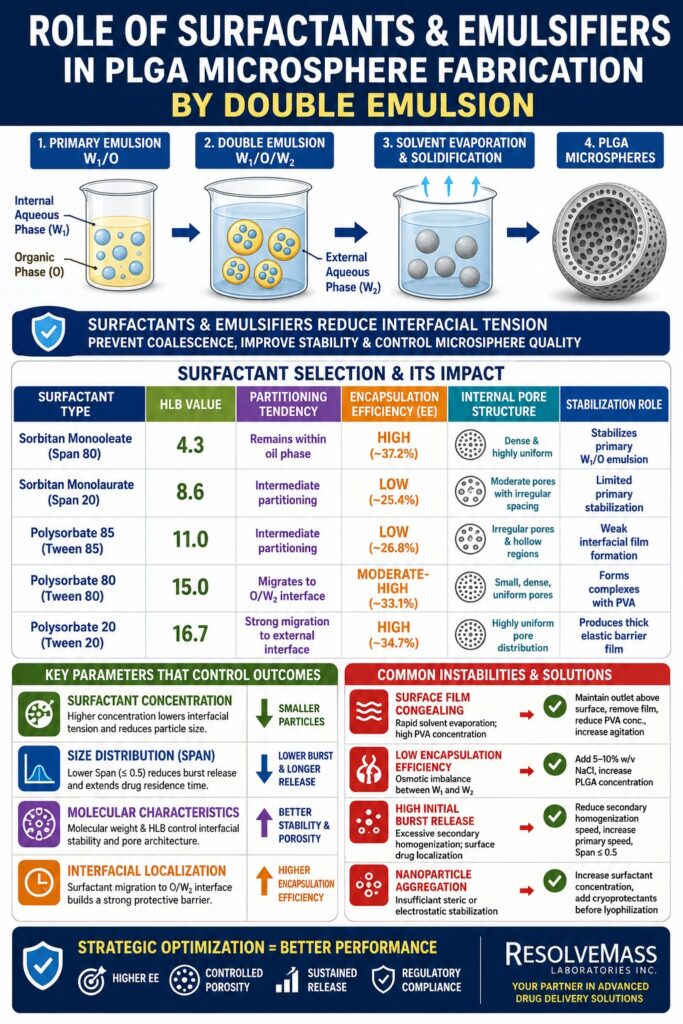
A distinct non-linear, U-shaped relationship exists between surfactant HLB values and drug encapsulation efficiency (EE). In the primary emulsion, lipophilic surfactants with HLB values ranging from 3 to 6 are generally considered optimal. Sorbitan Monooleate (Span 80, HLB 4.3), for example, produces the highest encapsulation efficiency of approximately 37.2% for hydrophilic compounds such as naltrexone HCl due to its ability to maintain a highly stable W₁/O emulsion.
By comparison, surfactants with intermediate HLB values, such as Span 20 (HLB 8.6) and Tween 85 (HLB 11.0), exhibit lower encapsulation efficiencies of approximately 25.4% and 26.8%, respectively. Their limited ability to stabilize the predominantly lipophilic primary phase contributes to greater drug loss.
Unexpectedly, highly hydrophilic surfactants such as Tween 80 (HLB 15.0) and Tween 20 (HLB 16.7) improve encapsulation efficiency again, reaching approximately 33.1% and 34.7%, respectively. This improvement is attributed to surfactant migration. Due to their strong affinity for water, these molecules relocate from the organic phase to the external O/W₂ interface, where they interact with PVA to form a dense viscoelastic gel layer. This interfacial film acts as a physical barrier that minimizes droplet disruption and seals surface channels through which drug molecules might otherwise diffuse.
Cross-sectional scanning electron microscopy (SEM) studies demonstrate that surfactant incorporation into the W₁ phase results in smaller, more uniform internal pores that are evenly distributed throughout the microsphere matrix, rather than producing hollow or collapsed structures.
Discover how these pore structures and polymer selections translate into tailored release rates by checking our study on PLGA Ratio Release Kinetics.
| Surfactant Type | HLB Value | Partitioning Tendency | Encapsulation Efficiency (EE) | Internal Pore Structure | Stabilization Role |
|---|---|---|---|---|---|
| Sorbitan Monooleate (Span 80) | 4.3 | Remains within oil phase | High (~37.2%) | Dense and highly uniform | Stabilizes primary W₁/O emulsion |
| Sorbitan Monolaurate (Span 20) | 8.6 | Intermediate partitioning | Low (~25.4%) | Moderate pores with irregular spacing | Limited primary stabilization |
| Polysorbate 85 (Tween 85) | 11.0 | Intermediate partitioning | Low (~26.8%) | Irregular pores and hollow regions | Weak interfacial film formation |
| Polysorbate 80 (Tween 80) | 15.0 | Migrates to O/W₂ interface | Moderate-High (~33.1%) | Small, dense, uniform pores | Forms complexes with PVA |
| Polysorbate 20 (Tween 20) | 16.7 | Strong migration to external interface | High (~34.7%) | Highly uniform pore distribution | Produces thick elastic barrier film |
Polyvinyl Alcohol (PVA) as the Standard Stabilizer: Structural and Molecular Parameters
Polyvinyl Alcohol (PVA) is widely recognized as the benchmark secondary stabilizer used in double emulsion fabrication processes. It prevents coalescence of secondary W₁/O/W₂ droplets through steric stabilization and significantly influences the structural characteristics of the resulting microspheres. The film-forming behavior and residual surface concentration of PVA are controlled primarily through adjustments in molecular weight and degree of hydrolysis.
PVA is produced through the hydrolysis of polyvinyl acetate, a process that converts hydrophobic acetate groups into hydrophilic hydroxyl groups. Depending on the extent of hydrolysis, the resulting polymer contains varying ratios of acetate and hydroxyl functionalities. Typical concentrations in the external aqueous phase range from 0.5% to 5.0% w/v, providing sufficient interfacial coverage while avoiding excessive viscosity increases. During the prolonged solvent evaporation period, which may extend from three to eight hours, PVA helps prevent collision and fusion of polymer droplets.
Comparative Effects of Hydrolysis Degree and Molecular Weight on Microcarrier Stability
A hydrolysis degree of approximately 87–89% is often considered optimal because it balances hydrophobic acetate segments with hydrophilic hydroxyl groups. In contrast, fully hydrolyzed grades (98–99%) form highly crystalline structures that offer excellent barrier properties but exhibit lower solubility.
The degree of hydrolysis directly influences water absorption, flexibility, and crystallinity. Partially hydrolyzed PVA readily dissolves in water at room temperature and remains highly flexible. Residual acetate groups act as hydrophobic anchors that associate with PLGA droplets, while hydroxyl groups extend into the aqueous phase and generate a strong steric barrier.
Fully hydrolyzed PVA, on the other hand, forms dense intermolecular hydrogen-bond networks that increase crystallinity and water resistance. However, these materials generally require heating above 85°C to dissolve effectively. When fully hydrolyzed PVA (MW 7,200–8,100 Da, 99% DH) is combined with sodium polyacrylate (PAAS), a highly stable three-dimensional network can be generated, exhibiting porosity values up to 92%, density values of 82 mg/cm³, and water absorption capacities of 38 g/g. Although this extensive hydrogen bonding improves structural integrity, it also makes PVA more resistant to removal, resulting in higher levels of residual stabilizer on microsphere surfaces.
Molecular weight also plays a significant role. High-molecular-weight PVA grades (70,000–130,000 Da) increase solution viscosity and provide strong steric protection, thereby preventing droplet coalescence during intensive homogenization. Lower-molecular-weight grades (13,000–23,000 Da) are easier to process and remove during purification but may provide less effective stabilization, potentially resulting in broader particle-size distributions when used at insufficient concentrations.
To effectively control how stabilizers interact with the matrix, formulators must master chemical indexing. Review our expert protocol on How to Determine Molecular Weight of PLGA Polymers.
Poloxamers, Tweens, and DMAB: Functional Alternatives for Advanced Formulation
Non-ionic block copolymers such as Poloxamers and cationic surfactants such as Didodecyldimethylammonium Bromide (DMAB) serve as valuable alternatives to PVA in specialized formulations. These materials can enhance protein stability, influence porosity, and facilitate production of ultra-small nanoparticles suitable for targeted drug delivery.
Proteins and peptides are particularly vulnerable to shear-induced denaturation and aggregation at water-organic interfaces. Poloxamers, especially Pluronic F127, demonstrate remarkable concentration-dependent stabilization, protecting recombinant human growth hormone (rhGH) and enabling encapsulation efficiencies greater than 98%.
If your therapeutic payload involves macromolecular structures, read our complete breakdown on the Characterization of Long Acting Biologics.
Poloxamer 407 additionally functions as a potent porogen. When incorporated at 2% into the primary W₁/O emulsion, it competes with drug molecules for interfacial occupancy. During PLGA solidification, Poloxamer molecules rapidly hydrate and diffuse outward, leaving behind pores ranging from 8 to 15 μm. This porous architecture substantially increases drug release rates but may reduce encapsulation efficiency by approximately 7% due to competitive interfacial displacement.
For applications requiring blood-brain barrier penetration, particle sizes below 100 nm are often necessary. Traditional PVA systems may struggle to achieve such dimensions. DMAB, when used in micro-double emulsion systems with propylene carbonate, consistently generates PLGA nanoparticles smaller than 60 nm. Its positively charged headgroups create strong electrostatic repulsion that effectively prevents droplet aggregation during solvent removal.
| Emulsifier | Ionic Nature | Main Advantage | Disadvantage | Porosity Impact | Target Application |
| Poloxamer 407 (Pluronic F127) | Non-ionic | Protects proteins from denaturation | Reduces EE by ~7% | Generates large pores (8–15 μm) | Rapid-release porous systems |
| Poloxamer 188 (Pluronic F68) | Non-ionic | Excellent biocompatibility | Weak primary emulsion stabilization | Minimal pore generation | Protein and peptide delivery |
| DMAB | Cationic | Produces nanoparticles <60 nm | Potential cytotoxicity at elevated concentrations | Dense, non-porous matrix | Brain targeting |
| Tween 80 | Non-ionic | High solubility and drug compatibility | May increase water uptake | Small, uniform pores | Long-acting injectable suspensions |
Impact of Surfactant Parameters on Particle Size, Polydispersity, and Release Kinetics
Surfactant concentration, molecular characteristics, and interfacial localization directly influence particle diameter, size distribution, and drug release behavior. Increasing surfactant concentration generally decreases particle size by lowering interfacial tension and improving stabilization.
In conventional emulsion-solvent evaporation methods, increasing PVA concentration reduces droplet size because newly created interfaces are rapidly coated and protected against coalescence. In solvent displacement methods, however, increasing PVA concentration from 0.25% to 2.0% w/v may increase nanoparticle size from 130 nm to 378 nm due to excessive polymer deposition on particle surfaces.
Particle-size distribution is commonly described using the Span value:
Span = (D90 − D10) / D50
A Span value of ≤ 0.5 indicates a highly monodisperse system. Reducing the Span value from 1.4 to 0.5 significantly lowers initial burst release from 24.15% to 14.51% and extends mean residence time from 88.52 hours to 123.53 hours in vivo. This improvement occurs because broader size distributions contain larger fractions of small particles that rapidly absorb water and release drug prematurely.
Explore how polydispersity indexes impact final product validation by reading PLGA PDI Pharmaceutical.
Residual surfactants can also influence the mechanical and thermal behavior of PLGA. Surfactants such as Triton X-100 may plasticize the polymer matrix, while PVA can exert antiplasticizing effects. Under conditions of elevated humidity (75% RH), these interactions increase polymer chain mobility, promoting pore restructuring and closure of surface defects. As a result, initial burst release can be significantly reduced without compromising particle integrity.
In composite delivery systems, such as dexamethasone-loaded microspheres coated with PVA hydrogels, water absorption and swelling occur in multiple stages. Blending low-molecular-weight carboxylic end-capped PLGA (approximately 25 kDa) with higher-molecular-weight lauryl ester end-capped PLGA (approximately 113 kDa) enables continuous drug release for six to seven months. The hydrophilic low-molecular-weight component rapidly absorbs water and accelerates autocatalytic hydrolysis, ensuring sustained release without prolonged lag phases.
Learn how matrix composition dictates performance when evaluating alternative core matrices in our comparative review of PLA vs PLGA vs PCL.
Interface Instabilities, Congealing Films, and Osmotic Pressure Troubleshooting
Interface instability remains a major challenge during scale-up and manufacturing. Problems such as surface film congealing and osmotic-pressure-induced rupture can be minimized through careful process optimization, including adjustment of solvent evaporation rates, phase-volume ratios, and electrolyte concentrations.
A common issue encountered with environmentally preferred solvents such as ethyl acetate is the formation of a congealed PVA film on the surface of the collection medium. As PLGA droplets emerge from the outlet tubing, they may collide and adhere to this film, resulting in significant product loss. Effective mitigation strategies include positioning the outlet tubing above the collection surface, allowing droplets to fall freely, continuously removing surface films, reducing polymer concentration, and increasing agitation rates within the continuous phase.
Osmotic pressure imbalance represents another significant failure mechanism. When the osmotic pressure of W₂ is lower than that of W₁, water migrates into internal droplets, causing swelling, coalescence, and eventual rupture of the organic barrier. This phenomenon can be minimized by adding 5% to 10% w/v sodium chloride (NaCl) to the external aqueous phase. The resulting osmotic balance reduces water migration and promotes formation of dense, smooth microspheres with improved encapsulation efficiency.
| Identified Problem | Physical Cause | Mechanistic Consequence | Engineering Solution |
| Surface Film Congealing | Rapid ethyl acetate evaporation; excessive PVA concentration | Droplet adhesion and product loss | Maintain outlet above collection surface, remove surface film, reduce PVA concentration |
| Low Encapsulation Efficiency | Osmotic imbalance between W₁ and W₂ | Swelling and rupture of internal droplets | Add 5–10% w/v NaCl and increase PLGA concentration |
| High Initial Burst Release | Excessive secondary homogenization; surface drug localization | Rapid drug diffusion upon hydration | Reduce secondary homogenization speed, increase primary homogenization speed, narrow Span ≤ 0.5 |
| Nanoparticle Aggregation | Insufficient steric or electrostatic stabilization | Irreversible clustering during drying | Increase surfactant concentration and add cryoprotectants before lyophilization |
Advanced Surfactant Removal, Purification, and Regulatory Compliance Protocols
Effective removal of residual surfactants and solvents requires carefully optimized washing procedures, centrifugation techniques, and validated analytical methods. Maintaining impurity levels below regulatory thresholds is essential for ensuring product safety and regulatory compliance.
Because PVA forms strong physical interactions with PLGA chains at the oil-water interface, as much as 13% w/w may remain associated with microsphere surfaces after repeated washing. Residual stabilizers can alter zeta potential, block functional groups, and potentially trigger unwanted biological responses.
Scientists at ResolveMass Laboratories Inc. employ advanced high-throughput washing and centrifugation procedures, including multiple deionized water washes followed by low-speed centrifugation at 1500–3000 RPM, to recover microspheres efficiently while minimizing aggregation.
Uncover the validation parameters required for Abbreviated New Drug Applications (ANDAs) in our specialized article on PLGA Polymer Sameness for ANDA.
To produce completely surfactant-free microcarriers, ResolveMass Laboratories Inc. also utilizes density-based centrifugation (DBC) in conjunction with Pickering stabilization technologies. Biodegradable bacterial cellulose nanocrystals (BCNCs) replace PVA as stabilizers during emulsion formation. Following microsphere solidification, BCNCs are removed using density differences between PLGA (~1.25 g/cm³) and BCNCs (~1.6 g/cm³) in a customized CaCl₂ separation medium (1.4 g/mL), resulting in smooth, surfactant-free microspheres.
Residual solvents such as dichloromethane and acetone must also be rigorously monitored to ensure compliance with ICH Q3C requirements. Elevated dichloromethane concentrations can plasticize the PLGA matrix and increase burst release, whereas excessive acetone concentrations may compromise structural integrity. ResolveMass Laboratories Inc. employs Headspace Gas Chromatography coupled with Flame Ionization Detection (HS-GC-FID) and Gas Chromatography-Mass Spectrometry (GC-MS) to quantify volatile solvents, ensuring dichloromethane concentrations remain below 600 ppm and acetone concentrations remain below 5000 ppm.
Conclusion: Strategic Optimization of Surfactants and Emulsifiers in PLGA Microsphere Fabrication
The strategic optimization of surfactants and emulsifiers remains one of the most important factors governing PLGA microsphere fabrication. Through careful adjustment of HLB values, surfactant concentration, molecular properties, and processing conditions, formulators can precisely control particle size, internal porosity, encapsulation efficiency, and long-term drug release behavior.
The role of surfactants and emulsifiers extends well beyond simple thermodynamic stabilization. These materials actively influence pore formation, surface architecture, polymer degradation kinetics, and release mechanisms. Whether employing low-HLB surfactants to stabilize primary emulsions or advanced non-ionic copolymers such as Poloxamer 407 to protect sensitive proteins and engineer controlled-release pathways, every formulation parameter must be carefully optimized.
Equally important is the rigorous analytical evaluation of residual stabilizers and organic solvents to meet global regulatory expectations. As a leading contract research and development partner, ResolveMass Laboratories Inc. offers extensive expertise and advanced analytical capabilities to support formulation optimization, process scale-up, and qualification of complex therapeutic delivery systems.
To explore custom formulation development, scale-up optimization, or advanced residual solvent and stabilizer characterization services, please visit the ResolveMass Laboratories Inc. contact page to connect with the specialized technical engineering team.
Frequently Asked Questions
Span 80 is characterized by a low Hydrophilic-Lipophilic Balance (HLB) value of 4.3, which gives it a strong affinity for the oil phase. This property allows it to effectively stabilize the primary W₁/O emulsion and maintain the integrity of the internal aqueous droplets. By reducing droplet fusion and preventing premature leakage of hydrophilic drugs, Span 80 helps retain a larger amount of the active ingredient within the polymer matrix. As a result, higher encapsulation efficiencies are commonly achieved compared to surfactants with higher HLB values.
Although Tween 20 is highly water-soluble and possesses an HLB value of 16.7, it can still improve drug retention through its unique interfacial behavior. During emulsification, Tween 20 tends to migrate toward the external O/W₂ interface rather than remaining within the oil phase. At this location, it interacts with Polyvinyl Alcohol (PVA) to form a stronger and more elastic interfacial layer. This protective barrier reduces drug diffusion into the surrounding aqueous medium and helps maintain higher encapsulation efficiency.
The degree of hydrolysis significantly influences the performance of PVA as an emulsion stabilizer. PVA with approximately 88% hydrolysis contains residual acetate groups that provide both hydrophilic and hydrophobic characteristics, allowing rapid adsorption at the oil-water interface. In contrast, 99% hydrolyzed PVA contains predominantly hydroxyl groups, resulting in greater crystallinity and stronger intermolecular hydrogen bonding. While it is more difficult to dissolve, it forms a more robust and water-resistant stabilizing layer around the microspheres.
Poloxamer 407 serves a dual purpose during PLGA microsphere fabrication. Initially, it acts as a stabilizer by protecting sensitive proteins and peptides from stress-induced denaturation at the water-organic solvent interface. Later, as the microspheres solidify and undergo washing, the hydrophilic Poloxamer molecules diffuse out of the polymer matrix. Their removal leaves behind interconnected pores, creating a porous structure that can enhance drug diffusion and accelerate release rates.
The Span value is a commonly used parameter for assessing particle size distribution and uniformity. Lower Span values indicate a more homogeneous population of microspheres with similar diameters. A Span value of 0.5 or less is generally considered highly monodisperse and is desirable for controlled drug delivery applications. Uniform particle populations contribute to predictable release profiles, lower burst release, and improved consistency in therapeutic performance.
The speed used during the secondary W₁/O/W₂ emulsification step has a direct effect on particle size and drug retention. Higher homogenization speeds generate stronger shear forces, producing smaller droplets and ultimately smaller microspheres. However, the increased surface area can also facilitate drug diffusion into the external aqueous phase, leading to reduced encapsulation efficiency. Therefore, emulsification speed must be carefully optimized to balance particle size control with drug retention.
Sodium chloride is commonly incorporated into the external W₂ phase to regulate osmotic pressure across the emulsion system. When the osmotic pressures of the internal and external aqueous phases are balanced, water movement between compartments is minimized. This prevents excessive swelling of the internal droplets and reduces the risk of droplet rupture during solvent evaporation. Consequently, microspheres with smoother surfaces, lower porosity, and improved encapsulation efficiency can be obtained.
Residual PVA often remains attached to microsphere surfaces because it forms strong interfacial associations with PLGA during particle formation. Standard washing procedures may reduce but not completely eliminate these residues. Quantification is commonly performed using an iodine-based colorimetric assay, where PVA reacts with an iodine-potassium iodide reagent to form a measurable colored complex. The intensity of this complex is analyzed using UV-Vis spectroscopy to determine the amount of residual PVA present.
Reference:
- McCall, R. L., & Sirianni, R. W. (2013). PLGA nanoparticles formed by single- or double-emulsion with vitamin E-TPGS. Journal of Visualized Experiments, 82, e51015. https://pmc.ncbi.nlm.nih.gov/articles/PMC4106449/
- Kaneko, Tomonori, Ezra, Sally, Abdo, Rober, et al. (2024). Kinome and phosphoproteome reprogramming underlies the aberrant immune responses in critically ill COVID-19 patients. Clinical Proteomics, 21(1), 13. https://doi.org/10.1186/s12014-024-09457-w
- Elena Lagreca, Valentina Onesto, Concetta Di Natale, Sara La Manna, Paolo Antonio Netti, & Raffaele Vecchione. (2020). Recent advances in the formulation of PLGA microparticles for controlled drug delivery. Progress in Biomaterials, 9(4), 153–174. https://doi.org/10.1007/s40204-020-00139-y
- Sah, H., Thoma, L. A., Desu, H. R., Sah, E., & Wood, G. C. (2013). Prospects of pharmaceuticals and biopharmaceuticals loaded microparticles prepared by double emulsion technique for controlled delivery. Journal of Controlled Release, 174, 159–174. https://doi.org/10.1016/j.jconrel.2013.12.018
- Khademhosseini, A., Langer, R., Borenstein, J., & Vacanti, J. P. (2021). Microscale technologies for tissue engineering and biology. Proceedings of the National Academy of Sciences, 103(8), 2480–2487. https://doi.org/10.1073/pnas.0507681102
- Wang, T., Wang, N., Zhang, Y., Shen, X., Li, H., Wang, Y., Li, Z., Xie, J., Li, G., & Wang, K. (2021). Solid-in-oil-in-water emulsion: An innovative paradigm to improve drug stability and biological activity. Frontiers in Pharmacology, 12, 708885. https://doi.org/10.3389/fphar.2021.708885
- Gu, B., Sun, X., Papadimitrakopoulos, F., & Burgess, D. J. (2016). Seeing is believing, PLGA microsphere degradation revealed in PLGA microsphere/PVA hydrogel composites. Journal of Controlled Release, 228, 170–178. https://doi.org/10.1016/j.jconrel.2016.03.011
- Sah, H. (2014). Preparing poly(lactic-co-glycolic acid) (PLGA) microspheres containing lysozyme-zinc precipitate using a modified double emulsion method. Methods in Molecular Biology, 1140, 293–306. https://doi.org/10.1007/978-1-4939-0363-4_20
Get In Touch With Us
About The Author


