Introduction:
In the rapidly evolving field of drug delivery, the ability to target specific cells or tissues while minimizing systemic exposure is a significant challenge. Traditional drug delivery systems often lack specificity, leading to off-target effects and reduced therapeutic efficacy. Targeted drug delivery aims to overcome these limitations by directing drugs to specific sites within the body, thereby increasing the concentration of the drug at the intended site of action while minimizing exposure to healthy tissues. Cyclodextrin-based dendrimers have emerged as a promising solution for targeted drug delivery, offering unique advantages due to their ability to encapsulate drugs, target specific cells, and control drug release.
At Resolvemass Laboratories, a leading Contract Research Organization (CRO) specializing in custom synthesis and analytical services, we are committed to advancing the development of innovative drug delivery systems. In this blog, we will explore how cyclodextrin-based dendrimers enable targeted drug delivery, their mechanisms of action, and their potential to revolutionize the treatment of various diseases.
Share via:
Summary :
- Targeted Drug Delivery improves therapeutic efficiency by delivering drugs directly to specific tissues or cells.
- Cyclodextrin-based dendrimers combine host–guest chemistry and branched nanostructures for superior drug encapsulation.
- These systems enhance drug solubility, stability, and bioavailability.
- They enable controlled and site-specific release, reducing side effects.
- Widely applicable in oncology, gene therapy, and precision medicine.
- Advanced analytical characterization is critical to ensure quality, safety, and regulatory compliance.
1: What is Targeted Drug Delivery?
Targeted Drug Delivery refers to the selective transport of therapeutic agents to specific cells, tissues, or organs. This ensures higher drug concentration at the disease site while reducing exposure to healthy tissues.
Key Benefits
- Enhanced therapeutic efficacy
- Reduced side effects and toxicity
- Lower required dosage
- Improved patient compliance
Conventional vs Targeted Delivery
| Feature | Conventional Delivery | Targeted Drug Delivery |
|---|---|---|
| Drug Distribution | Systemic | Site-specific |
| Side Effects | High | Low |
| Efficiency | Moderate | High |
| Dosage | Higher | Lower |
2: What are Cyclodextrin-Based Dendrimers?
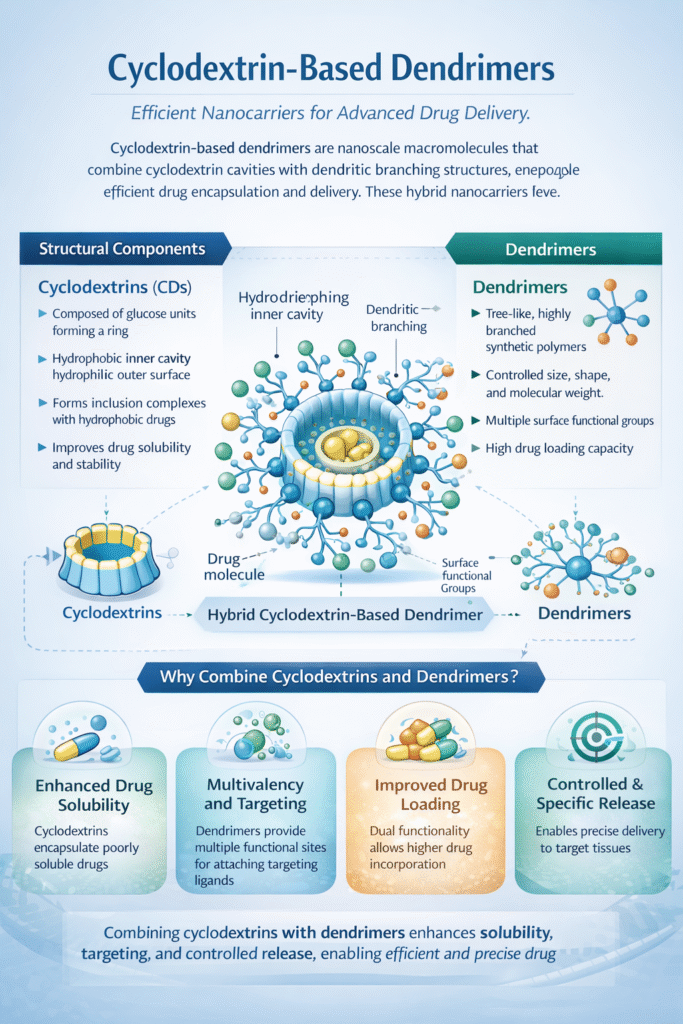
Cyclodextrin-based dendrimers are nanoscale macromolecules that combine cyclodextrin cavities with dendritic branching structures, enabling efficient drug encapsulation and delivery. These hybrid nanocarriers leverage the strengths of both components to enhance solubility, targeting, and controlled release in advanced drug delivery systems.
Structural Components
- Cyclodextrins (CDs)
Cyclodextrins are cyclic oligosaccharides that play a crucial role in drug encapsulation.- Composed of glucose units forming a ring structure
- Possess a hydrophobic inner cavity and hydrophilic outer surface
- Capable of forming inclusion complexes with hydrophobic drug molecules
- Improve drug solubility and stability
- Dendrimers
Dendrimers are highly branched, synthetic polymers with precise architecture.- Tree-like, three-dimensional structure
- Controlled size, shape, and molecular weight
- Multiple surface functional groups
- High drug loading capacity due to multivalent structure
Why Combine Them?
Combining cyclodextrins with dendrimers creates a powerful platform for targeted and efficient drug delivery.
Key Advantages of the Hybrid System
- Enhanced Drug Solubility
Cyclodextrins encapsulate poorly soluble drugs within their cavity - Multivalency and Targeting
Dendrimers provide multiple functional sites for attaching targeting ligands - Improved Drug Loading
Dual functionality allows higher drug incorporation - Controlled and Site-Specific Release
Enables precise delivery to target tissues
3: How do Cyclodextrin-Based Dendrimers enable Targeted Drug Delivery?
Cyclodextrin-based dendrimers enable Targeted Drug Delivery by encapsulating drugs and directing them to specific biological targets through functional surface modifications.
Mechanism of Action
- Drug Encapsulation
- Hydrophobic drugs are trapped inside cyclodextrin cavities
- Surface Functionalization
- Targeting ligands (e.g., antibodies, peptides) are attached
- Circulation in Bloodstream
- Stable nanostructure protects drug from degradation
- Target Recognition
- Ligands bind to specific receptors on target cells
- Controlled Release
- Drug is released at the target site via pH, enzyme, or stimuli triggers
4: Key Advantages of Cycldextrin-Based Dendrimers
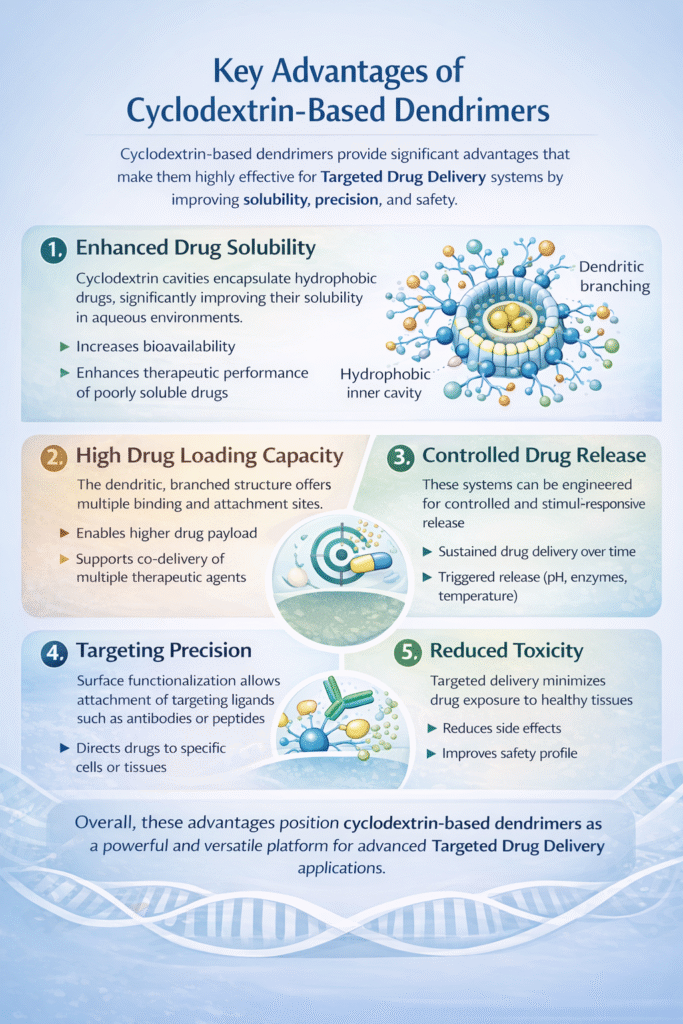
Cyclodextrin-based dendrimers provide significant advantages that make them highly effective for Targeted Drug Delivery systems by improving solubility, precision, and safety.
1. Enhanced Drug Solubility
Cyclodextrin cavities encapsulate hydrophobic drugs, significantly improving their solubility in aqueous environments.
- Increases bioavailability
- Enhances therapeutic performance of poorly soluble drugs
2. High Drug Loading Capacity
The dendritic, branched structure offers multiple binding and attachment sites.
- Enables higher drug payload
- Supports co-delivery of multiple therapeutic agents
3. Controlled Drug Release
These systems can be engineered for controlled and stimuli-responsive release.
- Sustained drug delivery over time
- Triggered release (pH, enzymes, temperature)
4. Targeting Precision
Surface functionalization allows attachment of targeting ligands such as antibodies or peptides.
- Directs drugs to specific cells or tissues
- Improves treatment accuracy
5. Reduced Toxicity
Targeted delivery minimizes drug exposure to healthy tissues.
- Reduces side effects
- Improves safety profile
Overall, these advantages position cyclodextrin-based dendrimers as a powerful and versatile platform for advanced Targeted Drug Delivery applications.
5: Applications in Pharmaceutical and Biotech Industries
Cyclodextrin-based dendrimers are widely used in advanced Targeted Drug Delivery applications, enabling precise, efficient, and safer treatment across multiple therapeutic areas.
Major Applications
1. Oncology
Cyclodextrin-based dendrimers enable targeted delivery of anticancer drugs directly to tumor cells, reducing damage to healthy tissues.
- Enhances accumulation of drugs at tumor sites
- Reduces systemic toxicity and side effects
- Supports delivery of chemotherapeutics and combination therapies
2. Gene Therapy
These nanocarriers efficiently deliver genetic materials such as DNA, RNA, and siRNA into cells.
- Protect nucleic acids from enzymatic degradation
- Improve cellular uptake and transfection efficiency
- Enable precise gene regulation and silencing
3. Antimicrobial Therapy
Cyclodextrin-based dendrimers improve the delivery and effectiveness of antimicrobial agents.
- Enhance solubility and stability of antibiotics
- Enable targeted delivery to infection sites
- Help overcome antimicrobial resistance mechanisms
4. CNS Drug Delivery
They facilitate drug transport across the blood-brain barrier (BBB), a major challenge in neurological treatments.
- Improve brain-targeted drug delivery
- Enhance therapeutic outcomes in neurological disorders
- Support treatment of diseases like Alzheimer’s and Parkinson’s
6: Challenges and Limitations
Despite their strong potential, cyclodextrin-based dendrimers face several challenges that can impact their effectiveness and scalability in Targeted Drug Delivery applications.
Key Challenges
1. Complex Synthesis and Scalability
The synthesis of cyclodextrin-based dendrimers involves multi-step, highly controlled processes.
- Difficult to scale for large-scale manufacturing
- Requires strict quality control to maintain consistency
- Increases production cost and time
2. Potential Cytotoxicity at Higher Generations
Higher-generation dendrimers may exhibit toxicity due to dense surface functionalities.
- Can interact with cell membranes and cause damage
- Requires careful design and surface modification
- Biocompatibility must be thoroughly evaluated
3. Regulatory Hurdles for Nanomedicines
Nanocarrier-based systems face complex regulatory pathways.
- Limited standardized guidelines for dendrimer-based systems
- Extensive safety and efficacy data required
- Longer approval timelines
4. Stability and Reproducibility Concerns
Maintaining consistent performance is a critical challenge.
- Structural variations can affect drug loading and release
- Stability issues during storage and transport
- Batch-to-batch reproducibility must be ensured
7: Analytical Characterization Requirements
Accurate analytical characterization is essential to ensure the safety, efficacy, and quality of cyclodextrin-based dendrimer systems used in Targeted Drug Delivery. Robust analytical workflows confirm structural integrity, drug loading, and reproducibility—critical for both development and regulatory approval.
Critical Analytical Techniques
1. Mass Spectrometry (MS)
Mass spectrometry provides precise molecular weight and structural confirmation of dendrimer systems.
- Confirms molecular mass and composition
- Detects impurities and structural variations
- Supports detailed structural elucidation
2. Nuclear Magnetic Resonance (NMR)
NMR spectroscopy evaluates structural integrity and verifies drug inclusion within cyclodextrin cavities.
- Confirms chemical structure and functional groups
- Identifies host–guest interactions
- Validates successful drug encapsulation
3. Dynamic Light Scattering (DLS)
DLS measures particle size and size distribution, which are critical for delivery performance.
- Determines hydrodynamic diameter
- Assesses uniformity and aggregation
- Supports stability studies
4. Chromatography (HPLC/UPLC)
Chromatographic techniques assess purity, drug loading, and release profiles.
- Quantifies drug content and impurities
- Evaluates loading efficiency
- Monitors batch consistency
Why It Matters
Comprehensive analytical characterization ensures that Targeted Drug Delivery systems perform reliably and meet regulatory expectations.
- Ensures Reproducibility
Consistent analytical data guarantees batch-to-batch uniformity - Supports Regulatory Submissions
High-quality data is essential for compliance with global regulatory standards - Validates Drug–Dendrimer Interactions
Confirms stability, efficacy, and mechanism of delivery
8: Future Outlook
The future of Targeted Drug Delivery using cyclodextrin-based dendrimers is highly promising, driven by advancements in nanotechnology and precision medicine.
Emerging Trends
- Smart stimuli-responsive dendrimers
- AI-driven drug delivery design
- Personalized nanomedicine platforms
- Integration with biologics and peptides
Conclusion:
Targeted Drug Delivery using cyclodextrin-based dendrimers represents a transformative approach in modern therapeutics. By combining the inclusion capabilities of cyclodextrins with the structural precision of dendrimers, these systems offer unmatched advantages in drug solubility, targeting, and controlled release.
As pharmaceutical innovation continues to evolve, the role of advanced analytical techniques and expert-driven characterization becomes increasingly critical. Organizations with deep expertise in mass spectrometry and structural analysis play a key role in accelerating the development and commercialization of these complex drug delivery systems.
Frequently Asked Questions:
Dendrimers are used as nanoscale carriers that encapsulate or conjugate drugs and deliver them to specific biological targets.
-Encapsulate drugs within internal cavities
-Attach drugs to surface functional groups
-Enable targeted delivery via ligand modification
-Support controlled and sustained drug release
Several marketed drugs use cyclodextrins to improve solubility and stability.
Common Examples:
-Itraconazole (Sporanox®) – antifungal formulation with cyclodextrin
-Voriconazole (Vfend®) – enhanced solubility for IV use
-Midazolam – improved aqueous formulation
-Diclofenac – better bioavailability in some formulations
Targeted Drug Delivery can be broadly classified based on mechanism and approach.
Major Types:
-Passive Targeting Utilizes natural accumulation (e.g., tumor EPR effect)
-Active Targeting Uses ligands (antibodies, peptides) to bind specific receptors
-Stimuli-Responsive Targeting Drug release triggered by pH, temperature, enzymes, or light
-Physical Targeting Uses external forces like magnetic fields or ultrasound
A widely studied example is the PAMAM (Polyamidoamine) dendrimer.
-Highly branched synthetic polymer
-Available in multiple generations (G0, G1, G2, etc.)
-Used in drug delivery, gene therapy, and imaging
A dendrimer is a complete, highly branched, symmetrical molecule, while a dendron is a single branch of that structure.
Dendrimers have a central core with multiple layers growing outward in all directions.
In contrast, dendrons extend in only one direction and are not complete molecules.
Dendrons are mainly used as building blocks to form full dendrimers.
In simple terms, a dendrimer is the whole tree, and a dendron is just one branch.
Dendrimers are synthesized using controlled, stepwise polymerization methods.
Main Synthesis Methods:
-Divergent Method Growth starts from a central core outward, Most commonly used approach
-Convergent Method Branches are synthesized first and then attached to the core, Offers better structural control
Click Chemistry & Advanced Methods High efficiency and precision, Used for complex and functional dendrimers
Reference
- Topuz F, Uyar T. Recent advances in cyclodextrin‐based nanoscale drug delivery systems. Wiley Interdisciplinary Reviews: Nanomedicine and Nanobiotechnology. 2024 Nov;16(6):e1995.https://wires.onlinelibrary.wiley.com/doi/abs/10.1002/wnan.1995
- Hussein I, Krabicová I, Hoti G, Er-Rahmani S, Matencio A, Caldera F, Trotta F. Cyclodextrin-based carriers for targeted drug delivery. Expert Opinion on Drug Delivery. 2026 Mar 4;23(3):537-55.https://www.tandfonline.com/doi/abs/10.1080/17425247.2025.2596707
- Yin JJ, Zhou ZW, Zhou SF. Cyclodextrin-based targeting strategies for tumor treatment. Drug delivery and translational research. 2013 Aug;3(4):364-74.https://link.springer.com/article/10.1007/s13346-013-0140-4
- Gadade DD, Pekamwar SS. Cyclodextrin based nanoparticles for drug delivery and theranostics. Advanced pharmaceutical bulletin. 2020 Feb 18;10(2):166.https://pmc.ncbi.nlm.nih.gov/articles/PMC7191229/
- Chaturvedi K, Ganguly K, Kulkarni AR, Kulkarni VH, Nadagouda MN, Rudzinski WE, Aminabhavi TM. Cyclodextrin-based siRNA delivery nanocarriers: a state-of-the-art review. Expert opinion on drug delivery. 2011 Nov 1;8(11):1455-68.https://www.tandfonline.com/doi/abs/10.1517/17425247.2011.610790