

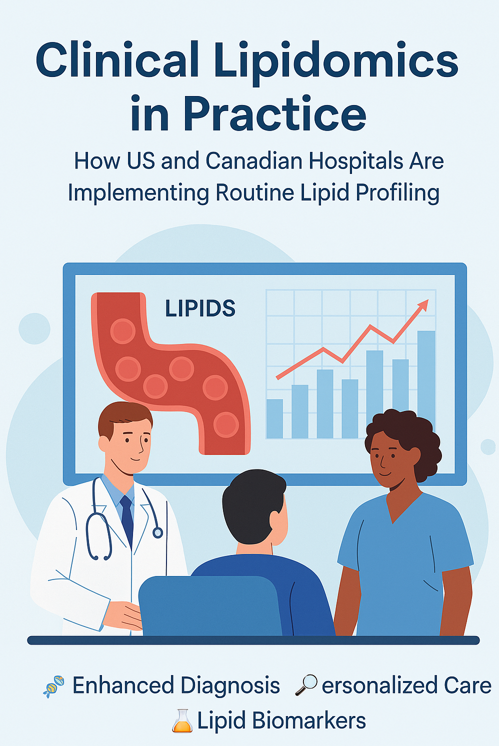
In recent years, the field of lipidomics—the large-scale study of pathways and networks of cellular lipids in biological systems—has gained significant traction in clinical settings. Hospitals across the United States and Canada are increasingly adopting routine lipid profiling to better understand disease mechanisms, improve diagnostics, and personalize patient care. This article delves into the implementation strategies, challenges, and benefits of integrating clinical lipidomics into routine hospital practice in North America.
The Rise of Clinical Lipidomics
Lipidomics, a branch of metabolomics, focuses on the comprehensive analysis of lipids within a biological system. Given the critical roles that lipids play in cellular structure, energy storage, and signaling, their dysregulation is often linked to various diseases, including cardiovascular conditions, diabetes, and neurodegenerative disorders. By profiling lipid species, clinicians can gain deeper insights into disease states and tailor interventions accordingly.
Implementation in US Hospitals
Case Study: Mayo Clinic’s Lipidomics Initiative
Mayo Clinic has been at the forefront of integrating lipidomics into clinical practice. Their Advanced Diagnostics Laboratory has developed lipidomic assays to assist in diagnosing and monitoring metabolic disorders. By employing mass spectrometry-based techniques, they can quantify specific lipid species, aiding in the detection of abnormalities that traditional lipid panels might miss.PMC
Collaborative Networks
In the US, several hospitals have formed collaborative networks with research institutions to advance lipidomics research and its clinical applications. For instance, partnerships between academic centers and hospitals have facilitated the translation of lipidomic discoveries into diagnostic tools and therapeutic strategies.
Implementation in Canadian Hospitals
Toronto General Hospital’s Lipid Research
Toronto General Hospital has initiated lipidomic studies focusing on cardiovascular diseases. By analyzing patient lipid profiles, they aim to identify biomarkers predictive of disease progression and response to treatment. This approach enables more personalized patient management and the development of targeted therapies.PMC+1ScienceDirect+1
Integration with National Health Initiatives
Canadian hospitals are aligning lipidomics integration with national health initiatives aimed at combating chronic diseases. By incorporating lipid profiling into routine screenings, they enhance early detection and prevention strategies, ultimately reducing healthcare costs and improving patient outcomes.
Challenges in Routine Lipid Profiling
Standardization of Protocols
One of the primary challenges in implementing routine lipidomics is the lack of standardized protocols. Variations in sample collection, storage, and analysis can lead to inconsistencies in data. Efforts are underway to establish standardized procedures to ensure reproducibility and reliability across institutions.
Data Interpretation and Clinical Relevance
The vast amount of data generated from lipidomic analyses necessitates sophisticated bioinformatics tools for interpretation. Determining the clinical relevance of specific lipid alterations remains complex, requiring ongoing research to correlate lipid profiles with disease states and outcomes.
Benefits of Routine Lipid Profiling
Enhanced Disease Diagnosis and Monitoring
Routine lipid profiling allows for the detection of subtle lipid abnormalities that may indicate early stages of disease. It also provides a means to monitor disease progression and response to treatment, facilitating timely adjustments to therapeutic strategies.PMC+9Canadian Journal of Cardiology+9Nature+9
Personalized Medicine
By understanding an individual’s unique lipid profile, clinicians can tailor interventions to target specific metabolic pathways, leading to more effective and personalized treatment plans.
Future Directions
The integration of lipidomics into clinical practice is poised to expand further with advancements in technology and bioinformatics. Future efforts will focus on large-scale studies to validate lipid biomarkers, development of point-of-care lipidomic assays, and incorporation of lipidomics data into electronic health records for comprehensive patient management.Journal of Lipid Research+11PMC+11PMC+11
Conclusion
The implementation of routine lipid profiling in US and Canadian hospitals represents a significant advancement in clinical diagnostics and personalized medicine. Despite challenges, the potential benefits in disease detection, monitoring, and tailored treatment are substantial. Continued collaboration, standardization, and technological innovation will be key to fully realizing the promise of clinical lipidomics in enhancing patient care.
REFERENCES
- Meikle TG, Huynh K, Giles C, Meikle PJ. Clinical lipidomics: realizing the potential of lipid profiling. Journal of Lipid Research. 2021 Jan 1;62:100127.
- Higgins V, White-Al Habeeb N, Venner AA, Bailey D, Collier C, Adeli K. A snapshot of lipid-reporting practices in canadian clinical laboratories: an urgent need for harmonisation. Canadian Journal of Cardiology. 2021 Jun 1;37(6):933-7.
- White-Al Habeeb NM, Higgins V, Venner AA, Bailey D, Beriault DR, Collier C, Adeli K. Canadian Society of Clinical Chemists harmonized clinical laboratory lipid reporting recommendations on the basis of the 2021 Canadian Cardiovascular Society Lipid Guidelines. Canadian Journal of Cardiology. 2022 Aug 1;38(8):1180-8.
- Nartey LK, Mikhael A, Pětrošová H, Yuen V, Kibsey P, Pekcan M, Ernst RK, Chen MX, Goodlett DR. A lipidomics-based method to eliminate negative urine culture in general population. Journal of Clinical Microbiology. 2024 Oct 16;62(10):e00819-24.
- Bowden JA, Heckert A, Ulmer CZ, Jones CM, Koelmel JP, Abdullah L, Ahonen L, Alnouti Y, Armando AM, Asara JM, Bamba T. Harmonizing lipidomics: NIST interlaboratory comparison exercise for lipidomics using SRM 1950–Metabolites in Frozen Human Plasma [S]. Journal of lipid research. 2017 Dec 1;58(12):2275-88.

Case Study: Chiral Purity Testing and D-Amino Acid Quantification in a Synthetic Octapeptide API
Introduction Chiral Purity Testing and D-Amino Acid Quantification in a synthetic octapeptide active pharmaceutical ingredient…

Hydrogen-Deuterium Exchange Mass Spectrometry (HDX-MS) for Peptide Conformational Analysis
Introduction Hydrogen-Deuterium Exchange Mass Spectrometry (HDX-MS) serves as a label-free biophysical approach for investigating peptide…

Case Study: Scaling Poly(lactic-co-glycolic acid) PLGA Microsphere Manufacturing from 1g Lab Batches to 500g GMP Pilot Scale
Introduction Scaling Poly(lactic-co-glycolic acid) PLGA Microsphere Manufacturing from a 1g laboratory bench batch to a…

Crossing the Blood-Brain Barrier with Peptide-Oligonucleotide Conjugates: Strategies and Evidence
Introduction: Peptide-Oligonucleotide Conjugates for Blood-Brain Barrier Delivery are being explored because conventional oligonucleotides generally struggle…

Case Study: Poly(lactic-co-glycolic acid) Nanoparticle Development for Subunit Vaccine Antigen Delivery and Immune Potentiation
Introduction Poly(lactic-co-glycolic acid) PLGA Nanoparticle Development offers an advanced biomaterial platform for the encapsulation, stabilization,…

What Are the Accuracy and Precision Requirements for a Validated Bioanalytical Method?
Introduction The Accuracy and Precision Requirements for a Validated Bioanalytical Method define the quantitative performance…

