

Introduction
Technology Transfer from Innovator to Generic CDMO is a structured and highly regulated process involving the systematic translation of drug manufacturing processes, analytical testing procedures, and Chemistry, Manufacturing, and Controls (CMC) technical packages from an originating drug developer to a generic contract development and manufacturing organization. When this transition is executed effectively, it establishes operational equivalence, confirms the control of critical quality attributes, and supports strict compliance with cGMP requirements for post-patent regulatory approvals, including Abbreviated New Drug Applications (ANDAs).
The commercial and technical implications of this transfer process are significant. Operational delays during technology transfer can lead to missed market opportunities and increased development overhead, potentially reaching up to 500,000 per day. Conventional transfer approaches may fail because of unidentified process variables, insufficient analytical method documentation, or mechanical differences between original R&D equipment and commercial CDMO manufacturing lines. Modern pharmaceutical engineering addresses these challenges by replacing paper-based legacy transfer practices with structured Quality by Design (QbD) frameworks and digitalized lifecycle management approaches aligned with International Council for Harmonisation (ICH) and United States Pharmacopeia (USP) guidelines.
Explore regulatory-driven CMC documentation support: Learn how comprehensive CMC packages streamline ANDA filings
Share via:
Quick Summary:
- Technology transfer moves manufacturing, analytical methods, and CMC knowledge from an innovator to a generic CDMO under strict cGMP and regulatory requirements.
- The process follows 4 key phases: initiation & knowledge management, facility-fit assessment, analytical method transfer, and PPQ/commercial handover.
- Major technical pitfalls include incomplete process knowledge, equipment and scale-up mismatches, fragile analytical methods, excipient/matrix interference, and paper-based data silos.
- QbD and ICH Q9 risk management help identify Critical Process Parameters (CPPs), Critical Quality Attributes (CQAs), and establish a scientifically justified design space.
- Analytical method transfer can use comparative testing, co-validation, revalidation, or risk-based transfer waivers, depending on method complexity and transfer risk.
- Pharma 4.0 digitalization replaces paper/PDF-based transfers with centralized digital data, automated pipelines, audit trails, MES/PLM integration, and real-time process monitoring.
- Overall, combining structured phase-gates, robust analytical transfer, QbD, PPQ, CPV, and digital data systems transforms technology transfer into a controlled and predictable pathway to commercial manufacturing.
Process Lifecycle for Technology Transfer from Innovator to Generic CDMO
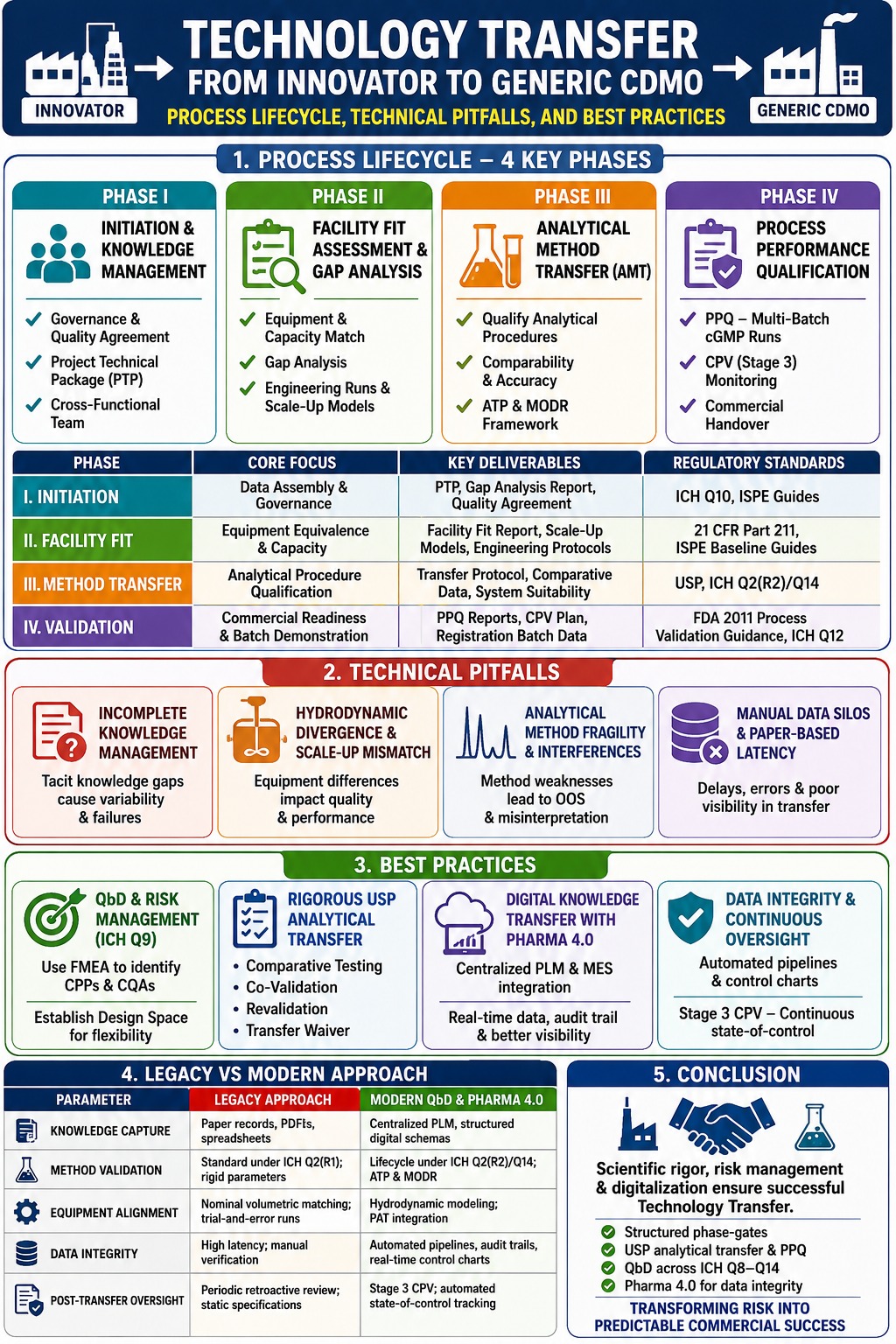
The lifecycle for Technology Transfer from Innovator to Generic CDMO consists of a structured four-stage progression that includes project initiation, facility fit evaluation, analytical and process optimization, and formal Process Performance Qualification (PPQ). This systematic approach ensures that Critical Process Parameters (CPPs) are appropriately identified and mapped to the consistent achievement of predefined Critical Quality Attributes (CQAs) under cGMP conditions.
Phase I: Project Initiation and Knowledge Management
Project initiation establishes the formal governance framework, quality agreements, and technical data repositories necessary to transfer baseline process and analytical knowledge between the sending and receiving sites. During this stage, the transferring team prepares the Project Technical Package (PTP), which brings together historical development reports, master batch records (MBRs), raw material quality specifications, degradation profiles, and safety information. Establishing a cross-functional team that includes Subject Matter Experts (SMEs) from Manufacturing Science and Technology (MS&T), Quality Assurance (QA), Regulatory Affairs, and Analytical Development provides clear technical accountability and communication across both organizations.
Evaluate potential CDMO partners: Compare US vs. Overseas CDMO capabilities for technical transfer success
Phase II: Facility Fit Assessment and Gap Analysis
A facility fit assessment involves a systematic comparison of the physical, volumetric, and technological capabilities of the receiving CDMO’s manufacturing suites with the process parameters established at the sending facility. This evaluation is performed to identify potential hardware limitations and operational differences before manufacturing activities begin. Comprehensive gap analyses covering tank geometries, mixing hydrodynamics, thermal transfer rates, and environmental controls can help prevent unforeseen bottlenecks during process scale-up. When differences in equipment geometry or mechanical configuration exist between facilities, engineering runs and non-GMP trial batches can be used to establish a practical connection between initial development data and commercial production capabilities.
Learn about reverse engineering and sourcing strategy: Discover RLD sourcing and reverse engineering for generic development
Phase III: Analytical Method Transfer (AMT)
Analytical method transfer qualifies the receiving laboratory to perform the analytical procedures established by the transferring laboratory, ensuring that product testing is precise, accurate, and reproducible. Governed by USP and ICH Q2(R2)/Q14 standards, AMT evaluates whether analytical results generated at the generic CDMO facility are comparable to those obtained at the originating facility. Critical analytical procedures, including high-performance liquid chromatography (HPLC) for purity and assay, dissolution profiling, and solid-state characterization, are evaluated within an Analytical Target Profile (ATP) framework to establish the Method Operable Design Region (MODR).
Access analytical testing suites: Explore integrated CDMO analytical services tailored for ANDA applications
Phase IV: Process Performance Qualification (PPQ) and Commercial Handover
Process Performance Qualification (PPQ) demonstrates that the generic CDMO manufacturing process can consistently operate within predefined parameters while producing drug products that meet established quality attributes. Consistent with Stage 2 of the FDA 2011 Process Validation Guidance, PPQ incorporates multi-batch commercial validation protocol runs performed under full cGMP compliance. After successful completion of PPQ, the manufacturing asset progresses into Stage 3 Continued Process Verification (CPV), where ongoing process performance is monitored to maintain a continuous state of control throughout the commercial manufacturing lifecycle.
Design robust bioequivalence programs: Review bioequivalence study design strategies for complex generics
| Transfer Phase | Core Technical Focus | Key Technical Deliverables | Relevant Regulatory Standards |
|---|---|---|---|
| Phase I: Initiation | Technical data assembly and governance alignment | Approved Project Technical Package (PTP), Gap Analysis Report, Quality Agreement | ICH Q10, ISPE Good Practice Guides |
| Phase II: Facility Fit | Equipment equivalence and capacity matching | Facility Fit Report, Scale-Up Hydrodynamic Models, Engineering Run Protocols | 21 CFR Part 211, ISPE Baseline Guides |
| Phase III: Method Transfer | Analytical procedure qualification at receiving unit | Transfer Protocol, Comparative Testing Data, System Suitability Specifications | USP, ICH Q2(R2)/Q14 |
| Phase IV: Validation | Commercial readiness and batch demonstration | PPQ Executed Reports, CPV Monitoring Plan, Registration Batch Data | FDA 2011 Process Validation Guidance, ICH Q12 |
Technical Pitfalls in Technology Transfer from Innovator to Generic CDMO
Technical pitfalls during Technology Transfer from Innovator to Generic CDMO commonly originate from unidentified process variables, insufficiently characterized raw material behavior, equipment scale-up differences, and analytical methods with limited robustness. If these technical gaps are not identified and controlled, they can contribute to non-conforming batches, prolonged deviation investigations, increased development activities, and delays in regulatory approval.
Incomplete Knowledge Management and Tacit Process Gaps
Manufacturing failures can frequently be traced to undocumented operational details, often described as tacit knowledge, that were not captured in formal batch records during early-stage development. Missing information concerning precise liquid addition rates, sensitivity to environmental humidity during milling, or specific order-of-addition requirements can contribute to substantial batch-to-batch variability following technology transfer. Depending only on summarized development reports without providing detailed processing records can prevent generic CDMO engineering teams from accurately defining the actual manufacturing design space and understanding the process conditions required for consistent performance.
Understand structural and molecular challenges: Explore the differences between peptide and small molecule drug development
Hydrodynamic Divergence and Equipment Scale-Up Mismatches
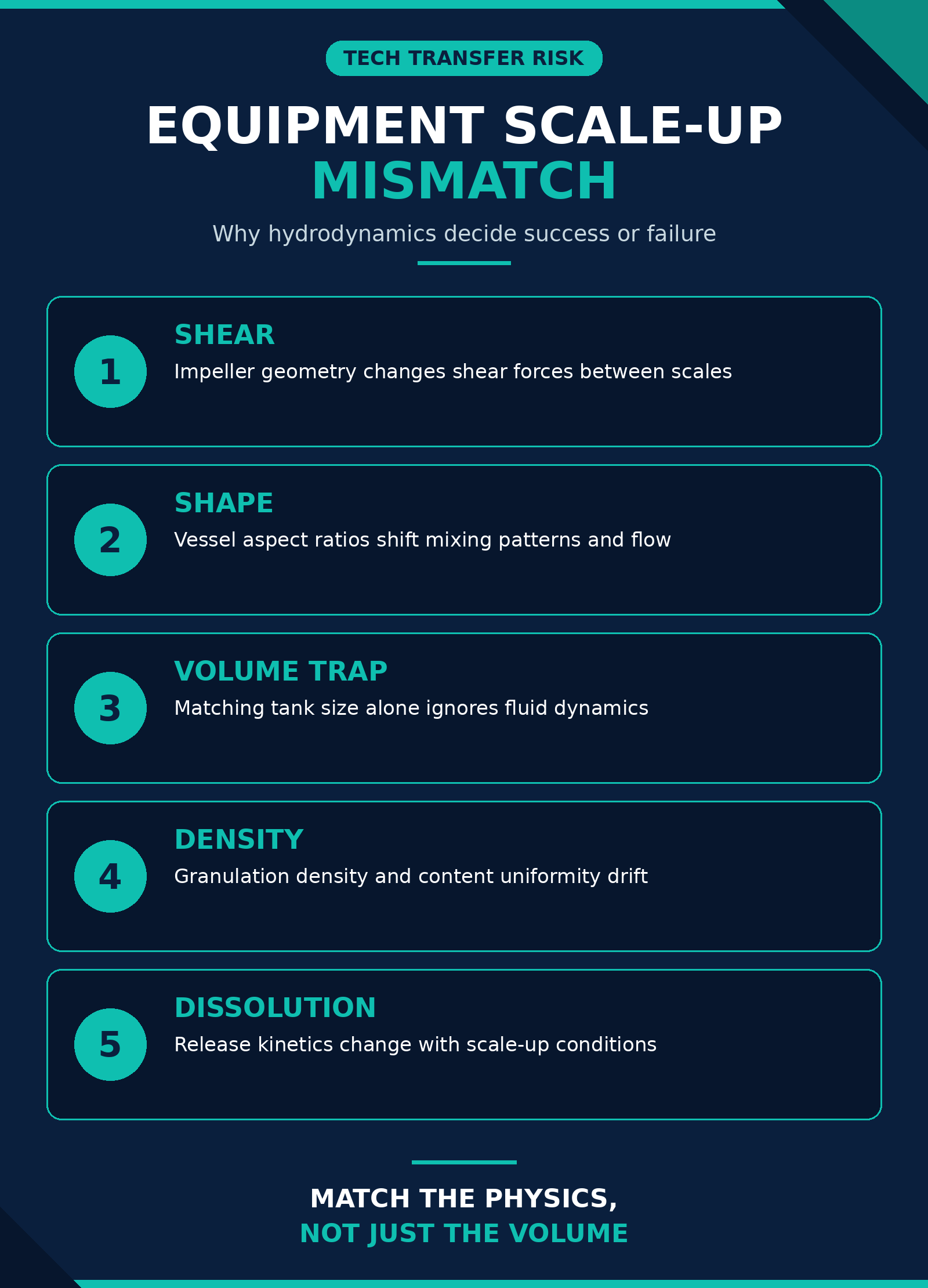
Differences in mechanical configuration, impeller shear geometry, and vessel aspect ratios between development-scale equipment and commercial production systems can introduce complex and non-linear scale-up challenges. Selecting manufacturing equipment solely according to total volumetric capacity, without considering hydrodynamic shear characteristics and fluid dynamics, may negatively affect granulation density, content uniformity, and dissolution kinetics. Therefore, equipment equivalence must consider the process mechanisms and physical conditions that influence product performance rather than relying exclusively on nominal equipment capacity.
Scale your complex process seamlessly: Discover end-to-end peptide CDMO scale-up solutions
Analytical Method Fragility and Excipient Matrix Interferences
Analytical methods without clearly established robustness boundaries under ICH Q14 principles can experience an increased frequency of system suitability failures during comparative testing. Differences in chromatographic instrument dwell volumes, variations between stationary phase batches, or unexpected matrix effects associated with generic excipients may contribute to misleading out-of-specification (OOS) results. Fragile stability-indicating methods (SIM) that do not have clearly defined operational limits may also have difficulty reliably separating degradation products from active pharmaceutical ingredients (APIs), thereby compromising the interpretation of analytical results during technology transfer.
Mitigate chemical contamination risks: Implement robust impurity control strategies under ICH Q3A
Manual Data Silos and Paper-Based Transfer Latency
Legacy paper-based data collection approaches can create substantial communication delays, increase the potential for manual transcription errors, and limit real-time visibility into process performance during site-to-site transfers. When technical knowledge is distributed across static PDF documents or offline spreadsheets, teams at different locations may face difficulties maintaining effective change control, conducting timely root-cause investigations, and ensuring that technical parameters remain aligned between the drug developer and CDMO systems. These limitations can increase the complexity of knowledge transfer and reduce the efficiency of technology transfer activities.
Best Practices for Technology Transfer from Innovator to Generic CDMO
Successful execution of Technology Transfer from Innovator to Generic CDMO requires the integration of structured Quality by Design (QbD) principles, standardized risk management approaches such as ICH Q9, fully digitized data architectures, and rigorous analytical protocols. Combining these engineering and quality practices helps minimize process variability, protect data integrity, improve knowledge continuity, and support more efficient regulatory review and approval timelines.
Implementing Quality by Design (QbD) and Risk Management (ICH Q9)
Applying Quality by Design (QbD) principles transforms technology transfer from an empirical trial-and-error activity into a systematic, science-based process. Cross-functional teams should apply formal risk assessment tools, including Failure Mode and Effects Analysis (FMEA), to identify, evaluate, prioritize, and control Critical Process Parameters (CPPs) in relation to Critical Quality Attributes (CQAs). Establishing a validated Design Space allows generic CDMO operators to make appropriate adjustments to operational parameters within predefined and scientifically justified ranges without automatically requiring post-approval regulatory filings.
Address specialized formulation hurdles: Learn best practices for formulating lyophilized peptide injectables
Executing Rigorous USP Analytical Transfer Protocols
Analytical method transfers should be performed using formal, pre-approved protocols that comply with applicable USP guidelines and clearly define statistical acceptance criteria, sample preparation requirements, and testing responsibilities. Depending on the complexity of the analytical procedure and the level of experience at the receiving site, organizations can apply one of four recognized execution pathways:
- Comparative Testing: This approach involves inter-laboratory comparative testing in which the sending and receiving laboratories analyze identical homogeneous sample lots. The resulting data are then evaluated against predefined statistical equivalence limits to determine whether the receiving laboratory can successfully reproduce the analytical procedure.
- Co-Validation: This approach involves multi-laboratory co-validation, with the receiving laboratory participating as an active testing site during the initial method validation study. The approach allows method performance to be assessed across laboratories while establishing confidence in the receiving laboratory’s ability to execute the procedure.
- Revalidation: Targeted partial or complete revalidation can be performed at the receiving facility to confirm selected analytical performance characteristics, including intermediate precision and specificity. The scope of revalidation should be based on method complexity, transfer risk, and the differences between the sending and receiving laboratories.
- Transfer Waiver: A transfer waiver involves a scientifically and risk-based decision to omit formal comparative testing. This pathway is generally reserved for simple, standardized compendial procedures that can be appropriately verified at the receiving laboratory under USP requirements.
Select the right manufacturing partner: Read our guide on how to choose a peptide CDMO in the US
Digitalizing Knowledge Transfer via Pharma 4.0 Frameworks
Implementing Pharma 4.0 digital architectures can replace manual document exchanges with automated and vendor-independent data structures, including formats such as the Allotrope format. Digitalized technology transfer establishes a continuous data thread throughout the asset lifecycle by connecting development databases with CDMO Manufacturing Execution Systems (MES). This level of integration reduces manual transcription errors, accelerates deviation management, improves information accessibility, and supports compliance with global data integrity expectations. It also provides greater visibility into technical information as an asset progresses from development through manufacturing and commercial operations.
Explore specialized drug delivery solutions: Review generic ophthalmic suspension ANDA development approaches
| Transfer Parameter | Legacy Transfer Methodology | Modern QbD & Pharma 4.0 Digital Architecture |
|---|---|---|
| Knowledge Capture | Paper records, static PDFs, localized spreadsheets | Centralized Product Lifecycle Management (PLM), structured digital schemas |
| Method Validation | Standard testing under ICH Q2(R1); rigid parameters | Lifecycle management under ICH Q2(R2)/Q14; ATP and MODR execution |
| Equipment Alignment | Nominal volumetric matching; trial-and-error runs | Hydrodynamic shear modeling; Process Analytical Technology (PAT) integration |
| Data Integrity | High data latency; manual verification requirements | Automated data pipelines; continuous audit trails; real-time control charts |
| Post-Transfer Oversight | Periodic retroactive review; static specifications | Stage 3 Continued Process Verification (CPV); automated state-of-control tracking |
Conclusion
Successfully managing Technology Transfer from Innovator to Generic CDMO requires the integration of rigorous scientific methodologies, advanced risk management frameworks, and modern digital platforms. Implementing structured phase-gate transitions, ranging from comprehensive facility fit gap assessments to USP analytical transfers and robust Process Performance Qualification (PPQ), helps establish manufacturing consistency while supporting regulatory requirements. Applying Quality by Design principles across ICH Q8–Q14 and incorporating Pharma 4.0 data standards can transform technology transfer from a high-risk operational challenge into a controlled and predictable pathway for commercial manufacturing success.
To discuss specialized analytical method transfers, process validation planning, or CMC technical support for your upcoming asset transfer, contact the technical team directly through the ResolveMass Contact Us portal.
Frequently Asked Questions (FAQs)
USP provides a structured approach for transferring analytical procedures from a sending laboratory to a receiving laboratory. It supports different transfer strategies, including comparative testing, co-validation, revalidation, and transfer waivers, with the selected approach determined by the complexity and risk associated with the analytical method.
A Project Technical Package (PTP) should provide the technical information required for the receiving organization to understand and reproduce the transferred process. It typically includes Chemistry, Manufacturing, and Controls (CMC) information, process flow diagrams, Critical Quality Attributes (CQAs), Critical Process Parameters (CPPs), master batch records, material specifications, analytical data, stability information, and relevant safety documentation.
The commonly recognized approaches for analytical procedure transfer include comparative testing, inter-laboratory co-validation, targeted revalidation, and risk-based transfer waivers. The appropriate strategy depends on factors such as analytical procedure complexity, laboratory capability, prior method experience, and the potential risk associated with the transfer.
Equipment differences are evaluated through a detailed facility fit assessment that compares factors such as vessel geometry, mixing characteristics, capacity, and process conditions. Engineering runs, hydrodynamic modeling, and non-GMP trials can then be used to understand and control scale-up differences before commercial manufacturing and Process Performance Qualification (PPQ).
ICH Q14 supports a science- and risk-based approach to analytical procedure development and lifecycle management. Concepts such as the Analytical Target Profile (ATP) and Method Operable Design Region (MODR) help define suitable operating conditions and provide a structured basis for managing analytical procedure performance during transfer and subsequent lifecycle activities.
Organizations can reduce this risk by defining appropriate raw material and excipient specifications and assessing variability during method development. Evaluating representative supplier lots and challenging the analytical procedure under relevant conditions can help identify potential matrix effects and demonstrate method robustness before the transfer begins.
Comparative testing generally involves the sending and receiving laboratories analyzing equivalent or identical samples and comparing the resulting data against predefined acceptance criteria. In co-validation, the receiving laboratory participates directly in the original validation exercise, allowing method performance to be assessed across laboratories as part of the validation process.
Continuous Process Verification (CPV) is Stage 3 of the process validation lifecycle and focuses on ongoing monitoring of manufacturing performance during routine commercial production. By evaluating process data and applying statistical monitoring techniques, CPV helps confirm that the manufacturing process remains stable, capable, and within its established state of control.
Digital technology transfer replaces fragmented paper records and manual data handling with connected, structured, and traceable digital systems. Pharma 4.0 approaches can reduce transcription errors, improve communication between sites, provide faster access to process information, and maintain auditable records that support data integrity and regulatory compliance.
Reference:
- Codina, A., & Tonge, N. (2025). Mastering chromatography method transfer in today’s connected world. LCGC International, 21(3), 7–12. https://www.chromatographyonline.com/view/mastering-chromatography-method-transfer-in-today-s-connected-world (chromatographyonline.com)
- Wahlich, J. (2021). Review: Continuous manufacturing of small molecule solid oral dosage forms. Pharmaceutics, 13(8), 1311. https://doi.org/10.3390/pharmaceutics13081311
- Burgess, C., & McDowall, R. D. (2022). Quo vadis analytical procedure development and validation? Spectroscopy, 37(9), 8–14. https://doi.org/10.56530/spectroscopy.mf9790d5 (spectroscopyonline.com)
Get In Touch With Us
About The Author


