

Introduction:
Technology Transfer to GMP CDMO is one of the most technically demanding steps in bringing a first-in-generic modified-release tablet from a university lab to market. University laboratories are optimized for formulation development and scientific experimentation at small scale. A GMP CDMO, by contrast, must operate through controlled procedures, qualified equipment, trained personnel, validated methods, documented processes, and an established pharmaceutical quality system.
ResolveMass Laboratories Inc. was engaged to close that gap for a university-originated MR tablet formulation, guiding it through a defined technology transfer pathway into a GMP-compliant manufacturing environment. This case study presents a representative scenario, referencing WHO and FDA technology-transfer frameworks, to show how a Technology Transfer to GMP CDMO actually happens in practice — and what academic innovators, generic sponsors, and formulation scientists should expect at each stage.
Summary
- Technology Transfer to GMP CDMO converts a laboratory-scale formulation and process into a controlled, reproducible, GMP-ready manufacturing operation.
- For a first-in-generic modified-release (MR) tablet, the transfer must preserve critical quality attributes (CQAs), the release profile, manufacturability, and analytical performance.
- A successful transfer is more than handing over a formula — it requires knowledge transfer, gap assessment, risk management, equipment evaluation, analytical method transfer, process optimization, qualification, validation, and documentation.
- WHO guidance describes technology transfer as a logical, controlled procedure involving documentation and professional expertise between development and manufacturing units, supported by quality risk management.
- FDA’s SUPAC-MR guidance specifically addresses scale-up, site changes, equipment changes, dissolution testing, and bioequivalence documentation for MR solid oral dosage forms.
- ResolveMass Laboratories Inc. supported a university-developed MR tablet formulation through a phased transfer — analytical bridging, gap assessment, scale-up, and GMP batch manufacturing — resulting in a dissolution-matched, audit-ready commercial process.
1: What Is Technology Transfer to GMP CDMO?
Technology Transfer to GMP CDMO is the structured transfer of product, process, analytical, and quality knowledge from a development organization to a qualified contract manufacturing partner so the receiving site can reproducibly manufacture and test the product. It is not simply handing over a recipe — it requires transferring the scientific understanding behind why the formulation and process work.
WHO’s technology-transfer guidance describes this as a logical procedure controlling the transfer of process, documentation, and professional expertise between development and manufacturing, or between manufacturing sites, supported by quality risk management. For a modified-release tablet, the transfer package typically includes the formulation composition, manufacturing process, critical material attributes (CMAs), critical process parameters (CPPs), critical quality attributes (CQAs), development reports, batch records, analytical procedures, dissolution methods and profiles, stability data, and risk assessments.
2: Why University-to-CDMO Technology Transfer Is So Challenging
University lab formulations are usually developed on small-scale equipment using research-grade materials, without the equipment train, in-process controls, or documentation structure required for GMP manufacturing.
| Gap Area | Typical University Lab Status | GMP CDMO Requirement |
|---|---|---|
| Equipment scale | Bench-top mixers, manual compression | Validated production-scale granulators, tablet presses |
| Raw materials | Research-grade excipients | Pharmacopeial-grade, vendor-qualified excipients |
| Analytical methods | Basic, unvalidated methods | Fully validated, stability-indicating methods |
| Documentation | Lab notebooks | Batch records, SOPs, deviation and change control |
| Process understanding | Single-batch proof of concept | Defined design space and CPPs |
Recognizing these gaps early allowed ResolveMass to build a transfer plan that addressed risk systematically rather than reactively — a step organizations should also apply when they qualify and audit a CDMO before committing to a transfer partner.
3: Establishing the Technology Transfer Team
A successful Technology Transfer to GMP CDMO begins with a cross-functional team that has clearly defined responsibilities, so problems aren’t misattributed to formulation, equipment, analytics, or manufacturing.
| Activity | University/Sponsor | GMP CDMO |
|---|---|---|
| Development history | Lead | Review |
| Formulation knowledge | Lead | Understand/assess |
| Equipment assessment | Support | Lead |
| Analytical method transfer | Support | Execute |
| Risk assessment | Joint | Joint |
| Scale-up batches | Support | Lead |
| GMP documentation | Review | Lead |
| Regulatory documentation | Lead | Provide technical data |
The Development Data Package: What Gets Transferred
The development data package gives the CDMO the technical knowledge needed to reproduce the formulation and understand its manufacturing sensitivities. In this case, the university’s package included a semi-quantitative formulation, single lab-scale batches, preliminary dissolution data using a non-validated method, and no formal stability program. This gap review identified analytical bridging and process scale-up as the two highest-risk workstreams — a pattern common enough that it’s a leading cause of later Complete Response Letters (CRLs) for generic ANDAs when it isn’t addressed early.
Analytical Method Bridging and Validation
Analytical bridging comes first because a process cannot be judged reproducible if the test methods measuring it aren’t validated. ResolveMass re-developed and validated a stability-indicating HPLC method and a discriminating dissolution method suited to the MR mechanism, covering specificity, forced degradation, linearity, accuracy, precision, and robustness. Where in vivo–correlated exposure data was later needed to support bioequivalence, the same analytical rigor extended into bioanalytical method development and validation.
4: Risk Assessment for Modified-Release Manufacturing
Risk assessment identifies which material attributes and process parameters most affect drug-release performance. ICH’s Q8, Q9, and Q10 framework connects pharmaceutical development, quality risk management, and quality systems throughout this process.
- Critical Material Attributes: API particle size, polymer viscosity/grade, excipient moisture, lubricant concentration
- Critical Process Parameters: granulation endpoint, drying temperature, compression force, coating weight gain, spray rate
- Critical Quality Attributes: assay, content uniformity, hardness, friability, dissolution profile, stability
5: Process Characterization and Scale-Up
Scale-up is not simply multiplying lab quantities by a scale factor. A lab blender and a production blender differ in geometry, fill level, shear, and residence time — and coating performance changes similarly when moving to a production-scale coater. FDA’s process-validation guidance frames this within a full product lifecycle, encouraging development knowledge and quality risk management throughout scale-up.
ResolveMass ran DoE studies on granulation and compression, ran pilot batches at 10x and 50x lab scale, and confirmed that compression force and coating parameters were the primary drivers of release-rate variability.
6: Managing Dissolution Across Scales
Maintaining the dissolution profile is the central technical challenge in transferring an MR tablet. FDA’s SUPAC-MR guidance specifically addresses scale-up, manufacturing-site and equipment changes, dissolution testing, and bioequivalence documentation for modified-release solid oral dosage forms.
| Batch Stage | Scale | f2 Similarity vs. Reference | Result |
|---|---|---|---|
| University lab batch | 1x (bench) | 38 (dissimilar) | Failed |
| Pilot batch (post-DoE) | 10x | 61 | Passed |
| GMP exhibit batch | 50x (commercial-representative) | 68 | Passed |
The improvement from a failing f2 score to a passing, regulator-acceptable range demonstrates the value of structured characterization over unoptimized direct scale-up.
7: Engineering Batches and GMP Manufacturing
Engineering batches test whether the transferred process works on the CDMO’s equipment before formal GMP execution — evaluating mixing, granulation, drying, compression, coating, yield, and dissolution against development targets. Once confirmed, GMP exhibit batches were manufactured under approved batch records with full in-process controls, and stability studies were initiated per ICH guidelines. This staged approach is the same one applied under ResolveMass’s broader CDMO support for ANDAs.
GMP Documentation and Quality Systems
The transferred process becomes commercially meaningful only when supported by a controlled quality system: technology-transfer protocols and reports, master batch records, SOPs, specifications, validation protocols, equipment qualification records, deviation and change-control systems, and training records. WHO describes GMP as a component of quality assurance ensuring medicines are consistently produced and controlled to appropriate quality standards.
8: Key Lessons from This Technology Transfer to GMP CDMO Project
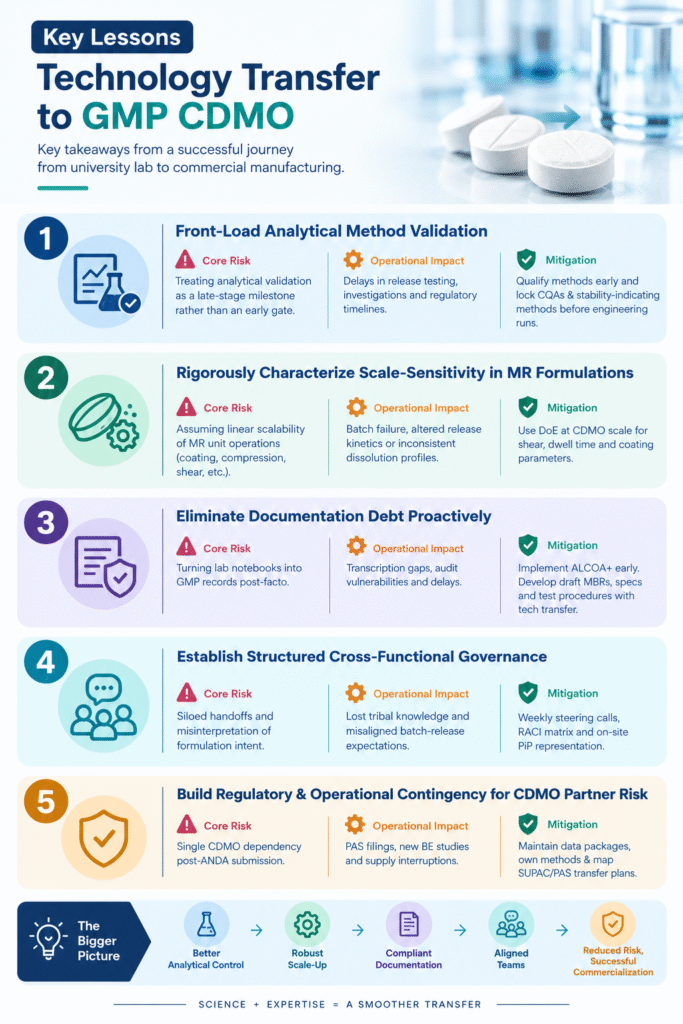
- Analytical validation should not be an afterthought — late-discovered method limitations delay entire programs.
- MR formulations are highly scale-sensitive — compression, coating, and shear must be characterized, not assumed to scale linearly.
- Documentation debt compounds — building GMP documentation retroactively from academic notes is slower than building it in from the start.
- Cross-functional communication matters — regular alignment between originating scientists and CDMO teams prevents misinterpretation of formulation intent.
- CDMO relationships need contingency planning — sponsors should understand the process to switch CDMOs after ANDA submission in case a partnership needs to change post-filing.
9: Beyond Oral Solids: Related CDMO Capabilities
While this case study focuses on an MR tablet, the same transfer discipline applies across modalities and markets. Sponsors working on parallel or future programs may also need:
- EU generic drug dossier development and EMA submission support for international filings
- Extractables and leachables (E&L) testing for generic injectable drugs
- CDMO capabilities for generic injectable ANDAs
- Peptide CDMO services and peptide technology transfer to a CDMO for complex molecule programs
10: Practical Checklist for Technology Transfer to GMP CDMO
- Development history and formulation composition are complete
- CQAs, CMAs, and CPPs are identified and risk-assessed
- Equipment and raw-material gaps are evaluated
- Analytical methods are transferred and dissolution is demonstrated
- Engineering batches are evaluated and deviations investigated
- GMP batch documentation is approved and personnel trained
- Process qualification and stability programs are defined
- Technology-transfer report is completed with documented action items for remaining gaps
Conclusion:
This case study shows how a disciplined Technology Transfer to GMP CDMO process — grounded in WHO and FDA/SUPAC-MR frameworks — can convert a promising but non-scalable university formulation into a robust, regulatory-ready, first-in-generic modified-release tablet. By treating analytical validation, risk assessment, scale-up, and documentation as sequential, risk-managed phases, ResolveMass Laboratories Inc. closed the gap between academic proof-of-concept and commercial manufacturing readiness.
Frequently Asked Questions:
Quality assurance helps ensure that technology-transfer activities follow the applicable quality system. QA may oversee documentation, risk assessments, change control, deviations, training, qualification, validation, and approval of transfer activities.
The type, grade, viscosity, particle characteristics, concentration, and behavior of a release-controlling polymer can influence drug-release kinetics. Therefore, polymer control can be an important part of the technology-transfer strategy.
Successful technology transfer depends on complete development knowledge, effective communication between teams, appropriate risk assessment, equipment and process understanding, analytical comparability, controlled documentation, trained personnel, and appropriate qualification and validation.
A structured technology-transfer process can help identify and address potential technical and quality risks before routine GMP manufacturing by using development knowledge, risk assessment, engineering studies, analytical evaluation, and controlled documentation.
A change in dissolution should trigger a documented scientific assessment. The team may investigate formulation materials, equipment, compression, coating, granulation, analytical factors, and other process variables to determine the potential cause and appropriate corrective action.
Reference
- Platz A, Buettner K, Roessler S, Sonnernberg S, Schaefer T, Schmidt A. Development from a Cord Blood Bank to a Contract Development and Manufacturing Organization (CDMO) for ATMP. Cytotherapy. 2025 May 1;27(5):S100-1.https://www.sciencedirect.com/science/article/pii/S1465324925002804
- Okazaki T. CHALLENGE TO ESTABLISH AN ACADEMIC INFRASTRUCTURE FOR MANUFACTURING AND PROVISION OF VIRAL VECTOR TO ACCELERATE THE PRACTICAL APPLICATION OF GENE AND CELL THERAPY. Cytotherapy. 2026 May 1;28(5):102516.https://www.sciencedirect.com/science/article/pii/S1465324926004779
- Minas W. Transforming a R&D-oriented start-up into a GMP-compliant biopharmaceutical production organization Dr. Wolfgang Minas· Chemgineering Technology AG, Münchenstein, Switzerland.https://www.ecv.de/suse_print.php?id=Z|pi|9378
- Lowdell MW. Considerations for manufacturing of cell and gene medicines for clinical development. Cytotherapy. 2025 Jul 1;27(7):874-83.https://www.sciencedirect.com/science/article/pii/S1465324924009411
About the Author


