

Introduction:
Teriparatide Generic Characterization is the analytical comparison of a proposed generic teriparatide against the RLD, Forteo, to show the same primary sequence, equivalent higher-order structure and a comparable or cleaner impurity profile. Teriparatide is a 34-amino-acid fragment of human parathyroid hormone, PTH(1-34), used to treat osteoporosis in patients at high fracture risk. Its small size is deceptive: the peptide is prone to oxidation and deamidation, and its biological activity depends on subtle conformational behavior.
The reference product, FORTEO®, contains teriparatide as its active ingredient. The peptide acts through the parathyroid hormone type 1 receptor (PTH1R) to drive the signaling pathways involved in bone remodeling, so any structural or impurity difference deserves a close look.
This case study walks through how ResolveMass Laboratories Inc., a Canadian analytical CRO/CDMO specializing in mass spectrometry, biosimilar characterization and peptide analysis, approaches a head-to-head comparability study. It is a representative study design that reflects our standard workflow, not a disclosure of a specific client program. Study design, methods and acceptance logic follow ICH Q6B, ICH Q2(R2) and Q3A principles and current FDA and EMA peptide guidance.
Summary:
A defensible teriparatide generic needs matched sequence, matched higher-order structure and an impurity profile no worse than the Reference Listed Drug (RLD), all shown with orthogonal methods.
- Sequence: LC-HRMS intact mass, peptide mapping and MS/MS confirm the 34-amino-acid PTH(1-34) sequence with full residue coverage.
- Higher-order structure: Far-UV circular dichroism (CD), FTIR and 2D NMR show whether the generic folds and behaves like the RLD in its formulation buffer.
- Impurities: Deamidation, oxidation, truncation, deletion and aggregate levels are compared side by side against multiple RLD lots.
- Biological relevance: A cell-based cAMP potency assay links structural similarity to function.
- Regulatory fit: The data package is designed around FDA, EMA and ICH expectations for peptide comparability.
- Bottom line: Teriparatide generic characterization is a weight-of-evidence exercise. No single assay proves sameness.
1: What Is Teriparatide Generic Characterization?
It is a structured set of orthogonal analytical studies that tests whether a generic teriparatide is analytically indistinguishable from the RLD on every quality attribute that can affect safety, efficacy or immunogenicity.
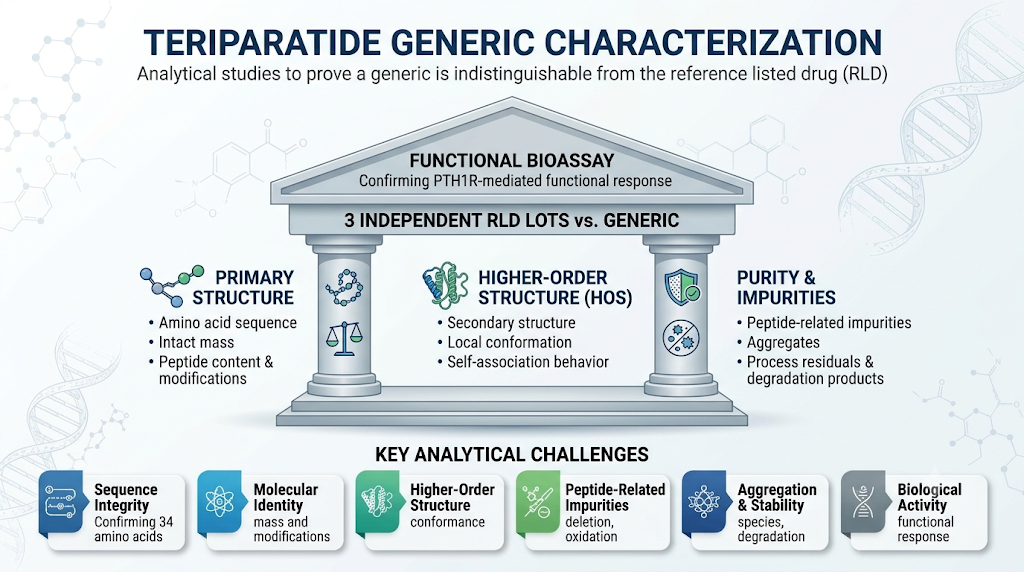
The study is built on three pillars:
- Primary structure: amino acid sequence, intact mass, peptide content and modifications.
- Higher-order structure (HOS): secondary structure, local conformation and self-association behavior.
- Purity and impurities: peptide-related impurities, aggregates, process residuals and degradation products.
A functional bioassay sits on top of these pillars. Samples from at least three independent RLD lots are tested alongside the generic so that natural lot-to-lot variability sets the comparison range.
Key analytical challenges
Sequence identity alone does not prove similarity. Even with the same amino acid sequence, differences in manufacturing process, raw materials, purification conditions and storage can produce different impurity profiles. The main challenges are:
- Sequence integrity: confirming all 34 amino acids are present in the correct order.
- Molecular identity: establishing the expected mass and detecting unexpected modifications.
- Higher-order structure: showing comparable conformational characteristics.
- Peptide-related impurities: identifying deletion sequences, oxidation products, isomers and other variants.
- Aggregation: detecting higher-molecular-weight species and oligomers.
- Stability: comparing degradation patterns under different conditions.
- Biological activity: confirming the expected PTH1R-mediated functional response.
2: Regulatory Expectations for Teriparatide Generic Characterization
Regulators expect the generic to have the same amino acid sequence as the RLD and an impurity profile that is not worse, supported by orthogonal data across multiple RLD lots.
FDA has issued guidance for highly purified synthetic peptides that reference rDNA-origin listed drugs, and teriparatide is a frequently cited example. In practice, reviewers focus on:
- Identical sequence: no tolerance for amino acid differences.
- Impurity control: new peptide-related impurities need identification and qualification, and levels above the RLD require justification.
- Immunogenicity risk: differences in aggregates, deamidated forms or process-related impurities can raise questions.
- Method suitability: assays should be validated or qualified in line with ICH Q2(R2).
Exact thresholds and the applicable pathway (ANDA or 505(b)(2) in the US, generic or hybrid routes in the EU and Canada) depend on the manufacturing route and the product, so teams should confirm them with the current guidance and the relevant agency before finalizing the protocol.
In the US, FDA’s November 2022 draft guidance, Sameness Evaluations in an ANDA—Active Ingredients, describes how active ingredient sameness is demonstrated. FDA also published revised draft product-specific guidances for certain generic peptide products on July 28, 2026, including entries for teriparatide products, so applicants should check the current guidance for their reference product and pathway.
Regional dossier and ANDA support
Characterization data are only useful if they fit the submission. ResolveMass supports US filings through its generic drug development CRO for ANDA services, and European strategy through EU generic drug dossier development and EMA submission support.
3: Case Study Design: Confirming the Teriparatide Sequence Against the RLD
Sequence identity is confirmed by combining intact mass, bottom-up peptide mapping and MS/MS fragmentation, with amino acid analysis as an orthogonal check.
The study compares one generic batch with three RLD lots. The reference sequence is the 34-residue PTH(1-34) chain, SVSEIQLMHNLGKHLNSMERVEWLRKKLQDVHNF, with an average molecular weight near 4117.8 Da.
| Parameter | Teriparatide characteristic |
|---|---|
| Drug class | Peptide therapeutic, human PTH(1-34) analog |
| Structural type | Single-chain linear peptide, 34 amino acids |
| Molecular formula | C181H291N55O51S2 |
| Molecular mass | Approximately 4,117.77 Da (free base) |
| Biological target | PTH1 receptor (PTH1R) |
| Reference product | FORTEO® |
RLD lots should be selected and documented with care, including product age, storage history, formulation and sample handling. It also matters whether the test article is the drug substance or the finished drug product: formulation components can interfere with some measurements, so certain procedures call for the isolated active ingredient and others for the formulated product.
Sequence methods used
- Intact mass by LC-HRMS: confirms the molecular weight within a few ppm on a high-resolution mass spectrometer.
- Peptide mapping with MS/MS: enzymatic digestion followed by fragment-ion sequencing, targeting 100% residue coverage.
- Amino acid analysis: verifies composition and supports peptide content calculation.
- N- and C-terminal checks: detect truncations or terminal modifications that intact mass alone could miss.
What a matching sequence result looks like
The generic and RLD show the same intact monoisotopic and average masses, the same fragment-ion series and no unexplained mass shifts. Any variant, such as a single-residue deletion or an isomeric substitution, would appear as a retention-time or fragment-ion difference and trigger an identification workflow.
Intact-mass agreement alone cannot exclude every difference, because isomeric modifications and some positional changes give the same mass. That is why peptide mapping and tandem MS follow the intact-mass step. Sequence-related impurities can arise from incomplete synthesis, manufacturing variation or degradation, so they are investigated with complementary techniques and not by retention-time comparison alone.
4: Higher-Order Structure in Teriparatide Generic Characterization
Higher-order structure is compared with CD, FTIR and NMR in the formulation buffer, and the generic should overlay the RLD within the variability of the RLD lots.
Teriparatide is a small, flexible peptide. It is largely disordered in aqueous solution with some helical propensity, so structural similarity is judged by spectral overlay and not by a single fold. That is why several techniques are used together.
Orthogonal HOS techniques
| Technique | What it shows | Typical comparison criterion |
|---|---|---|
| Far-UV circular dichroism | Secondary structure content | Spectral overlay within RLD lot range |
| FTIR (amide I region) | Secondary structure and hydrogen bonding | Second-derivative spectra overlay |
| 1D/2D NMR | Residue-level conformation | Matching chemical shift fingerprint |
| Intrinsic fluorescence | Local environment of Trp23 | Comparable emission maximum and intensity |
| Dynamic light scattering | Particle size and self-association | Same size distribution |
Samples are measured in the final formulation matrix and, where useful, in a simplified buffer, so excipient signals do not mask peptide signals. Because HOS differences can be subtle, ResolveMass pairs replicate measurements with simple statistical comparison, such as overlay plus quantitative spectral difference metrics, instead of relying on a visual match.
Ion mobility-mass spectrometry as an added dimension
Ion mobility-mass spectrometry (IM-MS) separates ions by their mobility through a gas and reports collision cross-section (CCS), a measure of molecular size and shape. For teriparatide it can show whether the generic and the RLD have comparable gas-phase conformational characteristics. Because gas-phase conformations do not fully mirror behavior in the formulation, IM-MS is interpreted alongside the solution-phase techniques above, never in place of them.
5: Impurity Comparison Against the RLD
Impurities are profiled by high-resolution RP-UPLC with MS detection, and each peak in the generic is matched to a peak in the RLD or identified and justified.
For Teriparatide Generic Characterization, the impurity work targets the degradation pathways known for PTH(1-34) and the process-related species expected from the manufacturing route.
Impurity classes assessed
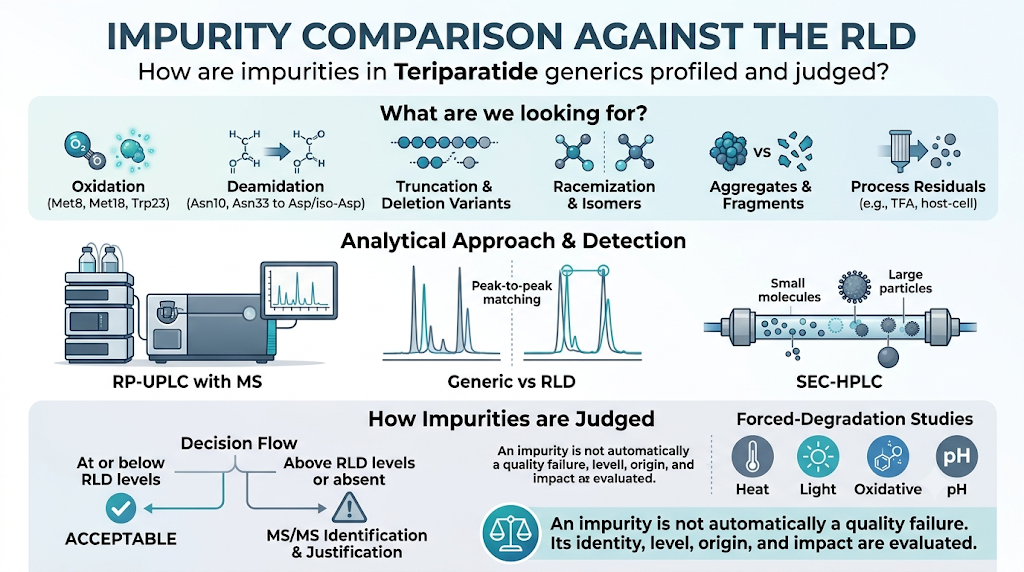
- Oxidation: Met8 and Met18 sulfoxide forms, and Trp23 oxidation products.
- Deamidation: Asn10 and Asn33 conversion to Asp or iso-Asp.
- Truncation and deletion variants: missing terminal or internal residues, especially for synthetic routes.
- Racemization and isomers: D-amino acid and aspartimide-related species.
- Aggregates and fragments: size-exclusion chromatography with MS confirmation.
- Process residuals: counter-ions such as TFA for synthetic material, or host-cell-related impurities for recombinant material.
How impurities are judged
Each impurity is reported against the RLD range. Species at or below RLD levels are acceptable. Species above RLD levels, or absent from the RLD, are identified by MS/MS, assessed for biological impact and justified against agency thresholds. Forced-degradation studies (heat, light, oxidative and pH stress) show that the methods are stability-indicating and reveal whether the generic degrades through the same pathways as the RLD.
Published research has shown that LC-HRMS methods can be validated to quantify peptide-related impurities in teriparatide, with lower quantification limits below the 0.10% reporting threshold discussed in that work. This is why sensitive mass spectrometric methods matter for low-level impurities.
Aggregate analysis by size-exclusion chromatography
SEC-HPLC separates species by hydrodynamic size and reports monomer content, higher-molecular-weight species and oligomers, including changes after storage or stress. Results are supported by method suitability and, where needed, light scattering or electrophoretic methods.
Impurity categories, origins and detection
| Impurity category | Possible origin | Analytical approach |
|---|---|---|
| Oxidized peptides | Oxygen, light or oxidizing conditions | LC-HRMS/MS |
| Deamidated variants | Chemical degradation of susceptible residues | RP-HPLC and LC-MS/MS |
| Deletion sequences | Incomplete synthesis or processing | Peptide mapping and LC-MS/MS |
| Truncated peptides | Incomplete synthesis or degradation | RP-HPLC and HRMS |
| Isomeric variants | Isomerization or epimerization | Chromatographic and advanced MS methods |
| Aggregates | Storage, handling or formulation changes | SEC-HPLC and orthogonal methods |
| Process-related impurities | Raw materials, synthesis or purification | Process-specific methods |
An impurity is not automatically a quality failure. Its identity, level, origin and potential toxicological or immunological significance must be evaluated against the applicable requirements.
6: Comparative Stability and Forced Degradation Studies
Forced degradation studies show whether the generic and the RLD degrade through the same pathways, and whether the methods are stability-indicating. The goal is not identical degradation percentages under every condition. It is comparable pathways, impurity identities and relative susceptibility under controlled, documented conditions.
| Stress condition | Purpose | Potential observations |
|---|---|---|
| Acidic hydrolysis | Acid-related degradation | Peptide degradation and modification |
| Alkaline hydrolysis | Base-related instability | Degradation and structural change |
| Oxidative stress | Oxidation susceptibility | Oxidized peptide variants |
| Thermal stress | Temperature-related change | Degradation and aggregation |
| Photolytic stress | Light sensitivity | Photo-induced modifications |
| Agitation stress | Physical instability | Aggregation or adsorption |
Concentration, exposure time, temperature and stress intensity are documented so the results can be interpreted meaningfully.
7: Case Study Findings: How the Evidence Comes Together
A generic is considered analytically comparable when every attribute meets its pre-defined criterion against the RLD lot range, and the data are consistent across methods.
The table shows the decision framework used in this study design, with the outcome pattern that supports comparability.
| Quality attribute | Primary method | Pre-defined criterion | Outcome supporting comparability |
|---|---|---|---|
| Sequence identity | Peptide mapping, MS/MS | 100% coverage, no variants | Identical to RLD |
| Intact mass | LC-HRMS | Within instrument mass accuracy | Matches RLD |
| Peptide content | Amino acid analysis | Within RLD lot range | Comparable |
| Secondary structure | CD, FTIR | Overlay within RLD range | Overlaid |
| Local conformation | 2D NMR | Matching fingerprint | Matching |
| Oxidation and deamidation | RP-UPLC-MS | At or below RLD levels | At or below RLD |
| New impurities | RP-UPLC-MS/MS | Identified and justified | None, or justified |
| Aggregates | SEC | Not higher than RLD | Comparable |
| Biological activity | cAMP cell-based assay | Relative potency within the agreed range | Comparable |
Interpretation: Agreement across sequence, structure, impurity and potency data gives reviewers a coherent weight-of-evidence story. A discrepancy in one attribute is a prompt to investigate with additional orthogonal methods, not a reason to ignore the signal.
Why Sponsors Choose ResolveMass for Teriparatide Generic Characterization
Sponsors choose ResolveMass Laboratories Inc. for scientist-led peptide analysis, high-resolution mass spectrometry depth and reports written to be reviewed by regulators.
- Domain focus: mass spectrometry, biosimilar characterization, PLGA-based drug delivery and nitrosamine testing sit at the core of our work.
- Orthogonal by design: every critical attribute is measured by at least two independent methods.
- Transparent reporting: raw data, method parameters, acceptance logic and limitations are documented for audit and submission.
- Practical support: our team helps define the protocol, RLD lot selection and gap-filling studies before you commit to a plan.
Our analytical capabilities cover LC-MS and LC-MS/MS peptide characterization, high-resolution mass spectrometry for identity, HPLC and UHPLC impurity profiling, peptide-related impurity identification, method development and validation, forced degradation and stability-indicating studies, and comparative characterization that supports CMC development. Peptide work also needs sound method selection, justified sample preparation and correct data interpretation, not just instruments. We help sponsors find analytical gaps before regulatory submission.
Team members who run peptide programs often have other generic products in the pipeline. ResolveMass also supports generic drug development for inhaled drug products, CDMO services for generic topical and semisolid drug products and generic drug development for poorly soluble APIs.
Conclusion:
A strong Teriparatide Generic Characterization package proves identical sequence, matched higher-order structure and an impurity profile no worse than the RLD, using orthogonal methods and multiple RLD lots. When the data are planned against pre-defined criteria and interpreted as a whole, the submission story is clear and reviewable.
Frequently Asked Questions:
Higher-order structure is evaluated using complementary spectroscopic and analytical techniques, including circular dichroism (CD), FTIR, fluorescence spectroscopy, and NMR. These methods help investigate conformational characteristics and potential structural differences between generic teriparatide and the RLD.
Impurity profiling helps determine whether the generic and reference products contain comparable peptide-related impurities. It also identifies potentially new or different impurities that may require additional investigation for safety, stability, and product quality.
Teriparatide aggregates and higher-molecular-weight species can be investigated using size-exclusion chromatography (SEC-HPLC). Additional techniques, such as light scattering, may provide complementary information about molecular size and aggregation behavior.
Biological activity can be evaluated using suitable cell-based assays that measure parathyroid hormone type 1 receptor (PTH1R)-mediated signaling. Comparative testing helps determine whether the generic peptide produces a consistent biological response relative to the reference product.
Reference
- Fernández-Carneado J, Vallès-Miret M, Arrastia-Casado S, Almazán-Moga A, Macias MJ, Martin-Malpartida P, Vilaseca M, Díaz-Lobo M, Vazquez M, Sanahuja RM, Gambús G. First generic Teriparatide: structural and biological sameness to its reference medicinal product. Pharmaceutics. 2024 Apr 13;16(4):537.https://www.mdpi.com/1999-4923/16/4/537
- Kovács P, Schäfer T, Háda V, Hevér H, Klingelhöfer S, Nebel M, Stadie T, Kiss R, Urbányi Z. Comparative Physicochemical and Biological Characterisation of the Similar Biological Medicinal Product Teriparatide and Its Reference Medicinal Product: P. Kovács et al. BioDrugs. 2020 Feb;34(1):65-75.https://link.springer.com/article/10.1007/s40259-019-00386-x
- Giri T, Sakharwade S, Subbappa P, Chinnakadoori SR, Sharma N. Regulatory considerations in synthetic peptide characterization: Techniques and compliance. Separation Science Plus. 2025 Jun;8(6):e70057.https://analyticalsciencejournals.onlinelibrary.wiley.com/doi/abs/10.1002/sscp.70057
- Rajput A, Pillai M, Ajabiya J, Sengupta P. Integrating Quantitative Methods & Modeling and Analytical Techniques in Reverse Engineering; A Cutting-Edge Strategy in Complex Generic Development. AAPS PharmSciTech. 2025 Mar 26;26(4):92.https://link.springer.com/article/10.1208/s12249-025-03067-x
About the Author