


Introduction
TFA Counterion Exchange and Salt Form Selection is a critical downstream unit operation in active pharmaceutical ingredient (API) manufacturing that converts crude peptide trifluoroacetate salts into pharmaceutically acceptable, stable, and non-toxic drug substances. During solid-phase peptide synthesis (SPPS), trifluoroacetic acid (TFA) is routinely used to cleave the peptide chain from the solid resin support and remove protecting groups from side-chain functional groups. Furthermore, preparative reversed-phase high-performance liquid chromatography (RP-HPLC) commonly incorporates TFA as a mobile-phase additive to improve peak shape and chromatographic resolution. As a result, synthetic peptides frequently emerge from synthesis and purification as trifluoroacetate (CF3COO−) salts, with the counterions associated stoichiometrically with basic amino acid residues such as Arg, Lys, and His, as well as unblocked N-termini.
Because residual trifluoroacetate counterions can produce undesirable biological effects, interfere with cellular proliferation at very low concentrations, contribute to immunogenic responses, and negatively affect physical formulation stability, commercial drug manufacturing may require substantial or complete counterion displacement, depending on the intended use and applicable specifications. Transitioning synthetic peptides into clinical-grade APIs can therefore involve conversion of TFA salts into more biocompatible forms, including acetate (CH3COO−) or hydrochloride (Cl−). Efficient execution of this unit operation requires a detailed understanding of counterion exchange thermodynamics, process scale-up behavior, analytical validation in accordance with International Council for Harmonisation (ICH) standards, and sequence-specific criteria for selecting the appropriate salt form.
Explore our Custom Peptide Synthesis Services to understand how peptide synthesis and downstream processing can be integrated into a controlled development workflow.
Share via:
Quick Summary:
- TFA counterion exchange converts peptide TFA salts into more biocompatible forms such as acetate or hydrochloride, improving API safety, stability, and pharmaceutical suitability.
- Salt-form selection depends on peptide sequence, chemical stability, route of administration, pH sensitivity, hygroscopicity, oxidation risk, and lyophilization behavior.
- Residual TFA can create concerns including potential cellular effects, altered membrane permeability, acidic formulations, and possible injection-site irritation, making effective TFA removal important for peptide APIs.
- Acetate, hydrochloride, and sodium salts offer different advantages: acetate is widely used for injectable peptides, HCl can benefit cysteine-containing or cationic peptides, while sodium salts are suitable for acidic Asp/Glu-rich sequences.
- Sequence-specific factors guide salt selection: HCl may help protect free cysteine from oxidation, acetate can help control Asp-related degradation, and highly basic Arg/Lys/His-rich peptides may require extended exchange and washing.
- Major exchange methods include preparative RP-HPLC washing, anion-exchange chromatography, and acid-lyophilization; reported TFA removal can reach approximately 98–99.9%, depending on the process.
- Analytical and regulatory control uses techniques such as RP-HPLC-CAD/ELSD, ¹⁹F-NMR, and ion chromatography, alongside ICH/USP validation, residual TFA, counterion stoichiometry, moisture, solvent, purity, and mass-balance testing to support a safe, stable, high-quality, regulatory-ready peptide API.
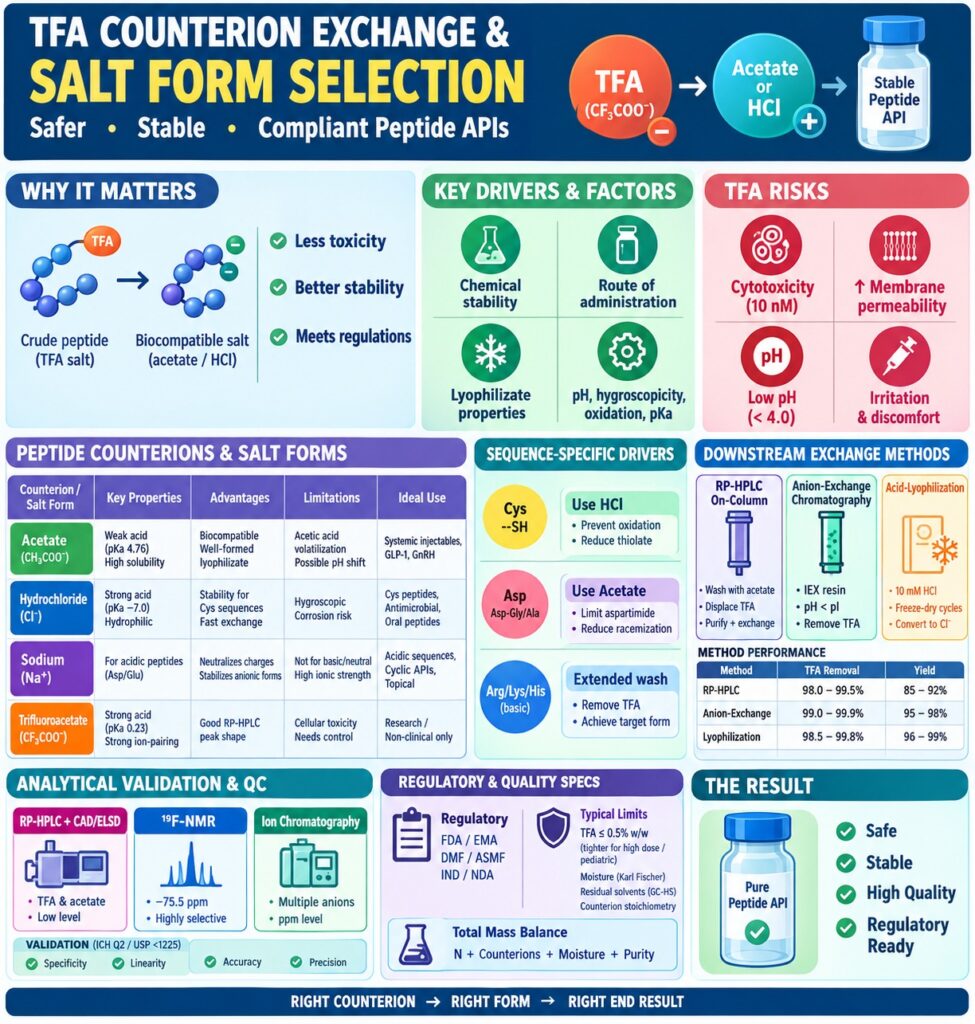
Essential Drivers and Physicochemical Factors in TFA Counterion Exchange and Salt Form Selection
Selection of the appropriate salt form during peptide API development depends on the chemical stability of individual amino acid residues, the intended route of administration, and the physical characteristics required for the final lyophilizate cake. Important factors, including pH sensitivity, hygroscopicity, oxidation susceptibility, and counterion pKa, influence whether acetate, hydrochloride, or another salt form is ultimately selected.
Read more about GMP Peptide API Manufacturing Services and the manufacturing considerations involved in taking peptide drug substances toward commercial production.
Biological Cytotoxicity and Membrane Permeability Risks of TFA
Residual trifluoroacetate ions may exhibit cellular effects at low concentrations and can influence passive membrane permeability, potentially compromising the interpretation of bioassay results and contributing to local tissue irritation. At concentrations as low as 10 nM, TFA has been reported to suppress the proliferation of human osteoblasts and chondrocytes in a concentration-dependent manner, whereas comparable concentrations of hydrochloric acid did not produce the same adverse effect on cell viability. In certain cell lines, including murine glioma cells, micromolar concentrations of TFA have also been reported to increase [3H]leucine incorporation, thereby increasing apparent protein synthesis and potentially introducing artifacts into cell-based assay results.
In addition to its potential metabolic effects, the lipophilicity and ion-pairing characteristics of CF3COO− can influence passive membrane permeability and liposomal diffusion behavior for cationic peptides. When peptide formulations are intended for parenteral administration, residual TFA can contribute to a reduction in solution pH and may result in highly acidic formulations (pH < 4.0), which can increase the risk of injection-site discomfort and tissue irritation. Conversion of peptides to appropriately selected biocompatible salt forms helps minimize these formulation-related effects and supports alignment of the drug substance with applicable pharmaceutical quality and safety requirements.
Learn about the Difference Between a Peptide and a Small-Molecule Drug for additional context on the physicochemical characteristics that distinguish peptide-based therapeutics from conventional small molecules.
Comparative Properties of Pharmaceutically Acceptable Peptide Counterions
Pharmaceutically acceptable peptide counterions are selected according to factors such as biocompatibility, aqueous solubility, volatile organic acid strength (pKa), and their ability to generate physically stable lyophilized powders. Acetate is frequently used as a counterion for therapeutic peptides because of its established physiological tolerance and favorable behavior during freeze-drying. Hydrochloride salts may be selected for cationic peptides or sequences that benefit from acidic conditions, including certain oxidation-sensitive sequences. Sodium salts can be appropriate for acidic peptides containing an excess of aspartic acid or glutamic acid residues.
| Counterion / Salt Form | Basic Chemical & Physical Properties | Key Advantages in API Manufacturing | Primary Limitations & Risks | Ideal Clinical Applications |
|---|---|---|---|---|
| Acetate (CH3COO−) | Volatile organic anion; weak acid salt (pKa = 4.76); high aqueous solubility. | Widely accepted pharmaceutical counterion; can produce well-formed lyophilizate cakes; highly biocompatible. | Potential acetic acid volatilization during deep lyophilization; possible pH shift. | Systemic parenteral injectables, GLP-1 analogs, GnRH agonists. |
| Hydrochloride (Cl−) | Small, non-volatile inorganic anion; strong acid salt (pKa = −7.0); hydrophilic. | Can suppress thiolate formation and support stability of certain sulfhydryl-containing sequences; rapid exchange kinetics. | Potentially hygroscopic lyophilizates; possible corrosion concerns for stainless steel processing equipment. | Free Cys-containing peptides, antimicrobial cationic peptides, oral peptide formulations. |
| Sodium (Na+) | Metallic alkali cation; utilized for acidic peptides containing Asp/Glu side chains. | Neutralizes negative charges; can stabilize anionic peptide forms; high water solubility. | Unsuitable for basic or neutral sequences; can substantially increase ionic strength. | Acidic peptide sequences, cyclic carboxylated APIs, specialized topical formulations. |
| Trifluoroacetate (CF3COO−) | Fluorinated organic anion; strong acid (pKa = 0.23); strong ion-pairing characteristics. | Synthetically convenient intermediate; provides excellent RP-HPLC peak symmetry. | Potential cellular toxicity; residual TFA requires appropriate control and characterization for pharmaceutical applications. | Preclinical lead optimization and non-clinical research reagents only. |
Explore our Formulating a Lyophilized Peptide Injectable resource for additional considerations related to salt selection, formulation composition, and freeze-drying behavior.
Sequence-Specific Stability Drivers in Salt Form Selection
The primary sequence of a peptide directly affects counterion compatibility because specific functional groups, including free sulfhydryls and aspartyl residues, can determine the dominant degradation pathways under different pH conditions. Peptides containing unoxidized, free cysteine residues (–SH) are particularly susceptible to air oxidation, disulfide cross-linking, and disulfide scrambling under conditions that promote thiolate formation. Selection of a hydrochloride counterion can maintain a more acidic microenvironment and reduce the concentration of the reactive thiolate species (–S−), thereby helping preserve sulfhydryl integrity during downstream processing and storage.
Conversely, peptide sequences containing sensitive Asp-Gly or Asp-Ala motifs may undergo base-catalyzed aspartimide ring formation followed by succinimide rearrangement. Maintaining a neutral to mildly acidic environment through an appropriately controlled acetate salt system can help limit aspartimide-mediated degradation and racemization. Basic residues, including Arginine (Arg, pKa ≈ 12.5), Lysine (Lys, pKa ≈ 10.5), and Histidine (His, pKa ≈ 6.0), can associate with counterions according to the protonation state and charge distribution of the peptide. Highly basic polycationic sequences may therefore require extended displacement and washing cycles to achieve the desired reduction of TFA and establish the target counterion composition.
Review our Peptide Analytical Testing Services for analytical strategies used to characterize peptide identity, purity, impurities, and other critical quality attributes.
Downstream Methodologies for Executing TFA Counterion Exchange
Industrial downstream processes can perform TFA counterion exchange through preparative RP-HPLC column displacement, anion-exchange chromatography, or acid-lyophilization exchange cycles. Each unit operation has distinct advantages and limitations related to processing time, solvent consumption, overall recovery, equipment requirements, and scalability. The appropriate approach should therefore be selected according to peptide-specific physicochemical properties and the requirements of the intended manufacturing process.
Preparative RP-HPLC On-Column Counterion Exchange
On-column counterion exchange using preparative RP-HPLC can combine purification and counterion displacement within a single downstream operation by washing the retained peptide with aqueous solutions containing a high concentration of the desired counterion. The target peptide is initially loaded onto a hydrophobic reversed-phase column, such as C18 or C8 silica with a typical particle size of 10–15 μm, using conventional mobile phases containing 0.1% v/v TFA. After peptide retention, the column can be washed with an aqueous solution containing 0.1 M to 0.5 M ammonium acetate or sodium acetate adjusted to pH 7.5–8.5.
The high molar excess of acetate anions promotes displacement of associated trifluoroacetate ions, which are subsequently directed to waste during the washing step. Following the salt wash, an additional aqueous washing step can remove excess inorganic species before peptide elution using an organic gradient, such as acetonitrile or ethanol, acidified with 0.1% v/v acetic acid. This approach can be incorporated into existing dynamic axial compression (DAC) column infrastructure and may provide high TFA displacement efficiency when the washing conditions are appropriately optimized for the individual peptide.
Learn more about North American Peptide CDMO Services for an overview of peptide development and manufacturing capabilities across the downstream workflow.
Anion-Exchange Chromatography Bed Exchange
Anion-exchange chromatography can facilitate removal of trifluoroacetate counterions by processing the peptide solution through a column containing functionalized resin, such as quaternary ammonium or tertiary amine groups, that has been pre-equilibrated with the desired counterion, including acetate or chloride. Anion-exchange resins may be conditioned using 1.0 M sodium acetate or hydrochloric acid solutions to establish the required ionic environment and resin loading state.
The peptide solution is generally processed at a pH below the molecule’s isoelectric point (pI), under which conditions the peptide carries a net positive charge. As the solution passes through the resin bed, the positively charged peptide can pass through under appropriate operating conditions, while free trifluoroacetate ions can interact with the positively charged stationary phase. Process performance depends on resin chemistry, peptide charge, ionic strength, loading, flow rate, and the relative affinity of the competing anions. With appropriate process development and optimization, anion-exchange chromatography can provide an efficient approach for larger-scale manufacturing and can achieve high counterion removal while maintaining substantial peptide recovery.
Compare United States vs. Overseas Peptide CDMOs when evaluating manufacturing location, technical capabilities, process integration, and scale-up considerations.
Acid-Lyophilization Exchange Cycles
Acid-lyophilization counterion exchange can be used to convert TFA-containing peptide material into chloride-containing material by freeze-drying the peptide from dilute aqueous or organic hydrochloric acid solutions. In this approach, the purified peptide TFA salt is dissolved in dilute aqueous hydrochloric acid, with approximately 10 mM HCl representing one possible processing condition. Because HCl is a stronger acid (pKa = −7.0) than TFA (pKa = 0.23), the processing environment can favor protonation and facilitate replacement of the original counterion under appropriately controlled conditions. During sublimation and secondary drying, volatile TFA-containing species can be reduced along with water and other volatile components.
Repeated freeze-drying cycles using 10 mM HCl may facilitate conversion toward the chloride salt form while limiting exposure to conditions that could promote peptide backbone hydrolysis. For acid-sensitive sequences, non-aqueous organic solvents, such as ethanol or acetonitrile containing gaseous HCl, may be evaluated as alternative processing media. The reduced water activity and altered acid-base environment of such systems can influence counterion dissociation and exchange while potentially protecting sensitive peptide bonds. Process conditions must nevertheless be experimentally optimized for each peptide sequence.
Read about Sterile Fill-Finish Services for Peptide Injectables to understand how peptide drug substances progress toward sterile injectable drug-product manufacturing.
| Downstream Exchange Method | Exchange Efficiency (% TFA Removal) | Solvent Consumption | Scale-Up Feasibility | Impact on Peptide Yield | Equipment Requirements |
|---|---|---|---|---|---|
| Preparative RP-HPLC Wash | 98.0%–99.5% | High (large volumes of organic/aqueous buffers) | Excellent (integrates into existing purification skid) | Moderate (85%–92% recovery) | Dynamic Axial Compression (DAC) HPLC columns; high-pressure skid. |
| Anion-Exchange Column | 99.0%–99.9% | Low (aqueous wash protocols) | Outstanding (continuous throughput capability) | High (95%–98% recovery) | Low-pressure chromatography column; functionalized IEX resin bed. |
| 10 mM HCl Lyophilization | 98.5%–99.8% | Minimal (water/acid media only) | Moderate (constrained by tray capacity) | High (96%–99% recovery) | Industrial freeze-dryer (Lyophilizer); corrosion-resistant trays. |
Analytical Validation and Quality Control Metrics for TFA Counterion Exchange
Comprehensive analytical characterization is essential for demonstrating that counterion exchange processes meet applicable ICH and USP requirements for residual TFA, salt stoichiometry, and overall product quality. Quality control laboratories typically employ orthogonal analytical techniques to quantify residual counterions over a broad concentration range, including trace-level concentrations where required by the established specification.
Explore Peptide Analytical Testing Services for analytical approaches that can support characterization and quality control of peptide APIs.
RP-HPLC with Charged Aerosol Detection (CAD) and ELSD
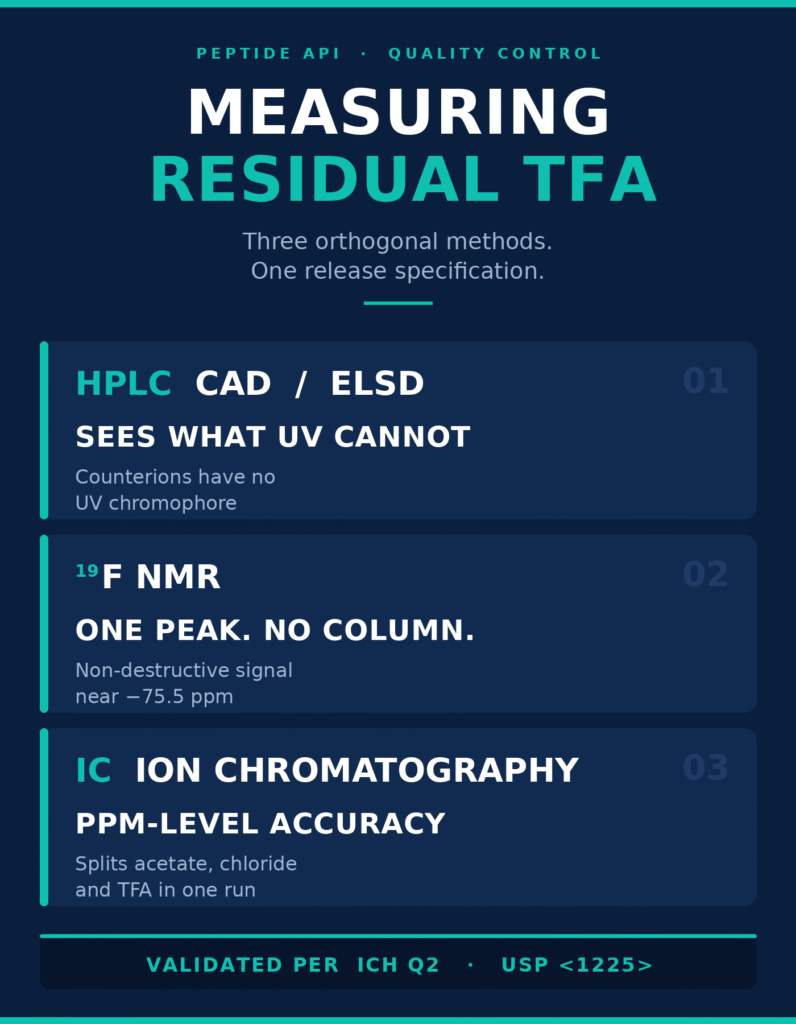
Reversed-phase HPLC coupled with Charged Aerosol Detection (CAD) or Evaporative Light Scattering Detection (ELSD) can be used to quantify volatile counterions such as trifluoroacetate and acetate without depending on strong UV chromophores. Because trifluoroacetate and acetate exhibit limited UV absorbance at commonly used detection wavelengths of approximately 210–220 nm, direct UV detection may be affected by mobile-phase background and other matrix contributions. Aerosol-based detectors nebulize the column effluent, evaporate volatile components, and measure the remaining analyte particles. With suitable chromatographic conditions and volatile ion-pairing mobile phases, HPLC-CAD can provide separation and quantification of CF3COO− at low concentration levels, with method sensitivity determined through formal analytical validation.
Fluorine-19 Nuclear Magnetic Resonance Spectroscopy (19F-NMR)
Fluorine-19 NMR spectroscopy provides a highly selective, non-destructive approach for quantifying residual TFA in peptide materials and can offer minimal matrix interference because most standard synthetic peptides do not contain fluorine. The technique takes advantage of the 100% natural abundance of 19F nuclei. In peptide samples containing residual TFA, the 19F-NMR spectrum can produce a characteristic resonance associated with the trifluoromethyl group (–CF3), typically observed near −75.5 ppm depending on solvent, temperature, concentration, and reference conditions. Integration of the TFA resonance against a calibrated internal or external reference can provide quantitative determination of residual TFA without requiring a physical chromatographic separation step.
Ion Chromatography (IC) and Validation Parameters
Ion chromatography with suppressed conductivity detection can simultaneously quantify multiple inorganic and organic anions at parts-per-million concentration levels when appropriately developed and validated. Specialized anion-exchange IC columns operated with potassium hydroxide (KOH) gradients can separate species such as fluoride, chloride, nitrate, phosphate, acetate, and trifluoroacetate. Membrane suppressors reduce background eluent conductivity while enhancing the relative response of ionic analytes, supporting sensitive quantification at low concentration levels.
Analytical methods used for commercial release testing must undergo appropriate validation in accordance with applicable ICH Q2 and USP <1225> requirements. Chromatographic specificity should demonstrate adequate separation between trifluoroacetate, acetate, chloride, and relevant peptide-related impurities under the defined method conditions. Method linearity should demonstrate an appropriate relationship between concentration and response across the validated range, which may encompass 50% to 150% of the target specification limit when scientifically justified. Method accuracy should demonstrate acceptable spike recovery across the relevant concentration range, while repeatability and intermediate precision should meet predefined acceptance criteria appropriate for the intended analytical application.
Read about Impurity Control Strategies Under ICH Q3A for additional information on impurity identification, qualification, specification, and control considerations.
Regulatory Compliance and Commercial Quality Specifications
Regulatory filings for therapeutic peptide APIs require appropriate control of residual trifluoroacetate, counterion stoichiometry, moisture content, and residual organic solvents. Regulatory authorities, including the US FDA and EMA, expect comprehensive characterization and control strategies to be documented within relevant Drug Master Files (DMF) and Active Substance Master Files (ASMF), as applicable, to support IND and NDA submissions.
Explore Peptide Drug Master File (DMF) Preparation for considerations involved in documenting peptide API chemistry, manufacturing, controls, and supporting analytical information for regulatory submissions.
Commercial API specifications may establish limits for residual trifluoroacetate based on toxicological assessment, route of administration, maximum daily exposure, and product-specific risk evaluation. A commonly referenced specification may restrict residual trifluoroacetate to ≤ 0.5% w/w (5000 ppm), although the scientifically justified limit for a particular product must be established according to the applicable regulatory and safety assessment. For high-dose parenteral formulations or pediatric applications, tighter limits may be appropriate, such as ≤ 0.1% w/w or lower concentrations, depending on the Maximum Daily Dose (MDD) and the relevant safety evaluation. Active counterion content, such as acetate, should demonstrate controlled stoichiometry and may be specified relative to the theoretical molar binding expected from the basic amino acid residues.
Lyophilized peptide APIs can be hygroscopic, making control of residual water important for maintaining chemical and physical stability. Residual water content should be monitored using Karl Fischer coulometric titration, with the established acceptance criterion determined according to the stability profile and formulation requirements of the specific API. Gas chromatography headspace analysis (GC-HS) can quantify residual synthesis and purification solvents, including acetonitrile, dichloromethane, DMF, and piperidine, in accordance with applicable ICH Q3C Class 2 and Class 3 limits. Finally, total mass balance assessments can combine elemental nitrogen analysis, counterion content, moisture determination, and peptide purity results to provide an overall assessment of material composition and analytical accountability.
Review CMC Documentation at a CDMO for ANDA for a broader perspective on how manufacturing and analytical information is organized within regulatory CMC documentation.
Conclusion and Strategic Recommendations for Salt Form Selection
Establishing a robust protocol for TFA Counterion Exchange and Salt Form Selection is fundamental to supporting the safety, stability, quality, and regulatory suitability of synthetic peptide APIs. Replacing residual trifluoroacetate with an appropriately selected biocompatible counterion, such as acetate or hydrochloride, can reduce undesirable biological effects, minimize potential interference with bioassay performance, and support the required solid-state and lyophilization characteristics of the drug substance.
Explore GMP Peptide API Manufacturing Services to discuss peptide API manufacturing, downstream processing, analytical characterization, and quality requirements.
Process development teams should evaluate peptide primary structure, oxidation susceptibility, charge distribution, intended route of administration, and manufacturing scale when selecting an appropriate counterion exchange strategy. Preparative RP-HPLC column displacement and anion-exchange chromatography can provide scalable approaches for counterion modification, while analytical platforms such as IC, 19F-NMR, and HPLC-CAD can support characterization and control of residual TFA and target counterion content. A scientifically justified combination of process optimization, analytical validation, and sequence-specific stability assessment is essential for establishing a reliable downstream manufacturing process for clinical and commercial peptide APIs. Advance your downstream process development and commercial API manufacturing programs by consulting the experts at ResolveMass Laboratories Inc..
Frequently Asked Questions
Residual TFA must be appropriately controlled because elevated exposure can affect cellular systems and potentially interfere with biological assay results. It may also contribute to an acidic formulation environment and increase the possibility of local irritation during parenteral administration. Reducing or replacing TFA therefore supports drug-substance safety, formulation compatibility, and quality requirements before clinical use.
Acetate (CH₃COO⁻) is frequently selected for therapeutic peptide APIs because it provides good aqueous solubility and generally favorable physiological compatibility. It can also produce suitable physical characteristics during freeze-drying and lyophilization. However, the final salt form should be selected according to the peptide sequence, stability profile, formulation requirements, and regulatory considerations.
A hydrochloride salt may be preferred for peptides containing free, unoxidized cysteine residues (–SH) when acidic conditions help control oxidation. Maintaining a lower pH can reduce thiolate ion (–S⁻) formation, which is involved in oxidation-related degradation pathways. The choice should be confirmed through peptide-specific stability studies and process-development experiments.
During preparative RP-HPLC counterion exchange, the peptide-TFA salt is retained on a hydrophobic stationary phase such as C18 or C8. The column is then washed with an aqueous solution containing an excess of the desired counterion, such as acetate. This promotes displacement of trifluoroacetate, which is removed during the washing step before the converted peptide is eluted.
Lyophilization from water alone generally does not provide a reliable means of removing counterions associated with protonated peptide sites. Counterion exchange can instead be incorporated by dissolving the peptide in a suitable dilute hydrochloric acid solution before freeze-drying. Repeated controlled drying cycles can promote conversion toward the chloride form while facilitating removal of volatile TFA-containing species.
There is no universal residual-TFA limit applicable to every therapeutic peptide because the specification depends on factors such as dose, route of administration, toxicological assessment, and product-specific regulatory requirements. A limit such as ≤0.5% w/w (5000 ppm) may be established for a particular API, while some products may require substantially tighter limits. The final specification should be scientifically justified for the individual drug substance.
Common analytical approaches include Ion Chromatography (IC), Fluorine-19 NMR Spectroscopy (¹⁹F-NMR), and RP-HPLC using Charged Aerosol Detection (CAD) or Evaporative Light Scattering Detection (ELSD). IC provides sensitive measurement of ionic species, while ¹⁹F-NMR offers selective detection of fluorinated TFA. CAD and ELSD can provide complementary chromatographic quantification of suitable counterions.
The number and distribution of basic residues, particularly Arg, Lys, and His, influence peptide charge and the extent of counterion association. Peptides with a high concentration of basic residues may retain more trifluoroacetate and consequently require longer washing cycles or higher concentrations of the replacement counterion. Exchange conditions should therefore be optimized according to the peptide’s charge characteristics and experimentally measured removal efficiency.
Counterion testing methods should be validated according to applicable ICH Q2 requirements and relevant USP expectations. Validation commonly evaluates specificity, linearity, accuracy, precision, range, robustness, and detection or quantitation limits, as applicable to the analytical procedure. Acceptance criteria should be established according to the intended use of the method and the specification of the peptide API.
Reference:
- Erckes, V., Streuli, A., Chamera Rendueles, L., Krämer, S. D., & Steuer, C. (2025). Towards a consensus for the analysis and exchange of TFA as a counterion in synthetic peptides and its influence on membrane permeation. Pharmaceuticals, 18(8), 1163. https://doi.org/10.3390/ph18081163
- Sikora, K., Neubauer, D., Jaśkiewicz, M., & Kamysz, W. (2018). Citropin 1.1 trifluoroacetate to chloride counter-ion exchange in HCl-saturated organic solutions: An alternative approach. International Journal of Peptide Research and Therapeutics, 24(2), 265–270. https://doi.org/10.1007/s10989-017-9611-7
- Sikora, K., Jaśkiewicz, M., Neubauer, D., Migoń, D., & Kamysz, W. (2020). The role of counter-ions in peptides—An overview. Pharmaceuticals, 13(12), 442. https://doi.org/10.3390/ph13120442
- Tovi, A., Eidelman, C., Shushan, S., Elster, S., Alon, H., Ivchenko, A., Butilca, G.-M., & Zaovi, G. (2006). A counterion exchange process for peptides (WO2006041945A2). World Intellectual Property Organization. Patent record
- Erckes, V., Streuli, A., Chamera Rendueles, L., Krämer, S. D., & Steuer, C. (2025). Towards a consensus for the analysis and exchange of TFA as a counterion in synthetic peptides and its influence on membrane permeation. Pharmaceuticals, 18(8), 1163. https://doi.org/10.3390/ph18081163
- Erckes, V., Streuli, A., Chamera Rendueles, L., Krämer, S. D., & Steuer, C. (2025). Towards a consensus for the analysis and exchange of TFA as a counterion in synthetic peptides and its influence on membrane permeation. Pharmaceuticals, 18(8), 1163. https://doi.org/10.3390/ph18081163
- Rocheleau, M.-J. (2008). Analytical methods for determination of counter-ions in pharmaceutical salts. Current Pharmaceutical Analysis, 4(1), 25–32. https://doi.org/10.2174/157341208783497560
Get In Touch With Us
About The Author


