Introduction:
The Future of Cyclodextrin-Based Dendrimers in Drug Delivery is becoming one of the most exciting areas in pharmaceutical nanotechnology. Traditional drug delivery systems often face limitations such as poor drug solubility, rapid degradation, low bioavailability, and systemic toxicity. Cyclodextrin-based dendrimers address many of these challenges through their unique molecular architecture and multifunctional capabilities.
By combining the host–guest inclusion properties of cyclodextrins with the highly branched structure of dendrimers, these advanced nanocarriers enable targeted delivery, improved drug loading, and controlled release. Researchers and pharmaceutical companies are increasingly exploring their applications in oncology, gene therapy, biologics, and precision medicine.
As nanomedicine continues to evolve, cyclodextrin-based dendrimers are expected to play a major role in the development of safer and more effective therapeutics.
Summary:
- Cyclodextrin-based dendrimers are emerging as advanced nanocarriers for targeted drug delivery and controlled therapeutic release.
- These systems improve drug solubility, bioavailability, stability, and therapeutic efficiency.
- Their multifunctional structure supports applications in cancer therapy, gene delivery, RNA therapeutics, and personalized medicine.
- Future innovations are expected to focus on smart nanomedicine, AI-assisted formulation development, and biodegradable dendrimer systems.
- Advanced analytical characterization and regulatory-quality data remain essential for successful pharmaceutical development.
1: What Are Cyclodextrin-Based Dendrimers?
Cyclodextrin-based dendrimers are nanoscale branched polymers that integrate cyclodextrin molecules into dendritic frameworks.
Cyclodextrins are cyclic oligosaccharides capable of forming inclusion complexes with hydrophobic molecules, while dendrimers are highly branched macromolecules with multiple surface functionalities. Their combination creates a highly versatile drug delivery platform.
Key Structural Features
| Feature | Pharmaceutical Benefit |
|---|---|
| Branched dendritic structure | High drug-loading capacity |
| Cyclodextrin cavities | Improved solubility of poorly soluble drugs |
| Surface functional groups | Targeted delivery capability |
| Nanoscale size | Enhanced cellular uptake |
| Tunable chemistry | Controlled drug release |
These properties make cyclodextrin-based dendrimers highly attractive for modern pharmaceutical formulations.
2: A Brief History: From Cyclodextrins to Dendrimer Hybrids
Cyclodextrins have been used in pharmaceuticals since the 1970s, primarily as solubility-enhancing excipients. Beta-cyclodextrin derivatives, in particular, have long appeared in approved drug formulations to improve the dissolution of BCS Class II and IV compounds.
Dendrimers emerged as a research concept in the 1980s, with PAMAM (polyamidoamine) dendrimers becoming the most widely studied scaffold. By the late 1990s and early 2000s, researchers began exploring what would happen if cyclodextrin units were incorporated into dendrimer architectures — and the results were transformative.
The early literature showed that cyclodextrin-functionalized dendrimers could:
- Load multiple drug molecules simultaneously
- Outperform traditional CD complexes in solubility enhancement
- Offer a surface that could be easily modified for active targeting
Today, the field has matured significantly, with multiple generations of research establishing structure-activity relationships, in vitro efficacy data, and early in vivo validation studies.
3: Current Applications of Cyclodextrin-Based Dendrimers in Drug Delivery
Cyclodextrin-based dendrimers are currently being investigated across several high-impact therapeutic areas, with oncology and gene therapy leading the field.
1. Cancer Drug Delivery
One of the most compelling applications is in oncology. Many potent anticancer drugs — including paclitaxel, curcumin, and doxorubicin — are highly hydrophobic and exhibit poor systemic bioavailability. Cyclodextrin dendrimer carriers address this directly:
- Solubilization: The CD cavities encapsulate hydrophobic payloads, enabling intravenous administration.
- EPR targeting: Dendrimers in the 5–50 nm size range accumulate preferentially in tumor tissue via the enhanced permeability and retention (EPR) effect.
- Active targeting: Surface functionalization with folic acid, transferrin, or antibody fragments allows receptor-mediated endocytosis in cancer cells.
2. Gene and siRNA Delivery
Cationic cyclodextrin dendrimers have shown exceptional ability to condense nucleic acids (DNA, siRNA, mRNA) into nanoparticles and facilitate cellular uptake. This is critical for:
- Gene silencing therapies
- mRNA vaccine platforms
- CRISPR delivery systems
The CD components reduce cytotoxicity compared to purely cationic PAMAM dendrimers, while maintaining transfection efficiency.
3. CNS and Blood-Brain Barrier Penetration
The blood-brain barrier (BBB) remains one of the greatest obstacles in neurological drug delivery. Cyclodextrin-based dendrimers functionalized with BBB-targeting peptides (such as angiopep-2) or glucose transporters have demonstrated improved CNS penetration in preclinical models — opening new avenues for treating Alzheimer’s disease, glioblastoma, and Parkinson’s disease.
4. Anti-Infective and Antifungal Therapy
Amphotericin B, a potent antifungal, is notorious for its renal toxicity when administered conventionally. CD-dendrimer formulations have been shown to reduce free drug exposure in systemic circulation while maintaining efficacy against fungal pathogens — a clinically significant advancement.
4: The Science Behind the Future: Emerging Research Directions
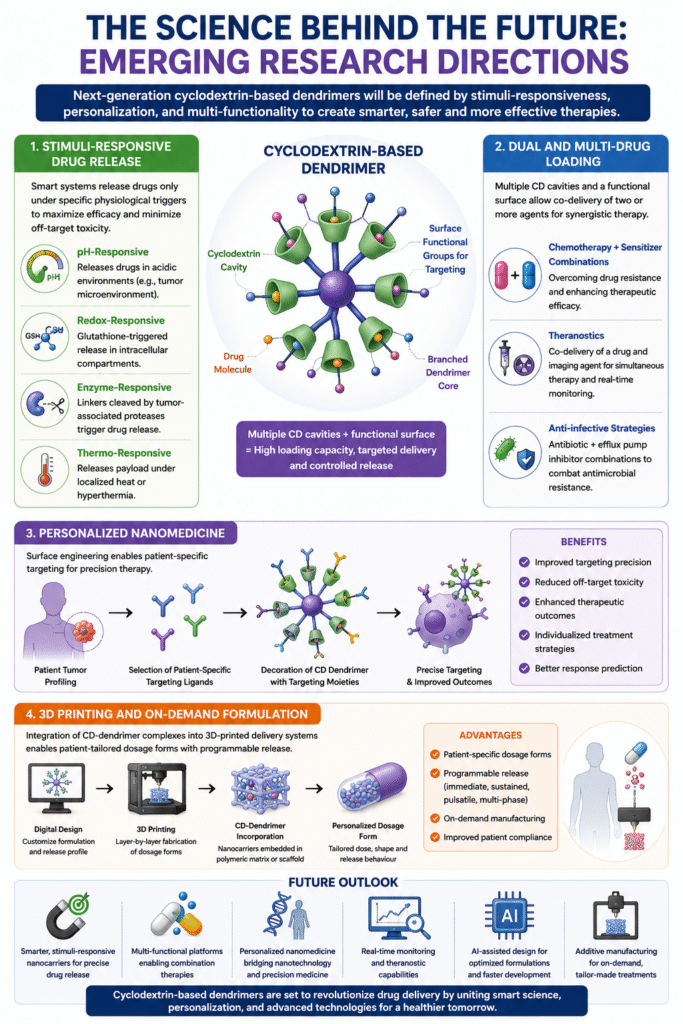
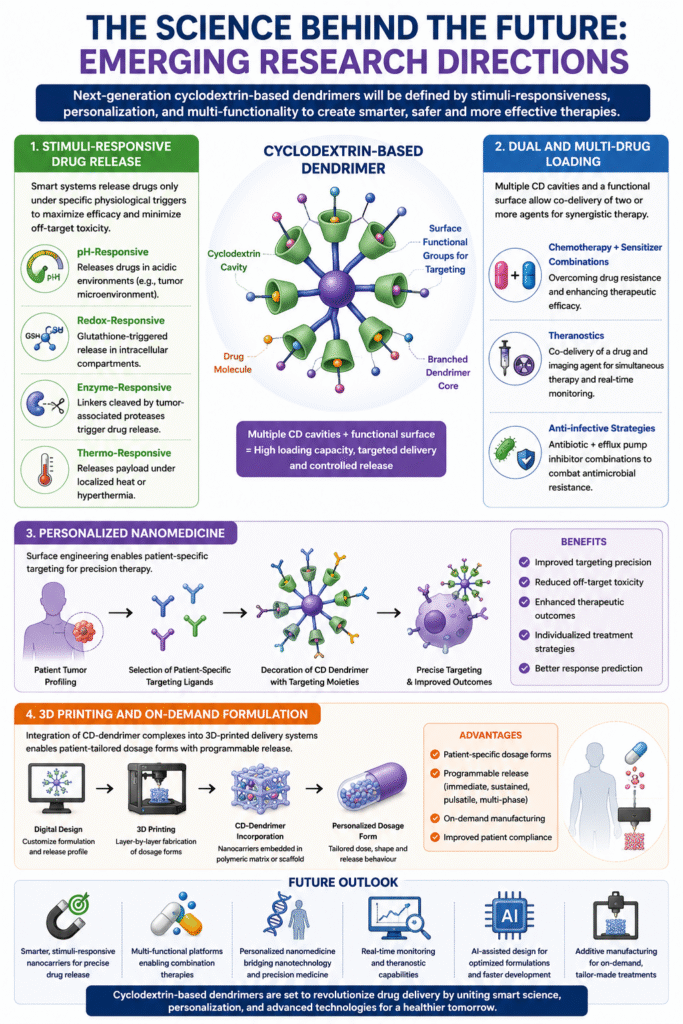
The next generation of cyclodextrin-based dendrimers in drug delivery will be defined by stimuli-responsiveness, personalization, and multi-functionality.
Stimuli-Responsive Drug Release
Researchers are engineering CD-dendrimer systems that release their payload only under specific physiological triggers:
- pH-responsive release (exploiting the acidic tumor microenvironment)
- Redox-responsive release (glutathione-triggered in intracellular compartments)
- Enzyme-responsive linkers that are cleaved by tumor-associated proteases
- Thermo-responsive systems for use with localized hyperthermia
These smart delivery systems maximize therapeutic effect while minimizing off-target toxicity.
Dual and Multi-Drug Loading
Cyclodextrin-based dendrimers possess multiple cyclodextrin cavities along with highly functionalized surfaces, allowing them to carry multiple therapeutic agents simultaneously.
This multi-drug delivery capability is becoming increasingly important in modern medicine because many diseases require combination therapy for optimal outcomes.
Because cyclodextrin dendrimers possess multiple CD cavities and a highly functionalized surface, they can co-deliver two or more drugs with different physicochemical properties — enabling combination therapy from a single nanocarrier. This is particularly relevant for:
- Chemotherapy + sensitizer combinations
- Drug + imaging agent (theranostics)
- Antibiotic + efflux pump inhibitor combinations for antimicrobial resistance
Personalized Nanomedicine
Advances in surface chemistry allow CD dendrimers to be decorated with patient-specific targeting moieties — for example, antibody fragments derived from a patient’s own tumor biopsy profiling. This bridges nanomedicine and precision medicine in a meaningful way.
Personalized medicine is becoming a major focus in pharmaceutical research, and cyclodextrin-based dendrimers are highly adaptable for individualized therapeutic strategies.
Surface Customization
Advanced surface chemistry enables dendrimers to be decorated with patient-specific targeting molecules, such as:
- Antibody fragments
- Peptides
- Aptamers
- Biomarker-recognizing ligands
These targeting moieties can be selected based on a patient’s disease profile or tumor biopsy analysis.
3D Printing and On-Demand Formulation
Another groundbreaking research direction involves integrating cyclodextrin-dendrimer systems into 3D-printed pharmaceutical dosage forms.
This approach combines nanotechnology with additive manufacturing to create personalized medicines with programmable release characteristics.
Potential Advantages
Patient-Specific Dosage Forms
3D printing allows the creation of dosage forms tailored to:
- Individual patient needs
- Age
- Disease severity
- Pharmacokinetic requirements
Programmable Drug Release
Researchers are developing systems capable of:
- Immediate release
- Sustained release
- Pulsatile release
- Multi-phase release profiles
This level of customization could revolutionize chronic disease management.
On-Demand Manufacturing
Hospitals and specialized pharmacies may eventually produce personalized medications on-site using:
- Patient-specific formulations
- Customized dendrimer-drug complexes
- Rapid manufacturing workflows
This could dramatically improve treatment flexibilit
5: Key Challenges and How ResolveMass Laboratories Inc. Is Addressing Them
Despite their enormous promise, cyclodextrin-based dendrimers face several development challenges. ResolveMass Laboratories Inc. approaches each of these with rigorous analytical and scientific methodology.
| Challenge | Scientific Approach at ResolveMass |
|---|---|
| Scalable synthesis | Development of divergent and convergent synthesis routes optimized for yield and purity |
| Batch-to-batch consistency | High-resolution MS, NMR, and SEC-MALS characterization for structural validation |
| Toxicity and biocompatibility | Systematic cytotoxicity screening and hemocompatibility studies |
| Regulatory pathway | ICH-compliant impurity profiling and stability testing |
| In vivo translation | Collaboration-ready pharmacokinetic and biodistribution study support |
Our laboratory’s analytical infrastructure — including advanced NMR spectroscopy, high-resolution mass spectrometry, dynamic light scattering (DLS), and zeta potential analysis — provides the characterization depth required to move cyclodextrin dendrimer systems from bench to clinic.
6: Regulatory Landscape for Cyclodextrin Dendrimers
Regulatory agencies including the FDA and EMA currently evaluate cyclodextrin dendrimer formulations under the broader framework for nanomedicines and complex drug products.
Key regulatory considerations include:
- Characterization requirements: Full structural characterization including molecular weight, polydispersity, surface charge, and encapsulation efficiency
- Impurity profiling: Residual synthesis reagents, byproducts, and degradation products must be identified and quantified
- Safety studies: In vitro genotoxicity, cytotoxicity, and in vivo toxicology per ICH S5/S6 guidelines
- Stability data: ICH Q1A-compliant studies demonstrating physical and chemical stability under accelerated and long-term conditions
ResolveMass Laboratories Inc. provides comprehensive analytical and regulatory support for clients navigating this evolving landscape, including method development, validation, and documentation.
7: Comparative Overview: Cyclodextrin Dendrimers vs. Other Nanocarriers
| Feature | CD-Dendrimers | Liposomes | PEGylated Nanoparticles | Micelles |
|---|---|---|---|---|
| Drug loading versatility | Very High | Moderate | Moderate | Moderate |
| Surface functionalization | Very High | High | Moderate | Low |
| Structural definition | Monodisperse | Polydisperse | Variable | Variable |
| Stability | High | Low–Moderate | High | Low |
| Scalability | Developing | Established | Established | Established |
| CNS penetration potential | High (with modification) | Low | Moderate | Low |
| Cost of synthesis | High (currently) | Low | Moderate | Low |
This comparison underscores both the advantages and the current commercial barriers of CD-dendrimer systems — barriers that are actively being reduced through improved synthetic chemistry and process optimization.
8: The Future of Cyclodextrin-Based Dendrimers in Drug Delivery: A 5-Year Outlook
The next five years will see cyclodextrin-based dendrimers move from predominantly academic research into clinical evaluation and early commercial applications. Key milestones anticipated include:
- IND filings for CD-dendrimer-based oncology candidates, particularly in hematological malignancies and solid tumors
- Platform licensing of CD dendrimer gene delivery systems for mRNA and siRNA therapeutics
- Integration with AI-driven formulation design to predict optimal CD dendrimer structure-activity relationships computationally
- Regulatory guidance documents from FDA and EMA specifically addressing dendrimer-based nanomedicines
- Commercial scale-up of GMP-grade CD dendrimer synthesis, reducing cost-of-goods to viable levels
The convergence of improved synthetic methods, better analytical tools, AI-assisted design, and a regulatory framework increasingly adapted to nanomedicines places cyclodextrin-based dendrimers on a clear trajectory toward clinical adoption.
9: ResolveMass Laboratories Inc.: Your Partner in Advanced Drug Delivery Science
At ResolveMass Laboratories Inc., we bring deep scientific expertise and state-of-the-art analytical capabilities to cyclodextrin chemistry and advanced drug delivery research. Our team includes:
- Experienced synthetic chemists specializing in cyclodextrin functionalization and dendrimer synthesis
- Analytical scientists proficient in structural characterization of complex macromolecules
- Formulation specialists bridging bench chemistry with pharmaceutical application
- Regulatory experts supporting ICH-compliant development pathways
Whether you are exploring cyclodextrin inclusion complexes for API solubilization, developing CD-dendrimer nanocarriers for targeted therapy, or require rigorous analytical characterization of your dendrimer platform, ResolveMass Laboratories Inc. provides the scientific rigor and collaborative expertise you need.
Conclusion:
The future of cyclodextrin-based dendrimers in drug delivery is bright, grounded in solid science, and accelerating rapidly. From their capacity to solubilize poorly water-soluble drugs and enable receptor-targeted delivery, to their emerging roles in gene therapy, CNS drug delivery, and stimuli-responsive nanomedicine — these hybrid nanoarchitectures represent a paradigm shift in how we think about drug formulation and delivery.
The challenges that remain — synthesis scalability, in vivo validation, and regulatory harmonization — are solvable. And they are being solved, by teams like ours at ResolveMass Laboratories Inc., who combine scientific depth with practical pharmaceutical development experience.
The future of cyclodextrin-based dendrimers in drug delivery is not just a scientific opportunity. It is an obligation to patients who need better therapies — delivered more precisely, more safely, and more effectively than ever before.
Frequently Asked Questions:
These nanocarriers help overcome major pharmaceutical challenges such as poor bioavailability, toxicity, and non-specific drug distribution. Their ability to deliver drugs directly to targeted tissues improves therapeutic efficiency while reducing side effects. They are expected to play a major role in personalized medicine and next-generation nanomedicine platforms.
Yes, they are highly promising for gene and RNA delivery applications. These systems can efficiently transport siRNA, mRNA, DNA plasmids, and CRISPR components into cells. They protect genetic material from enzymatic degradation while improving cellular uptake and transfection efficiency, making them useful for advanced gene therapies and vaccine platforms.
Stimuli-responsive dendrimers are smart drug delivery systems that release drugs only under specific physiological conditions such as acidic pH, redox environments, enzymes, or heat. These systems improve therapeutic precision and minimize off-target toxicity by ensuring that drugs are released only at the desired disease site.
Artificial intelligence helps optimize dendrimer formulation design by predicting drug-loading efficiency, release kinetics, molecular interactions, and stability profiles. AI-assisted modeling reduces development time and improves formulation accuracy, accelerating the discovery of clinically viable nanomedicine systems.
Yes, their highly customizable surface chemistry allows attachment of patient-specific targeting ligands such as antibodies and peptides. This enables individualized therapeutic strategies based on patient biomarkers and disease profiles, making them highly valuable in precision medicine applications.
The future outlook is highly promising, with expected growth in oncology therapeutics, RNA medicine, targeted drug delivery, and smart nanomedicine systems. Advances in AI-driven formulation design, personalized medicine, and scalable manufacturing are expected to accelerate clinical adoption and commercialization over the next decade.
Reference
- Davis ME, Brewster ME. Cyclodextrin-based pharmaceutics: past, present and future. Nature reviews Drug discovery. 2004 Dec 1;3(12):1023-35.https://www.nature.com/articles/nrd1576
- Vyas A, Saraf S, Saraf S. Cyclodextrin based novel drug delivery systems. Journal of inclusion phenomena and macrocyclic chemistry. 2008 Oct;62(1):23-42.https://link.springer.com/article/10.1007/s10847-008-9456-y
- Chaturvedi K, Ganguly K, Kulkarni AR, Kulkarni VH, Nadagouda MN, Rudzinski WE, Aminabhavi TM. Cyclodextrin-based siRNA delivery nanocarriers: a state-of-the-art review. Expert opinion on drug delivery. 2011 Nov 1;8(11):1455-68.https://www.tandfonline.com/doi/abs/10.1517/17425247.2011.610790
- Uekama K, Hirayama F, Arima H. Recent aspect of cyclodextrin-based drug delivery system. Journal of inclusion phenomena and macrocyclic chemistry. 2006 Oct;56(1):3-8.https://link.springer.com/article/10.1007/s10847-006-9052-y
- Pandey A. Cyclodextrin-based nanoparticles for pharmaceutical applications: A review. Environmental Chemistry Letters. 2021 Dec;19(6):4297-310.https://link.springer.com/article/10.1007/s10311-021-01275-y