

Introduction to the Advanced Landscape of Toxicological Qualification of Leachables
The toxicological qualification of leachables is a critical process that ensures any chemical substance migrating from container closure systems, delivery devices, or manufacturing materials into a pharmaceutical product remains below established safe exposure limits for patients. This evaluation establishes scientifically justified exposure thresholds based on chemical potency, clinical dosing regimens, and route of administration, thereby supporting both patient safety and regulatory compliance.
In contemporary biopharmaceutical development, interactions between drug products and their packaging, delivery systems, or manufacturing components have become an increasingly important quality consideration. Packaging materials, including elastomeric stoppers, plastic syringes, single-use bioprocessing bags, and administration sets, contain polymers and additive substances that may migrate into pharmaceutical formulations throughout storage and use. These migrated compounds, referred to as leachables, may produce systemic toxicity, mutagenic effects, localized tissue reactions, or indirect product-related consequences such as active pharmaceutical ingredient (API) degradation, physical precipitation, or enhanced immunogenicity. As a result, the toxicological qualification of leachables has evolved from a simple compliance-driven testing activity into a comprehensive, risk-based scientific discipline aligned with international regulatory expectations.
Successfully managing this complex scientific and regulatory landscape requires analytical technologies capable of detecting and characterizing trace-level compounds at part-per-million (ppm) and part-per-billion (ppb) concentrations. ResolveMass Laboratories Inc., a USFDA-registered and ISO 9001:2015-certified pharmaceutical contract research organization (CRO) located in Laval, Quebec, Canada, provides the advanced analytical infrastructure necessary for the characterization of these impurities. Through the application of liquid chromatography-mass spectrometry (LC-MS), gas chromatography-mass spectrometry (GC-MS), and quantitative nuclear magnetic resonance (qNMR) spectroscopy, their team of PhD-level scientists delivers detailed structural elucidation and precise quantitative measurements required for comprehensive hazard assessments. The integration of these analytical capabilities with toxicological risk assessment methodologies is essential for establishing appropriate safety thresholds and avoiding regulatory setbacks.
Learn more about navigating compliance requirements by reading our comprehensive guide on Extractables and Leachables (E&L) Testing in the United States.
Executive Summary:
- Toxicological qualification of leachables is a risk-based process used to confirm that chemicals migrating from packaging systems, delivery devices, and manufacturing materials remain within scientifically established safety limits, ensuring patient protection and regulatory compliance.
- Modern extractables and leachables (E&L) programs rely on internationally recognized thresholds such as the Safety Concern Threshold (SCT), Qualification Threshold (QT), and Threshold of Toxicological Concern (TTC) to prioritize compounds that require detailed toxicological assessment while excluding low-risk impurities.
- The Analytical Evaluation Threshold (AET) converts permissible daily exposure limits into product-specific analytical limits, enabling laboratories to identify which detected leachables require characterization, quantification, and formal toxicological review.
- ISO 10993-17:2023 provides a structured framework for toxicological risk assessment through constituent identification, exposure estimation, Toxicological Screening Limits (TSLs), and Margin of Safety (MoS) calculations, helping reduce uncertainty and minimize unnecessary biological testing.
- In silico toxicology tools, including dual-model (Q)SAR approaches recommended by ICH M7, support the evaluation of mutagenic hazards when experimental toxicological data are unavailable, allowing scientifically justified risk assessments while reducing dependence on animal studies.
- The emerging ICH Q3E guideline introduces a harmonized classification system for leachables based on toxicological potency, helping manufacturers prioritize high-risk compounds, establish appropriate exposure limits, and implement effective lifecycle management strategies.
- Reliable toxicological qualification depends on high-quality analytical characterization using advanced technologies such as LC-MS, GC-MS, and qNMR. Accurate identification and quantification of trace-level leachables are essential for defensible safety assessments, successful regulatory submissions, and long-term product quality assurance.
Methodological Standards and Thresholds in the Toxicological Qualification of Leachables
Standardized toxicological thresholds are derived from internationally recognized pharmacopoeial standards and consensus-based guidelines. These thresholds facilitate the screening of low-risk impurities while focusing toxicological investigations on compounds that may present meaningful safety concerns. They convert allowable daily exposure limits into analytical concentration thresholds based on product-specific dosing regimens.
The current regulatory framework governing extractables and leachables (E&L) is based on safety thresholds developed by the Product Quality Research Institute (PQRI) and incorporated into USP standards as well as the forthcoming ICH Q3E guideline. These thresholds distinguish compounds requiring formal toxicological qualification from those that present minimal risk to patient health due to low exposure levels.
The principal thresholds used in toxicological evaluations include:
Safety Concern Threshold (SCT): The exposure level below which a leachable is considered to present a negligible risk of both carcinogenic and non-carcinogenic toxicity, regardless of its chemical identity.
Qualification Threshold (QT): The exposure level below which a leachable generally does not require formal toxicological qualification unless it possesses structural alerts associated with genotoxicity or belongs to a category of high-concern chemicals.
Threshold of Toxicological Concern (TTC): A duration-dependent exposure limit developed to protect patients from potential mutagenic and carcinogenic effects. This threshold is primarily based on principles established within the ICH M7 guideline for genotoxic impurities.
These safety thresholds vary according to the route of administration because physiological barriers and systemic absorption characteristics differ substantially between delivery pathways. Inhalation and parenteral administration routes bypass many of the body’s natural metabolic defense mechanisms and therefore often warrant more conservative exposure limits than oral administration.
| Route of Administration | Threshold Type | Recommended Exposure Limit | Key Reference Guidelines |
|---|---|---|---|
| Orally Inhaled and Nasal Drug Products (OINDP) | Safety Concern Threshold (SCT) | 0.15 μg/day | PQRI, USP <1664.1> |
| Orally Inhaled and Nasal Drug Products (OINDP) | Qualification Threshold (QT) | 5.0 μg/day | PQRI, USP <1664.1> |
| Parenteral Drug Products (PDP) | Safety Concern Threshold (SCT) | 1.5 μg/day | PQRI, USP |
| Parenteral Drug Products (PDP) | Qualification Threshold (QT) | 5.0 μg/day | PQRI, USP |
| Topical Ophthalmic Products | Reporting Threshold | 1.0 ppm | USFDA Draft Guidance |
| Topical Ophthalmic Products | Identification Threshold | 10.0 ppm | USFDA Draft Guidance |
| Topical Ophthalmic Products | Qualification Threshold | 20.0 ppm | USFDA Draft Guidance |
Discover how the new guidelines streamline these safety assessments in our detailed article on ICH Q3E Extractables and Leachables (E&L) Study Requirements.
Deriving the Analytical Evaluation Threshold (AET) for High-Risk Dosage Forms
The Analytical Evaluation Threshold (AET) transforms a daily systemic safety threshold into a concentration-based analytical limit tailored to a drug product’s packaging configuration, administration schedule, and analytical uncertainty. Establishing an appropriate AET minimizes the risk of overlooking toxicologically relevant compounds while reducing the likelihood of unnecessary analytical investigations.
To apply systemic exposure limits such as the SCT or TTC to chromatographic datasets, toxicologists must convert exposure values expressed in μg/day into concentration-based limits expressed as μg/mL or μg/g. This conversion is based on product-specific parameters including packaging volume and daily clinical dosage.
The standard equation used to calculate the Estimated AET (AETestimated) for a container closure system (CCS) is:
AETestimated = (SCT / Doses per Day) × (Doses per CCS / Active Mass or Volume of CCS)
For chromatography-based non-targeted analyses, the estimated value must be adjusted using an Analytical Uncertainty Factor (UF) to account for differences in response factors between unknown leachables and calibration standards. This adjustment yields the Final AET (AETfinal):
AETfinal = AETestimated × UF
To demonstrate this calculation, consider a single-dose prefilled syringe (PFS) containing 1.2 mL of a parenteral biotherapeutic product administered once daily. Using the parenteral SCT value of 1.5 μg/day and an analytical uncertainty factor of 50% (UF = 0.5), the calculation proceeds as follows:
AETestimated = (1.5 μg/day ÷ 1 dose/day) × (1 dose/CCS ÷ 1.2 mL) = 1.25 μg/mL
AETfinal = 1.25 μg/mL × 0.5 = 0.625 μg/mL
Under these conditions, any leachable detected at or above 0.625 μg/mL must be identified, quantified, and evaluated by a toxicologist through a formal risk assessment process. To improve analytical accuracy, ResolveMass Laboratories Inc. employs quantitative NMR (qNMR) and advanced mass spectrometry technologies to generate product-specific response factor databases. This strategy reduces analytical uncertainty, minimizes false-negative findings (Type II errors), and limits unnecessary assessments of low-risk compounds that may otherwise result in false-positive concerns (Type I errors).
Ensure your regulatory filings are error-free by exploring Extractables and Leachables (E&L) Testing for Drug Safety for NDA and ANDA Submissions.
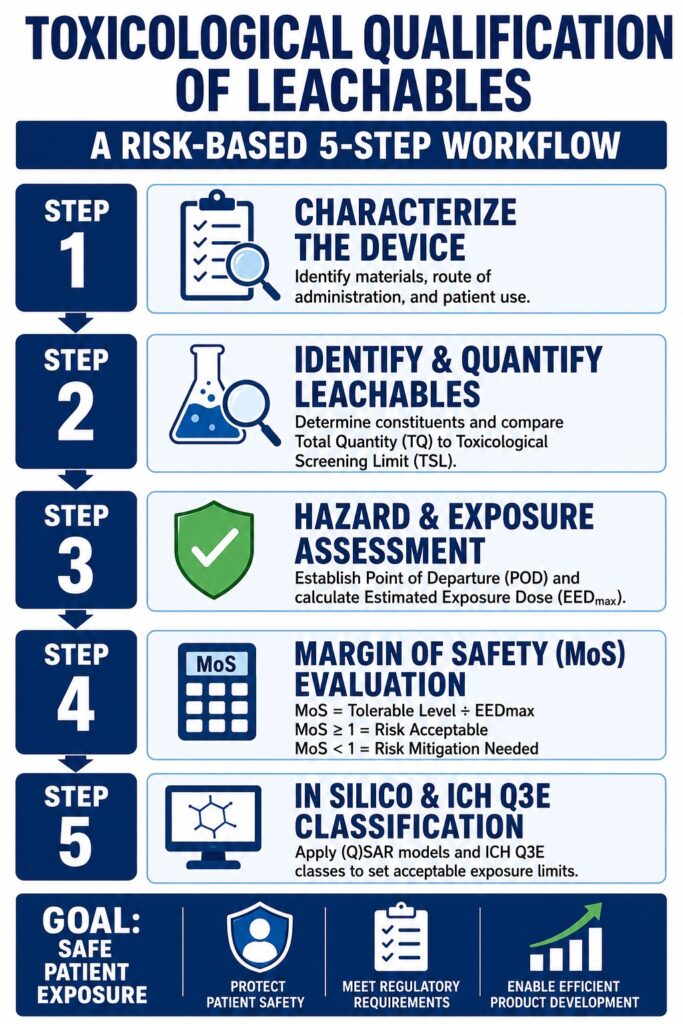
Comprehensive Workflow Under ISO 10993-17:2023
The ISO 10993-17:2023 framework establishes a systematic, exposure-based methodology for evaluating toxicological risks associated with medical device and combination product constituents. Through the use of Toxicological Screening Limits (TSLs) and Margin of Safety (MoS) calculations, this framework streamlines risk assessments while reducing the need for additional animal testing.
The updated standard, Biological Evaluation of Medical Devices — Part 17: Toxicological Risk Assessment of Medical Device Constituents, introduces a structured process designed to align modern biocompatibility evaluations with current toxicological risk assessment principles.
Workflow Overview
Step 1: Device Characterization
Identify materials of construction, body-contact category, duration of contact, and intended patient populations.
Step 2: Constituent Evaluation (ISO 10993-18)
Determine constituent identities and calculate the Total Quantity (TQ) extracted from each identified compound.
Decision Point
Determine whether TQ is less than the Toxicological Screening Limit (TSL).
- If Yes, screening is complete and the risk is considered negligible.
- If No, proceed to hazard and exposure assessment.
Step 3: Hazard and Exposure Assessment
Calculate EEDmax and derive the appropriate Tolerable Intake (TI) or Tolerable Contact Level (TCL).
Step 4: Margin of Safety Evaluation
MoS = Tolerable Level ÷ EEDmax
- If MoS ≥ 1, the risk is considered acceptable.
- If MoS < 1, risk mitigation measures, reformulation efforts, or additional testing are required.
Detailed Evaluation Steps within the ISO 10993-17 Framework
To effectively implement this framework, toxicologists and risk assessors should systematically perform the following activities:
Device Description
Define the device’s physical and chemical composition, intended clinical use, body-contact classification (such as blood-pathway, mucosal, or subcutaneous contact), and target patient populations, including pediatric users where applicable.
Identification and Selection of Chemical Constituents
Utilize chemical characterization data generated in accordance with ISO 10993-18 to determine the molecular identities of extractables and potential leachables. Compare the Total Quantity (TQ) of each constituent with the applicable Toxicological Screening Limit (TSL):
- Short-Term Exposure Limit (TSL≤30d): 120 μg cumulative exposure
- Long-Term Exposure Limit (TSL>30d): 600 μg cumulative exposure
Mathematical Exclusion
If the clinically adjusted total extracted quantity (TQmax) is below the duration-specific TSL, the constituent is considered to pose negligible risk and may be excluded from further evaluation.
Hazard Assessment (Step 3A)
For compounds exceeding the TSL or detected above the AET, conduct a hazard assessment to establish an appropriate Point of Departure (POD), such as a No Observed Adverse Effect Level (NOAEL) or Lowest Observed Adverse Effect Level (LOAEL), using peer-reviewed literature and recognized toxicological databases.
Apply suitable uncertainty factors to derive:
- Tolerable Intake (TI): For systemic, reproductive, or developmental toxicity endpoints.
- Tolerable Contact Level (TCL): For localized effects such as irritation or tissue damage.
Exposure Assessment (Step 3B)
Calculate the Worst-Case Estimated Exposure Dose (EEDmax) using relevant clinical use scenarios. When release kinetics data are unavailable, EEDmax is conservatively calculated under the assumption that the entire quantity of the constituent is released immediately.
Margin of Safety (MoS) Calculation
MoS = Tolerable Level (TI or TCL) / Estimated Exposure Dose (EEDmax)
An MoS value greater than or equal to 1 indicates that patient exposure remains below levels associated with adverse biological effects, supporting a conclusion of safety and eliminating the need for additional biological testing.
Review real-world regulatory feedback on combination devices in our detailed summary of FDA Extractables and Leachables Case Studies.
Role of In Silico Modeling in the Toxicological Qualification of Leachables
Under the ICH M7 framework, computational toxicology utilizes Quantitative Structure-Activity Relationship ((Q)SAR) methodologies to evaluate the mutagenic potential of leachables when empirical toxicological data are unavailable. This approach combines complementary rule-based and statistical-based computational models with expert scientific review to classify impurities and establish acceptable exposure limits.
The identification of extractables and leachables frequently reveals compounds for which no in vivo or in vitro toxicological data exist. Conducting traditional toxicological studies for every detected impurity is often impractical from both scientific and economic perspectives. Consequently, regulatory agencies including the USFDA and Health Canada recognize validated (Q)SAR methodologies as acceptable tools for predicting mutagenic and carcinogenic hazards.
To meet regulatory expectations, the in silico assessment should incorporate the dual-model approach described in ICH M7:
Expert Rule-Based Systems
These systems identify structural alerts using established toxicological principles and mechanistic understanding derived from expert knowledge.
Statistical-Based Systems
These models rely on machine learning algorithms trained on extensive experimental datasets to identify structural features associated with toxicological outcomes.
A leachable may be classified as having no mutagenic concern (ICH M7 Class 5) when both computational platforms produce negative results for mutagenicity-related structural alerts. If either model identifies a potential concern, a compound-specific safety limit must be established.
For known or predicted mutagenic compounds, acceptable exposure limits are determined using the Threshold of Toxicological Concern (TTC) approach, adjusted according to treatment duration.
| Clinical Treatment Duration | Acceptable Daily Intake (Individual Mutagenic Impurity) | Acceptable Total Daily Intake (Multiple Mutagenic Impurities) | Key Toxicological Reference Guideline |
|---|---|---|---|
| ≤ 1 Month | 120 μg/day | 120 μg/day | ICH M7, USP |
| > 1 to 12 Months | 20 μg/day | 60 μg/day | ICH M7, USP |
| > 1 to 10 Years | 10 μg/day | 30 μg/day | ICH M7, USP |
| > 10 Years to Lifetime | 1.5 μg/day | 5 μg/day | ICH M7, USP |
The application of these computational methodologies represents an important component of modern toxicological qualification programs. By integrating dual-model (Q)SAR analyses with literature reviews and read-across assessments involving structurally related analogues, toxicologists can address critical data gaps without extensive animal testing.
Learn more about evaluating toxic impurities by reading our analysis of Extractables and Leachables Carcinogenicity Testing.
Toxicological Classification of Leachables under the Emerging ICH Q3E Guideline
The draft ICH Q3E guideline categorizes organic and elemental leachables according to toxicological potency and risk, enabling efficient prioritization of safety evaluations throughout the product lifecycle. This structured classification system assists manufacturers in identifying high-concern compounds, establishing appropriate Permitted Daily Exposure (PDE) values, and responding effectively to lifecycle changes.
The development of the ICH Q3E guideline, Guideline for Extractables and Leachables, represents a major advancement in global regulatory harmonization. Historically, pharmaceutical manufacturers faced inconsistencies among regional requirements and pharmacopoeial expectations. ICH Q3E introduces a unified, science-based framework that prioritizes hazards using a systematic leachable classification strategy.
Class 1 – Leachables to Be Avoided
This category includes mutagenic carcinogens, such as N-nitrosamines and polycyclic aromatic hydrocarbons (PAHs), as well as highly potent non-mutagenic toxicants. Exposure should be avoided whenever possible or controlled below compound-specific acceptable intake limits.
Class 2 – Leachables to Be Limited
This category encompasses substances with moderate toxicological concern, where the derived Permitted Daily Exposure (PDE) exceeds the default Qualification Threshold. Exposure must be justified through appropriate safety assessments and less-than-lifetime TTC methodologies.
Class 3 – Leachables with Low Toxic Potential
These compounds generally consist of stable, non-mutagenic substances with well-established low toxicity profiles. When exposure remains below applicable threshold values, minimal toxicological qualification is typically required.
| Leachable Class | Potential Toxicological Risk | Structural Examples | Typical Source Materials |
|---|---|---|---|
| Class 1 (Avoid) | Mutagenicity, carcinogenicity, high-potency systemic toxicity | N-Nitrosamines (e.g., NDMA), PAHs (e.g., Benzo[a]pyrene) | Elastomeric vulcanization accelerators, carbon black reinforcing agents |
| Class 2 (Limit) | Reproductive toxicity, developmental toxicity, organ toxicity, local irritation | Phthalates (e.g., DEHP), Bisphenols (e.g., BPA) | Plasticized PVC tubing, polycarbonate components |
| Class 3 (Low) | Minimal systemic or organ-specific toxicity | Stable polymer oligomers, non-reactive alkanes | Polypropylene and high-density polyethylene (HDPE) materials |
In addition to hazard categorization, the draft ICH Q3E guideline promotes an ongoing lifecycle management approach. Leachable profiles can change over time due to modifications in raw materials, manufacturing processes, container closure systems, or clinical dosing schedules. Therefore, periodic reassessment and change-control procedures are essential components of a robust E&L program.
Find out how emerging classes of therapeutics are affected by checking out our resource on Extractables and Leachables (E&L) in Emerging Biologics and Advanced Therapies.
Strategic Analytical Practices for Defensible Safety Assessments
A scientifically defensible toxicological risk assessment depends on accurate, reproducible analytical data generated using validated, highly sensitive instrumentation. Collaboration with specialized analytical laboratories helps ensure that low-level leachables are correctly identified and quantified, thereby reducing regulatory uncertainty and minimizing product risk.
The effectiveness of any toxicological qualification program depends heavily on the quality of the underlying analytical data. If a laboratory fails to detect or accurately quantify a migrating compound, subsequent risk assessments may be based on inaccurate exposure assumptions. Consequently, pharmaceutical developers should work with contract laboratories that maintain advanced instrumentation and operate within established quality systems.
ResolveMass Laboratories Inc., as a USFDA-registered and ISO 9001:2015-certified organization, offers advanced analytical solutions that address key challenges in pharmaceutical development:
Advanced Mass Spectrometry
High-resolution LC-MS/MS and GC-MS platforms support non-targeted screening, trace-level quantification, and structural characterization of unknown impurities.
Quantitative NMR (qNMR)
qNMR provides absolute concentration measurements and structural confirmation for complex polymers, additives, and peptide-conjugated compounds.
Custom Synthesis
The laboratory develops pure, structurally verified reference standards for novel impurities and proprietary polymer-related compounds, enabling robust quantitative method development and validation.
Impurity Profiling
Comprehensive impurity profiling services include the characterization of nitrosamines, PFAS compounds, and process-related contaminants to satisfy global regulatory expectations.
Working with an experienced analytical laboratory ensures that extractables and leachables studies are designed and executed according to internationally accepted scientific principles. This partnership effectively connects trace-level analytical characterization with clinical safety assessments, helping accelerate regulatory approval while protecting patient health.
Partner with industry specialists by selecting ResolveMass Extractables and Leachables Testing for your analytical workflows.
Conclusion and Actions for Regulatory Success
Successful toxicological qualification of leachables requires a proactive, science-based strategy that integrates analytical excellence with advanced toxicological evaluation. Adopting these best practices supports international regulatory compliance, reduces clinical risk, and facilitates efficient product development and approval.
A comprehensive toxicological qualification program represents a fundamental component of pharmaceutical quality and patient safety. By applying the risk-based principles outlined in ICH Q3E and ISO 10993-17:2023, developers can distinguish toxicologically significant compounds from low-concern impurities, optimize resource allocation, and accelerate development timelines. Collaboration with a USFDA-registered and ISO 9001:2015-certified contract research organization such as ResolveMass Laboratories Inc. helps ensure that study design, analytical methodology, and toxicological assessments meet the highest international standards.
Understand what steps are necessary for cross-border market entry by exploring Extractables and Leachables (E&L) Requirements for U.S. Market Authorization.
To discuss container closure qualification, polymer characterization, or custom reference standard synthesis requirements, please visit the ResolveMass Laboratories Inc. Contact Us page.
Frequently Asked Questions
Extractables are chemical compounds that can be released from packaging materials, manufacturing equipment, or delivery systems when exposed to aggressive laboratory conditions such as elevated temperatures, extended extraction periods, or strong solvents. They represent the theoretical worst-case chemical profile of a material. Leachables, in contrast, are substances that actually migrate into a drug product or medical device during routine manufacturing, storage, and clinical use. Toxicological assessments primarily focus on leachables because they reflect the compounds to which patients may be directly exposed.
The Safety Concern Threshold (SCT) is a scientifically established exposure level below which a leachable is considered unlikely to cause either carcinogenic or non-carcinogenic adverse health effects. It serves as a screening tool to identify compounds requiring further toxicological evaluation. Because exposure risks differ among administration routes, the SCT is route-specific. For Orally Inhaled and Nasal Drug Products (OINDP), the recommended SCT is 0.15 μg/day, while Parenteral Drug Products (PDP) are assigned an SCT of 1.5 μg/day.
How do response factor variations influence AET calculations, and why is an uncertainty factorIn chromatographic screening methods, unknown leachables are often quantified relative to a calibration standard, assuming similar detector responses. However, different chemical structures may generate significantly different response factors, leading to underestimation or overestimation of actual concentrations. To compensate for this variability, an Analytical Uncertainty Factor (UF) is incorporated into the AET calculation. Applying the UF creates a more conservative reporting threshold and helps ensure that toxicologically relevant compounds are not overlooked during analysis.
The Toxicological Screening Limit (TSL) is an exposure-based threshold introduced in ISO 10993-17:2023 to streamline the evaluation of chemical constituents identified in medical devices. It helps determine whether a detected compound poses a sufficiently low risk to be excluded from further toxicological assessment. The standard establishes a cumulative exposure limit of 120 μg for short-term exposure and 600 μg for long-term exposure. Constituents with exposure levels below the applicable TSL are generally considered to present negligible toxicological concern.
The Permitted Daily Exposure (PDE) represents the maximum quantity of a substance that can be safely administered daily over an extended period without causing harmful effects. PDE values are derived from toxicological studies using a Point of Departure (POD), such as a NOAEL or LOAEL, and are adjusted using uncertainty factors that account for interspecies differences, human variability, study duration, and data quality. This risk-based approach ensures that safety limits remain protective under real-world clinical conditions.
The draft ICH Q3E guideline promotes a continuous lifecycle management strategy rather than a one-time qualification exercise. It recognizes that extractables and leachables profiles may change as products, packaging materials, or manufacturing processes evolve. Manufacturers are expected to establish re-evaluation procedures triggered by events such as formulation changes, supplier modifications, updated toxicological information, or adjustments to storage conditions and dosing regimens. This ongoing monitoring approach helps maintain product safety throughout its commercial lifecycle.
N-nitrosamines and polycyclic aromatic hydrocarbons (PAHs) are regarded as compounds of special concern because of their well-documented mutagenic and carcinogenic properties. Even extremely low levels of exposure may present meaningful health risks over time. As a result, standard threshold approaches such as SCT or TSL are generally not sufficient for these compounds. Instead, toxicologists establish compound-specific Acceptable Intake (AI) limits using detailed carcinogenicity data and highly conservative risk assessment methodologies.
Reference:
- U.S. Food and Drug Administration. (2025, November 28). Q3E guideline for extractables and leachables: Draft guidance for industry. U.S. Department of Health and Human Services. https://www.fda.gov/media/189890/download
- European Medicines Agency. (2026, January 28). Overview of comments received on ICH Q3E guideline and supporting documentation for extractables and leachables (EMA/CHMP/ICH/236669/2025 and EMA/CHMP/ICH/236668/2025) [Comment summary report]. European Medicines Agency. https://www.ema.europa.eu/en/documents/comments/overview-comments-received-ich-q3e-guideline-supporting-documentation-extractables-leachables-ema-chmp-ich-236669-2025-ema-chmp-ich-236668-2025_en.pdf
- Hasselgren, C., Bercu, J., Cayley, A., Cross, K., Glowienke, S., Kruhlak, N., Muster, W., Nicolette, J., Reddy, M. V., Saiakhov, R., & Dobo, K. (2020). Management of pharmaceutical ICH M7 (Q)SAR predictions: The impact of model updates. Regulatory Toxicology and Pharmacology, 118, 104807. https://doi.org/10.1016/j.yrtph.2020.104807
- International Council for Harmonisation of Technical Requirements for Pharmaceuticals for Human Use. (2025, August 26). ICH Q3E Step 2 presentation: Guideline for extractables and leachables [PowerPoint presentation]. ICH. ICH Q3E Step 2 Presentation PDF
- International Council for Harmonisation of Technical Requirements for Pharmaceuticals for Human Use. (2023, April 3). M7(R2): Assessment and control of DNA reactive (mutagenic) impurities in pharmaceuticals to limit potential carcinogenic risk (Step 4 version). ICH. https://database.ich.org/sites/default/files/ICH_M7(R2)_Guideline_Step4_2023_0216_0.pdf
Get In Touch With Us
About The Author


