


Polymers play a vital role in a multitude of industries, from healthcare and electronics to packaging and aerospace. Their properties—including mechanical strength, thermal stability, and chemical resistance—are critical to their applications. To ensure optimal performance, it is essential to understand these properties through precise analysis. This blog explores the various methods and techniques used to analyze polymer properties, offering insights into how this process contributes to innovation and quality control.
Master the fundamentals of material science: Learn how understanding polymer properties through analysis can unlock new possibilities for your product development and engineering goals.
Article Summary
- Polymer analysis is essential for understanding critical properties such as mechanical strength, thermal stability, chemical resistance, electrical behavior, and optical performance across diverse industries.
- Advanced analytical techniques help ensure quality assurance, regulatory compliance, and consistency in manufacturing while supporting innovation in research and development.
- Key polymer properties—including molecular weight, thermal, mechanical, chemical, electrical, and morphological characteristics—are evaluated using specialized testing and spectroscopic methods.
- Modern polymer analysis increasingly integrates data analytics, automation, and advanced instrumentation to improve accuracy, efficiency, and reproducibility.
- Specialized studies such as aging, degradation, rheology, surface analysis, and blend compatibility provide insights into long-term performance, processability, and material optimization.
- Comprehensive polymer analysis enables the development of high-performance, application-specific materials and supports innovation in custom polymer synthesis for emerging technologies.
The Importance of Polymer Analysis
Understanding polymer properties is crucial for:
- Quality Assurance: Ensuring that the polymer meets required specifications.
- Application Development: Tailoring polymers to specific end-use applications.
- Regulatory Compliance: Meeting industry standards and environmental regulations.
- Research and Development: Innovating new materials with enhanced performance.
Accurate analysis is indispensable for delivering high-quality custom polymer synthesis solutions tailored to industry needs.
Access world-class diagnostic expertise: Partner with a premier polymer analysis laboratory to ensure your materials meet the highest standards of safety and performance.
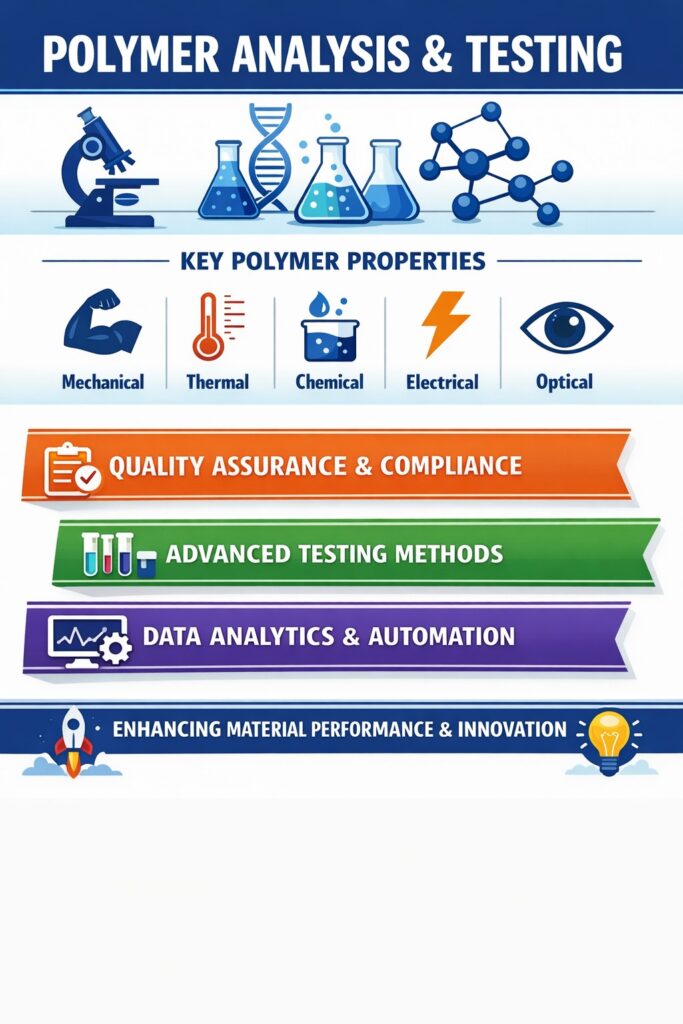
Key Polymer Properties and Their Analysis
Role of Data Analytics and Automation in Polymer Analysis
Modern polymer analysis increasingly relies on data analytics and automation to improve accuracy and efficiency. Advanced software tools can process large datasets generated by analytical instruments, revealing subtle property relationships that may not be evident through manual interpretation. This data-driven approach enhances decision-making in research, quality control, and material optimization.
Automation also reduces human error and increases reproducibility in polymer testing. Automated sampling, instrument calibration, and real-time data monitoring allow laboratories to maintain consistent analytical standards. As polymer systems become more complex, integrating digital tools into analysis workflows is becoming essential for innovation and scalability.
Streamline your testing workflow: Discover the latest polymer analysis techniques that leverage automation and data-driven insights to accelerate your R&D cycles.
1. Molecular Weight and Polydispersity
The molecular weight of a polymer significantly impacts its mechanical and thermal properties. Polydispersity, the measure of molecular weight distribution, provides insights into the uniformity of polymer chains.
Analytical Techniques:
- Gel Permeation Chromatography (GPC): Determines molecular weight distribution.
- Mass Spectrometry: Provides detailed molecular weight information for smaller polymers.
2. Thermal Properties
Thermal stability and transitions, such as melting and glass transition temperatures, are critical for processing and application.
Analytical Techniques:
- Differential Scanning Calorimetry (DSC): Measures melting and glass transition temperatures.
- Thermogravimetric Analysis (TGA): Assesses thermal degradation and stability.
Evaluate heat-resistance and stability: Utilize professional polymer thermal analysis to determine exactly how your materials behave under extreme temperature conditions.
3. Mechanical Properties
Mechanical strength, elasticity, and toughness are essential for polymers used in structural and load-bearing applications.
Analytical Techniques:
- Tensile Testing: Measures tensile strength and elongation at break.
- Dynamic Mechanical Analysis (DMA): Evaluates viscoelastic properties.
4. Chemical Properties
Chemical resistance and solubility influence polymer performance in various environments.
Analytical Techniques:
- Fourier Transform Infrared Spectroscopy (FTIR): Identifies functional groups.
- Nuclear Magnetic Resonance (NMR) Spectroscopy: Provides structural information.
Verify chemical integrity: Ensure your material meets exact specifications with comprehensive polymer composition analysis for additives, fillers, and base resins.
Polymer Electrical Properties and Their Evaluation
Electrical properties of polymers are increasingly important due to their expanding use in electronics, sensors, and energy storage devices. Characteristics such as electrical conductivity, dielectric strength, and insulation behavior determine how polymers perform in applications like flexible circuits, capacitors, and cable coatings. Understanding these properties helps manufacturers select or modify polymers to achieve reliable electrical performance under varying operational conditions.
The evaluation of electrical behavior also plays a crucial role in safety and durability. Polymers exposed to high voltages or fluctuating electrical loads must resist breakdown and maintain stability over time. Through systematic electrical analysis, researchers can identify weaknesses, improve formulations, and develop advanced polymer systems suitable for modern electronic and electrochemical applications.
Analytical Techniques:
- Dielectric Spectroscopy: Measures dielectric constant and loss behavior.
- Volume and Surface Resistivity Testing: Evaluates insulating performance.
Ensure reliability in the US market: Benefit from local expertise at our specialized polymer analysis laboratory in the US for rapid, high-precision material evaluation.
5. Morphological Properties
The morphology of a polymer, including crystallinity and phase separation, affects its optical and mechanical properties.
Analytical Techniques:
- X-Ray Diffraction (XRD): Measures crystallinity.
- Scanning Electron Microscopy (SEM): Examines surface morphology.
Advanced Techniques in Polymer Analysis
Aging, Degradation, and Long-Term Performance Analysis
Polymers often experience physical and chemical changes over time due to environmental exposure, mechanical stress, or thermal cycling. Aging and degradation analysis helps predict a material’s lifespan and performance stability. This is particularly important in industries such as construction, automotive, and healthcare, where polymer failure can lead to safety risks or costly replacements.
By simulating long-term conditions in controlled laboratory environments, analysts can evaluate how polymers respond to heat, oxygen, moisture, and radiation. These insights enable the development of more durable materials and guide improvements in formulation, additives, and processing techniques to extend service life.
Analytical Techniques:
- Accelerated Aging Tests: Simulate long-term environmental exposure.
- Oxidative Stability Testing: Measures resistance to chemical degradation.
Overcome technical hurdles: Review key challenges and solutions in polymer analysis to better understand how to mitigate degradation and improve material longevity.
Rheological Analysis
Rheology studies the flow and deformation of polymers under applied stress, providing insights into processing behavior.
- Capillary Rheometry: Evaluates flow properties during extrusion.
- Rotational Rheometry: Analyzes shear and viscosity.
Surface Analysis
Surface properties influence adhesion, wettability, and compatibility.
- Atomic Force Microscopy (AFM): Provides nanoscale surface topography.
- Contact Angle Measurement: Assesses surface energy.
Characterize complex networks: Gain deep insights into material durability and elasticity through specialized crosslinked polymer analysis.
Polymer Compatibility and Blend Analysis
Polymer blends and composites are widely used to achieve a balance of properties that single polymers cannot provide alone. Compatibility between different polymer phases determines mechanical strength, thermal behavior, and overall stability. Poor compatibility can lead to phase separation, weak interfaces, and reduced performance, making blend analysis a critical step in material development.
Through compatibility analysis, researchers can optimize polymer combinations and identify suitable compatibilizers. This ensures uniform dispersion and strong interfacial bonding within blends. Such evaluations are especially valuable in recycling processes, where mixed polymer streams must be assessed for reuse potential.
Analytical Techniques:
- Differential Scanning Calorimetry (DSC): Detects miscibility through thermal transitions.
- Microscopy Techniques: Visualize phase distribution and interfacial behavior.
Innovate in biotherapeutics: Optimize delivery systems and therapeutic efficacy with high-resolution drug-polymer conjugate analysis.
Spectroscopic Techniques
Spectroscopy offers detailed insights into the chemical and structural composition of polymers.
- Raman Spectroscopy: Complements FTIR for structural analysis.
- UV-Vis Spectroscopy: Analyzes optical properties and electronic transitions.
Optical Properties and Light Interaction in Polymers
Optical properties such as transparency, refractive index, and light absorption are critical for polymers used in lenses, displays, packaging, and medical devices. These properties influence how light passes through or interacts with polymer materials, directly affecting product functionality and visual quality. Polymer analysis allows scientists to fine-tune optical clarity and color stability for precise application requirements.
Understanding light–polymer interactions also helps prevent long-term degradation caused by UV exposure. Certain polymers may yellow, crack, or lose strength when exposed to light over time. Through optical analysis, manufacturers can incorporate stabilizers or coatings that enhance durability while maintaining desired visual performance.
Analytical Techniques:
- UV-Visible Spectroscopy: Measures light absorption and transmission.
- Refractive Index Measurement: Assesses optical clarity and bending of light.
Local solutions for North American industry: Get comprehensive results with polymer testing in Canada and the US, tailored to meet regional regulatory and quality standards.
Applications of Polymer Analysis
1. Enhancing Material Performance
By analyzing properties like mechanical strength and thermal stability, industries can develop polymers optimized for specific applications, such as high-temperature aerospace components or flexible electronics.
2. Quality Control in Manufacturing
Regular polymer analysis ensures consistency across production batches, reducing waste and maintaining customer satisfaction.
3. Environmental and Regulatory Compliance
Analyzing biodegradable and chemical composition helps meet environmental standards and regulatory requirements.
4. Innovation in Custom Polymer Synthesis
Customizing polymers for emerging technologies requires in-depth analysis to ensure desired properties. At ResolveMass Laboratories Inc., we leverage advanced analytical tools to deliver high-performance polymers tailored to unique needs.
Partner with Canadian experts: Accelerate your research and production with precision polymer analysis in Canada, utilizing the latest instrumentation and industry insights.
Learn More About Our Services
ResolveMass Laboratories Inc. specializes in custom polymer synthesis and advanced analytical services. Discover how we can help meet your material needs here. Explore our antibody sequencing services for innovative solutions in biotechnology here.
Frequently Asked Questions
Polymer analysis methods include thermal, mechanical, chemical, and structural techniques used to evaluate material behavior and composition. Common methods involve spectroscopy, chromatography, microscopy, and rheological testing. These techniques help determine molecular structure, stability, strength, and processing characteristics. Together, they provide a comprehensive understanding of polymer performance.
Polymer analysis and testing is the systematic examination of polymer materials to assess their physical, chemical, thermal, and mechanical properties. It ensures that polymers meet design requirements, quality standards, and regulatory guidelines. This process supports material selection, product development, and performance validation across industries.
Polymers exhibit a wide range of properties, including mechanical strength, flexibility, thermal resistance, chemical stability, electrical behavior, and optical characteristics. These properties depend on molecular structure, composition, and processing conditions. Understanding them helps tailor polymers for specific applications and environments.
The four key characteristics of polymers are their lightweight nature, versatility in properties, durability, and ease of processing. Polymers can be engineered to be rigid or flexible, insulating or conductive, and resistant to heat or chemicals. These characteristics make them suitable for diverse industrial and consumer applications.
Conclusion
Understanding polymer properties through detailed analysis is the cornerstone of innovation and quality in material science. From molecular weight to surface properties, each aspect provides essential insights into performance and application suitability. At ResolveMass Laboratories Inc., we combine state-of-the-art analytical techniques with expertise in custom polymer synthesis to deliver solutions that meet the highest standards of excellence.
References
- Malucelli, G. (2025). Recent highlights in polymer analysis and characterization. Polymers, 17(21), 2846. https://doi.org/10.3390/polym17212846
- Malucelli, G. (2024). Polymer Analysis and Characterization. Polymers, 16(24), 3509. https://doi.org/10.3390/polym16243509

