
Introduction
The FDA Purple Book is an online database that enables biopharmaceutical researchers and regulatory specialists to assess FDA-licensed Section 351(a) innovator reference products alongside Section 351(k) biosimilar and interchangeable therapies. When biopharmaceutical regulatory specialists, market analysts, and laboratory researchers use the FDA Purple Book to research competitive drug landscapes, they gain access to authoritative information on licensed Section 351(a) innovator reference products, Section 351(k) biosimilars, statutory exclusivity periods, and publicly available patent lists.
Biological products constitute a complex category of therapeutics manufactured using living organisms. These products range from monoclonal antibodies and therapeutic proteins to gene and cell therapies. Unlike small-molecule drugs, which are regulated under the Federal Food, Drug, and Cosmetic Act (FD&C Act) and documented in the Orange Book, biological products are licensed under the Public Health Service Act (PHS Act). Under Section 351(a) of the PHS Act, a full Biologics License Application (BLA) requires an independent demonstration of safety, purity, and potency, supported by comprehensive clinical trials. In contrast, Section 351(k) establishes an abbreviated licensure pathway for biosimilars that are highly similar to an FDA-licensed reference product, notwithstanding minor differences in clinically inactive components, and demonstrate no clinically meaningful differences in safety or potency.
The regulatory framework governing biological products expanded significantly following the enactment of the Biologics Price Competition and Innovation Act (BPCI Act). Another major development occurred on March 23, 2020, when biological products previously approved under Section 505 of the FD&C Act were deemed to be licensed under BLAs pursuant to the PHS Act. Furthermore, statutory amendments introduced through the Biological Product Patent Transparency (BPPT) provisions of the Consolidated Appropriations Act of 2021 established requirements for publicly listing patent information in the Purple Book. Navigating this database enables biopharmaceutical innovators, including those collaborating with analytical testing organizations such as ResolveMass Laboratories Inc., to align analytical characterization, structural comparability assessments, and biosimilarity studies with applicable statutory exclusivity periods.
Explore our biosimilar characterization services to support comprehensive analytical assessments throughout biosimilar development.
Share via:
Quick Summary:
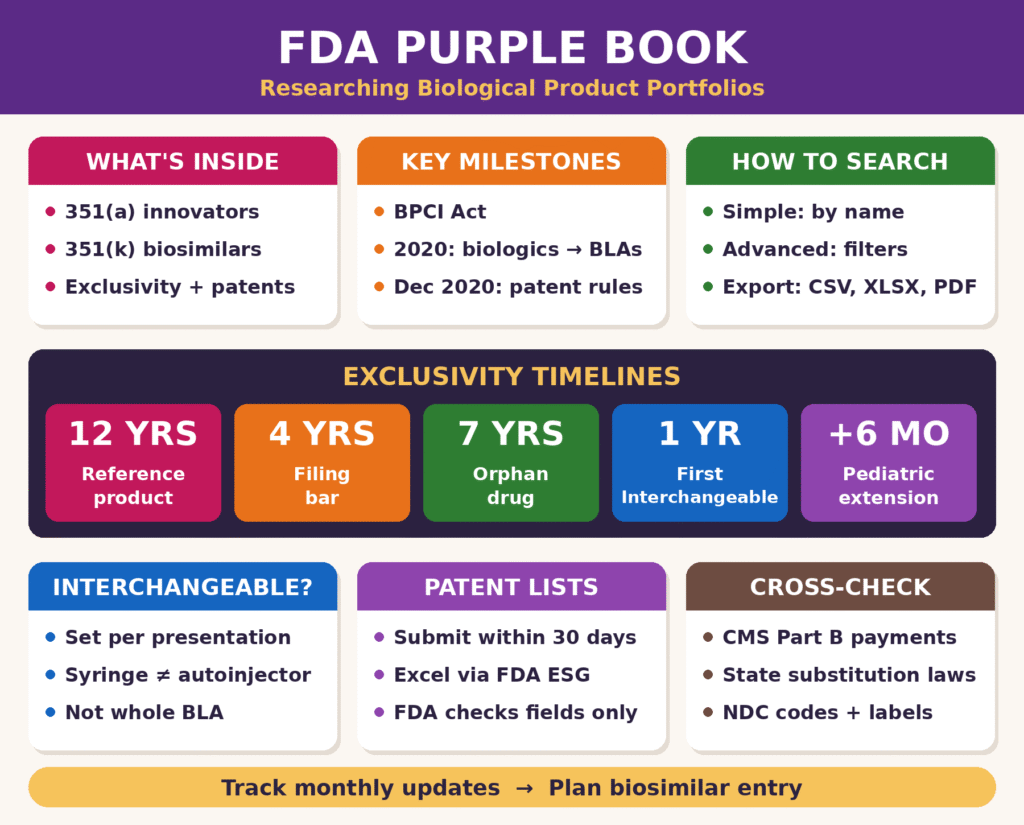
- What it is: The FDA Purple Book is the FDA’s online database of licensed biological products. It lists Section 351(a) innovator reference products alongside Section 351(k) biosimilar and interchangeable products, together with their exclusivity periods and patent lists.
- Regulatory background: Biologics are licensed under the PHS Act, not the FD&C Act. The framework grew with the BPCI Act and with the March 23, 2020 transition of certain biologics to BLAs. Patent listing rules were added by the Biological Product Patent Transparency provisions signed on December 27, 2020.
- Searching the database: Simple Search finds a reference product and all its biosimilars from one core name, such as infliximab. Advanced Search filters by BLA number, sponsor, dosage form, presentation and marketing status, and exports data as CSV, XLSX or PDF.
- Interchangeability is set for each presentation: The FDA grants interchangeability to individual presentations rather than to a whole BLA. A pre-filled syringe can therefore be interchangeable while an autoinjector under the same BLA is only biosimilar.
- Exclusivity timelines:
- Reference products get 12 years of exclusivity, and biosimilar applications cannot be filed in the first 4 years.
- Orphan exclusivity lasts 7 years.
- The first interchangeable product can get up to 1 year of exclusivity.
- Pediatric exclusivity adds 6 months.
- Patent disclosures: Reference product sponsors must submit the patent lists exchanged in the “patent dance” within 30 days, as Excel files through the FDA ESG. The FDA’s role is only administrative: it checks the identifying fields and does not judge whether a patent is valid or infringed.
- Linking to other datasets: For realistic market analysis, Purple Book data should be compared with CMS Part B payment files, state pharmacy substitution laws, NDC codes and DailyMed labels. Tracking monthly updates alongside strong analytical comparability testing supports biosimilar development and planning for market entry.
Step-by-Step Methodology: How to Use FDA’s Purple Book to Research Biological Portfolios
Researchers can use the FDA Purple Book to investigate biological product portfolios by conducting targeted searches through either the Simple Search interface, which supports searches by brand or core nonproprietary names, or the Advanced Search interface, which allows filtering across multiple attributes. By applying specific parameters related to BLA numbers, sponsors, dosage forms, and product presentations, analysts can map complete biological drug families and identify relationships between reference products and their corresponding biosimilars.
The Purple Book database organizes records using specific key fields associated with Section 351(a) and Section 351(k) applications. Conducting an effective search requires selecting the appropriate search interface according to the depth and scope of the analytical information needed.
Learn how our biosimilar comparability studies support systematic assessments of analytical similarity between reference products and biosimilar candidates.
Executing Queries via Simple Search and Advanced Filters
Simple Search enables users to quickly identify groups of products that share a common core nonproprietary name. In comparison, Advanced Search supports real-time filtering across detailed metadata fields, including BLA numbers, routes of administration, and product strengths. This dual-search functionality allows users to switch between broad biological product groupings and detailed analyses of individual BLA parameters.
Simple Search Execution: Entering a core nonproprietary name, such as infliximab, retrieves a consolidated results page displaying the original Section 351(a) reference product alongside all approved Section 351(k) biosimilars and interchangeable products associated with that core name. The interface uses color-coded product cards to distinguish reference products from biosimilar and interchangeable entries.
Advanced Search Customization: For comprehensive portfolio analysis, the Advanced Search interface provides an interactive, dynamically updated table. Users can apply real-time filters across multiple parameters:
- Applicant (Sponsor): Filters database entries according to the BLA license holder.
- BLA Number: Identifies specific six-digit BLA registration numbers.
- Proprietary and Proper Name: Retrieves products using their exact brand names or nonproprietary naming conventions, including the four-letter lowercase suffixes assigned to biosimilars, such as infliximab-dyyb.
- Product Presentation and Dosage Form: Distinguishes among single-dose vials, autoinjectors, pre-filled syringes, and multi-dose cartridges.
- Marketing Status: Filters entries according to whether the associated BLA is actively marketed or discontinued.
| Search Interface Feature | Simple Search | Advanced Search |
|---|---|---|
| Primary Query Parameters | Proprietary Name, Proper Core Name | BLA Number, Sponsor, Dosage Form, Route, Presentation |
| Data Display Format | Visual product cards grouped by core name | Interactive, real-time, multi-column data table |
| Data Export Options | Individual product details view | Full dataset downloads in CSV, XLSX, and PDF formats |
| Patent List Visibility | Direct link on the Product Details page | Dedicated column filter and complete patent view |
| Target Use Case | Quick identification of reference-to-biosimilar relationships | Pipeline tracking, statutory review, and dataset auditing |
Navigating Presentation-Level Interchangeability Evaluations
The FDA grants biological product interchangeability designations at the individual product presentation level rather than automatically extending them across an entire BLA. Consequently, different drug delivery formats covered under the same application, such as pre-filled syringes and autoinjectors, may have different regulatory designations, including biosimilar or interchangeable status.
An important consideration when researching biological products is that sharing a core nonproprietary name does not automatically establish interchangeability across every product presentation. For example, regulatory evaluations of a drug product line may determine that a pre-filled syringe presentation qualifies as interchangeable, while an autoinjector presentation covered by the same BLA is designated as a biosimilar without an interchangeability designation. Analysts must therefore preserve presentation-level distinctions during data collection to avoid incorrect assumptions about pharmacy substitution rights.
Discover our critical quality attributes (CQAs) in biosimilars resource to understand the quality characteristics that contribute to comprehensive biosimilar assessments.
How to Use FDA’s Purple Book to Research Statutory Exclusivity Expiration Timelines
To use the FDA Purple Book to research statutory exclusivity timelines, analysts should examine four primary fields: Reference Product Exclusivity Expiration Date, Date of First Licensure, Orphan Exclusivity Expiration Date, and First Interchangeable Exclusivity Expiration Date. These fields help establish the legal boundaries governing when biosimilar applications may be submitted to or approved by the FDA.
Exclusivity information in the Purple Book identifies statutory periods during which a Section 351(k) biosimilar or interchangeable application may be restricted from submission or licensure by the FDA. Evaluating these timelines enables regulatory intelligence teams to establish loss-of-exclusivity (LOE) dates and estimate potential biosimilar market entry windows.
Under Section 351(k)(7) of the PHS Act, an innovator Section 351(a) reference product generally benefits from a 12-year period of reference product exclusivity beginning on the date of first licensure. In addition, biosimilar applicants are prohibited from submitting a Section 351(k) application during the first four years following the reference product’s initial licensure date.
– Date of First Licensure: This field identifies the official licensure date of the original Section 351(a) BLA. It establishes the starting point for calculating the statutory four-year application submission restriction and the 12-year reference product exclusivity period.
– Reference Product Exclusivity Expiration Date: This field identifies the formal calendar date on which the reference product’s 12-year statutory market protection expires. Under the commitments associated with the Biosimilar User Fee Act (BsUFA II), the FDA publishes the date of first licensure and the reference product exclusivity expiration date within 30 days of making an exclusivity determination.
– Orphan Exclusivity Expiration Date: This field indicates the expiration date of the seven-year market exclusivity period granted under Section 527 of the FD&C Act for qualifying products approved for rare diseases or conditions.
– First Interchangeable Exclusivity Expiration Date: This field identifies the expiration date associated with the exclusivity period granted under Section 351(k)(6) of the PHS Act to the first biosimilar approved as an interchangeable biological product. This provision can prevent the FDA from approving subsequent interchangeable biosimilars for the same reference product for up to one year after the first interchangeable product’s commercial marketing begins, subject to the applicable statutory conditions.
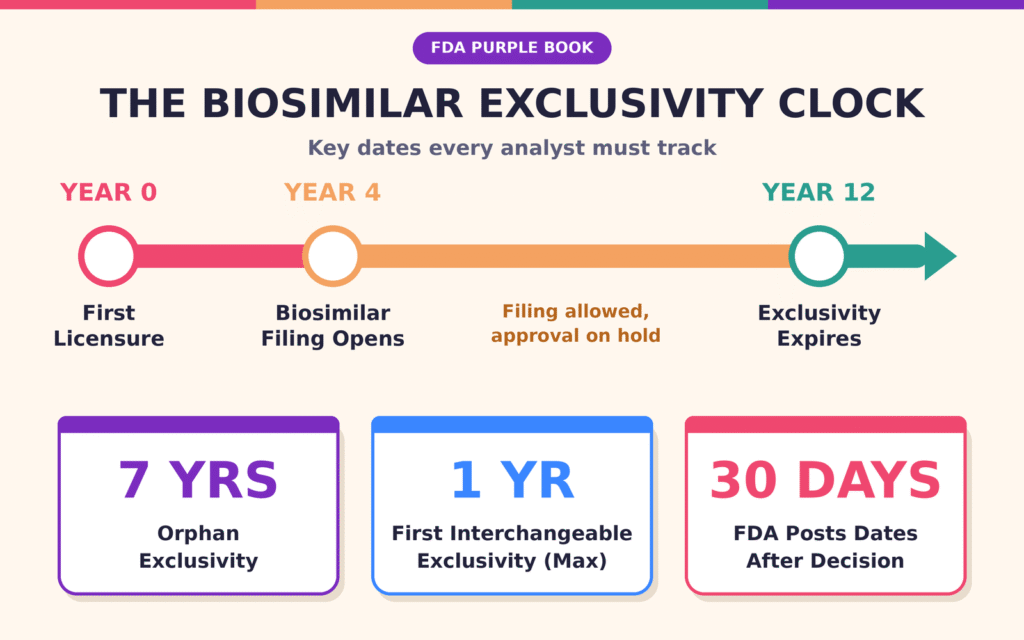
| Exclusivity Field Name | Statutory Foundation | Exclusivity Period / Scope | Operational Impact |
|---|---|---|---|
| Reference Product Exclusivity | PHS Act § 351(k)(7) | 12 years total; four-year submission bar | Restricts FDA licensure of Section 351(k) biosimilars before the applicable exclusivity period expires |
| Orphan Exclusivity | FD&C Act § 527 | Seven years for qualifying rare disease indications | Prevents approval of the same drug for the same rare disease or condition during the applicable exclusivity period |
| First Interchangeable Exclusivity | PHS Act § 351(k)(6) | Up to one year after commercial marketing begins, subject to statutory conditions | Restricts subsequent interchangeable determinations for competing biosimilars during the applicable period |
| Pediatric Exclusivity | PHS Act § 351(m) / FD&C Act § 505A | Adds six months to qualifying existing exclusivity periods | Extends applicable reference product or orphan exclusivity timelines when statutory requirements are met |
Explore our end-to-end biosimilar analytical package for a regulatory submission to support the analytical evidence needed for biosimilar regulatory submissions.
Navigating Patent Disclosures under the Biological Product Patent Transparency Framework
Patent transparency within the Purple Book is governed by the Biological Product Patent Transparency (BPPT) provisions. These provisions require reference product sponsors to disclose patent lists exchanged during pre-litigation proceedings, along with the corresponding patent expiration dates. The framework also establishes requirements for administrative updates to the public database based on standardized electronic submissions from BLA holders.
Before the enactment of the BPPT provisions under the Consolidated Appropriations Act of 2021, signed into law on December 27, 2020, biological patent information did not have a centralized public repository comparable to the Orange Book. The BPPT provisions established formal mechanisms requiring reference product sponsors (RPS) to disclose patents exchanged during the Section 351(l) pre-litigation process, commonly known as the “patent dance.”
Learn about our ICH Q6B guidelines for biological characterization to understand the regulatory framework supporting biological product characterization and quality assessment.
Statutory Submission Rules and FDA Verification Protocol
Reference product sponsors must submit exchanged patent lists to the FDA in Microsoft Excel format through the Electronic Submissions Gateway within 30 days of exchanging the relevant information during Section 351(l) proceedings. Before publishing the disclosures, the FDA performs a ministerial verification of four core metadata fields.
– Submission Timeline: Reference product sponsors must submit their patent lists and corresponding expiration dates to the FDA no later than 30 days after providing the initial patent list to a Section 351(k) applicant under Section 351(l)(3)(A) or Section 351(l)(7) of the PHS Act.
– Updates and Supplemental Lists: Any subsequent or supplemental patent lists exchanged during ongoing Section 351(l) proceedings must also be submitted to the FDA within 30 days of the exchange.
– Submission Format and Channel: Submissions must be transmitted electronically in Microsoft Excel format through the FDA Electronic Submissions Gateway (ESG) for inclusion in the sponsor’s BLA file. The submission must be accompanied by a cover letter, with an email copy sent to PurpleBook@fda.hhs.gov. Cover letters must use the required subject lines, such as “PURPLE BOOK PATENT INFORMATION” for initial submissions or “PURPLE BOOK PATENT INFORMATION – UPDATE” for supplemental filings.
– Mandatory Submission Fields: Each submission must contain six specified fields: Reference Product BLA Number, Applicant Name, Proprietary Name, Proper Name, Patent Number, and Patent Expiration Date.
– FDA Verification Role: The FDA performs a strictly ministerial function when processing Purple Book patent disclosures. The agency does not evaluate or confirm the validity, enforceability, applicability, or potential infringement of the listed patents. Its administrative verification is limited to confirming that four fields correspond to the current Purple Book entries: Reference Product BLA Number, Applicant Name, Proprietary Name, and Proper Name.
Accessing and Exporting Patent Information
Patent information can be accessed by selecting the ‘Patent List Provided’ link on an individual product’s details page or by filtering the relevant columns in the Advanced Search interface. Users can export these records in CSV, Excel, or PDF formats to support offline legal reviews and technical assessments.
– Via Simple Search: Opening the Product Details page for a selected product reveals a ‘Patent List Provided’ heading. Clicking the ‘Yes’ link opens the complete patent disclosure table.
– Via Advanced Search: Users can select the ‘Show/Hide Columns’ utility, enable the ‘Patent List Provided’ column, and click ‘Yes’ in the corresponding table cell to view the listed patent numbers and expiration dates.
– Data Customization and Export: Patent tables support Row View and Card View layouts, column sorting, and immediate downloads through the download icon. Available export formats include CSV, MS Excel, and PDF.
Explore our biosimilar analytical characterization service to support detailed analytical investigations of biological products during development.
Advanced Data Integration: Linking Purple Book Mappings with External Datasets
A comprehensive market and regulatory assessment requires cross-referencing Purple Book BLA relationship mappings with CMS Medicare Part B payment files, state pharmacy laws, and National Drug Code directories. Integrating these separate data sources helps identify operational differences between federal licensing status, reimbursement limits, and local substitution requirements.
Although the Purple Book establishes federal BLA approval relationships and statutory exclusivity information, practical pharmacy substitution, product coding, and reimbursement also depend on additional regulatory systems. To develop reliable market models, regulatory intelligence teams should compare Purple Book database snapshots with three external operational domains.
– CMS Reimbursement Files: The Centers for Medicare & Medicaid Services (CMS) uses Purple Book relationship mappings for certain administrative classifications. However, reimbursement limits for Medicare Part B injectable biologics are determined and published separately, generally on a quarterly basis. Researchers should cross-reference Purple Book BLA identifiers with quarterly CMS Part B payment files to evaluate average sales price (ASP) billing codes and Healthcare Common Procedure Coding System (HCPCS) assignments.
– State Pharmacy Substitution Statutes: An FDA designation of “interchangeable” in the Purple Book indicates that a biological product meets the applicable federal scientific standards for interchangeability, including the requirement that it can be expected to produce the same clinical result as the reference product in any given patient. However, automatic substitution at the pharmacy counter remains subject to individual state pharmacy practice laws. Analysts must therefore combine Purple Book interchangeability classifications with state-specific requirements concerning patient notification, prescriber opt-out provisions, and recordkeeping.
– Package-Level National Drug Codes (NDCs): Purple Book records primarily describe BLA-level and product presentation-level relationships, whereas commercial distribution, inventory management, and drug coverage often depend on 11-digit NDCs. Because an individual BLA may encompass multiple NDCs associated with different packaging configurations and labeler segments, researchers must independently identify the relevant package-level NDCs before performing unit-level reimbursement or volume calculations.
| External Dataset | Key Identifier | Purple Book Integration Objective | Strategic Value |
|---|---|---|---|
| CMS Part B Payment Files | HCPCS / Billing Code | Map BLA relationships to ASP payment limits | Evaluates commercial reimbursement parity and potential reimbursement spread |
| State Pharmacy Acts | State Jurisdiction | Validate local pharmacy substitution requirements | Determines the practical barriers to retail substitution |
| FDA NDC Directory | 11-Digit NDC Code | Link BLA presentation cards to package units | Supports supply chain tracking and package-level analysis |
| DailyMed / FDA Labels | Set ID / Version | Correlate approved indications across BLA relationships | Identifies indication carve-outs and skinny labels |
Discover our comparability exercise in biosimilar development to learn how structured comparability assessments contribute to evidence-based biosimilar development.
Conclusion
In conclusion, understanding how to use the FDA Purple Book to research biological product portfolios enables biopharmaceutical sponsors and laboratory partners to develop precise regulatory strategies, reduce risks associated with biosimilar development, and align analytical testing protocols with statutory exclusivity timelines. Integrating bioanalytical comparability data with statutory exclusivity intelligence establishes a strong foundation for planning market entry and evaluating competitive opportunities.
Learn more about our proteomics approach for biosimilars and how advanced analytical techniques can support comprehensive molecular characterization.
Systematic monitoring of monthly database snapshots helps regulatory affairs teams and analytical scientists remain responsive as loss-of-exclusivity dates approach. Rigorous analytical characterization, physicochemical structural profiling, and bioanalytical comparability testing provide essential evidence for establishing biosimilarity and supporting interchangeability determinations under Section 351(k).
For specialized analytical characterization, bioanalytical comparability testing, and regulatory submission support, contact our scientific team at ResolveMass Laboratories Inc. through our Contact Page.
Frequently Asked Questions
A biosimilar is a biological product licensed under Section 351(k) that is highly similar to an FDA-licensed reference product, with no clinically meaningful differences in safety, purity, and potency. An interchangeable biological product must satisfy additional statutory requirements demonstrating that it can be expected to produce the same clinical result as the reference product in any given patient. Subject to applicable state laws, an interchangeable product may be substituted for its reference product at a pharmacy without prescriber intervention.
Under the Biosimilar User Fee Act (BsUFA II) commitments, the FDA publishes the date of first licensure and reference product exclusivity expiration dates in the Purple Book within 30 days of making an exclusivity determination. This information helps researchers assess regulatory protection periods and anticipate potential biosimilar market entry. Patent disclosures submitted under the Biological Product Patent Transparency (BPPT) provisions are incorporated into the database through its update process.
The FDA’s interchangeability determination applies to the specific biological product covered by the regulatory assessment and does not automatically extend to every presentation associated with a BLA. Differences between delivery systems, such as pre-filled syringes and autoinjectors, may require separate evaluations of product-specific evidence and applicable requirements. Consequently, researchers should verify the designation of each presentation rather than assuming that all presentations under one BLA share the same status.
Under the BPPT provisions of the Consolidated Appropriations Act of 2021, reference product sponsors must submit relevant patent numbers and expiration dates to the FDA within 30 days of exchanging the applicable initial or supplemental patent lists during Section 351(l) proceedings. Submissions must follow the FDA’s specified electronic filing procedures and use the required Microsoft Excel format. Sponsors must also comply with the applicable cover letter, identification, and notification requirements.
No, the FDA’s responsibility for publishing patent information in the Purple Book is administrative rather than judicial or substantive. The agency does not determine whether a listed patent is valid, enforceable, applicable to a particular product, or infringed by another party. Its verification process checks specified information, including the Reference Product BLA Number, Applicant Name, Proprietary Name, and Proper Name, against existing Purple Book records.
On March 23, 2020, certain biological products previously approved under Section 505 of the FD&C Act were transitioned to regulation under Section 351 of the PHS Act in accordance with the Biologics Price Competition and Innovation Act (BPCI Act). These products, which included insulin products and certain human growth hormone products, were deemed to have approved Biologics License Applications (BLAs). This transition brought them within the biological product regulatory framework and the relevant Purple Book listings.
Researchers can use the Advanced Search interface to filter biological product records and export the resulting data for further analysis. Depending on the available export options, information can be downloaded in formats such as CSV, Microsoft Excel (XLSX), and PDF. Researchers can also consult the FDA’s official Purple Book Downloads page for available database snapshots that support portfolio mapping, computational research, and regulatory surveillance.
The First Interchangeable Exclusivity Expiration Date identifies the end of the statutory exclusivity period associated with the first biological product approved as interchangeable with a particular reference product under Section 351(k)(6) of the PHS Act. This provision may restrict the approval of subsequent interchangeable products for the same reference product for up to one year after the first interchangeable product’s commercial marketing begins, subject to statutory conditions. Researchers use this date to evaluate potential competition and plan biosimilar development strategies.
No, an FDA interchangeability designation does not eliminate the need to comply with state-specific pharmacy substitution requirements. Although federal approval establishes that a biological product meets the applicable interchangeability standards, state pharmacy practice laws govern how substitution is carried out. Depending on the jurisdiction, requirements may include prescriber notification, patient communication, consent, or maintaining appropriate pharmacy records.
Reference:
- U.S. Food and Drug Administration. (n.d.). Purple Book: Search results for Inflectra (infliximab). https://purplebooksearch.fda.gov/index.cfm?event=simplesearch&proprietary=Inflectra&proper=infliximab
- U.S. Food and Drug Administration. (n.d.). Purple Book: Database of licensed biological products. https://purplebooksearch.fda.gov/
- U.S. Food and Drug Administration. (n.d.). Purple Book: Advanced search. https://purplebooksearch.fda.gov/advanced-search
- U.S. Food and Drug Administration. (n.d.). Background information: List of licensed biological products with reference product exclusivity and biosimilarity or interchangeability evaluations. https://www.fda.gov/drugs/biosimilars/background-information-list-licensed-biological-products-reference-product-exclusivity-and
- U.S. Food and Drug Administration. (n.d.). Purple Book: Lists of licensed biological products with reference product exclusivity and biosimilarity or interchangeability evaluations. https://www.fda.gov/drugs/therapeutic-biologics-applications-bla/purple-book-lists-licensed-biological-products-reference-product-exclusivity-and-biosimilarity-or
Get In Touch With Us
About The Author