
Introduction
Qualifying plastic manufacturing equipment under USP and requires a structured, risk-based chemical characterization approach to ensure that organic extractables and leachables do not compromise the safety, efficacy, or purity of drug products. As single-use systems (SUS) and polymeric multi-use components become increasingly common across biopharmaceutical and pharmaceutical production lines, assessing potential elemental and organic impurities that migrate from process equipment into drug streams has become a central regulatory compliance requirement. The United States Pharmacopeia established these standards to replace fragmented testing practices with a unified, legally enforceable compendial framework. With the mandatory enforcement date set for May 1, 2026, understanding and implementing the regulatory requirements and analytical testing expectations of USP and is essential for pharmaceutical manufacturers seeking to prevent regulatory holds, submission rejections, and supply chain disruptions.
The risk profile of single-use bags, tubing, filters, connectors, and filling needles is directly associated with their chemical composition and process operating parameters. Polymeric formulations frequently contain low-molecular-weight additives, including antioxidants, plasticizers, slip agents, stabilizers, and residual monomers, that may leach into process streams under specific thermal, chemical, or time-dependent conditions. When these substances enter drug products, potential extractables and leachables (PERLs) can degrade active pharmaceutical ingredients (APIs), trigger protein aggregation, affect product stability, or introduce direct toxicological risks to patients. Addressing these analytical challenges requires an integrated testing strategy that combines risk assessments, standardized extraction procedures, and high-resolution instrumental characterization.
For additional guidance on selecting appropriate extraction conditions, explore our guide to solvents for extractables studies.
Share via:
Quick Summary:
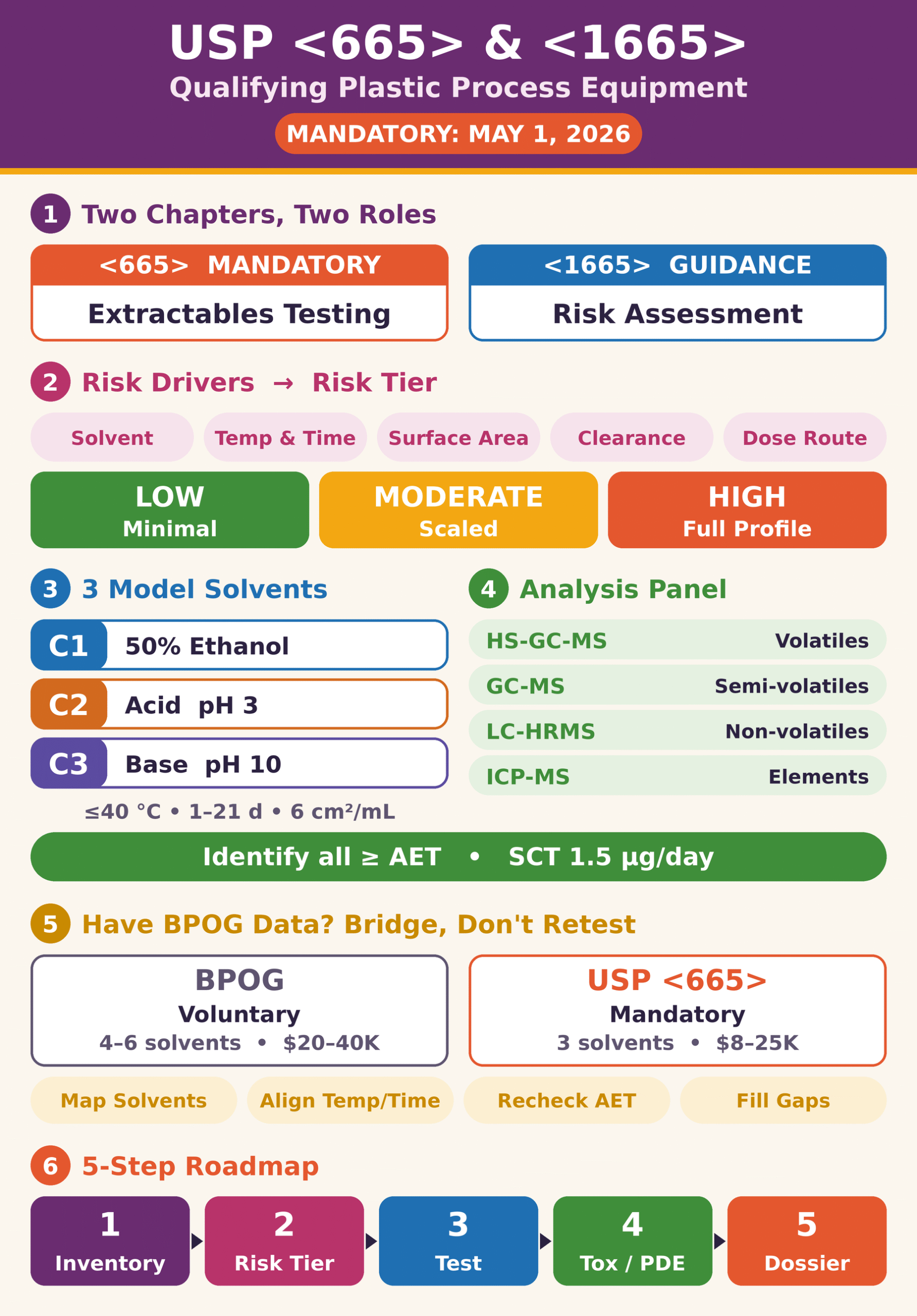
- What it is: USP <665> is a mandatory chapter that sets extractables testing for plastic components that touch drug process streams. USP <1665> is its informational companion on risk assessment. Enforcement starts May 1, 2026.
- Why it matters: Additives in single-use bags, tubing, filters and connectors can leach into drug products. There they can harm product stability, cause protein aggregation or pose a toxicity risk to patients.
- Risk-based approach: Each component is classed as Low, Moderate or High risk. The class depends on solvent strength, temperature and contact time, surface-area-to-volume ratio, downstream clearance and route of administration. Higher risk means more testing.
- Standard testing: Extractions use three model solvents: C1 (50% ethanol), C2 (pH 3) and C3 (pH 10). They run at up to 40°C for 1–21 days. The extracts are analyzed by HS-GC-MS, GC-MS, LC-HRMS and ICP-MS.
- Safety thresholds: Any compound at or above the Analytical Evaluation Threshold (AET) must be identified and assessed by a toxicologist. The AET is based on a 1.5 µg/day safety concern threshold for parenterals.
- Reusing BPOG data: Existing BPOG data packages don’t need to be repeated. They can be bridged to USP <665> through a gap analysis: map the solvents, align temperature and time, recalculate the AET, and run targeted supplemental tests only where needed. USP testing is also cheaper ($8–25K vs $20–40K per assembly).
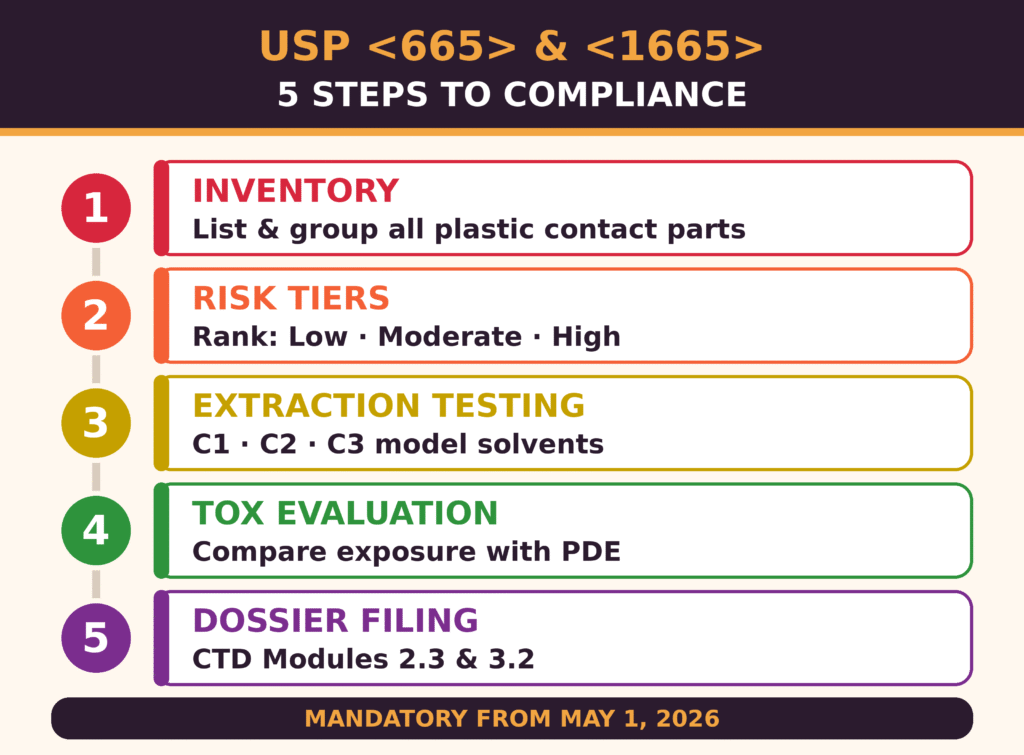
- Five-step roadmap: Build a component inventory, assign risk tiers, run the testing, complete toxicological (PDE) evaluation, and add the results to the regulatory dossier, with supplier change controls in place.
Regulatory Mandate: Demarcating USP and
The primary distinction between USP and concerns their regulatory status and intended application. USP is a mandatory, legally enforceable compendial chapter that establishes extractables testing requirements, whereas USP is an informational companion chapter that provides guidance on risk assessment. This two-chapter structure establishes a clear separation between enforceable testing requirements and the scientific principles used to develop appropriate testing programs.
The scope of USP covers both single-use systems (SUS) and multi-use systems (MUS) manufactured from polymeric materials that come into contact with liquid or semi-solid process streams during the production of active pharmaceutical ingredients (APIs), biological drug substances, and finished drug products. The regulatory differences between these chapters extend across several important operational areas.
Legal Status and Enforcement
USP is a normative, enforceable compendial chapter referenced in the General Notices, making compliance mandatory for commercial product release and regulatory submissions after May 1, 2026. In contrast, USP is an informational chapter designed to support scientific decision-making without establishing explicit pass/fail criteria.
Applicability Domain
USP applies to the physical testing of plastic processing components, including tubing, connectors, storage bags, depth filters, sterile membrane filters, chromatography columns, impellers, and filling nozzles. USP addresses the qualitative and quantitative risk modeling that must be conducted before laboratory extraction studies are designed and performed.
Execution Sequence
Process owners use USP to calculate component risk scores based on relevant operational parameters. The resulting risk classification directly determines the scope and intensity of extraction testing required under USP .
Vendor Versus Drug Manufacturer Roles
Plastic component vendors may generate standardized extractables data packages using USP testing protocols. However, ultimate regulatory responsibility remains with the drug product manufacturer, which must establish process-specific safety profiles using the risk assessment principles outlined in USP .
The Risk Assessment Framework Under USP
The risk assessment framework under USP categorizes process-contact plastic components into Low, Moderate, or High risk tiers according to their operational interactions with the process fluid. This multidimensional assessment helps prevent unnecessary or excessively complex testing of low-risk components while ensuring that high-risk contact materials undergo rigorous analytical characterization.
The risk assessment examines operational parameters across chemical, physical, and clinical dimensions to determine the appropriate level of testing intensity.
| Risk Dimension | Evaluation Parameters | Impact on Risk Score |
|---|---|---|
| Process Stream Solvent Power | Aqueous, acidic, basic, or organic co-solvents; surfactants; or high ionic strength. | Higher organic content or extreme pH conditions substantially increase extraction potential. |
| Contact Temperature and Duration | Contact time, ranging from minutes to weeks, and operating temperatures, from cryogenic conditions to ambient temperatures and 40°C or higher. | Elevated temperatures and prolonged contact times increase the diffusion rates of leachables. |
| Component Surface Area-to-Volume Ratio | Small fluid-path connectors compared with large-volume storage bags or high-surface-area depth filters. | Higher surface-area-to-volume ratios increase the potential concentration of migrating compounds in the process fluid. |
| Downstream Clearance Capacity | Position of the component relative to purification steps, such as ultrafiltration, chromatography, and dialysis. | Components located after the final purification stage, such as those in final filling lines, present the highest risk. |
| Clinical Route of Administration | Parenteral, inhalation, ophthalmic, oral, or topical dosage forms. | Parenteral and respiratory routes present particularly high clinical risks because of the potential for rapid or substantial systemic exposure. |
The component evaluation results in one of three classifications: Low Risk, Moderate Risk, or High Risk. Low-risk components, such as fluid transfer tubing used for short contact periods before effective downstream purification, generally require minimal characterization. This may be limited to basic physicochemical testing or supplier-provided material declarations. Moderate-risk components require appropriately scaled extractables profiling under conditions representative of the manufacturing process. High-risk components, including single-use final formulation bags, sterile-grade filling-line filters, and filling needles, require comprehensive organic profiling across the full suite of USP model solvents.
Extractables Testing Protocol and Analytical Methodologies in USP
Extractables testing under USP involves exposing plastic components to Standardized Extractables Testing Protocol (SETP) model solvents, followed by orthogonal chemical characterization using GC-MS, LC-HRMS, and ICP-MS. The SETP establishes consistent extraction conditions that generate reproducible data representing potential worst-case chemical release profiles for regulatory submissions.
Standardized Extraction Media (SETP Model Solvents)
USP replaces complex and inconsistently selected extraction solvent mixtures with three core model solutions designed to represent common pharmaceutical manufacturing process streams.
Solution C1 (50% Ethanol / 50% Water v/v): This solution represents process streams containing organic solvents, lipophilic compounds, high-solute formulations, or surfactants. Solution C1 provides organic extraction capability while being designed to avoid dissolving the primary polymer backbone.
Solution C2 (Acidic Extraction Medium — 0.2 M KCl adjusted to pH 3.0): This medium simulates low-pH bioprocess buffers, including those used during viral inactivation steps and acidic eluates obtained from protein A chromatography.
Solution C3 (Basic Extraction Medium — 0.1 M Phosphate Buffer adjusted to pH 10.0): This solution represents high-pH cleaning solutions, alkaline buffer systems, and basic process streams that may promote base-catalyzed degradation or hydrolysis of polymer additives.
Extractions are performed at controlled temperatures of up to 40°C for defined periods, ranging from 24 hours to 21 days depending on the component’s risk profile. A standardized surface-area-to-volume ratio, typically 6 cm²/mL, is also maintained to support consistent and comparable extraction results.
For a closer look at analytical method selection, read our comparison of GC-MS and LC-MS in extractables and leachables testing.
Instrumental Analytical Panels
Characterization of the extracted solutions requires complementary analytical instruments capable of detecting, identifying, and quantifying trace organic and inorganic migrating compounds. Specialized testing laboratories use comprehensive analytical platforms to cover a broad range of compound volatilities and polarities.
| Volatility / Target Class | Primary Analytical Instrument | Typical Target Analytes / Additives |
|---|---|---|
| Volatile Organic Compounds (VOCs) | Headspace Gas Chromatography-Mass Spectrometry (HS-GC-MS). | Residual solvents, low-boiling monomers, oxidation products, and degradation fragments. |
| Semi-Volatile Organic Compounds (SVOCs) | Direct Injection Gas Chromatography-Mass Spectrometry (GC-MS). | Plasticizers, including phthalates and adipates; slip agents, such as erucamide and oleamide; alkylphenols; and antioxidants, including BHT. |
| Non-Volatile Organic Compounds (NVOCs) | Ultra-High Performance Liquid Chromatography coupled to High-Resolution Mass Spectrometry (UHPLC-HRMS / LC-MS). | Hindered phenolic antioxidants, including Irganox 1010/1076; phosphite processing stabilizers, such as Irgafos 168 and its oxidized forms; oligomers; and photoinitiators. |
| Elemental Impurities | Inductively Coupled Plasma-Mass Spectrometry (ICP-MS). | Heavy metals, catalyst residues, including zinc, titanium, and platinum, and metallic cross-linking agents. |
| Physicochemical Screening | Total Organic Carbon (TOC), Non-Volatile Residue (NVR), and UV-Vis Absorbance. | Overall organic load, accumulation of non-volatile material, and light-absorbing chromophores. |
Analytical Evaluation Thresholds (AET) must be calculated for each testing configuration. The AET represents the concentration threshold at or above which an extractable compound must be chemically identified and assessed for toxicological safety. Its calculation relies on the Safety Concern Threshold (SCT), which is typically set at 1.5 µg/day for parenteral products based on ICH M7 principles, with adjustments for daily dose volume, contact surface area, and analytical dilution factors.
Learn more about establishing appropriate identification thresholds in our guide to AET for extractables and leachables studies.
Comparing USP and with BPOG Guidelines and Data Bridging Strategies
Although BPOG guidelines provide a voluntary, worst-case extraction framework involving four to six solvents for supplier benchmarking, USP and establish a mandatory compendial framework using three model solvents tailored to pharmaceutical manufacturing risk classifications. Understanding these operational differences allows drug manufacturers to evaluate existing datasets through gap analyses rather than unnecessarily repeating expensive testing programs.
Technical Protocol Comparison
The BioPhorum Operations Group (BPOG) developed standardized extractables protocols that have achieved widespread adoption across the pharmaceutical and biopharmaceutical industries. However, BPOG guidelines represent voluntary industry best practices, whereas USP establishes a mandatory compendial standard.
| Comparison Parameter | BPOG Extractables Protocol | USP Compendial Standard |
|---|---|---|
| Regulatory Status | Voluntary industry consortium best practice. | Mandatory compendial standard, effective May 1, 2026. |
| Primary Design Intent | Development of worst-case supplier benchmarking profiles. | Process-representative risk evaluation for regulatory dossiers. |
| Extraction Solvents | Four to six solvents, including WFI, 0.1 M H₃PO₄, 0.5 N NaOH, and 50% ethanol, among others. | Three standardized model solvents: Solution C1 (50% EtOH), C2 (pH 3), and C3 (pH 10). |
| Sampling Timepoints | Up to four timepoints, such as 24 hours, 7 days, 21 days, and 70 days, to evaluate leaching kinetics. | A single representative timepoint selected within 1 to 21 days according to the applicable risk tier. |
| Risk Tailoring | Uniform worst-case testing of components, regardless of their individual risk classification. | Testing scope scaled according to USP risk tiers. |
| Average Testing Cost | USD 20,000–40,000 per component assembly. | USD 8,000–25,000 per component assembly, depending on the risk-based testing scope. |
Data Bridging and Gap Analysis Strategies
Drug manufacturers do not necessarily need to repeat extractables testing for components supported by comprehensive BPOG data packages. Instead, process owners can use existing analytical results through a scientifically justified and documented bridging approach.
Solvent Equivalence Mapping
Determine whether the solvent systems used in existing BPOG studies adequately cover the chemical extraction conditions represented by Solutions C1, C2, and C3. BPOG’s 50% ethanol solution corresponds to Solution C1, while its 0.5 N NaOH solution may provide coverage for, or exceed the extraction strength of, Solution C3. However, the acidic extraction medium used in BPOG studies (0.1 M H₃PO₄) may require a scientific bridging assessment to establish equivalence with Solution C2 (0.2 M KCl, pH 3.0).
Temperature and Time Point Alignment
Confirm that the extraction temperatures and historical sampling timepoints adequately represent or encompass the actual operating conditions and contact durations encountered during drug manufacturing. Any differences must be evaluated to determine whether the existing dataset sufficiently characterizes the potential migration of compounds under process-specific conditions.
AET Recalculation
Reassess the analytical detection and identification limits reported in historical studies against the AET calculated for the relevant drug product. This calculation must account for the specific dosage, maximum daily administration, and other applicable exposure-related factors to establish whether the available analytical sensitivity is adequate.
Targeted Supplemental Testing
When data gaps are identified, such as missing acidic extraction results or inadequate analytical sensitivity for volatile compounds, manufacturers can conduct targeted supplemental extraction studies. This approach addresses specific deficiencies without requiring the entire testing matrix to be repeated.
ResolveMass Laboratories Inc. supports pharmaceutical manufacturers by conducting detailed gap analyses of vendor-supplied datasets, restructuring historical BPOG reports into USP-compliant formats, and performing targeted supplemental extractions to address regulatory deficiencies in a cost-effective manner.
Explore our extractables and leachables testing services for outsourced projects to understand how specialized laboratory support can help address testing requirements and data gaps.
Step-by-Step Implementation Roadmap for USP and Compliance
Achieving compliance with USP and involves implementing a five-stage roadmap that includes inventory compilation, risk classification, protocol execution, toxicological safety assessment, and regulatory dossier submission.
Inventory Compilation and Component Grouping
Develop a comprehensive inventory of all plastic components that contact liquid or semi-solid process streams during API synthesis, bioprocessing, purification, and final formulation. Group identical components or those manufactured from the same materials of construction into component families. For example, tubing sets made from identical silicone or C-Flex formulations may be grouped to optimize the testing workload while maintaining scientifically justified coverage.
Execution of USP Risk Assessments
Apply the USP decision matrix to assign every component group to an appropriate risk tier. Document the scientific justification for each classification, explicitly addressing the extraction potential of the process stream, contact duration, operating temperature, downstream purification and clearance steps, and clinical risks associated with the intended dosage and route of administration.
Analytical Protocol Execution
For components requiring chemical characterization, finalize testing protocols using the applicable USP SETP parameters. Ensure that the contract testing laboratory operates in compliance with cGMP requirements, uses validated analytical methods, and establishes AET limits appropriate to the drug product’s maximum daily dose. The selected analytical methods should provide adequate sensitivity and coverage for the expected range of organic and inorganic extractables.
For drug products requiring additional method development and verification, see our resource on method validation for leachables testing.
Toxicological Evaluation and PDE Derivation
Chemical species detected at or above the AET must undergo appropriate toxicological evaluation. Toxicologists calculate compound-specific Permitted Daily Exposure (PDE) values using available toxicological evidence, including published data, NOAEL (No Observed Adverse Effect Level) values, and appropriate safety factor adjustments. The estimated patient exposure is then compared with the applicable PDE to determine whether the potential exposure presents an unacceptable safety concern.
Read our guide to toxicological qualification of leachables for further information about evaluating potential patient exposure and establishing safety-based acceptance criteria.
Dossier Integration and Lifecycle Management
Incorporate risk assessment justifications, SETP analytical reports, and toxicological evaluations into the relevant sections of regulatory dossiers, including the Quality Overall Summary (Module 2.3) and the Body of Data (Modules 3.2.S and 3.2.P). Establish robust supplier change-notification agreements to ensure that future resin modifications, changes in gamma irradiation dose, or manufacturing process adjustments trigger appropriate requalification and additional testing when necessary.
For products in prefilled syringe systems, review the specific considerations described in our extractables and leachables testing guide for prefilled syringes.
Conclusion and Strategic Next Steps for USP and Readiness
Proactive preparation for USP and compliance ahead of the mandatory May 1, 2026 deadline is essential for minimizing regulatory submission delays and protecting drug product safety. Pharmaceutical manufacturers should systematically audit their process-contact materials, complete risk classifications, conduct gap analyses of supplier-provided extractables data, and perform any additional analytical testing required to address identified deficiencies. Collaborating with experienced analytical testing laboratories provides access to the technical infrastructure, mass spectrometry capabilities, and regulatory expertise necessary to develop scientifically justified and defensible compliance packages.
To evaluate process-contact components, conduct USP extraction testing, or assess legacy BPOG datasets for potential compliance gaps, pharmaceutical manufacturers can consult the analytical and regulatory specialists at ResolveMass Laboratories Inc. through the ResolveMass Contact Page.
Frequently Asked Questions
USP covers polymeric processing components that come into contact with liquid or semi-solid process streams during pharmaceutical and biopharmaceutical manufacturing. Examples include single-use bags, tubing, filtration assemblies, connectors, chromatography columns, mixing impellers, sensors, pump tubing, and filling-line components.
Yes, multi-use systems (MUS) made from polymeric materials may fall within the scope of USP when they contact liquid or semi-solid process streams. Examples include reusable polymeric filter housings and transfer tubing, whereas the applicability of requirements to other equipment depends on its material composition and intended use.
Previously generated BPOG extractables data may support USP compliance if a documented scientific assessment demonstrates that the existing studies adequately address the applicable requirements. Manufacturers should evaluate solvent compatibility, extraction conditions, contact durations, and analytical sensitivity to identify whether additional testing is necessary.
The article identifies three model solvents: Solution C1, containing 50% ethanol and 50% water (v/v); Solution C2, consisting of 0.2 M KCl adjusted to pH 3.0; and Solution C3, containing 0.1 M phosphate buffer adjusted to pH 10.0. These solutions represent different extraction conditions for assessing potential chemical migrants from polymeric processing components.
Several complementary analytical techniques are used to characterize extractables across different chemical classes. HS-GC-MS is suitable for volatile organic compounds, direct-injection GC-MS for semi-volatile compounds, UHPLC-HRMS for non-volatile organic compounds, and ICP-MS for evaluating elemental impurities.
Toxicological evaluation determines whether potential exposure to identified extractables could pose a risk to patients. Compounds detected at or above the calculated Analytical Evaluation Threshold (AET) are assessed using available toxicological evidence to establish appropriate safety limits, including Permitted Daily Exposure (PDE) values where applicable.
The effectiveness of downstream purification can influence the risk classification of polymeric components by reducing the potential transfer of extractables into the final drug product. Components positioned before processes such as ultrafiltration, chromatography, or diafiltration may present a lower residual risk when these steps effectively remove relevant compounds.
A comprehensive qualification package should include the USP risk assessment, justification for component grouping, applicable SETP extraction reports, and supporting AET calculations. It should also contain relevant toxicological assessments, including PDE evaluations where appropriate, together with supplier change-control procedures to maintain compliance throughout the product lifecycle.
Reference:
- United States Pharmacopeia. (n.d.). Accelerated revisions: Official date. https://www.uspnf.com/official-text/accelerated-revisions-official-date
- United States Pharmacopeia. (2022, February 25). Notice of intent to revise USP–NF General Chapter : Plastic components and systems used to manufacture pharmaceutical drug products and biopharmaceutical drug substances and products. https://www.uspnf.com/notices-665-nitr-20220225
- United States Pharmacopeia. (n.d.). Frequently asked questions. https://www.usp.org/frequently-asked-questions
Get In Touch With Us
About The Author