
Introduction
The USP Risk Assessment Explained framework provides biopharmaceutical manufacturers with a standardized, science-based methodology for classifying polymeric manufacturing components and determining the precise level of extractables testing required. United States Pharmacopeia (USP) Chapter 665, entitled “Plastic Components and Systems Used to Manufacture Pharmaceutical Drug Products and Biopharmaceutical Drug Substances and Products,” officially becomes mandatory on May 1, 2026. This compendial standard addresses the safety and suitability of single-use systems (SUS) and polymeric process hardware used throughout upstream and downstream bioprocessing. By implementing a defensible risk assessment aligned with the companion informational chapter USP 1665, drug product sponsors can eliminate redundant testing, reduce analytical expenditure, and protect regulatory approval timelines.
Historically, pharmaceutical manufacturers have relied on fragmented guidance documents and different testing protocols, including those published by the BioPhorum Operations Group (BPOG). Although BPOG helped standardize solvent extraction practices, its broad implementation frequently resulted in testing protocols that were overly aggressive or insufficiently aligned with specific manufacturing conditions. USP 665 establishes a consistent compendial baseline across regulatory jurisdictions, requiring structured risk evaluations for components that come into contact with liquid process streams. Determining whether a plastic component requires basic physicochemical screening or comprehensive, multi-solvent chromatographic profiling depends on a systematic risk assessment.
| Implementation Phase / Framework | Regulatory Significance | Core Requirement |
|---|---|---|
| Legacy Guidance (e.g., BPOG) | Voluntary industry best practice | Multi-solvent extractions that may result in redundant analytical testing. |
| May 1, 2026, Mandate | Mandatory USP 665 enforceability | Legally binding compendial standard for plastics that contact drug substances and drug products. |
| USP 1665 Risk Matrix | Compendial informational standard | Standardized scoring matrix to justify Low, Moderate, or High Risk classifications. |
Proper implementation of the USP 665 risk assessment enables companies to avoid unnecessary analytical testing while establishing clear compliance documentation. Instead of subjecting every fluid-contact plastic component to the most extensive level of chemical characterization, manufacturers can use historical comparator data, vendor documentation, and process-stream characteristics to justify reduced testing requirements or complete exemptions.
Learn how solvent selection influences extractables recovery and supports scientifically justified testing protocols.
Explore solvent selection for extractables studies
Share via:
Quick Summary:
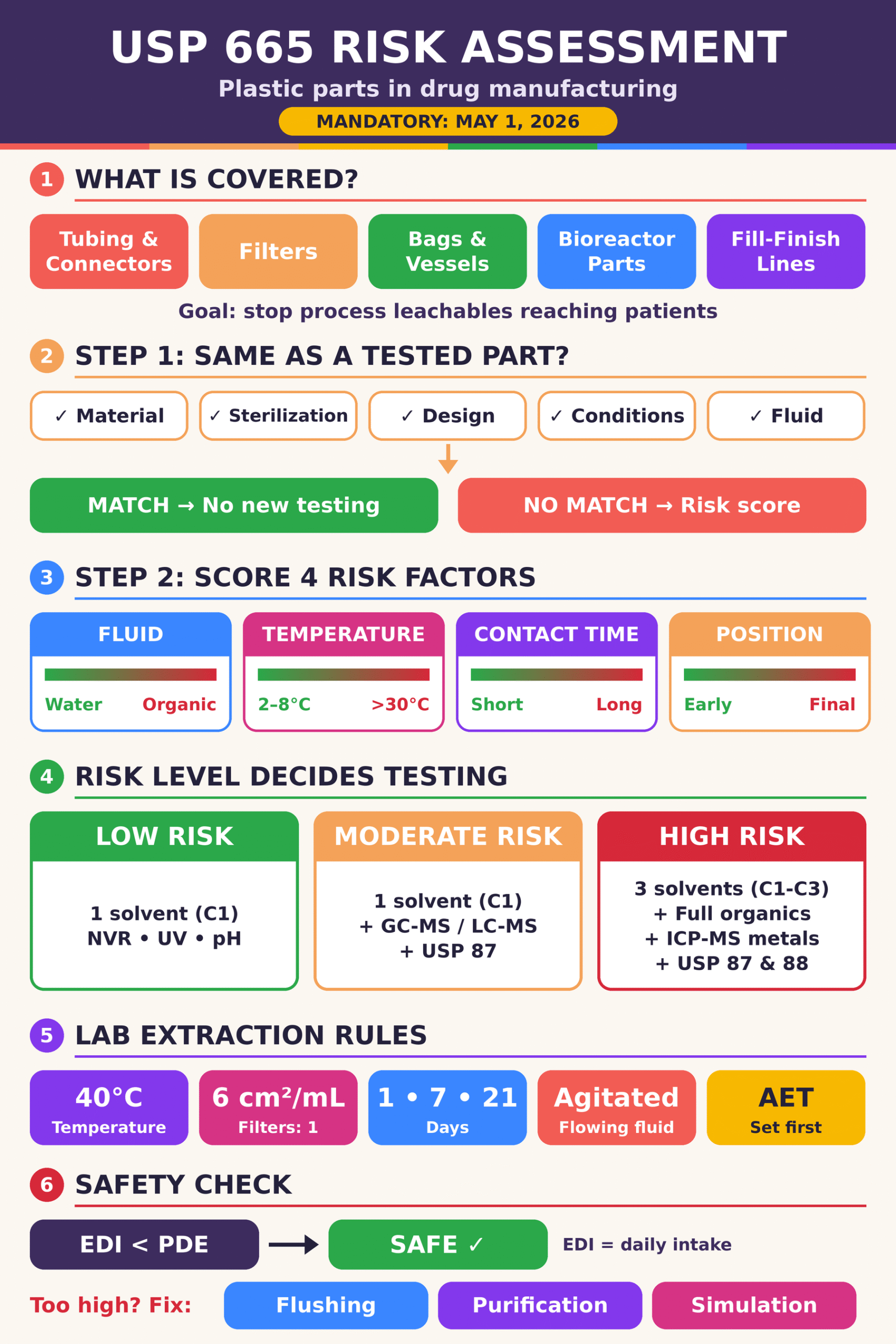
- USP 665 becomes mandatory on May 1, 2026. It sets one compendial standard for plastic parts that touch drug substances and products during manufacturing. It replaces fragmented approaches such as BPOG, which often led to excessive or poorly matched testing.
- Scope covers all fluid-contact plastics. This includes tubing, connectors, filters, bags, bioreactor parts and fill-finish lines. The goal is to keep process equipment-related leachables (PERLs) from harming patients. Final accountability rests with the drug product sponsor, but vendor data can be used.
- Equivalency can remove the need for testing. A new part may need no new extractables testing if it matches a previously tested part. It must match on five things: material, sterilization or pre-treatment, design, contact conditions, and process fluid.
- Four factors decide the risk score. Under the USP 1665 matrix, parts that don’t qualify for equivalency are scored on process fluid composition, contact temperature, contact duration, and how close the part is to the final product. The score places each part in Low, Moderate, or High risk.
- Testing scales with the risk level:
- Low-risk parts need one solvent (C1) plus basic screening: NVR, UV and ΔpH.
- Moderate-risk parts add GC-MS and LC-MS organic profiling and USP 87 cytotoxicity testing.
- High-risk parts need three solvents (C1, C2 and C3), full organic profiling, ICP-MS for metals, and USP 87 and 88 biological testing.
- Extraction conditions are standardized. Studies run at 40°C, with 6 cm²/mL surface area to volume (1 cm²/mL for filters), for 1, 7 or 21 days, with agitation. The Analytical Evaluation Threshold (AET) must be calculated before the study begins.
- Toxicology review closes the loop. Any compound found above the AET is assessed by comparing its estimated daily intake (EDI) with its permitted daily exposure (PDE). If the EDI is too high, the risk can often be managed without replacing the part, through flushing, purification clearance studies, or process simulation studies.
Scope and Core Mechanics under USP 665
The scope of USP 665 encompasses all fluid-contact polymeric components used in the manufacture of drug substances and drug products, with the objective of ensuring that Process Equipment-Related Leachables (PERLs) do not compromise patient safety. The chapter defines the boundaries for evaluating process hardware and assigns ultimate regulatory accountability to the finished drug product sponsor.
Process Equipment-Related Leachables may originate from base polymers, residual monomers, catalysts, or additive formulations, including antioxidants, plasticizers, slip agents, and lubricants. Components that fall directly within the scope of USP 665 include the following:
- Fluid Transfer Systems: Polymeric tubing made from materials such as silicone and thermoplastic elastomers, connectors, manifolds, and sanitary fittings.
- Filtration Units: Sterilizing-grade membrane filters, viral filters, depth filters, and tangential flow filtration (TFF) cassettes.
- Storage and Processing Vessels: Flexible biocontainers, including mixing and storage bags, rigid plastic carboys, and process bottles.
- Single-Use Bioreactor Hardware: Bioreactor bags, spargers, impellers, and internal sensor ports.
- Fill-Finish Equipment: Dosing needles, surge bags, and elastomeric or plastic filling lines.
| Polymeric Material Origin | Potential PERL Classes | Primary Risk Impact |
|---|---|---|
| Base Polymer Matrix | Monomers and low-molecular-weight oligomers | Chemical reactivity and product toxicity. |
| Additive Packages | Antioxidants (Irganox, Irgafos), plasticizers, and slip agents | Migration into the process stream and inhibition of cell growth. |
| Processing Aids | Residual solvents, catalysts (platinum, zinc), and lubricants | Elemental impurities and API degradation. |
Although the ultimate legal responsibility for establishing component suitability rests with the drug product sponsor, successful compliance depends heavily on integrating high-quality vendor datasets. When component manufacturers generate standardized USP 665 extractables reports under defined worst-case conditions, biopharmaceutical end users can incorporate these documentation packages directly into their risk assessments.
Understand how extractables and leachables testing evaluates materials used in pharmaceutical autoinjectors and supports packaging safety assessments.
Explore extractables and leachables testing for autoinjectors
Initial Assessment and Justified Equivalency: Bypassing Unnecessary Extractables Testing
The initial assessment phase allows biopharmaceutical manufacturers to avoid conducting new extractables testing by scientifically demonstrating that a candidate plastic component is functionally and chemically equivalent to a previously evaluated comparator. When justified equivalency has been established and appropriately documented, the component may require no additional extraction studies, thereby preventing unnecessary analytical expenditure.
To establish defensible equivalency and satisfy regulatory auditors, the initial assessment must document matching criteria across five core parameters:
- Material Composition: The component must have the same base polymer, additive formulation, structural fillers, and manufacturing process as the qualified comparator.
- Pre-Treatment and Preparation: Sterilization methods, such as gamma irradiation dose ranges and autoclaving cycles, as well as pre-use preparation procedures, including flushing volumes, must match or meet the comparator specifications.
- Functionality and Design: Surface-area-to-volume ratios, mechanical configurations, and fluid-flow dynamics must be structurally comparable.
- Operational Contact Conditions: Process contact time, maximum exposure temperature, and fluid-line pressure must be equivalent to or less severe than the conditions evaluated for the comparator.
- Process Stream Compatibility: The chemical composition, pH, organic content, and ionic strength of the process fluid must be equivalent to or less aggressive than those of the fluid stream used in the historical evaluation.
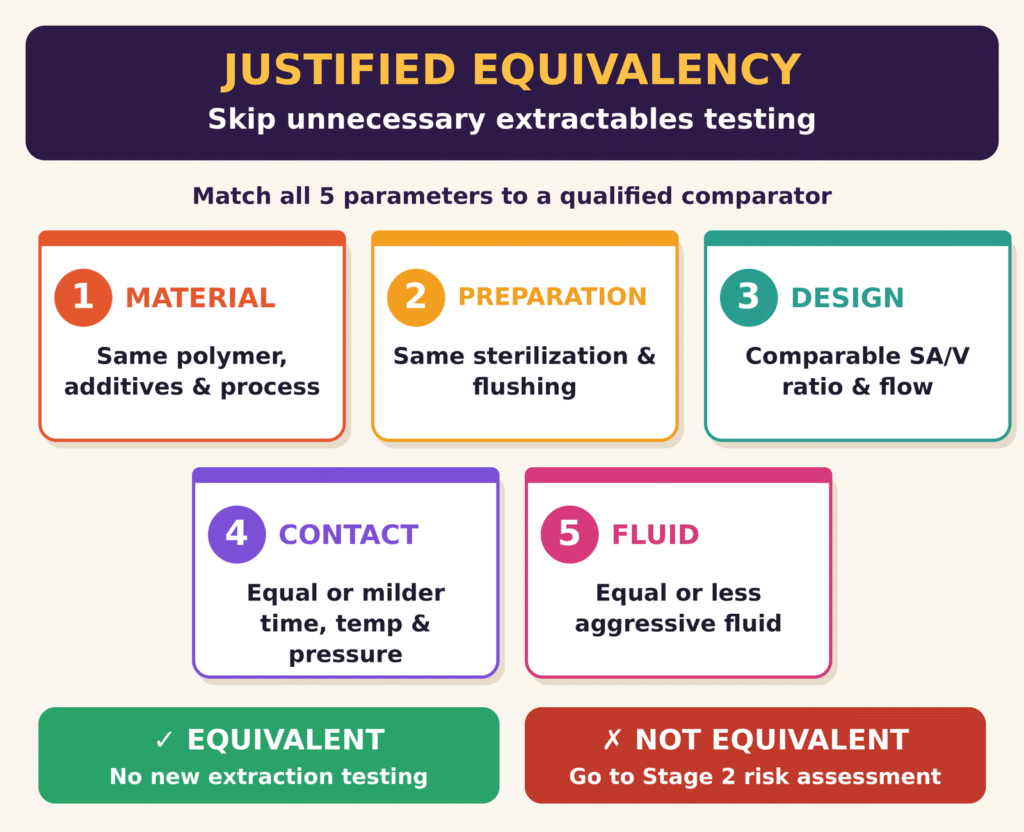
When equivalency is scientifically justified and documented within the quality management system, the component may be exempted from additional extraction testing. If equivalency cannot be demonstrated, the component proceeds to Stage 2: a formal risk assessment conducted according to USP 665.
Step-by-Step USP Risk Assessment Explained through the USP 1665 Framework
A structured USP risk assessment conducted using the USP 1665 framework evaluates component risk through a matrix comprising four operational dimensions: the chemical composition of the process stream, contact temperature, contact duration, and process proximity to the final drug product. Evaluating these dimensions produces an overall risk classification that determines whether a component is categorized as Low Risk, Moderate Risk, or High Risk.
Dimension 1: Chemical Composition of the Process Stream
The chemical composition dimension evaluates the solvency and extraction potential of the process fluid based on its organic solvent content, surfactant presence, and extreme pH conditions. Process fluids are categorized as aqueous (≤5% organic), somewhat organic (5%–40% organic), or highly organic (>40% organic or extreme pH).
When a process fluid contains multiple surfactants or solubilizing agents, such as a therapeutic protein solution containing Polysorbate 80, the chemical risk must account for the combined effect of these substances and their cumulative solubilization potential.
Review how analytical evaluation thresholds help establish appropriate identification and quantification limits for extractables and leachables studies.
Learn about AETs for extractables and leachables studies
Dimension 2: Exposure Temperature
Exposure temperature measures the thermal energy that drives the migration of organic molecules from the polymer matrix into the process stream. Operating conditions are classified into three categories: refrigerated (2°C–8°C), ambient (15°C–25°C), and elevated (>30°C) temperatures.
Dimension 3: Exposure Duration
Exposure duration quantifies the time a fluid remains in contact with a polymeric component because leaching is a time-dependent mass transfer process. Contact periods are classified as short-term (7 days).
Dimension 4: Process Proximity and Downstream Clearance
Process proximity assesses the component’s distance from the final fill-finish stage and considers whether downstream purification steps are available to remove or dilute leachables. Upstream components may benefit from clearance mechanisms such as ultrafiltration or chromatography, whereas downstream components located immediately before primary packaging require the greatest degree of safety consideration.
| USP 665 Risk Dimension | Parameter Criteria | Assigned Risk Level |
|---|---|---|
| Chemical Composition | Aqueous (≤5% organic, pH 3–9) | Low Solvency Risk |
| Chemical Composition | Somewhat organic (5%–40% organic) | Moderate Solvency Risk |
| Chemical Composition | Highly organic (>40% organic or extreme pH) | High Solvency Risk |
| Contact Temperature | Refrigerated (2°C to 8°C) | Low Diffusion Kinetic Risk |
| Contact Temperature | Ambient (15°C to 25°C) | Moderate Diffusion Kinetic Risk |
| Contact Temperature | Elevated (>30°C) | High Diffusion Kinetic Risk |
| Contact Duration | Short (7 days) | High Mass Transfer Potential |
| Process Proximity | Far upstream (multiple clearance steps) | High Dilution / Clearance Potential |
| Process Proximity | Immediate downstream (post-final filtration) | Direct Product Exposure |
Component Risk Tier Classification and Derived Testing Strategies
Combining the scores assigned across the four risk dimensions classifies components into Low Risk, Moderate Risk, or High Risk categories. These classifications determine the extraction media and analytical techniques required for evaluation. This tiered approach ensures that the extent of testing remains proportionate to the potential patient safety risks.
| Risk Tier | Required Extraction Solutions | Physicochemical Screening Suite | Advanced Organic and Elemental Characterization |
|---|---|---|---|
| Low Risk | Solution C1 (50:50 ethanol/water, v/v) | Non-Volatile Residue (NVR), UV Absorbance, ΔpH | Not required unless screening results exceed established limits. |
| Moderate Risk | Solution C1 (50:50 ethanol/water, v/v) | NVR, UV Absorbance, ΔpH, USP 87 Cytotoxicity | Volatiles (HS-GC/MS), semi-volatiles (DI-GC/MS), and non-volatiles (LC-UV/MS). |
| High Risk | Solution C1 (50:50 ethanol/water, v/v); Solution C2 (pH 3.0, acidic); Solution C3 (pH 10.0, basic) | NVR, UV Absorbance, ΔpH, USP 87 Cytotoxicity, and USP 88 Biological Reactivity | Comprehensive volatile, semi-volatile, and non-volatile organic profiling, together with ICP-MS analysis for elemental impurities. |
Low-Risk Components
Low-risk plastic components have a relatively low potential to affect drug product quality or patient safety. Testing is limited to a single extraction medium: Solution C1, a 50:50 (v/v) mixture of anhydrous ethanol and ultrapure water. The screening suite includes Non-Volatile Residue (NVR) gravimetric analysis, Ultraviolet (UV) Absorbance spectrophotometry, and determination of the ΔpH shift.
Moderate-Risk Components
Moderate-risk components undergo extraction using Solution C1, followed by compound-specific organic extractables profiling. The objective is to identify and quantify individual volatile, semi-volatile, and non-volatile organic compounds using Headspace GC-MS, Direct Injection GC-MS, and LC-UV/MS. This analytical approach is combined with USP 87 in vitro cytotoxicity testing to provide additional information about potential biological risks.
Compare the analytical capabilities of GC-MS and LC-MS to understand how complementary techniques support the characterization of volatile, semi-volatile, and non-volatile extractables.
Compare GC-MS and LC-MS in extractables and leachables testing
High-Risk Components
High-risk components require comprehensive extractables characterization using three standardized extraction media: Solution C1 (50:50 ethanol/water), Solution C2 (acidic, pH 3.0), and Solution C3 (basic, pH 10.0). These components undergo complete volatile, semi-volatile, and non-volatile organic profiling, Inductively Coupled Plasma-Mass Spectrometry (ICP-MS) analysis for elemental impurities, and biological reactivity evaluations in accordance with the applicable requirements of USP 87 and USP 88, including in vitro and in vivo assessments where appropriate.
Discover how ICP-MS helps detect and characterize elemental impurities that may originate from polymeric materials and manufacturing components.
Explore ICP-MS in extractables and leachables testing
Standardization of Extraction Protocols and Analytical Methodologies
USP 665 standardizes physical extraction parameters, including temperature, surface-area-to-volume ratios, extraction duration, and dynamic agitation, to generate reproducible extractables profiles under challenging laboratory conditions. Establishing precise Analytical Evaluation Thresholds (AETs) helps ensure that potential leachables present above toxicologically relevant safety thresholds are identified and quantified.
| Extraction Parameter | Compendial Standard Requirement | Scientific Rationale |
|---|---|---|
| Surface Area-to-Volume Ratio | 6 cm²/mL for general fluid-contact parts; 1 cm²/mL for effective filtration area | Represents challenging exposure geometry while maintaining analytical sensitivity above the applicable AET. |
| Extraction Temperature | 40°C ± 2°C | Accelerates thermal leaching kinetics without intentionally altering the polymer matrix structure. |
| Extraction Duration | 1 day (24 hours), 7 days, or 21 days | Aligns extraction duration with the contact-duration categories established during component risk assessment. |
| Fluid Dynamic Agitation | Continuous recirculation or agitation | Simulates mass-transfer boundary-layer dynamics associated with operational fluid flow. |
Analytical Evaluation Thresholds (AETs) must be calculated before the study begins. The AET represents the concentration threshold at or above which an analytical chemist is required to identify and quantify individual extractables. The formula for calculating the AET is expressed as follows:
AET = ( SCT⁄Dose ) × ( Batch Volume⁄Surface Area ) × ( Test Surface Area⁄Extraction Volume ) × ( 1⁄UF )
Where:
- SCT is the Safety Concern Threshold, typically 1.5 µg/day when applying principles used for mutagenic impurities, where appropriate.
- Dose is the maximum daily dose of the final drug product administered to the patient.
- UF is an Uncertainty Factor that accounts for variations in analytical response factors across chromatographic detectors.
The AET calculation must be applied using consistent units and the appropriate study-specific assumptions. The selected threshold and uncertainty factors should be justified and documented to support the identification and quantification of relevant extractables.
Understand why validated analytical methods are essential for producing reliable, reproducible, and defensible leachables data.
Explore method validation for leachables testing
Toxicological Evaluation and Operational Risk Mitigation
Toxicological evaluation compares extractables data with Permitted Daily Exposure (PDE) levels to verify that patient exposure remains within acceptable safety limits. When an extractable exceeds an established threshold, targeted risk mitigation strategies, such as pre-use flushing, downstream clearance validation, or process simulation studies, may help resolve safety concerns without requiring component replacement.
When an extractable compound is identified at a concentration above the calculated AET, a toxicologist evaluates its potential toxicity and establishes an appropriate Permitted Daily Exposure (PDE) or Threshold of Toxicological Concern (TTC), as applicable. If the calculated Estimated Daily Intake (EDI) of a leachable compound remains below the applicable PDE, the exposure may be considered acceptable, provided that the overall toxicological assessment supports this conclusion.
Learn how toxicological qualification evaluates patient exposure and helps determine whether identified leachables present an acceptable level of risk.
Explore toxicological qualification of leachables
If toxicological evaluation identifies a potential safety concern because the EDI exceeds the PDE, manufacturers can implement physical process mitigation measures, including the following:
– Flushing Validation Studies: Conducting pre-use flushing with water for injection (WFI) or suitable buffer solutions can remove low-molecular-weight surface extractables and reduce the potential accumulation of leachables before product exposure. The effectiveness of flushing must be demonstrated under justified conditions.
– Purification Clearance Validation: Manufacturers can demonstrate that downstream purification operations, such as diafiltration cassettes or chromatography columns, remove or dilute the specific extractable compound to acceptable levels. Clearance claims should be supported by appropriate experimental data.
– Targeted Leachable / Simulation Studies: Conducting process-specific simulation studies with actual process fluids under representative operating conditions can establish whether compounds identified during worst-case laboratory extractables testing migrate into the process stream during manufacturing. These studies help determine whether the laboratory findings translate into meaningful product exposure.
Conclusion: Strategic Implementation of USP Risk Assessment Explained
Mastering the USP risk assessment framework enables biopharmaceutical manufacturers to establish a structured approach to regulatory compliance while avoiding redundant and costly extractables testing ahead of the May 2026 deadline. Combining science-based matrix evaluations with comprehensive vendor documentation supports patient safety and operational efficiency.
Conducting a defensible risk assessment using USP 665 provides a systematic foundation for classifying components, designing targeted extraction protocols, and interpreting analytical characterization datasets. As global regulatory expectations concerning Process Equipment-Related Leachables continue to evolve, biopharmaceutical organizations must transition from arbitrary testing practices to structured quality risk management supported by scientific evidence.
Strengthen your extractables and leachables testing strategy with services tailored to your study requirements, analytical objectives, and regulatory documentation needs.
Explore extractables and leachables testing services
For specialized technical consulting, customized risk assessment matrix execution, and advanced analytical characterization aligned with applicable compendial standards, request expert assistance through the ResolveMass Laboratories Contact Page.
Frequently Asked Questions (FAQs)
USP 665 establishes the compendial requirements for plastic components and systems used in pharmaceutical and biopharmaceutical manufacturing. In contrast, USP 1665 provides supporting informational guidance to help manufacturers understand the principles of risk assessment and component evaluation. Together, these chapters support a systematic, science-based approach to assessing potential risks associated with process equipment-related leachables.
USP 665 addresses polymeric components and systems that come into contact with process fluids during the manufacture of pharmaceutical drug substances and drug products. Examples include single-use bags, biocontainers, fluid transfer tubing, sterilizing filters, connectors, impellers, process bottles, and fill-finish dosing needles. Manufacturers should evaluate individual components according to their intended use, material characteristics, and manufacturing conditions.
Manufacturers may be able to avoid repeating extractables studies by demonstrating justified equivalency between a proposed component and a previously evaluated comparator. This assessment should consider material composition, manufacturing processes, sterilization, design, contact conditions, and process-fluid compatibility. Suitable supplier-generated extractables data may also support the assessment, provided its relevance, completeness, and applicability to the intended use are adequately justified and documented.
The three extraction media described in the article are Solution C1, a 50:50 volume-to-volume mixture of ethanol and water; Solution C2, an acidic aqueous medium; and Solution C3, a basic aqueous medium. These solutions help evaluate the potential release of extractable substances under different chemical conditions. The appropriate extraction media and their specified conditions depend on the applicable compendial requirements and the component’s risk classification.
Low-risk plastic components may undergo extraction using Solution C1, followed by basic physicochemical screening. The analytical procedures described include Non-Volatile Residue (NVR) gravimetric analysis, Ultraviolet (UV) Absorbance spectrophotometry, and measurement of changes in pH (ΔpH). Additional testing may be necessary if the screening results exceed established acceptance criteria or indicate a potential safety concern.
High-risk components may require comprehensive extractables profiling using the specified extraction media and suitable analytical methods. Headspace GC-MS is used to investigate volatile compounds, Direct Injection GC-MS to characterize semi-volatile compounds, LC-UV/MS to assess non-volatile compounds, and ICP-MS to detect elemental impurities. Appropriate biological reactivity assessments are also performed to help evaluate potential risks associated with the component’s intended use.
The finished drug product sponsor retains ultimate responsibility for demonstrating that manufacturing components are suitable for their intended use and for supporting the drug product’s regulatory compliance. Component suppliers can contribute by providing material information, manufacturing details, and relevant extractables datasets generated under defined conditions. The sponsor must assess whether these data adequately represent the component and its actual application in the manufacturing process.
The extraction ratios described in the article are 6 cm²/mL for general fluid-contact components and 1 cm²/mL for the effective filtration area of filtration components. These ratios define the relationship between the exposed material surface and the extraction medium volume. Because the appropriate ratio depends on the component type and applicable compendial instructions, the values should be verified against the official USP requirements before study execution.
Downstream purification operations, including ultrafiltration, diafiltration, and chromatography, may reduce patient exposure to process equipment-related leachables by removing or diluting them. Components positioned upstream of effective clearance steps may therefore present a different exposure profile from components located immediately before final drug product filling. However, the extent of risk reduction must be supported by process-specific evidence, and purification steps should not automatically be assumed to eliminate all potential leachables.
Reference:
- United States Pharmacopeia. (2021). General Chapter 〈1665〉: Characterization and qualification of plastic components and systems used to manufacture pharmaceutical drug products and biopharmaceutical drug substances and products. USP–NF. https://doi.org/10.31003/USPNF_M11136_02_01
- GMP Compliance International. (n.d.). Approved USP chapters on plastic components used in manufacturing. https://www.gmp-compliance.org/gmp-news/approved-usp-chapters-on-plastic-components-used-in-manufacturing
- United States Pharmacopeia. (n.d.). Technical challenges and considerations [PDF]. https://www.usp.org/sites/default/files/usp/document/events-training/07%20-%20Technical%20Challenges%20and%20Considerations.pdf
- United States Pharmacopeia. (n.d.). Extractables and leachables. https://www.usp.org/impurities/extractables-and-leachables
Get In Touch With Us
About The Author