

Introduction:
Nitrosamine Testing Inhalation Drug Products MDI DPI Nasal Spray has become a critical focus area for pharmaceutical manufacturers after global regulatory agencies identified nitrosamine contamination risks across multiple drug categories. Inhalation and nasal drug products require especially careful evaluation because these formulations deliver active compounds directly to sensitive respiratory tissues.
For a broader overview of nitrosamine impurities and their pharmaceutical impact, read:
What Are Nitrosamines?
Nitrosamines are classified as potentially carcinogenic impurities. Even trace-level contamination can raise significant regulatory and patient safety concerns. As a result, pharmaceutical companies developing Metered Dose Inhalers (MDIs), Dry Powder Inhalers (DPIs), and nasal sprays must implement scientifically robust nitrosamine risk assessment and testing programs.
Inhalation products present unique analytical complexities due to:
- Low dosage strengths
- Complex formulations
- Propellant interactions
- Elastomeric packaging systems
- Moisture sensitivity
- Volatile matrices
To address these challenges, highly sensitive analytical technologies and validated workflows are required to ensure regulatory compliance and product safety.
Summary:
- Nitrosamine impurities are probable human carcinogens that can form during the manufacturing, storage, or packaging of pharmaceutical products.
- Regulatory agencies including the U.S. Food and Drug Administration and European Medicines Agency require comprehensive nitrosamine risk assessments and testing strategies for inhalation and nasal drug products.
- Nitrosamine Testing Inhalation Drug Products MDI DPI Nasal Spray requires highly sensitive analytical methods due to extremely low acceptable intake limits.
- Metered Dose Inhalers (MDIs), Dry Powder Inhalers (DPIs), and nasal sprays present unique analytical challenges because of propellants, complex excipients, elastomeric components, and low-dose formulations.
- Advanced mass spectrometry-based methods such as LC-MS/MS and GC-MS/MS are essential for accurate detection and quantification.
- ResolveMass Laboratories Inc. supports pharmaceutical manufacturers with method development, validation, extractables and leachables studies, and routine nitrosamine analysis for inhalation drug products.
1: What Are Nitrosamines in Pharmaceutical Products?
Nitrosamines are chemical compounds that may form when secondary or tertiary amines react with nitrosating agents under certain manufacturing or storage conditions.
For additional insights into API-related impurity generation mechanisms, refer to:
Nitrosamine Formation Pathways in API Synthesis
Manufacturers working with complex or highly potent molecules may also benefit from:
Nitrosamine Testing for Highly Potent APIs
Common nitrosamines identified in pharmaceuticals include:
| Nitrosamine Compound | Common Abbreviation |
|---|---|
| N-Nitrosodimethylamine | NDMA |
| N-Nitrosodiethylamine | NDEA |
| N-Nitrosoethylisopropylamine | NEIPA |
| N-Nitrosodibutylamine | NDBA |
| N-Nitrosomethylphenylamine | NMPA |
These impurities can originate from:
- Active pharmaceutical ingredients (APIs)
- Solvents and reagents
- Degradation pathways
- Packaging materials
- Rubber closures and elastomers
- Manufacturing process contamination
For inhalation products, the risk profile can differ significantly from oral dosage forms because inhaled delivery bypasses first-pass metabolism and exposes lung tissues directly.
2: Why Is Nitrosamine Testing Important for Inhalation Drug Products?
Nitrosamine testing is essential because inhalation products may expose patients to impurities directly within the respiratory tract, potentially increasing toxicological concerns.
Regulatory agencies now expect manufacturers to:
- Perform nitrosamine risk assessments
- Identify potential sources
- Develop sensitive analytical methods
- Validate detection procedures
- Establish ongoing monitoring programs
Failure to adequately evaluate nitrosamines can result in:
- Regulatory observations
- Product recalls
- Delayed approvals
- Market withdrawals
- Patient safety risks
To understand recent market impacts and regulatory concerns associated with nitrosamine contamination, see:
- Nitrosamine Drug Recalls Analysis
- Nitrosamine Testing for Ranitidine
- Nitrosamine Testing for Rifampicin
- Nitrosamine Testing for Rifapentine
Due to the low acceptable intake limits for many nitrosamines, analytical methods often require detection capability at parts-per-billion (ppb) or even parts-per-trillion (ppt) levels.
For regulatory intake calculations and toxicological thresholds, explore:
- Acceptable Intake for Multiple Nitrosamines
- Nitrosamine AI Limits Comparison
- Less Than Lifetime (LTL) Exposure Calculations for Nitrosamines
3: Unique Challenges in Nitrosamine Testing for MDIs, DPIs, and Nasal Sprays
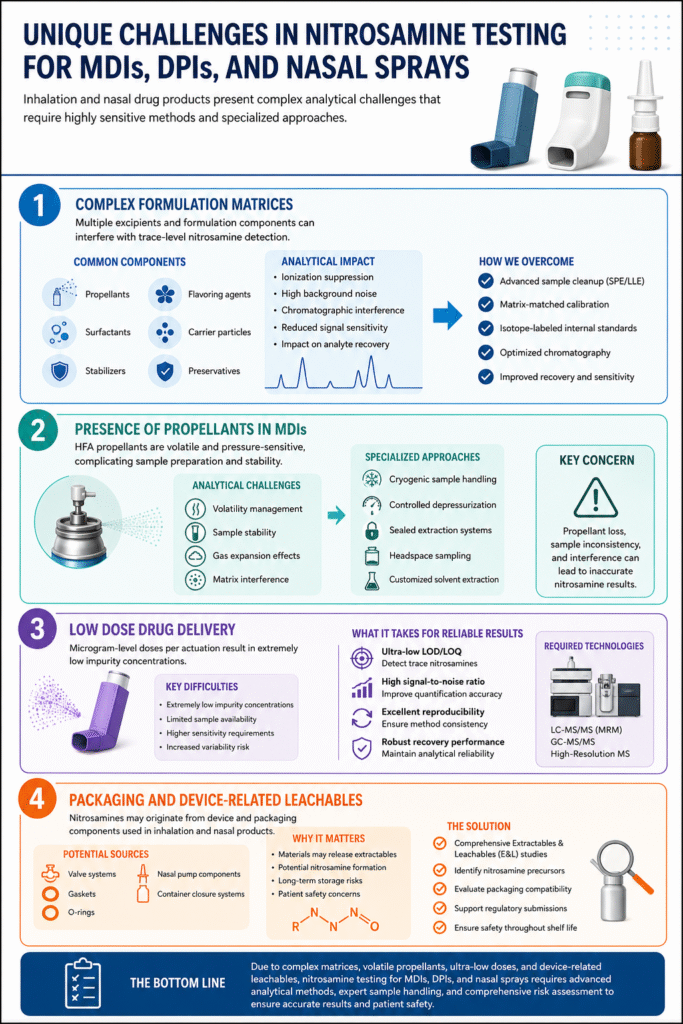
Nitrosamine testing for inhalation drug products is significantly more complex than testing conventional oral dosage forms. MDIs, DPIs, and nasal sprays contain intricate formulations, specialized delivery systems, and ultra-low-dose APIs that demand highly sensitive and carefully optimized analytical methods. Understanding these challenges is essential for developing reliable nitrosamine control strategies and ensuring regulatory compliance.
To overcome matrix-related interferences during LC-MS/MS analysis, laboratories frequently use advanced analytical strategies discussed here:
Overcoming Matrix Effects in LC-MS/MS
For inhalation products containing volatile components, specialized extraction workflows may involve headspace methodologies:
Direct Injection vs Headspace Techniques for Nitrosamines
Packaging interactions are another critical risk area. Additional details are available in:
Packaging Leachables and Nitrosamine E&L Studies
1. Complex Formulation Matrices
Inhalation and nasal drug products often contain multiple excipients and formulation components that can interfere with trace-level nitrosamine detection. These matrices are far more complicated than standard tablet or capsule formulations and can directly affect analytical sensitivity and accuracy.
Common formulation components include:
- Propellants
- Surfactants
- Stabilizers
- Flavoring agents
- Carrier particles
- Preservatives
These substances may create significant analytical complications during LC-MS/MS or GC-MS/MS testing by:
- Suppressing ionization efficiency
- Generating high background noise
- Causing chromatographic interference
- Reducing signal sensitivity
- Impacting analyte recovery
For example, surfactants and oily excipients can interfere with electrospray ionization during LC-MS/MS analysis, while volatile formulation ingredients may complicate chromatographic separation in GC-MS workflows.
To overcome these issues, laboratories often implement:
- Advanced sample cleanup procedures
- Solid-phase extraction (SPE)
- Matrix-matched calibration standards
- Isotope-labeled internal standards
- Optimized chromatographic conditions
Careful method development is essential to achieve reliable trace-level nitrosamine quantification in complex inhalation formulations.
2. Presence of Propellants in MDIs
Metered Dose Inhalers (MDIs) present unique analytical challenges because they contain hydrofluoroalkane (HFA) propellants that are highly volatile and pressure-sensitive. These propellants can complicate both sample preparation and analytical stability.
Major analytical concerns include:
- Volatility management
- Sample stability
- Gas expansion effects
- Matrix interference
During sample handling, rapid propellant evaporation may lead to:
- Inconsistent analyte concentration
- Sample loss
- Pressure-related safety concerns
- Reduced reproducibility
In addition, volatile propellants may interfere with nitrosamine extraction efficiency or co-elute with volatile nitrosamine compounds during GC-MS/MS analysis.
To address these challenges, specialized analytical workflows are often required, including:
- Cryogenic sample handling
- Controlled depressurization techniques
- Sealed extraction systems
- Headspace sampling approaches
- Customized solvent extraction protocols
Proper containment and sample preparation are critical to ensuring accurate and reproducible nitrosamine testing in MDI products.
3. Low Dose Drug Delivery
Many inhalation products deliver extremely small doses of active pharmaceutical ingredient (API), often in the microgram range per actuation. While therapeutically effective, these ultra-low-dose systems create major analytical sensitivity challenges for nitrosamine testing.
Key difficulties include:
- Extremely low impurity concentrations
- Limited sample availability
- Higher sensitivity requirements
- Increased variability risk
Because acceptable intake limits for nitrosamines are already extremely low, detecting trace impurities in microgram-dose inhalation products requires ultra-sensitive instrumentation and highly optimized analytical methods.
Analytical laboratories must often achieve:
| Analytical Requirement | Importance |
|---|---|
| Very low LOD/LOQ | Detect trace nitrosamines |
| High signal-to-noise ratio | Improve quantification accuracy |
| Excellent reproducibility | Ensure regulatory compliance |
| Robust recovery performance | Maintain analytical reliability |
Techniques such as LC-MS/MS with multiple reaction monitoring (MRM) and high-resolution mass spectrometry (HRMS) are commonly used to meet these demanding sensitivity requirements.
4. Packaging and Device-Related Leachables
Inhalation devices and nasal spray packaging systems may themselves become potential sources of nitrosamine contamination. Nitrosamines can form from elastomeric materials, adhesives, inks, or rubber components used in device construction and container closure systems.
Potential contributors include:
- Valve systems
- Gaskets
- O-rings
- Nasal pump components
- Container closure systems
Over time, packaging materials may release extractables or leachables that either contain nitrosamines directly or contribute to nitrosamine formation during storage.
This is particularly important because inhalation products often remain in contact with device components for extended periods under varying temperature and humidity conditions.
As a result, comprehensive Extractables and Leachables (E&L) studies are essential during product development and stability assessment. These studies help manufacturers:
- Identify potential nitrosamine precursors
- Evaluate long-term contamination risks
- Assess packaging compatibility
- Support regulatory submissions
- Ensure patient safety throughout shelf life
Advanced mass spectrometry techniques play a crucial role in characterizing unknown leachables and confirming trace-level nitrosamine presence in inhalation drug-device combination products.
4: Nitrosamine Risk Assessment for Inhalation Products
A scientifically sound nitrosamine risk assessment helps identify potential contamination pathways early in development.
Risk assessments should include both theoretical and experimentally confirmed evaluations.
Additional guidance for regulatory submissions and lifecycle management includes:
- Nitrosamine Lifecycle Management
- Nitrosamine Risk Assessment for ANDA Submission
- Impact of ICH M7(R2) Updates on Nitrosamine Risk Assessment
- Nitrosamine Control During Supplier Qualification
Key Areas Evaluated During Risk Assessment
| Risk Factor | Evaluation Focus |
|---|---|
| API synthesis | Amines, nitrites, solvents |
| Excipients | Nitrite contamination |
| Manufacturing process | Cross-contamination potential |
| Packaging materials | Nitrosatable compounds |
| Storage conditions | Degradation pathways |
| Water systems | Nitrite presence |
Risk assessments should include both theoretical and experimentally confirmed evaluations.
5: Method Development Considerations for Inhalation Products
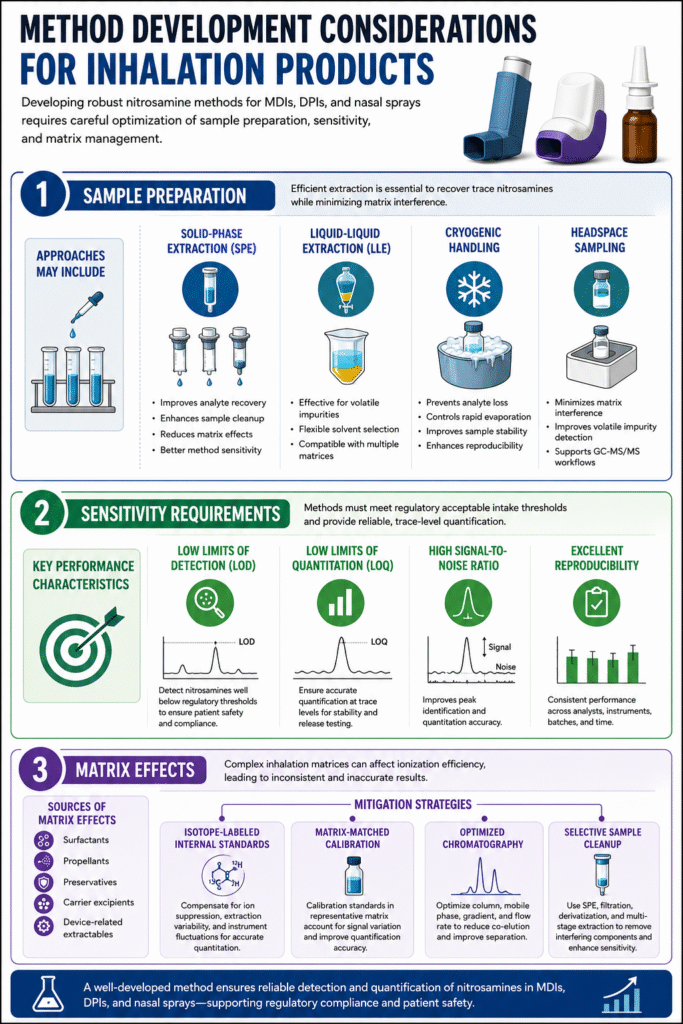
Developing robust nitrosamine analytical methods for inhalation drug products requires careful optimization of sample preparation, sensitivity, and matrix management. MDIs, DPIs, and nasal sprays contain highly complex formulations that can significantly impact trace-level impurity detection. To ensure accurate and regulatory-compliant results, analytical methods must be specifically designed for inhalation product characteristics.
Because inhalation products often require ultra-trace detection capability, highly sensitive analytical methods are essential.
Additional analytical resources include:
- Ultra-Low Limit of Quantitation (LOQ) in Nitrosamine Testing
- HRMS for Nitrosamine Testing
- Nitrosamine Reference Standard Qualification
Critical Parameters:
1. Sample Preparation
Efficient extraction is essential to recover trace nitrosamines while minimizing matrix interference.
Approaches may include:
- Solid-phase extraction (SPE)
- Liquid-liquid extraction (LLE)
- Cryogenic handling
- Headspace sampling
2. Sensitivity Requirements
Methods must meet regulatory acceptable intake thresholds.
Key performance characteristics include:
- Low limits of detection (LOD)
- Low limits of quantitation (LOQ)
- High signal-to-noise ratio
- Excellent reproducibility
3. Matrix Effects
Complex inhalation matrices can affect ionization efficiency.
Mitigation strategies include:
- Isotope-labeled internal standards
- Matrix-matched calibration
- Optimized chromatography
- Selective sample cleanup
6: Regulatory Expectations for Nitrosamine Testing
Regulatory authorities worldwide now require proactive nitrosamine control strategies.
Manufacturers may need continuous monitoring throughout the product lifecycle.
This includes:
- Stability studies
- Change control assessments
- Supplier qualification
- Batch release testing
For more detailed regulatory compliance guidance, see:
- Nitrosamine Batch Release Testing Requirement
- Nitrosamine Testing in Stability Studies
- Nitrosamine Specification Setting
- Nitrosamine Alert Limit vs Action Limit
- NDA vs ANDA Nitrosamine Submission Requirements
Key Regulatory Expectations:
1. Risk-Based Evaluation
Manufacturers should evaluate:
- Raw materials
- Process chemistry
- Packaging systems
- Storage conditions
2. Validated Analytical Methods
Methods should demonstrate:
| Validation Parameter | Requirement |
|---|---|
| Specificity | No interference |
| Accuracy | Reliable recovery |
| Precision | Repeatable results |
| Sensitivity | Low ppb/ppt detection |
| Robustness | Stable performance |
3. Ongoing Monitoring
Manufacturers may need continuous monitoring throughout the product lifecycle.
This includes:
- Stability studies
- Change control assessments
- Supplier qualification
- Batch release testing
7: Nitrosamine Testing for Nasal Sprays
Nitrosamine testing for nasal sprays requires specialized analytical strategies because these formulations often contain aqueous environments that may promote nitrosation reactions under certain manufacturing or storage conditions. Compared with many other inhalation products, nasal sprays present unique formulation and packaging challenges that can directly influence nitrosamine formation and stability.
Because nasal drug products are administered directly onto highly vascularized nasal tissues, regulatory agencies typically expect highly sensitive impurity monitoring and robust risk assessment programs to ensure patient safety.
Nasal spray products often require ongoing stability evaluation and packaging compatibility assessments.
Additional related resources include:
Why Nasal Sprays Require Specialized Nitrosamine Testing
Nasal spray formulations commonly contain:
- Water-based systems
- Preservatives
- Buffering agents
- Stabilizers
- Pump delivery components
- Polymer-based materials
These components may contribute to nitrosamine formation, degradation pathways, or analytical interference during trace-level impurity testing.
Additionally, nasal products often remain in prolonged contact with packaging and pump system materials throughout their shelf life, increasing the importance of extractables and leachables evaluations.
Important Considerations in Nitrosamine Testing for Nasal Sprays
1. Preservative Compatibility
Preservatives used in nasal sprays can sometimes interact with formulation components or degradation products, potentially contributing to nitrosamine formation under certain conditions.
Common concerns include:
- Chemical incompatibility
- Reactive degradation pathways
- Formation of nitrosating species
- Analytical interference during detection
Preservative systems must therefore be carefully evaluated during formulation development and stability studies.
Analytical scientists often assess:
- Preservative stability
- Interaction with amine-containing compounds
- Long-term degradation behavior
- Potential impurity generation pathways
Sensitive LC-MS/MS methods are commonly used to monitor trace nitrosamine levels in preservative-containing nasal formulations.
2. pH Stability
The pH of nasal spray formulations can significantly influence nitrosation reactions and overall product stability.
Certain acidic conditions may increase the likelihood of nitrosamine formation when nitrites and amines are present simultaneously.
Key pH-related considerations include:
| Parameter | Importance |
|---|---|
| Formulation pH range | Influences nitrosation potential |
| Buffer selection | Affects chemical stability |
| Long-term pH drift | May alter impurity formation |
| Storage conditions | Impacts degradation pathways |
Careful pH optimization helps reduce the risk of impurity formation while maintaining formulation performance and patient tolerability.
Stability studies are essential for monitoring potential nitrosamine generation over time under various environmental conditions.
3. Pump System Extractables
Nasal spray pump systems may contain elastomers, plastics, adhesives, lubricants, and polymeric materials that can release extractables or leachables into the formulation during storage.
Potential risk sources include:
- Rubber seals
- Gaskets
- O-rings
- Plastic pump components
- Adhesives and coatings
Some extractable compounds may:
- Contain nitrosamine precursors
- Directly contribute nitrosamine impurities
- Interfere with analytical measurements
Comprehensive Extractables and Leachables (E&L) studies are therefore critical during nasal spray product development.
Advanced analytical techniques such as:
- LC-MS/MS
- GC-MS/MS
- High-resolution mass spectrometry (HRMS)
are frequently used to identify and characterize trace-level leachables associated with nasal spray devices.
4. Long-Term Storage Stability
Nitrosamine risk in nasal sprays may evolve over time due to interactions between formulation ingredients, packaging materials, and environmental conditions.
Factors influencing long-term stability include:
- Temperature
- Humidity
- Light exposure
- Oxygen exposure
- Packaging compatibility
Even trace nitrosamine formation during storage can become a significant regulatory concern because acceptable intake limits are extremely low.
Long-term stability programs should therefore include:
- Periodic nitrosamine monitoring
- Degradation profiling
- Packaging interaction studies
- Shelf-life impurity evaluation
Regulatory agencies increasingly expect manufacturers to demonstrate that nitrosamine levels remain controlled throughout the entire product lifecycle.
Regulatory Expectations for Nasal Spray Nitrosamine Testing
Due to direct exposure of nasal tissues and systemic absorption potential, regulators often require highly sensitive analytical methods capable of detecting nitrosamines at ultra-trace levels.
Key regulatory expectations include:
- Comprehensive nitrosamine risk assessments
- Scientifically validated analytical methods
- Low ppb or ppt detection capability
- Ongoing stability monitoring
- Packaging compatibility evaluations
Validated LC-MS/MS and GC-MS/MS methods are widely used to achieve the sensitivity and specificity required for modern nasal spray nitrosamine analysis.
8: Nitrosamine Testing for Dry Powder Inhalers (DPIs)
Nitrosamine testing for Dry Powder Inhalers (DPIs) requires specialized analytical approaches because these formulations involve complex powder systems, carrier particles, and highly sensitive inhalation delivery mechanisms. Compared with liquid or propellant-based inhalation products, DPIs present unique challenges associated with powder homogeneity, moisture sensitivity, and particle interactions that can influence trace-level nitrosamine detection.
Because DPIs often deliver extremely low doses directly to the lungs, regulatory agencies expect highly sensitive impurity monitoring and scientifically validated analytical methods capable of detecting nitrosamines at ultra-trace concentrations.
Why DPIs Present Unique Nitrosamine Testing Challenges
Dry Powder Inhalers typically contain:
- Micronized active pharmaceutical ingredients (APIs)
- Carrier excipients such as lactose
- Flow-enhancing agents
- Moisture-sensitive powder blends
- Device-related polymeric components
These systems can complicate nitrosamine extraction, quantification, and stability assessment during analytical testing.
In addition, powder-based formulations may exhibit non-uniform distribution of impurities, making representative sampling especially important.
Common Concerns in Nitrosamine Testing for DPIs
1. Lactose Carrier Impurities
Lactose is one of the most commonly used carrier excipients in DPI formulations. Although pharmaceutically acceptable, lactose materials may contain trace impurities or degradation products that interfere with nitrosamine analysis.
Potential concerns include:
- Trace nitrite contamination
- Residual processing impurities
- Interaction with amine-containing compounds
- Matrix interference during mass spectrometry analysis
Because lactose is often present at significantly higher concentrations than the active ingredient, it may contribute to:
- Ion suppression
- Background signal interference
- Reduced analytical sensitivity
Careful sample cleanup and optimized chromatographic separation are therefore essential for accurate nitrosamine quantification in lactose-containing DPI products.
2. Moisture-Induced Degradation
Dry powder formulations are highly sensitive to environmental moisture, which can alter both product stability and impurity formation pathways.
Moisture exposure may contribute to:
- Chemical degradation
- Nitrosation reactions
- API instability
- Excipient interactions
- Reduced powder flow properties
Even low levels of absorbed moisture can significantly affect trace-level impurity behavior over time.
Important stability considerations include:
| Stability Factor | Potential Impact |
|---|---|
| Relative humidity | Increased degradation risk |
| Water uptake | Promotes chemical reactions |
| Storage temperature | Accelerates impurity formation |
| Packaging integrity | Influences moisture protection |
Comprehensive stability studies are therefore critical for evaluating long-term nitrosamine risk in DPI formulations.
3. Static Charge Effects
Static charge accumulation is a common challenge in dry powder inhalation systems and can affect both formulation performance and analytical testing.
Electrostatic interactions may cause:
- Uneven powder distribution
- Sample loss during handling
- Poor reproducibility
- Inconsistent extraction efficiency
These issues become particularly problematic when detecting nitrosamines at ultra-trace levels.
To minimize electrostatic effects, laboratories may implement:
- Controlled humidity conditions
- Anti-static handling procedures
- Specialized sampling equipment
- Optimized powder transfer techniques
Careful handling protocols are essential for maintaining analytical accuracy and reproducibility.
4. Blend Uniformity
Uniform distribution of both the API and trace impurities is critical in DPI formulations. Poor blend homogeneity can lead to inconsistent nitrosamine concentrations between samples, creating challenges for representative testing.
Factors influencing blend uniformity include:
- Particle size distribution
- Mixing efficiency
- Powder segregation
- Electrostatic interactions
- Carrier particle adhesion
Inadequate blend uniformity may result in:
- Variable analytical recovery
- Inconsistent impurity quantification
- Regulatory compliance concerns
Robust sampling strategies and validated extraction methods are therefore necessary to ensure reliable nitrosamine analysis across multiple batches and stability time points.
Advanced Extraction Workflows for DPI Nitrosamine Analysis
Due to the complexity of dry powder matrices, advanced extraction workflows are often required to isolate trace nitrosamines while minimizing matrix interference.
Common analytical approaches include:
- Solid-phase extraction (SPE)
- Selective solvent extraction
- Multi-stage cleanup procedures
- Matrix-matched calibration
- Isotope-labeled internal standards
These workflows help improve:
- Recovery efficiency
- Detection sensitivity
- Quantitative accuracy
- Method reproducibility
Advanced LC-MS/MS and high-resolution mass spectrometry (HRMS) platforms are commonly used to achieve the ultra-low detection limits required for DPI nitrosamine testing.
Regulatory Expectations for DPI Nitrosamine Testing
Regulatory agencies increasingly expect pharmaceutical manufacturers to implement proactive nitrosamine control strategies for inhalation drug products, including DPIs.
Key regulatory expectations include:
- Comprehensive risk assessments
- Sensitive validated analytical methods
- Stability monitoring programs
- Packaging compatibility evaluations
- Ongoing impurity control strategies
Because inhaled products directly expose lung tissues to drug substances and impurities, regulators often require highly sensitive detection capability at parts-per-billion (ppb) or parts-per-trillion (ppt) levels.
9: Nitrosamine Testing for Metered Dose Inhalers (MDIs)
Nitrosamine testing for Metered Dose Inhalers (MDIs) is particularly complex due to the presence of volatile propellant systems, pressurized packaging, and intricate device components. Among inhalation drug products, MDIs are considered one of the most analytically challenging dosage forms for trace-level nitrosamine analysis.
Because MDIs deliver medication directly into the lungs through aerosolized formulations, regulatory agencies require highly sensitive impurity monitoring and scientifically validated analytical methods capable of detecting nitrosamines at ultra-trace levels.
GC-MS/MS methods are frequently optimized for volatile nitrosamine analysis in MDI systems.
Additional method development resources include:
- Direct Injection vs Headspace Techniques for Nitrosamines
- Nitrosamine Solvent and Catalyst Mitigation Strategies
Key Testing Concerns in Nitrosamine Testing for MDIs:
1. Propellant Compatibility
Hydrofluoroalkane (HFA) propellants are essential components of modern MDIs, but they also introduce significant analytical complexity during nitrosamine testing.
Potential concerns include:
- Volatile matrix interference
- Propellant-induced extraction variability
- Chemical compatibility with APIs and excipients
- Stability of trace nitrosamine impurities
Rapid evaporation of propellants during sample handling may lead to:
- Inconsistent analyte recovery
- Concentration variability
- Sample loss
- Reduced reproducibility
Carefully controlled extraction procedures and sealed handling systems are often necessary to maintain analytical accuracy.
2. Valve Component Extractables
MDI valve systems contain multiple elastomeric and polymeric materials that may contribute extractables or leachables during storage.
Potential sources include:
- Rubber seals
- Gaskets
- O-rings
- Lubricants
- Adhesives
- Polymeric valve materials
These materials may:
- Release nitrosamine precursors
- Directly contribute nitrosamine impurities
- Interfere with trace-level analysis
Comprehensive Extractables and Leachables (E&L) studies are therefore critical for evaluating potential contamination risks associated with MDI device components.
Advanced analytical techniques such as LC-MS/MS, GC-MS/MS, and high-resolution mass spectrometry (HRMS) are commonly used to characterize device-related impurities.
3. Aerosol Consistency
MDIs rely on controlled aerosol generation to ensure accurate drug delivery. However, aerosol variability can complicate representative sampling and nitrosamine quantification.
Factors affecting aerosol consistency include:
- Propellant pressure
- Valve performance
- Particle size distribution
- Formulation stability
- Canister orientation
Inconsistent aerosol generation may result in:
- Variable sample collection
- Uneven analyte distribution
- Reduced analytical reproducibility
Specialized aerosol collection systems and standardized actuation procedures are often implemented to improve sampling consistency during nitrosamine testing.
4. Container Closure Interactions
The interaction between the formulation and container closure system can significantly influence nitrosamine risk over time.
Important considerations include:
| Container Component | Potential Concern |
|---|---|
| Aluminum canisters | Surface interactions |
| Elastomeric seals | Nitrosamine precursor release |
| Valve assemblies | Leachable generation |
| Internal coatings | Chemical compatibility |
Long-term storage conditions may promote:
- Extractable migration
- Chemical degradation
- Nitrosamine formation pathways
- Product instability
As a result, stability studies and packaging compatibility evaluations are essential components of MDI nitrosamine risk assessment programs.
Role of GC-MS/MS in MDI Nitrosamine Analysis
GC-MS/MS (Gas Chromatography–Tandem Mass Spectrometry) is one of the most widely used analytical techniques for nitrosamine testing in MDI formulations.
This technique is especially valuable because many nitrosamines and propellant-related compounds are volatile or semi-volatile in nature.
Advantages of GC-MS/MS for MDIs
- Excellent sensitivity for volatile nitrosamines
- Strong chromatographic separation
- High selectivity
- Effective analysis of complex volatile matrices
- Low-level impurity detection capability
GC-MS/MS methods are frequently optimized to evaluate:
- NDMA
- NDEA
- Volatile nitrosamine species
- Residual solvent-related impurities
- Propellant-associated contaminants
In some cases, headspace GC-MS/MS approaches are used to minimize matrix interference and improve volatile impurity detection.
10: How ResolveMass Laboratories Inc. Supports Nitrosamine Testing
ResolveMass Laboratories Inc. supports pharmaceutical manufacturers with advanced nitrosamine testing services for inhalation products, generics, OTC formulations, and complex drug-device combination products.
Related service areas include:
- Nitrosamine Testing for Generic Drugs
- Nitrosamine Testing for OTC Products
- Nitrosamine Testing for High-Risk Drug Classes
- Nitrosamine Reformulation Strategy
Capabilities include:
- Nitrosamine method development
- LC-MS/MS and GC-MS/MS analysis
- Extractables and leachables studies
- Method validation
- Stability testing
- Unknown impurity characterization
- Regulatory support documentation
The laboratory’s expertise in high-resolution mass spectrometry and trace-level impurity analysis enables reliable detection of nitrosamines in complex inhalation formulations.
11: Future Trends in Nitrosamine Analysis
Nitrosamine regulations and analytical expectations continue to evolve.
Emerging trends include:
- Lower regulatory thresholds
- Expanded nitrosamine lists
- AI-assisted impurity prediction
- Advanced HRMS screening workflows
- Automated data processing
- Increased focus on device-material compatibility
Pharmaceutical manufacturers are increasingly integrating nitrosamine risk mitigation into early-stage formulation development to reduce future regulatory risks.
Conclusion:
Nitrosamine Testing Inhalation Drug Products MDI DPI Nasal Spray is now a critical component of pharmaceutical quality and regulatory compliance. Inhalation and nasal drug products present unique analytical and toxicological challenges due to their complex formulations, sensitive delivery routes, and device-related materials.
Robust risk assessments, scientifically validated analytical methods, and comprehensive extractables and leachables studies are essential for ensuring patient safety and meeting global regulatory expectations.
Advanced analytical technologies such as LC-MS/MS, GC-MS/MS, and HRMS enable accurate detection of trace-level nitrosamines in MDIs, DPIs, and nasal sprays. Partnering with experienced analytical laboratories helps pharmaceutical manufacturers develop compliant, reliable, and scientifically sound nitrosamine control strategies throughout the product lifecycle.
For additional regulatory and scientific guidance, explore:
- Nitrosamine Lifecycle Management
- HRMS for Nitrosamine Testing
- Impact of ICH M7(R2) Updates on Nitrosamine Risk Assessment
Frequently Asked Questions:
Nitrosamine testing is critical because inhalation and nasal drug products expose sensitive lung and nasal tissues directly to pharmaceutical compounds and impurities. Regulatory agencies such as the FDA and EMA require manufacturers to evaluate nitrosamine risks, validate analytical methods, and ensure impurity levels remain below acceptable intake limits. Proper testing helps prevent recalls, regulatory issues, and patient safety risks.
Metered Dose Inhalers (MDIs) contain volatile hydrofluoroalkane (HFA) propellants and pressurized delivery systems that complicate sample preparation and analysis. Challenges include rapid propellant evaporation, matrix interference, aerosol variability, and extractables from valve components. Specialized handling techniques and highly sensitive GC-MS/MS methods are often required to achieve accurate nitrosamine quantification.
DPIs present challenges related to powder homogeneity, lactose carrier interactions, moisture sensitivity, and static charge effects. Trace nitrosamine impurities may not distribute uniformly throughout powder blends, making representative sampling difficult. Advanced extraction workflows and optimized LC-MS/MS methods are typically necessary for accurate testing.
Packaging materials such as elastomeric seals, gaskets, O-rings, adhesives, and coatings may release extractables or leachables that either contain nitrosamines or promote nitrosamine formation during storage. Long-term interactions between formulations and device materials are therefore carefully evaluated through Extractables and Leachables (E&L) studies.
Nasal sprays often contain aqueous formulations, preservatives, and buffering agents that may promote nitrosation reactions under certain conditions. Factors such as pH, storage conditions, and packaging interactions can influence impurity formation. Because nasal tissues are highly vascularized, regulators typically require highly sensitive impurity monitoring for these products.
Acceptable intake (AI) limits are regulatory thresholds established to minimize potential carcinogenic risk from nitrosamine exposure. These limits are usually extremely low and often require analytical detection at parts-per-billion (ppb) or parts-per-trillion (ppt) levels. AI limits may vary depending on the specific nitrosamine compound and treatment duration.
Reference
- Khan HS, Despres-Gnis F, Stults CL, Mullis J, Nugara N, Sen A, Nagao L. An Overview and Discussion of N-Nitrosamine Considerations for Orally Inhaled Drug Products and Relevance to Other Dosage Forms. AAPS PharmSciTech. 2023 Jan 18;24(1):37.https://link.springer.com/article/10.1208/s12249-022-02491-7
- Ball DJ, Norwood DL, Nagao LM. Overview of Leachables and Extractables in Orally Inhaled and Nasal Drug Products. Leachables and Extractables Handbook. 2012 Jan 13:1.https://onlinelibrary.wiley.com/doi/pdf/10.1002/9781118147672#page=15
- Farina DJ. Regulatory aspects of nasal and pulmonary spray drug products. InHandbook of Non-Invasive Drug Delivery Systems 2010 Jan 1 (pp. 247-290). William Andrew Publishing.https://www.sciencedirect.com/science/article/pii/B9780815520252100101
- Van Campen L. Inhalation Products in Clinical Trials. InDrug Products for Clinical Trials 2005 Nov 9 (pp. 279-302). CRC Press.https://api.taylorfrancis.com/content/chapters/edit/download?identifierName=doi&identifierValue=10.1201/9780849352768-13&type=chapterpdf
About the Author


