


Introduction: Why Insulin Biosimilar Characterization Demands Analytical Precision
Insulin biosimilar characterization is far more than a routine regulatory requirement. It serves as the scientific basis for regulatory approval, patient safety assurance, and long-term confidence in biosimilar products. With patents for innovator insulin products such as Lantus, Humalog, and NovoLog having expired, the insulin biosimilar market has expanded rapidly and become increasingly competitive. However, recombinant insulin analogues possess considerable structural complexity, including interchain disulfide bonding, tightly regulated tertiary and hexameric conformations, and a high susceptibility to chemical and physical degradation. As a result, demonstrating biosimilarity requires substantially more than conventional biological activity testing.
Liquid chromatography coupled with mass spectrometry (LC-MS) has become the leading analytical platform for insulin biosimilar characterization because it provides exceptional molecular specificity, sensitivity, and resolution throughout the comparability assessment process. LC-MS workflows support every major analytical requirement, ranging from intact molecular weight confirmation and site-specific post-translational modification (PTM) analysis to ultra-trace host-cell protein (HCP) detection at sub-ppm concentrations. These capabilities directly address the critical quality attributes (CQAs) expected by regulatory agencies including the FDA, EMA, and Health Canada.
To learn more about how advanced mass spectrometry platforms accelerate drug development and analytical validation, read our comprehensive overview on biosimilar characterization using mass spectrometry.
This article examines the advanced analytical workflows, molecular targets, impurity profiles, and regulatory alignment strategies that define modern insulin biosimilar characterization using LC-MS. The discussion is intended to provide the level of technical depth required by biopharmaceutical scientists, formulation chemists, and regulatory affairs professionals involved in biosimilar development programs.
Share via:
Article Summary:
- LC-MS serves as the central analytical technology in insulin biosimilar characterization, supporting intact molecular weight determination, peptide mapping, disulfide bond assessment, and impurity analysis within a unified workflow.
- Tryptic peptide mapping combined with LC-MS/MS provides greater than 99% amino acid sequence coverage while accurately identifying critical post-translational modifications (PTMs), including Asn-A21 deamidation, methionine or phenylalanine oxidation, and N-terminal truncation variants.
- Insulin contains three essential disulfide linkages — A6–A11, A7–B7, and A20–B19 — that are required for proper biological function. Any disulfide scrambling represents a major quality concern and can only be conclusively identified through non-reduced LC-MS/MS peptide mapping studies.
- Product-associated impurities such as desPheB1 variants, pyroGluB4-related modifications, and high-molecular-weight (HMW) aggregates are monitored using complementary analytical approaches including reversed-phase HPLC, SEC-MS, and advanced LC-MS characterization methods.
- Regulatory expectations established by ICH Q6B and FDA/EMA biosimilar guidance require a tier-based Critical Quality Attribute (CQA) framework in which robust LC-MS analytical comparability data can help minimize the extent of nonclinical and clinical study requirements.
- Evaluation of higher-order structure (HOS) is performed alongside LC-MS characterization, using orthogonal analytical tools such as circular dichroism (CD), FTIR spectroscopy, HDX-MS, and differential scanning calorimetry (DSC) to confirm structural comparability.
- ResolveMass Laboratories Inc. offers comprehensive LC-MS-driven characterization solutions for insulin biosimilars, assisting developers throughout comparability assessment, analytical validation, and regulatory submission preparation.
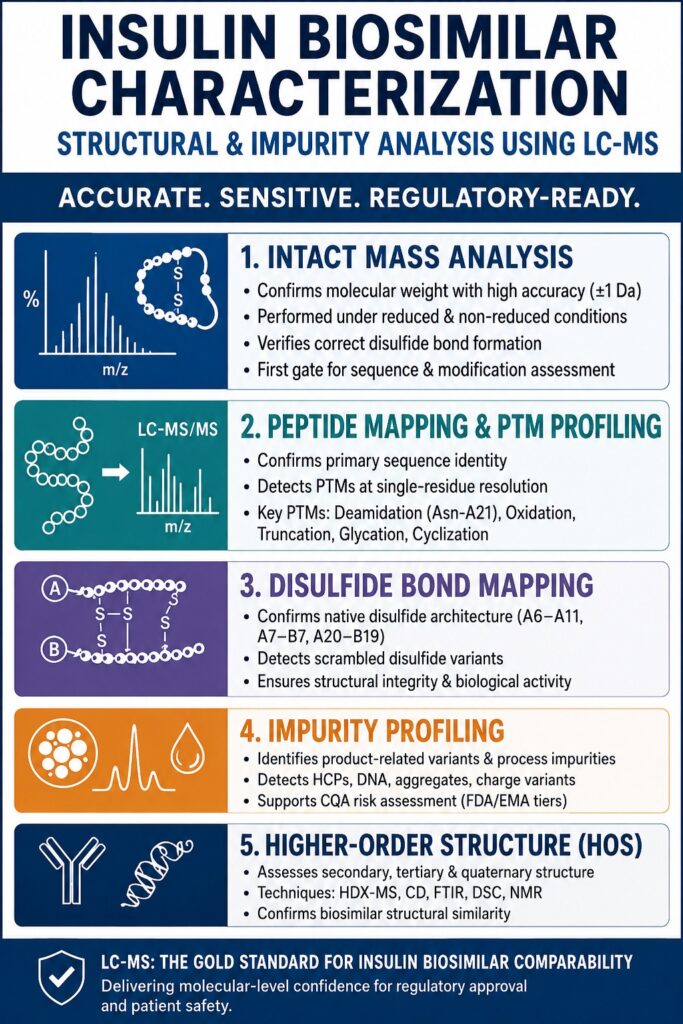
Intact Mass Analysis — The First Gate in Insulin Biosimilar Characterization
Intact mass analysis using LC-ESI-MS determines the molecular weight of the intact insulin analogue with an accuracy typically within ±1 Da. This analysis confirms the expected amino acid composition and identifies major sequence deviations or unexpected modifications before peptide-level characterization begins.
For commonly used insulin analogues, the expected intact molecular masses are as follows:
| Insulin Analogue | Molecular Formula | Average Molecular Weight |
|---|---|---|
| Human Insulin | C₂₅₇H₃₈₃N₆₅O₇₇S₆ | 5,807.6 Da |
| Insulin Glargine | C₂₆₇H₄₀₄N₇₂O₇₈S₆ | 6,063.0 Da |
| Insulin Lispro | C₂₅₇H₃₈₃N₆₅O₇₇S₆ | 5,807.6 Da |
| Insulin Aspart | C₂₅₆H₃₈₁N₆₅O₇₉S₆ | 5,825.8 Da |
| Insulin Glulisine | C₂₅₈H₃₈₄N₆₄O₇₈S₆ | 5,823.0 Da |
The intact mass workflow generally begins with reverse-phase liquid chromatography using a C4 or C8 column operated under denaturing conditions. Electrospray ionization (ESI) is then applied, followed by data acquisition on a high-resolution platform such as a Q-TOF or Orbitrap instrument capable of maintaining mass accuracy within 5 ppm. The multiply charged ion envelope generated during ionization is subsequently deconvoluted using charge-state distribution or maximum entropy algorithms to produce a zero-charge mass spectrum. Any observed mass shift of ≥1 Da relative to the reference standard typically triggers additional peptide-level investigation.
An important consideration unique to insulin characterization is that intact mass analysis must be performed under both reduced and non-reduced conditions. Reduction is typically achieved using DTT or TCEP to cleave disulfide bonds. Comparing reduced and native spectra confirms the presence of the three correctly formed disulfide bonds because each bond contributes a net loss of 2 Da. Any abnormality in the expected mass difference between reduced and non-reduced forms may indicate disulfide scrambling, a structurally significant defect associated with potential immunogenicity concerns.
Discover how high-resolution mass precision verifies primary sequences at the macro-level by exploring our specialized services in intact mass analysis of biosimilars.
Tryptic Peptide Mapping — Primary Sequence Confirmation and PTM Profiling
Tryptic peptide mapping by LC-MS/MS remains the gold-standard approach for confirming complete amino acid sequence identity between a biosimilar insulin product and its reference molecule. At the same time, the method enables comprehensive characterization of post-translational modifications at single-residue resolution.
Digestion Strategy and Sample Preparation
Successful peptide mapping requires careful sample preparation to fully linearize the insulin molecule and expose all cleavage sites for enzymatic digestion. A standard preparation workflow includes the following steps:
- Denaturation: 6 M guanidine HCl or 8 M urea at 37°C
- Reduction: TCEP or DTT (10 mM for 60 minutes at 37°C)
- Alkylation: Iodoacetamide (IAA, 25 mM for 30 minutes in darkness) to convert free thiols into carbamidomethyl-cysteine (CAM)
- Buffer exchange: Spin filtration using a 10 kDa MWCO membrane into a trypsin-compatible buffer such as 50 mM ammonium bicarbonate at pH 7.8
- Tryptic digestion: Sequencing-grade trypsin at a 1:20 enzyme-to-substrate ratio for approximately 18 hours at 37°C
- Quenching: Addition of 0.1% TFA or thermal inactivation
The use of a low-artifact digestion buffer (LADB) is strongly recommended because it minimizes artificial in-solution deamidation events. This is particularly important for accurate monitoring of Asn-A21 deamidation, which represents one of the most clinically significant PTMs observed in insulin products.
For a deeper look into optimizing digestion protocols and achieving 100% sequence coverage, review our technical guide on peptide mapping in biosimilars.
LC-MS/MS Detection and Critical Peptide Targets
Due to the compact structure of insulin, tryptic digestion typically generates a relatively small peptide set consisting of approximately 8 to 15 peptides spanning both the A and B chains. High-resolution chromatographic separation is generally achieved using a sub-2 µm C18 column with a 75-minute gradient at 40°C. Data acquisition is then performed using Orbitrap or Q-TOF MS/MS systems operating in data-dependent acquisition (DDA) mode. Higher-energy collisional dissociation (HCD) fragmentation produces b-ion and y-ion series suitable for de novo sequence confirmation.
Key PTM targets monitored during insulin biosimilar characterization include:
| PTM Type | Site | Analytical Significance |
|---|---|---|
| Deamidation | Asn-A21 | Highly labile; converts to Asp; accelerated at low pH; Tier 1 CQA |
| Deamidation | GlnB4 | Lower frequency; monitored in stressed samples |
| Oxidation | PheB1, MetB5 (in some analogues) | Influences receptor binding; accelerated by oxidative stress |
| N-terminal truncation | desPheB1 | Common process-related impurity affecting potency |
| Cyclization | pyroGluB4 → pyroglutamate | Associated with deamidation pathways |
| Glycation | LysB29 | Process-related adduct; classified as Tier 2 CQA |
| Dimer formation | A-chain cysteine residues | Indicates disulfide scrambling |
Among these modifications, deamidation at Asn-A21 carries particular regulatory importance because it introduces an isobaric mass increase of +0.984 Da, which may be overlooked on low-resolution systems. Accurate differentiation between true deamidation and naturally occurring ¹³C isotopic contributions requires high-resolution Orbitrap analysis exceeding 60,000 FWHM at m/z 200.
To understand the critical pathways of chemical degradation and modification at the molecular level, see our deep-dive on post-translational modifications (PTMs) in biosimilars.
Disulfide Bond Mapping — The Structural Integrity Checkpoint
Insulin contains three essential disulfide bonds: A6–A11 (intrachain), A7–B7 (interchain), and A20–B19 (interchain). Correct formation of these disulfide linkages is indispensable for biological activity, and non-reduced peptide mapping by LC-MS/MS is considered the definitive analytical method for confirming native disulfide architecture and detecting scrambled variants.
Disulfide scrambling remains an important risk factor during recombinant insulin manufacturing, especially when fermentation, refolding, or purification conditions are not fully optimized. Analytical workflows distinguish between:
- Reduced peptide mapping: All disulfide bonds are cleaved before analysis, allowing confirmation of primary sequence and PTMs
- Non-reduced peptide mapping: Native disulfide connectivity is preserved, enabling direct detection of linked peptide pairs
In non-reduced LC-MS/MS experiments, each correctly formed disulfide bond generates a characteristic molecular mass equal to the combined mass of the linked peptides minus 2 Da, reflecting hydrogen atom loss during bond formation. Any unexpected paired masses are indicative of scrambled disulfide variants.
Free thiol analysis provides an additional measure of structural integrity. Techniques such as Ellman’s reagent assays or direct LC-MS following alkylation with N-ethylmaleimide (NEM) can quantify residual free thiol groups. Properly folded insulin should contain no detectable free thiol content; any measurable signal suggests incomplete disulfide bond formation.
Impurity Profiling by LC-MS — Distinguishing Product-Related and Process-Related Variants
LC-MS impurity profiling differentiates product-related variants originating from structural alterations of the insulin molecule itself from process-related impurities introduced during manufacturing. This distinction is critical for the tiered CQA risk assessment frameworks required by regulatory authorities including the FDA and EMA.
Product-Related Variants
Product-related variants are especially important because they may directly influence potency, stability, pharmacokinetics, and immunogenicity.
Truncation Variants
- desPheB1: Loss of the N-terminal phenylalanine from the B-chain; among the most frequently observed process-related variants; commonly generated through tryptic-like cleavage during fermentation or purification
- desThrB30: Observed in certain long-acting insulin analogues; influences pharmacokinetic behavior
- A-chain N-terminal variants: Less common; typically associated with signal peptide processing abnormalities
Oxidation Variants
Single and double oxidation events involving residues such as phenylalanine, tyrosine, histidine, cysteine, and methionine are observed as +16 Da or +32 Da mass shifts during LC-MS analysis. Oxidative degradation is especially relevant for insulin glargine because the extended C-terminal arginine residues on the B-chain are susceptible to oxidative modification.
High-Molecular-Weight Aggregates
High-molecular-weight aggregates include soluble oligomeric forms such as dimers, tetramers, and non-native hexamers beyond the physiological zinc-stabilized hexamer. These species are commonly analyzed using SEC-MS or SEC-MALS. Insoluble aggregates are monitored through complementary methods including dynamic light scattering (DLS), micro-flow imaging (MFI), and HIAC particle analysis.
Charge Variants
Charge heterogeneity is typically characterized using cation-exchange chromatography (CEX) or capillary isoelectric focusing (cIEF). Common contributors include deamidated species and C-terminal lysine variants.
Learn how high-resolution separation techniques distinguish and resolve charge variants from native molecules in our detailed resource on charge variant analysis in biosimilars.
Process-Related Impurities
| Impurity Class | Detection Method | Regulatory Guidance |
|---|---|---|
| Host Cell Proteins (HCPs) | LC-MS/MS HCP mapping; ELISA | <100 ppm (product dependent) |
| Host Cell DNA | qPCR with orthogonal LC-MS confirmation | <10 ng/dose (WHO guidance) |
| Residual Insulin Precursors | RP-HPLC; LC-MS | Product-specific limits |
| Proinsulin | LC-MS/MS with immunodepletion and targeted MRM | Typically <10 ppm |
| Zinc Content | ICP-MS | Formulation-specific |
| Residual Solvents | GC-headspace; USP <467> | ICH Q3C limits |
HCP characterization by LC-MS/MS has become increasingly important as regulatory expectations for process impurity profiling continue to evolve. Following API immunodepletion, a single LC-MS/MS analysis can identify and relatively quantify hundreds of co-purifying proteins originating from expression systems such as E. coli or Saccharomyces cerevisiae. This level of molecular insight cannot be achieved through ELISA alone.
For comprehensive methodologies on identifying trace contaminants and host cell proteins, read about our approach to impurity profiling of biosimilars.
Multi-Attribute Method (MAM) — The Next Frontier in Insulin Biosimilar LC-MS Analysis
The Multi-Attribute Method (MAM) is an advanced LC-MS/MS workflow designed to simultaneously monitor multiple CQAs within a single assay. These CQAs include sequence integrity, oxidation, deamidation, glycation, and additional PTMs. By consolidating multiple traditional assays into one quantitative platform, MAM significantly improves throughput and analytical depth in insulin biosimilar quality control programs.
Originally developed for monoclonal antibody characterization, MAM is increasingly being adapted for therapeutic peptides and small proteins such as insulin. In a typical MAM workflow:
- A single tryptic peptide map is acquired using label-free quantification (LFQ) or stable isotope-labeled internal standards such as AQUA peptides
- PTM abundance is reported quantitatively as a percentage of modification at each site
- New peak detection algorithms identify unexpected peptide species absent from the reference product spectral library
This approach provides a powerful mechanism for real-time detection of novel degradation products while simultaneously enabling lot-to-lot consistency monitoring throughout the manufacturing process, from drug substance through final drug product.
Higher-Order Structure (HOS) Characterization — Completing the Picture
Higher-order structure characterization verifies that a biosimilar insulin adopts secondary, tertiary, and quaternary structures equivalent to those of the reference product. Although LC-MS alone cannot fully define higher-order structure, it is complemented by orthogonal techniques such as HDX-MS, circular dichroism (CD), FTIR spectroscopy, and DSC.
| HOS Technique | Structural Information Revealed | Sensitivity |
|---|---|---|
| Far-UV CD | α-helix and β-sheet content | High sensitivity to secondary structure changes |
| Near-UV CD | Aromatic side-chain environment | Moderate tertiary structure sensitivity |
| FTIR | Amide I/II secondary structure signatures | Moderate; confirmatory |
| HDX-MS | Backbone hydrogen exchange dynamics | Very high; site-specific |
| DSC | Thermal unfolding thermodynamics | Moderate; global stability |
| NMR (¹H, ²H) | Atomic-level structural detail | Highest resolution |
Hydrogen-Deuterium Exchange Mass Spectrometry (HDX-MS) deserves particular attention as an emerging LC-MS-based higher-order structure technique. HDX-MS measures the rate at which backbone amide hydrogens exchange with deuterium from D₂O. Exchange kinetics provide highly sensitive information regarding solvent accessibility and conformational dynamics at the peptide-segment level. Differences in deuterium uptake between a biosimilar and its reference product may reveal subtle structural deviations that are not detectable using CD or FTIR methods.
Regulatory Framework — Aligning LC-MS Data with ICH Q6B and FDA Guidance
Regulatory agencies including the FDA, EMA, and Health Canada require a stepwise “totality of evidence” approach to biosimilar characterization. Within this framework, LC-MS-derived structural and impurity data form the primary analytical layer. When analytical similarity is comprehensively demonstrated, the need for extensive nonclinical and clinical studies may be substantially reduced.
Key regulatory references include:
- ICH Q6B: Defines analytical procedures and acceptance criteria for biotechnological products, including peptide mapping, mass spectrometry, and impurity characterization
- FDA Guidance on Biosimilar Development: Establishes the three-tier CQA statistical assessment framework
- EMA/CHMP Guideline on Similar Biological Medicinal Products: Provides product-class-specific comparability requirements for insulin biosimilars
FDA Three-Tier CQA Framework
| Tier | CQA Characteristics | Statistical Approach | LC-MS Methods Involved |
|---|---|---|---|
| Tier 1 | High clinical impact; amenable to statistics | Equivalence testing (90% CI within ±1.5σ) | Deamidation %, oxidation %, purity % |
| Tier 2 | Moderate impact; statistical analysis applicable | Quality range approach | HMW%, charge variant profiles |
| Tier 3 | Low clinical impact or not statistically amenable | Descriptive/visual comparison | Rare PTMs, minor variant peaks |
A robust LC-MS characterization strategy that comprehensively addresses Tier 1 CQAs through validated and stability-indicating analytical methods compliant with ICH Q2(R1) provides one of the strongest pathways for reducing clinical development burden and accelerating biosimilar approval timelines.
To understand how to establish a robust regulatory framework and fulfill the “totality of evidence” criteria, check out our insights on running biosimilar comparability studies.
Forced Degradation Studies — Stress Testing Insulin Biosimilar Purity by LC-MS
Forced degradation studies subject insulin biosimilars to controlled thermal, oxidative, acidic, alkaline, and photolytic stress conditions. LC-MS analysis is then used to identify and quantify degradation products, establish degradation pathways, and confirm the stability-indicating capability of analytical methods.
| Stress Condition | Primary LC-MS-Detected Degradation Products |
|---|---|
| Thermal (40°C for 2 weeks) | HMW aggregates; desPheB1 truncation; Asn-A21 deamidation |
| Oxidative (0.1% H₂O₂ for 2 hours) | +16 Da oxidation; +32 Da double oxidation |
| Acidic (pH 2.0 for 24 hours) | Asp-A21 deamidation products; hydrolysis variants |
| Basic (pH 12.0 for 1 hour) | Disulfide scrambling; backbone hydrolysis |
| Photolytic (ICH Q1B exposure) | Phenylalanine oxidation; oxidation of susceptible aromatic residues |
From a regulatory standpoint, forced degradation studies serve two essential purposes. First, they characterize the degradation chemistry of the molecule and support impurity specification development. Second, they demonstrate that the analytical method can reliably distinguish stressed samples from unstressed controls, which is a core requirement for any stability-indicating assay.
Published studies have also demonstrated that the percentage of aggregation observed at Day 0 may significantly predict aggregation levels after accelerated storage conditions, highlighting the importance of stringent initial purity specifications and kinetic LC-MS-based stability modeling.
For detailed strategies on stress-testing molecules and profiling degradation pathways, review our complete guide to the forced degradation of biosimilars.
Conclusion: Building a Defensible Insulin Biosimilar Characterization Package with LC-MS
An effective and defensible insulin biosimilar characterization strategy is fundamentally built around LC-MS as the central analytical platform. Orthogonal methods such as CD spectroscopy, FTIR, DSC, HDX-MS, cIEF, and SEC provide complementary structural evidence, but LC-MS remains the primary driver of molecular-level comparability assessment. The ultimate objective is not simply to demonstrate superficial similarity to the reference product, but to quantitatively establish, with statistically validated confidence, that every critical quality attribute falls within the accepted variability range of the innovator molecule.
Although the path from analytical characterization to regulatory approval remains demanding, the field has matured considerably in terms of instrumentation, software capabilities, validated workflows, and global regulatory precedent. As a result, a carefully designed LC-MS-based characterization program for insulin biosimilars can now be implemented within a highly efficient development timeline.
Explore how LC-MS integrates into full analytical validation packages by reading our definitive guide on how to prove biosimilarity using lc-ms.
At ResolveMass Laboratories Inc., our bioanalytical scientists possess extensive practical expertise in insulin biosimilar characterization, including intact mass analysis, quantitative peptide mapping, MAM implementation, HCP profiling, and forced degradation studies using advanced Orbitrap and Q-TOF LC-MS platforms. We collaborate closely with biosimilar developers to design characterization programs that are scientifically rigorous, fully regulatory-ready, and aligned with the totality-of-evidence standards expected by the FDA, EMA, and Health Canada.
Ready to advance your insulin biosimilar characterization program?
Contact ResolveMass Laboratories Inc. today.
Frequently Asked Questions (FAQs)
LC-MS identifies deamidation by detecting the small mass increase that occurs when asparagine converts into aspartate. In insulin, the Asn-A21 residue is especially vulnerable to this modification under acidic or stressed conditions. High-resolution Orbitrap mass spectrometry can accurately distinguish the +0.984 Da deamidation shift from naturally occurring isotopic variations. Confirmation is further supported through altered chromatographic retention behavior and fragmentation analysis that pinpoints the exact modified residue within the peptide sequence.
Critical quality attributes for insulin biosimilars include structural integrity, impurity levels, post-translational modifications, and higher-order structural consistency. Important CQAs involve amino acid sequence confirmation, correct disulfide bond formation, molecular weight accuracy, and the monitoring of modifications such as oxidation, deamidation, glycation, and truncation variants. Product purity, aggregate content, host cell protein contamination, and residual proinsulin are also carefully evaluated. Regulatory agencies place particular emphasis on attributes that may directly affect potency, immunogenicity, or product stability.
Disulfide bond mapping is essential because insulin activity depends on the correct formation of its three native disulfide linkages. Incorrect cysteine pairing can alter the molecule’s three-dimensional structure, reduce biological activity, and increase immunogenic risk. Non-reduced LC-MS/MS peptide mapping allows direct verification of native disulfide connectivity while simultaneously identifying low-level scrambled variants. Regulatory agencies consider this analysis a critical part of structural comparability for all disulfide-containing biosimilar proteins.
The Multi-Attribute Method, commonly referred to as MAM, is an LC-MS/MS-based analytical workflow that monitors multiple quality attributes within a single experiment. Instead of using separate assays for purity, oxidation, deamidation, and sequence confirmation, MAM integrates all these measurements into one streamlined platform. In insulin biosimilar analysis, the method uses reference peptide libraries to compare expected and observed peptide profiles. Any unexpected signal or modification can be rapidly detected, supporting efficient comparability and stability assessments.
Host cell proteins are trace impurities originating from microbial expression systems such as E. coli or yeast used during insulin manufacturing. LC-MS/MS-based HCP profiling enables the identification and relative quantification of these residual proteins after selective depletion of the insulin active ingredient. Unlike traditional ELISA assays, LC-MS can identify individual HCP species and assess their potential biological or immunogenic risks. This detailed impurity characterization is becoming increasingly important in regulatory submissions and biosimilar risk assessments.
Several recurring product-related impurities are routinely detected during insulin biosimilar analysis. These include desPheB1 truncation variants, Asn-A21 deamidation products, pyroglutamate formation at B4, oxidized peptide species, and high-molecular-weight aggregates. Such variants may arise during manufacturing, purification, formulation, or storage. LC-MS provides highly sensitive detection and structural confirmation of these impurities, allowing manufacturers to monitor stability and ensure that impurity levels remain within acceptable regulatory specifications.
Hydrogen-Deuterium Exchange Mass Spectrometry (HDX-MS) evaluates protein conformational dynamics by measuring how rapidly backbone amide hydrogens exchange with deuterium in solution. In insulin biosimilar studies, HDX-MS compares solvent accessibility and structural flexibility between the biosimilar and reference product at the peptide-segment level. Even subtle differences in folding or molecular dynamics can be detected through changes in deuterium uptake patterns. This makes HDX-MS an especially valuable tool for identifying conformational differences that may not be visible using traditional spectroscopic methods.
Insulin biosimilar characterization is governed by several major international regulatory frameworks. ICH Q6B establishes analytical testing expectations for biological and biotechnological products, while FDA biosimilar guidance documents outline the totality-of-evidence approach for demonstrating analytical similarity. The EMA guideline CHMP/437/04 and Health Canada biosimilar guidance also define product-specific comparability expectations for insulin products. Across all regulatory agencies, comprehensive LC-MS structural and impurity characterization is considered a central requirement of the analytical data package.
Forced degradation studies intentionally expose insulin biosimilars to stress conditions such as heat, oxidation, acidic pH, alkaline pH, and light exposure to accelerate degradation pathways. LC-MS is then used to identify and characterize the resulting degradation products at the molecular level. These studies help establish stability-indicating analytical methods and define impurity profiles that may emerge during long-term storage. Regulatory agencies also require forced degradation data to demonstrate that analytical methods can reliably distinguish degraded samples from unstressed product material.
Reference:
- Vishwakarma, G., Nupur, N., & Rathore, A.S. (2023). Assessing the Structural and Functional Similarity of Insulin Glargine Biosimilars. Journal of Diabetes Science and Technology, 17(3). https://doi.org/10.1177/19322968211058482
- Alfaleh, M.A., et al. (2021). Physicochemical and functional characterization of MYL-1501D, a proposed biosimilar to insulin glargine. PLOS ONE, 16(6), e0253168. https://doi.org/10.1371/journal.pone.0253168
- ICH Q6B: Specifications: Test Procedures and Acceptance Criteria for Biotechnological/Biological Products. International Council for Harmonisation (ICH). https://www.ich.org/page/quality-guidelines
- FDA Guidance for Industry: Scientific Considerations in Demonstrating Biosimilarity to a Reference Product (2019, updated 2024). U.S. Food and Drug Administration. https://www.fda.gov/media/82647/download
Get In Touch With Us
About The Author


