

Introduction:
Peptide-Oligonucleotide Conjugates in Gene Silencing applications have emerged as one of the most technically sophisticated and clinically promising strategies for solving RNA therapeutics’ oldest problem: getting the payload into the right cell, intact, and in a form the cellular machinery can use. Since the first RNAi therapeutics reached approval, the field has largely relied on two delivery platforms — lipid nanoparticles (LNPs) and GalNAc conjugates — both of which are effective but structurally and biodistributionally limited, with GalNAc conjugation in particular confined almost entirely to hepatocyte-targeted delivery via the asialoglycoprotein receptor.
Peptide-oligonucleotide conjugates offer a third path. By covalently attaching a therapeutic oligonucleotide to a rationally selected peptide, drug developers gain a modular chemical toolkit that can, in principle, be redirected to almost any tissue with a known, druggable surface receptor — muscle, brain endothelium, tumor stroma, immune cells, and beyond. This flexibility is precisely why POCs have become a focal point of gene silencing research over the past several years, and why sponsors advancing POC candidates need analytical partners who understand both halves of the molecule with equal rigor, from early POC synthesis and characterization through preclinical services and into IND-enabling studies.
This article walks through what POCs are, how they work mechanistically, why their analytical characterization is uniquely demanding, what regulators expect to see in a CMC package, and how ResolveMass Laboratories’ combined peptide and oligonucleotide capabilities support sponsors through each stage of development.
Summary:
- Peptide-Oligonucleotide Conjugates (POCs) covalently link a functional peptide (for cell targeting, membrane penetration, or endosomal escape) to a therapeutic oligonucleotide (siRNA, ASO, aptamer, or splice-switching oligo) to achieve more precise, tissue-specific gene silencing.
- POCs address the two biggest translational barriers for RNA therapeutics: poor cellular uptake of naked oligonucleotides and lack of extrahepatic tissue selectivity.
- Conjugation chemistry (site, linker type, and stoichiometry) directly determines potency, stability, and immunogenicity — making it a critical quality attribute (CQA), not a formulation detail.
- Full characterization requires an orthogonal analytical toolkit spanning LC-MS/MS, ion-pair RP-HPLC, AEX-HPLC, capillary electrophoresis, and peptide/oligonucleotide-specific digestion strategies.
- Regulators (FDA, EMA) expect POCs to be characterized as a single, well-defined conjugated drug substance, with data resembling antibody-drug conjugate (ADC)-style CMC packages rather than simple mixtures.
- CROs with integrated peptide and oligonucleotide analytical expertise — such as ResolveMass Laboratories — remove the cross-lab data gaps that typically slow POC programs down.
1: What Are Peptide-Oligonucleotide Conjugates?
Peptide-oligonucleotide conjugates are hybrid biomolecules formed by covalently joining a peptide sequence to an oligonucleotide through a chemical linker, combining the biological targeting or delivery function of the peptide with the gene-silencing function of the nucleic acid. The peptide component is not a passive carrier — it is purpose-selected for a specific role, and that role dictates much of the downstream analytical and regulatory strategy. Understanding the different types of peptide-oligonucleotide conjugates available is the starting point for choosing the right design for a given indication.
Core Structural Components of a POC
| Component | Role | Typical Design Considerations |
|---|---|---|
| Oligonucleotide payload | Performs gene silencing (RNAi, RNase H-mediated knockdown, or splice modulation) | Chemistry (2′-OMe, 2′-MOE, LNA), backbone (phosphorothioate vs. phosphodiester), strand length |
| Peptide domain | Targeting, membrane penetration, or endosomal escape | Sequence length, charge, amphipathicity, protease resistance |
| Linker | Connects peptide and oligonucleotide; controls release kinetics | Cleavable (disulfide, ester) vs. non-cleavable (thioether, triazole); stability under physiological conditions — see linker chemistry considerations |
| Conjugation site | Defines where on the peptide/oligonucleotide the bond forms | N-terminus, C-terminus, internal cysteine/lysine, or 5’/3′ oligonucleotide terminus |
How POCs Differ From Other RNAi Delivery Platforms
- Versus lipid nanoparticles (LNPs): POCs are discrete, single molecular entities with a defined molecular weight and structure, whereas LNPs are multi-component colloidal formulations. This gives POCs more straightforward analytical characterization (no particle size, encapsulation efficiency, or lipid-ratio variables) but places more weight on getting the conjugation chemistry exactly right.
- Versus GalNAc conjugates: GalNAc-siRNA conjugates are restricted almost exclusively to hepatocyte targeting through the ASGPR receptor. Peptides can be selected against a far broader range of receptors, opening extrahepatic indications that GalNAc chemistry cannot reach. Learn more about how receptor-targeted peptide-oligonucleotide conjugates are designed for specific tissues.
- Versus antibody-oligonucleotide conjugates: Peptides are smaller, easier to synthesize at scale, less immunogenic in many cases, and more tunable in terms of pharmacokinetics than full antibodies, though they typically offer lower target-binding affinity and shorter plasma half-life. For a deeper side-by-side comparison, see our breakdown of peptide vs. antibody-oligonucleotide conjugates.
2: How Do Peptide-Oligonucleotide Conjugates Enable Targeted Gene Silencing?
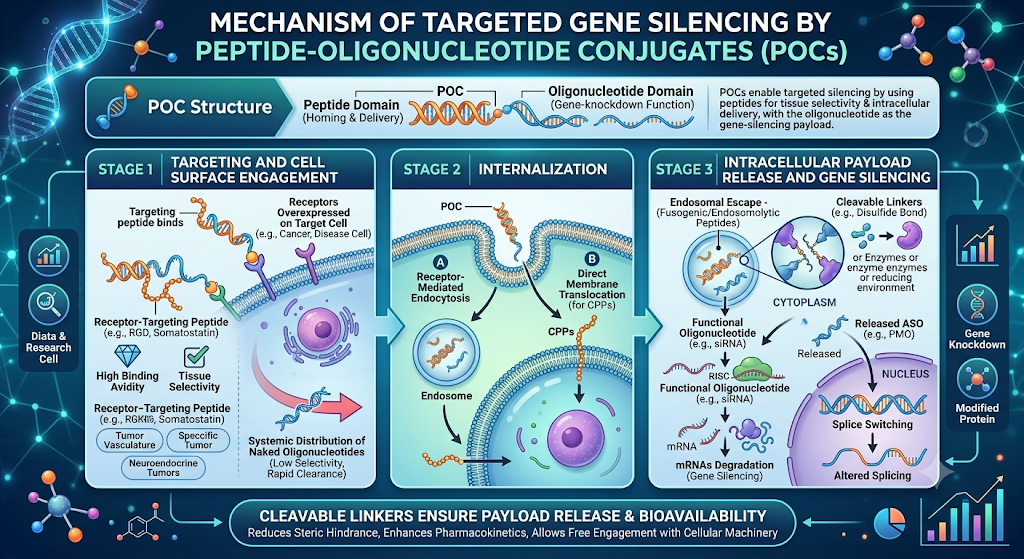
POCs enable targeted gene silencing by using the peptide domain as a homing and delivery mechanism while the oligonucleotide domain performs the actual gene-knockdown function once inside the target cell. The full mechanism of action of peptide-oligonucleotide conjugates generally unfolds in three stages: receptor engagement or membrane interaction, internalization, and intracellular payload release.
Stage 1 — Targeting and Cell Surface Engagement
Receptor-targeting peptides bind selectively to surface markers overexpressed on the intended tissue or cell type — for example, integrin-binding RGD peptides on tumor vasculature, or somatostatin-receptor-binding peptides on neuroendocrine tumor cells. This step is what gives POCs their tissue selectivity advantage over systemically distributed naked oligonucleotides, and it is central to how POCs support targeted drug delivery strategies.
Stage 2 — Internalization
Depending on the peptide class, internalization occurs either through receptor-mediated endocytosis (for targeting peptides) or through direct, transient membrane destabilization (for cell-penetrating peptides). Some POC designs combine both functions in a single construct, using a targeting peptide fused to a fusogenic or endosomolytic sequence.
Stage 3 — Intracellular Payload Release and Gene Silencing
Once inside the cell, the oligonucleotide must escape the endosome and reach the cytoplasm (for siRNA engaging RISC) or the nucleus (for splice-switching ASOs). Cleavable linkers, such as disulfide bonds that are reduced in the cytoplasmic redox environment, are frequently used to release the oligonucleotide from the peptide at this stage so the payload is not sterically hindered from engaging its intracellular machinery. How efficiently and predictably this release occurs also shapes the conjugate’s overall pharmacokinetics.
Common Peptide Classes Used in POCs
| Peptide Class | Representative Examples | Primary Function |
|---|---|---|
| Cell-penetrating peptides (CPPs) | TAT, penetratin, Pip6a, R9 (polyarginine) | Facilitate cytosolic/nuclear entry across the plasma membrane |
| Receptor-targeting peptides | RGD (integrin-binding), somatostatin analogs, GLP-1 receptor peptides | Direct binding to overexpressed tumor or tissue-specific receptors |
| Fusogenic/endosomolytic peptides | Influenza HA2-derived peptides, GALA, INF7 | Promote endosomal escape after receptor-mediated uptake |
| Dendrimeric/branched peptides | Multivalent CPP constructs | Increase avidity and payload-carrying capacity per conjugate |
| Cyclic/stapled peptides | Cyclic RGD, stapled CPPs | Improve protease resistance and binding rigidity |
3: Why Is Analytical Characterization of Peptide-Oligonucleotide Conjugates More Complex Than Standard Biologics?
Analytical characterization of POCs is more complex than characterizing either a standalone peptide or a standalone oligonucleotide because the conjugate must be evaluated as a single intact hybrid molecule while simultaneously confirming the identity, purity, and integrity of each individual domain. Peptide-focused platforms are typically optimized for amide backbone chemistry and amino acid sequence confirmation; oligonucleotide-focused platforms are optimized for phosphorothioate/phosphodiester backbone chemistry and base sequence confirmation. Few platforms are validated to do both with equal confidence on the same conjugated molecule, which is why sponsors so often run into the same recurring challenges in peptide-oligonucleotide conjugate development.
Key Characterization Challenges
- Conjugation site verification — confirming the oligonucleotide is attached at the intended peptide residue (N-terminus, C-terminus, or an internal cysteine/lysine side chain), since regiochemical mis-conjugation changes the molecule’s pharmacology.
- Degree of conjugation (DoC) — quantifying the ratio of conjugated to unconjugated species; incomplete conjugation reduces effective potency and introduces batch-to-batch heterogeneity that regulators will scrutinize closely during specification-setting.
- Linker stability — assessing whether the chemical linker (disulfide, thioether, amide, or click-chemistry triazole) survives synthesis, purification, formulation, and long-term storage without premature cleavage or unintended side reactions; this ties directly into conjugate stability and mapped degradation pathways.
- Domain-specific sequence and purity confirmation — verifying the peptide sequence and the oligonucleotide sequence independently, in addition to confirming the intact conjugate mass.
- Impurity profiling — identifying and quantifying truncated oligonucleotide sequences, deletion peptides, unconjugated free oligonucleotide, unconjugated free peptide, and any conjugation-related side products (e.g., over-conjugated species where more than one oligonucleotide attaches to a single peptide). Comprehensive impurity profiling for peptide-oligonucleotide conjugates is essential before advancing to toxicology or clinical studies.
- Secondary structure integrity — for peptides whose function depends on a specific folded conformation (e.g., cyclic or stapled peptides), confirming that conjugation has not disrupted that structure.
- Immunogenicity risk — peptide domains, particularly non-native or highly cationic sequences, can trigger immune responses that must be assessed as part of a broader immunogenicity evaluation program.
4: Which Analytical Techniques Are Used to Characterize Peptide-Oligonucleotide Conjugates?
The most reliable characterization strategy for POCs combines high-resolution mass spectrometry with chromatographic and electrophoretic separation techniques tailored to each domain of the molecule. No single method is sufficient on its own; regulatory-grade analysis of peptide-oligonucleotide conjugates requires an orthogonal, multi-technique approach where each method’s blind spots are covered by another.
Primary Analytical Toolkit
| Technique | What It Confirms | Why It’s Necessary |
|---|---|---|
| LC-MS/MS (intact mass) | Overall conjugate molecular weight, conjugation stoichiometry | Detects mis-conjugation, adduct formation, and unexpected mass shifts — see our mass spectrometry characterization capabilities |
| Peptide mapping (LC-MS/MS after digestion) | Peptide sequence and conjugation site | Pinpoints exactly which residue carries the oligonucleotide |
| Ion-pair reversed-phase HPLC (IP-RP-HPLC) | Separation of conjugated species from free oligonucleotide/free peptide | Charge- and hydrophobicity-based resolution of closely related species; also used in HPLC purification services |
| Anion-exchange HPLC (AEX-HPLC) | Degree of conjugation, charge-based heterogeneity | Resolves species differing by phosphorothioate backbone charge |
| Capillary electrophoresis (CE) | High-resolution separation of n-1/n+1 truncations | Detects single-nucleotide-level impurities within the conjugate |
| Circular dichroism (CD) | Peptide secondary structure post-conjugation | Confirms folding is preserved when peptide function is conformation-dependent |
| Enzymatic digestion (nuclease/protease) with LC-MS | Independent sequence confirmation of each domain | Cross-validates intact-mass data with domain-level sequence data |
| UV/Fluorescence-based quantification | Concentration and stoichiometric ratio checks | Provides an orthogonal quantification cross-check to MS-based methods |
A Note on Method Development Strategy
Because POCs sit between two established but distinct analytical disciplines, method development typically starts with methods validated for oligonucleotides (IP-RP-HPLC, AEX) and methods validated for peptides (RP-HPLC, peptide mapping), then bridges the two through intact-mass LC-MS to confirm the conjugate as a whole. Robust bioanalytical method development for POC therapeutics and routine QC testing should be planned early, since sponsors should expect method development timelines for POCs to run longer than for either molecule type alone — more orthogonal methods need to be qualified before a stability-indicating package is complete.
5: What Regulatory Expectations Apply to Peptide-Oligonucleotide Conjugates-Based Therapeutics?
Regulatory agencies expect POC developers to characterize the conjugate as a single, well-defined drug substance while also demonstrating consistent conjugation efficiency, linker stability, and impurity control across batches. Because POCs combine attributes of small-molecule/peptide therapeutics and biologic/oligonucleotide therapeutics, sponsors should expect a level of scrutiny comparable to that applied to antibody-drug conjugates (ADCs), where conjugation-related critical quality attributes (CQAs) sit at the center of the CMC review supporting peptide-oligonucleotide conjugates in IND submissions.
Typical CMC Expectations for POC Drug Substances
- Full structural elucidation of the intact conjugate, including confirmed conjugation site and linker chemistry
- Degree of conjugation specification with scientifically justified acceptance criteria
- Forced degradation and stability studies demonstrating linker integrity and payload release kinetics across the proposed shelf life, along with defined handling and storage conditions
- Process-related impurity limits (residual coupling reagents, unreacted peptide/oligonucleotide) and product-related impurity limits (truncations, deletion sequences, over-conjugated species)
- Reference standard qualification performed on the intact conjugate, not solely on its individual peptide and oligonucleotide components
- Comparability protocols for any changes to conjugation chemistry, linker, or synthesis route during development
- Supporting toxicology studies designed around the conjugate’s specific degradation and impurity profile, not just the parent components
Where Sponsors Commonly Encounter Delays
- Underestimating how long orthogonal method development takes for a hybrid molecule class with no single compendial method
- Treating degree-of-conjugation data as a formulation attribute rather than a CQA requiring formal specification-setting
- Insufficient forced-degradation data on the linker specifically, as opposed to degradation data on the peptide or oligonucleotide domains in isolation
- Leaving scale-up and GMP manufacturing planning too late, after analytical methods were only ever qualified at small scale
6: How ResolveMass Laboratories Supports Peptide-Oligonucleotide Conjugates Development
ResolveMass Laboratories combines dedicated peptide characterization and oligonucleotide analytical capabilities under one roof, which is precisely the cross-disciplinary expertise POC programs require. Rather than splitting testing between a peptide-focused CRO and a separate oligonucleotide-focused lab — a common source of data gaps, inconsistent reference standards, and timeline delays — sponsors working with ResolveMass gain a single analytical partner capable of managing the conjugate as one integrated molecule from early synthesis methods through CMC-ready reporting.
ResolveMass Capabilities Relevant to POC Programs
- Intact mass confirmation and high-resolution peptide mapping via LC-MS/MS
- Degree of conjugation and conjugation-site verification across peptide and oligonucleotide domains
- Ion-pair RP-HPLC and AEX-HPLC method development and validation for conjugate purity and charge-heterogeneity assessment
- Capillary electrophoresis for high-resolution impurity and truncation profiling
- Impurity identification and structural elucidation of degradation products, including linker-specific degradation pathways
- Forced degradation and stability-indicating method development
- Reference standard qualification for the intact conjugate
- Comprehensive CMC services for peptide-oligonucleotide conjugates and end-to-end conjugate manufacturing support, from bench-scale synthesis through GMP-scale production
- CMC-ready documentation packages aligned with FDA and EMA expectations for complex conjugated biologics, including ADC-style conjugation CQA reporting
This combination of technical depth across both molecule classes, paired with regulatory-focused reporting, is what allows sponsors to move POC candidates from discovery into IND-enabling studies with confidence in the underlying analytical data package.
Conclusion:
Peptide-Oligonucleotide Conjugates in Gene Silencing applications offer a genuinely differentiated path toward tissue-specific RNA therapeutics beyond the liver-centric reach of GalNAc chemistry and the formulation complexity of lipid nanoparticles. Realizing that promise, however, depends entirely on rigorous, multi-technique analytical characterization: conjugation-site verification, degree-of-conjugation quantification, linker stability assessment, and comprehensive impurity profiling across both the peptide and oligonucleotide domains. POCs demand an analytical partner fluent in both chemistries and comfortable treating the conjugate as its own defined molecular entity rather than a simple mixture of two known components. ResolveMass Laboratories’ integrated characterization capabilities are built for exactly this kind of structurally complex, cross-disciplinary molecule, helping sponsors generate the robust CMC data packages that regulators expect from next-generation gene silencing therapeutics.
Frequently Asked Questions:
Peptide-oligonucleotide conjugates (POCs) use short peptides to deliver oligonucleotides into target cells, while antibody-oligonucleotide conjugates rely on monoclonal antibodies for highly specific receptor targeting. Peptides are smaller, easier to synthesize, and often penetrate tissues more effectively. Antibodies generally provide greater target specificity but are larger and more complex to manufacture. POCs can offer better tissue diffusion and lower production costs for certain applications. The choice between the two platforms depends on the disease indication, target tissue, delivery requirements, and desired pharmacokinetic profile. Both approaches aim to improve the precision and efficacy of gene-silencing therapies.
Several peptide classes are commonly incorporated into peptide-oligonucleotide conjugates depending on the therapeutic goal. Cell-penetrating peptides (CPPs) such as TAT, penetratin, and transportan improve cellular uptake. Receptor-targeting peptides help direct therapeutics to specific tissues or cell types. Endosomal escape peptides enhance the release of oligonucleotides into the cytoplasm after internalization. Tumor-homing and muscle-targeting peptides are also widely studied for disease-specific applications. Selecting the appropriate peptide is critical for maximizing delivery efficiency, specificity, and therapeutic effectiveness.
Peptide-oligonucleotide conjugates are generally synthesized by preparing the peptide and oligonucleotide separately using solid-phase synthesis techniques. The two components are then chemically linked using conjugation methods such as click chemistry, maleimide-thiol coupling, or amide bond formation. After conjugation, the product is purified to remove unreacted materials and process-related impurities. Analytical techniques such as LC-MS and HPLC are used to verify molecular identity, conjugation efficiency, and purity. Process optimization ensures reproducibility and scalability for clinical and commercial manufacturing. Strict quality control is maintained throughout the production process.
Critical quality attributes (CQAs) include molecular identity, sequence integrity, purity, conjugation efficiency, peptide-to-oligonucleotide ratio, and linker stability. Additional attributes such as aggregation, degradation products, potency, and biological activity are also carefully monitored. These parameters directly influence the safety, efficacy, and stability of the therapeutic product. Regulatory agencies expect manufacturers to establish well-defined specifications for each CQA. Comprehensive analytical characterization ensures consistent product quality across manufacturing batches. Monitoring these attributes throughout development supports successful regulatory approval and commercialization.
Yes. Peptide-oligonucleotide conjugates are specifically designed to improve targeted delivery of oligonucleotides to desired tissues or cell types. Targeting peptides recognize specific receptors, increasing drug accumulation in diseased cells while reducing exposure to healthy tissues. This selective delivery minimizes unintended gene silencing and lowers the risk of systemic toxicity. Improved intracellular uptake also allows therapeutic activity at lower doses. Together, these advantages contribute to a better safety profile and enhanced treatment efficacy. Continued optimization of peptide design is further improving targeting precision.
The field of peptide-oligonucleotide conjugates is evolving rapidly with advances in targeted delivery technologies and RNA therapeutics. Researchers are developing multifunctional peptides that combine targeting, cellular uptake, and endosomal escape capabilities within a single molecule. Artificial intelligence is accelerating peptide design and therapeutic optimization. Personalized gene-silencing therapies based on patient-specific biomarkers are also gaining momentum. Improved linker chemistries and biodegradable conjugates are enhancing safety and efficacy. These innovations are expected to expand the clinical applications of peptide-oligonucleotide therapeutics across many disease areas.
Reference
- Venkatesan N, Kim BH. Peptide conjugates of oligonucleotides: synthesis and applications. Chemical reviews. 2006 Sep 13;106(9):3712-61.https://pubs.acs.org/doi/full/10.1021/cr0502448
- Turner JJ, Jones S, Fabani MM, Ivanova G, Arzumanov AA, Gait MJ. RNA targeting with peptide conjugates of oligonucleotides, siRNA and PNA. Blood Cells, Molecules, and Diseases. 2007 Jan 1;38(1):1-7.https://www.sciencedirect.com/science/article/pii/S1079979606002038
- Patutina OA, Bichenkova EV, Miroshnichenko SK, Mironova NL, Trivoluzzi LT, Burusco KK, Bryce RA, Vlassov VV, Zenkova MA. miRNases: Novel peptide-oligonucleotide bioconjugates that silence miR-21 in lymphosarcoma cells. Biomaterials. 2017 Apr 1;122:163-78.https://www.sciencedirect.com/science/article/pii/S0142961217300261
- Winkler J. Oligonucleotide conjugates for therapeutic applications. Therapeutic delivery. 2013 Jul 1;4(7):791-809.https://www.tandfonline.com/doi/abs/10.4155/tde.13.47
- Zatsepin TS, Turner JJ, Oretskaya TS, Gait MJ. Conjugates of oligonucleotides and analogues with cell penetrating peptides as gene silencing agents. Current pharmaceutical design. 2005 Nov 1;11(28):3639-54.https://www.benthamdirect.com/content/journals/cpd/10.2174/138161205774580769
- Taskova M, Mantsiou A, Astakhova K. Synthetic nucleic acid analogues in gene therapy: an update for peptide–oligonucleotide conjugates. ChemBioChem. 2017 Sep 5;18(17):1671-82.https://chemistry-europe.onlinelibrary.wiley.com/doi/abs/10.1002/cbic.201700229
About the Author


