


Introduction:
The immunogenicity of peptide-oligonucleotide conjugates is one of the most consequential development risks facing sponsors working with this rapidly growing modality. As peptide-oligonucleotide conjugates (POCs) move from academic proof-of-concept into IND-enabling and clinical-stage programs, unanticipated immune responses can derail timelines, trigger dose-limiting toxicities, or compromise therapeutic efficacy by neutralizing the active agent. Because POCs combine two structurally distinct biomolecules, immunogenicity risk does not simply add—it compounds, drawing from peptide immunology, nucleic acid sensing pathways, and the chemistry of the conjugation linkage itself. For CMC and nonclinical teams, understanding where this risk originates and how to systematically assess and mitigate it is now a core requirement of any credible development plan, and is one of the most persistent challenges in peptide-oligonucleotide conjugate programs reaching IND-enabling stages.
Summary:
- Immunogenicity of peptide-oligonucleotide conjugates (POCs) arises from a combination of peptide carrier sequences, oligonucleotide chemistry, conjugation chemistry, and impurity profiles.
- Key risk drivers include cell-penetrating peptide (CPP) sequences, unmethylated CpG motifs, residual double-stranded RNA, linker immunogenicity, and aggregation-prone impurities.
- Regulatory expectations (FDA, EMA, ICH S6/S8/M3) require both in silico and in vitro immunogenicity risk assessment before clinical development.
- Mitigation strategies include peptide sequence engineering, chemical modification of nucleotide backbones, linker optimization, and rigorous analytical characterization.
- Early, integrated immunogenicity risk assessment reduces costly late-stage clinical failures and supports faster regulatory review.
1: What Makes Peptide-Oligonucleotide Conjugates Immunogenic?
Peptide-oligonucleotide conjugates trigger immune responses through three converging pathways: peptide-driven adaptive immunity, oligonucleotide-driven innate immune sensing, and conjugation-related neoantigen formation. Unlike single-modality biologics, POCs present the immune system with a hybrid molecule that can simultaneously engage T-cell receptors, pattern recognition receptors (PRRs), and antibody-mediated surveillance.
The peptide component, particularly when it includes a cell-penetrating peptide (CPP) or targeting ligand, may contain sequences recognized by MHC class II and presented to CD4+ T cells, initiating an adaptive immune cascade. The oligonucleotide component, meanwhile, is a known agonist for several innate immune receptors—most notably Toll-like receptors (TLR3, TLR7, TLR8, TLR9) and cytosolic sensors such as RIG-I and cGAS-STING—depending on sequence motifs, secondary structure, and chemical modification status. Understanding the mechanism of action of peptide-oligonucleotide conjugates and how this varies across the different types of peptide-oligonucleotide conjugates is therefore a prerequisite for accurate immunogenicity risk prediction.
2: Key Risk Factors Driving Peptide-Oligonucleotide Conjugates Immunogenicity
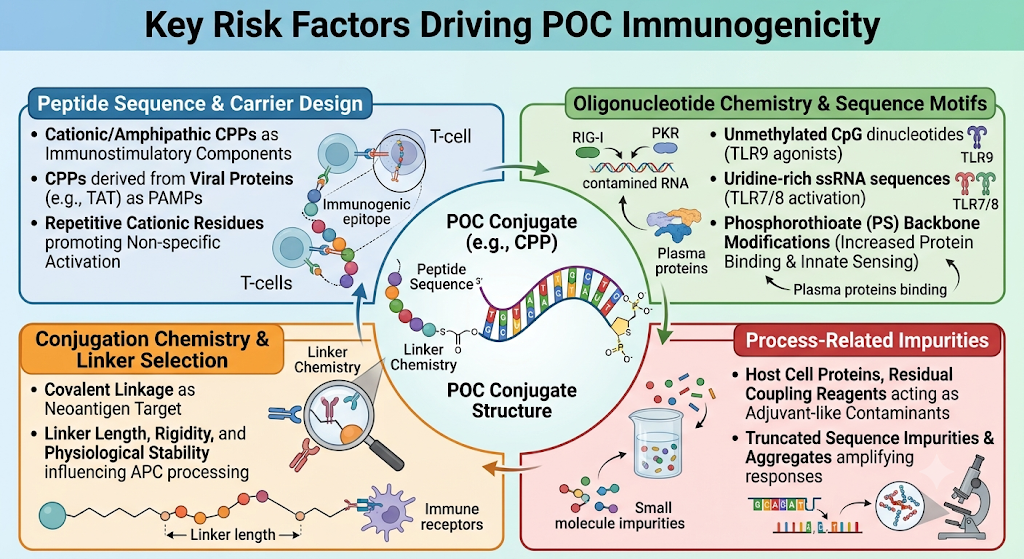
Peptide Sequence and Carrier Design
Cationic and amphipathic cell-penetrating peptides are effective delivery vehicles but are also among the most immunostimulatory components in a POC. CPPs derived from viral proteins (e.g., TAT, penetratin-like sequences) can be recognized as pathogen-associated molecular patterns, increasing the likelihood of innate immune activation and subsequent adaptive responses against the carrier itself. This risk profile differs meaningfully for a receptor-targeted peptide-oligonucleotide conjugate, where carrier design is optimized for selective uptake rather than broad membrane penetration.
- Repetitive cationic residues can promote non-specific immune cell activation
- Sequence homology to known immunogenic epitopes increases T-cell engagement risk
- Peptide aggregation propensity correlates with higher immunogenic potential
Oligonucleotide Chemistry and Sequence Motifs
Unmethylated CpG dinucleotides in single-stranded DNA oligonucleotides are potent TLR9 agonists, while uridine-rich single-stranded RNA sequences activate TLR7/8. Even therapeutic siRNA and antisense oligonucleotides (ASOs) not intended as immune modulators can inadvertently trigger these pathways if sequence design does not account for known immunostimulatory motifs. These chemical modifications also influence peptide-oligonucleotide conjugate pharmacokinetics, since backbone and ribose modifications affect both immune recognition and systemic clearance. The choice of peptide-oligonucleotide conjugate synthesis method further determines which modifications can be incorporated without compromising yield or purity.
- Phosphorothioate (PS) backbone modifications can increase plasma protein binding and innate immune activation compared to natural phosphodiester linkages
- Residual double-stranded RNA contaminants from synthesis are potent RIG-I and PKR agonists
- 2′-O-methyl and other ribose modifications can reduce, but not eliminate, TLR engagement
Conjugation Chemistry and Linker Selection
The covalent linkage joining peptide and oligonucleotide introduces a structural element with no natural biological precedent, which can itself become a target of immune recognition or alter the conformational presentation of both components. Linker length, rigidity, and chemical stability under physiological conditions all influence whether the conjugate is processed by antigen-presenting cells in a manner that promotes tolerance or sensitization. Sponsors evaluating peptide-oligonucleotide conjugate linker chemistry options should weigh immunogenicity risk alongside peptide-oligonucleotide conjugate stability data, since linkers optimized purely for in vitro stability do not always minimize immune recognition in vivo.
Process-Related Impurities
Host cell proteins, residual coupling reagents, truncated sequence impurities, and aggregates introduced during synthesis or purification can act as adjuvant-like contaminants, amplifying immune responses to an otherwise low-risk conjugate. This is why analytical characterization of impurity profiles is inseparable from immunogenicity risk assessment in POC development. Comprehensive peptide-oligonucleotide conjugate impurity profiling should also account for peptide-oligonucleotide conjugate degradation pathways, as degradation products generated during storage or handling can introduce immunogenic species not present at release.
| Risk Factor Category | Primary Mechanism | Typical Mitigation Approach |
|---|---|---|
| CPP/carrier peptide sequence | T-cell epitope presentation, innate activation | Epitope deimmunization, sequence redesign |
| CpG/ssRNA motifs | TLR7/8/9 activation | Sequence masking, chemical modification |
| Backbone chemistry (PS, 2′-OMe) | Altered protein binding, innate sensing | Modified nucleotide chemistries |
| Linker chemistry | Neoantigen formation, altered conformation | Linker length/rigidity optimization |
| Process impurities/aggregates | Adjuvant-like amplification | Tightened in-process and release specifications |
3: How Is Immunogenicity Risk Assessed for Peptide-Oligonucleotide Conjugates?
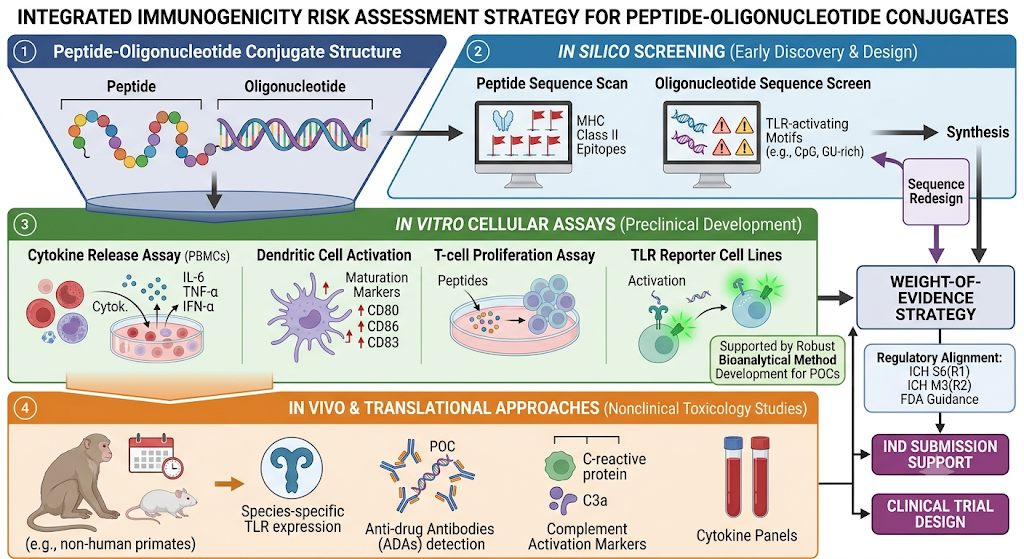
Immunogenicity risk for peptide-oligonucleotide conjugates is assessed through a tiered approach combining in silico prediction, in vitro cellular assays, and in vivo nonclinical studies, in alignment with ICH S6(R1), ICH M3(R2), and emerging FDA guidance on oligonucleotide therapeutics. No single assay can capture the full immunogenicity risk profile of a hybrid molecule, which is why regulatory agencies and experienced CROs apply a multi-tiered, weight-of-evidence strategy. This evidence is also a core component of peptide-oligonucleotide conjugates in IND submissions, and is typically generated through dedicated peptide-oligonucleotide conjugate preclinical services designed specifically for hybrid molecules.
In Silico Screening
Computational tools are used early to scan peptide sequences for predicted MHC class II binding epitopes and to screen oligonucleotide sequences for known TLR-activating motifs such as CpG dinucleotides and GU-rich stretches. This step is inexpensive relative to wet-lab work and allows sponsors to redesign problematic sequences before synthesis.
In Vitro Cellular Assays
These assays rely on robust bioanalytical method development for POC therapeutics to generate reliable, reproducible immunogenicity data.
- Cytokine release assays using human PBMCs assess innate immune activation potential, measuring IL-6, TNF-α, IFN-α, and other markers
- Dendritic cell activation assays evaluate maturation marker upregulation (CD80, CD86, CD83) as a proxy for adaptive immune priming potential
- T-cell proliferation assays assess whether peptide components drive antigen-specific T-cell expansion
- TLR reporter cell lines provide rapid, receptor-specific screening for oligonucleotide-driven innate activation
In Vivo and Translational Approaches
Nonclinical species selection for POC immunogenicity studies must account for species-specific differences in TLR expression and peptide MHC presentation, which can limit direct translatability. Anti-drug antibody (ADA) assays, complement activation markers, and cytokine panels are typically incorporated into repeat-dose toxicology studies to capture both immediate innate responses and delayed adaptive immune signals.
4: Mitigation Strategies for Reducing Peptide-Oligonucleotide Conjugates Immunogenicity
Reducing immunogenicity risk in peptide-oligonucleotide conjugates requires coordinated design choices across the peptide sequence, oligonucleotide chemistry, conjugation strategy, and manufacturing controls rather than a single fix applied after the fact. The most effective programs build mitigation into molecule design from the outset, informed by a clear understanding of peptide-oligonucleotide conjugate drug delivery mechanisms and, where relevant, a comparison of peptide vs. antibody-oligonucleotide conjugates to determine which carrier platform best balances delivery efficiency against immunogenic risk.
- Peptide deimmunization: Redesigning or substituting residues within predicted T-cell epitopes while preserving carrier or targeting function
- Chemical modification of oligonucleotides: Incorporating 2′-O-methyl, 2′-fluoro, or locked nucleic acid (LNA) modifications to reduce TLR recognition while maintaining target engagement
- CpG motif avoidance or masking: Sequence design that minimizes unmethylated CpG content where biologically feasible
- Linker optimization: Selecting cleavable or non-immunogenic linker chemistries validated for stability and minimal neoantigen risk
- Impurity control: Implementing tightened analytical specifications for residual dsRNA, aggregates, and process-related impurities through orthogonal characterization methods
- Formulation strategies: Encapsulation or shielding approaches that reduce direct immune cell exposure to immunostimulatory motifs
5: Why Analytical Characterization Is Central to Immunogenicity Control
Robust immunogenicity risk management for POCs depends on analytical methods capable of detecting low-level impurities, confirming sequence fidelity, and verifying conjugation efficiency at a resolution that links directly to biological risk. Techniques such as LC-MS/MS for sequence confirmation, ion-pair HPLC for purity assessment, and orthogonal aggregation analysis are not just quality control checkpoints—they are immunogenicity risk controls in their own right, since unidentified impurities are a recurring root cause of unexpected immune responses in clinical-stage programs. Comprehensive mass spectrometry characterization of peptide-oligonucleotide conjugates is typically established during POC synthesis and characterization and carried forward into routine QC testing for peptide-oligonucleotide conjugates and peptide-oligonucleotide conjugate analysis programs.
These controls must also scale consistently as a program advances. CMC services for peptide-oligonucleotide conjugates, peptide-oligonucleotide conjugate manufacturing, and GMP manufacturing of peptide-oligonucleotide conjugates all depend on analytical methods that remain sensitive and reproducible through scale-up of peptide-oligonucleotide conjugates, ensuring that impurity-driven immunogenicity risk does not increase as batch sizes grow.
This is the area where experienced CRO/CDMO partners add the most value: translating immunogenicity risk factors into specific, validated analytical and bioanalytical strategies tailored to a sponsor’s individual conjugate design, rather than applying a generic peptide or oligonucleotide testing panel that misses conjugate-specific risks.
Conclusion:
Managing the immunogenicity of peptide-oligonucleotide conjugates requires sponsors to address risk at every stage—from initial sequence design through analytical release testing—because the hybrid nature of POCs means immunogenic risk cannot be predicted from peptide or oligonucleotide data in isolation. A tiered assessment strategy combining in silico screening, in vitro immune cell assays, and targeted analytical characterization gives sponsors the evidence base needed to make informed design decisions before costly clinical-stage failures occur. Partnering with an analytical and bioanalytical team experienced specifically in conjugate chemistries, rather than generalist peptide or oligonucleotide testing alone, is often the determining factor in whether immunogenicity risk is identified early or discovered too late.
Frequently Asked Questions:
Immunogenicity is evaluated using a combination of computational, analytical, bioanalytical, and clinical approaches. In silico tools predict potential immune-reactive sequences before laboratory testing begins. Analytical techniques such as LC-MS, peptide mapping, and impurity profiling confirm molecular integrity and product quality. Cell-based assays assess cytokine release, immune cell activation, and T-cell responses. Anti-drug antibody (ADA) assays monitor immune responses during preclinical and clinical studies. Biomarkers including cytokines and complement proteins provide additional evidence of immune activation. Together, these methods provide a comprehensive understanding of immunogenicity risk.
Several factors can increase the immunogenicity of peptide-oligonucleotide conjugates. These include immunogenic peptide sequences, immune-stimulating oligonucleotide motifs, unstable chemical linkers, and structural heterogeneity. Product-related impurities such as aggregates, oxidation products, and truncated molecules can also trigger stronger immune responses. The route of administration, dosing frequency, and formulation components further influence immunogenicity. Manufacturing consistency plays an important role in maintaining product quality and reducing variability. Comprehensive analytical characterization helps identify these risk factors early in development. Managing these variables is key to producing safer therapeutic products.
Anti-drug antibodies (ADAs) are antibodies produced by the immune system in response to a therapeutic drug. They can bind to the drug and reduce its effectiveness or completely neutralize its therapeutic activity. ADA formation may also accelerate drug clearance from the body, requiring dosage adjustments or discontinuation of treatment. Some ADAs can trigger hypersensitivity or infusion-related reactions in patients. Regulatory agencies require ADA testing for many biologics and advanced therapeutics, including peptide-oligonucleotide conjugates. Sensitive and validated bioanalytical assays are used to detect and characterize these antibodies. Monitoring ADA responses helps ensure product safety and long-term clinical success.
Yes, immunogenicity can often be reduced through careful molecular design and robust manufacturing practices. Scientists may optimize peptide sequences, modify oligonucleotide chemistry, and select stable linker technologies to minimize immune recognition. Reducing aggregates and impurities during manufacturing also lowers immunogenicity risk. Stable formulations help preserve product integrity throughout storage and administration. Comprehensive analytical characterization ensures batch consistency and identifies potential quality issues early. Preclinical immunogenicity screening further supports risk mitigation before clinical development. These combined strategies contribute to safer and more effective therapeutic products.
Regulatory agencies evaluate immunogenicity using a science-based, risk-focused approach throughout product development. Developers are expected to provide detailed analytical characterization, validated bioanalytical methods, and anti-drug antibody testing data. In vitro immune assays, clinical safety monitoring, and biomarker analysis are also commonly required. Agencies assess whether potential immune risks have been identified, evaluated, and appropriately mitigated. Manufacturing consistency and impurity control are important parts of the regulatory review process. Comprehensive documentation demonstrating product quality and patient safety strengthens regulatory submissions. Following current regulatory guidance helps accelerate approvals and supports successful commercialization.
Impurities can significantly increase the immunogenicity of peptide-oligonucleotide conjugates, even when the active molecule itself has a low immune risk. Aggregates, truncated peptides, free oligonucleotides, oxidized variants, and residual process contaminants may stimulate unwanted immune responses. These impurities can alter the product’s structural integrity and create new immune-reactive epitopes. Advanced analytical methods are used to detect, identify, and quantify these impurities throughout development. Effective purification and manufacturing controls help minimize impurity levels. Continuous quality monitoring ensures batch consistency and regulatory compliance. Controlling impurities is therefore essential for improving product safety and therapeutic performance.
Reference
- Holz E, Darwish M, Tesar DB, Shatz-Binder W. A review of protein-and peptide-based chemical conjugates: past, present, and future. Pharmaceutics. 2023 Feb 10;15(2):600.https://www.mdpi.com/1999-4923/15/2/600
- Anwar S, Mir F, Yokota T. Enhancing the effectiveness of oligonucleotide therapeutics using cell-penetrating peptide conjugation, chemical modification, and carrier-based delivery strategies. Pharmaceutics. 2023 Apr 3;15(4):1130.https://www.mdpi.com/1999-4923/15/4/1130
- Holz E, Darwish M, Tesar DB, Shatz-Binder W. A Review of Protein-and Peptide-Based Chemical Conjugates: Past, Present, and Future. Pharmaceutics 2023, 15, 600 [Internet]. 2023https://www.academia.edu/download/104280929/pdf.pdf
- Malinowska AL, Huynh HL, Bose S. Peptide–oligonucleotide conjugation: chemistry and therapeutic applications. Current issues in molecular biology. 2024 Sep 30;46(10):11031-47.https://www.mdpi.com/1467-3045/46/10/655
- Tripathy RK, Pande AH. Nanobody-oligonucleotide conjugates (NucleoBodies): the next frontier in oligonucleotide therapy. Pharmaceutical Research. 2025 Feb;42(2):219-36.https://link.springer.com/article/10.1007/s11095-025-03829-z
About the Author


