

Introduction:
PLGA vs PLGA-PEG for nanoparticle drug delivery is one of the first formulation decisions a sponsor faces when designing a polymeric nanoparticle system, and the choice affects everything from in vitro release testing to biodistribution studies to the analytical package a regulator will expect to see. Both polymers belong to the same biodegradable polyester family, but the addition of polyethylene glycol (PEG) significantly changes how nanoparticles interact with biological systems.
PLGA nanoparticles have been extensively used for controlled drug release because of their excellent biodegradability and long regulatory track record. However, many PLGA nanoparticle formulations face challenges such as rapid clearance by the mononuclear phagocyte system (MPS), limited circulation time, and poor penetration into target tissues. Incorporating PEG into PLGA addresses many of these limitations by creating a hydrophilic surface that improves nanoparticle stability and prolongs systemic circulation.
For pharmaceutical companies developing generic, 505(b)(2), biosimilar-support, or novel nanoparticle-based drug products, selecting the appropriate polymer requires careful evaluation supported by comprehensive analytical characterization. At ResolveMass Laboratories, our analytical teams routinely support sponsors characterizing PLGA and PLGA-PEG nanoparticle systems — from polymer composition and molecular weight verification through drug loading, encapsulation efficiency, particle size distribution, and in vitro release profiling.
Summary:
- PLGA and PLGA-PEG are both biodegradable polymers widely used in nanoparticle drug delivery, but they differ significantly in surface chemistry and biological behavior.
- PLGA provides controlled drug release, high encapsulation capacity, and decades of regulatory acceptance, but its hydrophobic surface leads to rapid protein adsorption and immune clearance.
- PLGA-PEG adds a hydrophilic PEG shell that reduces protein adsorption, delays macrophage uptake, and extends circulation time — making it the preferred platform for systemic and targeted delivery.
- The right choice depends on the drug molecule, administration route, therapeutic target, and desired pharmacokinetic profile.
- Molecular weight analysis, PEG content determination, degradation studies, and full nanoparticle characterization are essential to support formulation development and regulatory submissions to the FDA, Health Canada, and EMA.
1: Why Are PLGA and PLGA-PEG Widely Used in Nanomedicine?
PLGA and PLGA-PEG are preferred because they are biodegradable, biocompatible, and capable of delivering a wide range of therapeutic molecules. Both polymers degrade into naturally occurring metabolites — lactic acid and glycolic acid — which enter normal metabolic pathways, making them highly suitable for parenteral pharmaceutical applications.
Common applications across both polymer platforms include:
- Cancer therapeutics and oncology implants
- Peptide delivery
- Protein formulations
- mRNA delivery research
- Gene therapy
- Vaccine and antigen delivery
- Long-acting injectables
- Ocular drug delivery
- CNS drug delivery across the blood-brain barrier
- Pulmonary drug delivery
- Targeted nanoparticle systems
2: What Is PLGA?
PLGA (poly(lactic-co-glycolic acid)) is a biodegradable copolymer composed of lactic acid and glycolic acid, and it remains among the most studied and most widely used polymers in controlled drug delivery.
Key characteristics:
- Biodegradable and biocompatible
- Long history of regulatory acceptance
- Tunable degradation rate
- Excellent encapsulation capability
- Suitable for hydrophobic and moderately hydrophilic drugs
Its degradation profile can be modified by altering:
- Lactide:glycolide (L:G) ratio — for example, the difference between PLGA 50:50 and PLGA 75:25 grades produces meaningfully different degradation and release timelines
- Molecular weight
- End-group chemistry (acid- vs. ester-terminated)
- Polymer architecture
Because polymer grade has such a direct impact on release performance, the role of PLGA polymer grade in long-acting release formulation is one of the most consequential — and most commonly under-characterized — decisions in a formulation program.
3: What Is PLGA-PEG?
PLGA-PEG is a block copolymer formed by chemically linking PLGA with polyethylene glycol. During self-assembly, the PEG chains orient outward, forming a hydrophilic shell around the nanoparticle core that improves biological performance compared to conventional PLGA nanoparticles.
PEG provides several advantages:
- Reduced protein adsorption
- Reduced macrophage uptake
- Improved colloidal stability
- Longer circulation time
- Better tumor accumulation through passive targeting (where applicable)
- Improved mucus penetration
- Reduced nanoparticle aggregation
4: PLGA vs PLGA-PEG for Nanoparticle Drug Delivery: Key Differences
| Feature | PLGA | PLGA-PEG |
|---|---|---|
| Polymer structure | PLGA copolymer | PLGA linked with PEG |
| Surface property | Hydrophobic | Hydrophilic shell |
| Protein adsorption | Higher | Lower |
| Blood circulation | Shorter | Longer |
| Macrophage uptake | Higher | Reduced |
| Colloidal stability | Moderate | High |
| Drug release | Controlled | Controlled, with altered release kinetics |
| Cellular interaction | Stronger uptake by phagocytes | Reduced immune recognition |
| Targeting potential | Conventional | Improved passive/active targeting |
| Steric stabilization | Limited | Excellent |
5: How Does PEG Change Nanoparticle Behaviour?
PEG significantly alters the biological fate of nanoparticles by reducing interactions with plasma proteins and immune cells. Without PEG, nanoparticles quickly adsorb plasma proteins in a process known as protein corona formation.
Protein adsorption often leads to:
- Rapid liver uptake
- Splenic clearance
- Reduced circulation time
- Lower drug exposure
PEG forms a hydrated protective layer that minimizes these interactions, resulting in longer systemic circulation, better nanoparticle stability, increased therapeutic exposure, and an improved pharmacokinetic profile overall.
6: Drug Release Differences
Drug release from both polymer systems depends on polymer degradation, drug diffusion, water uptake, and polymer erosion — but the two platforms don’t erode the same way. This is best understood through the lens of bulk erosion vs. surface erosion in PLGA, since PLGA predominantly undergoes bulk erosion, with water penetrating throughout the matrix before significant mass loss occurs.
PLGA drug release generally occurs through:
- Initial burst release
- Diffusion-controlled release
- Polymer degradation
- Matrix erosion
PLGA-PEG changes water penetration into the nanoparticle core, which may result in faster hydration, a modified burst release phase, different degradation behavior, and a more tunable release profile. As PLGA degrades, it also generates an acidic microenvironment inside the particle, which can affect the stability of acid-sensitive payloads such as peptides and proteins — a factor that should be evaluated regardless of which polymer platform is selected.
The optimal polymer, grade, and architecture depend on the therapeutic goal, and comparing degradation rates across PLGA, PLA, and PCL is a useful reference point when selecting among biodegradable polymer families more broadly.
7: Advantages of PLGA Nanoparticles
PLGA remains the preferred choice for many formulations because of its extensive pharmaceutical history.
Advantages include:
- Excellent regulatory acceptance
- Controlled release
- High encapsulation efficiency
- Wide formulation flexibility
- Adjustable degradation
- Extensive scientific literature
- Suitable for depot formulations
Typical applications include:
- Long-acting injectable drug delivery technologies
- Microspheres
- Implantable systems, such as dexamethasone implant characterization and goserelin implant characterization
- Sustained-release nanoparticles
8: Advantages of PLGA-PEG Nanoparticles
PLGA-PEG has become increasingly important for advanced nanomedicine applications that require prolonged systemic exposure.
Major benefits include:
- Extended blood circulation
- Reduced opsonization
- Lower immune recognition
- Better colloidal stability
- Improved tissue penetration
- Enhanced delivery of biologics — including characterization of long-acting biologics
- Suitable for targeted formulations
- Improved pharmacokinetics
Applications include: oncology, gene delivery, RNA therapeutics, antibody delivery, peptide therapeutics, protein therapeutics, and vaccines.
9: When Should Researchers Choose PLGA?
PLGA is often selected when long-term sustained release is required, rapid immune evasion is not critical, controlled polymer degradation is the primary objective, high drug loading is needed, and manufacturing simplicity is preferred.
Examples include:
- Leuprolide depot formulations — including reverse-engineered PLGA characterization of Lupron Depot
- Reverse-engineered risperidone PLGA microspheres for depot antipsychotics
- Buprenorphine depot formulations that involve high drug-load challenges
- Exenatide PLGA microsphere characterization, where peptide-polymer interaction challenges must be resolved
- Orthopaedic implants and local drug delivery systems
When Is PLGA-PEG a Better Choice?
PLGA-PEG is often preferred when long circulation time is essential, reduced RES/MPS clearance is desired, intravenous administration is planned, nanoparticle stability must be maximized, improved pharmacokinetics are required, or surface functionalization for active/targeted delivery is needed.
Common examples include: cancer nanomedicines, targeted drug delivery, gene therapies, mRNA therapeutics, and precision medicine applications.
PLGA Nanoparticles vs. Microspheres
It’s worth distinguishing nanoparticle systems from the closely related microsphere platform, since the two are often discussed together but behave differently in vivo — a comparison covered in more depth in our guide to PLGA nanoparticles vs. microspheres. Particle size class affects everything downstream, from injection route and tissue distribution to the analytical methods required to characterize the product.
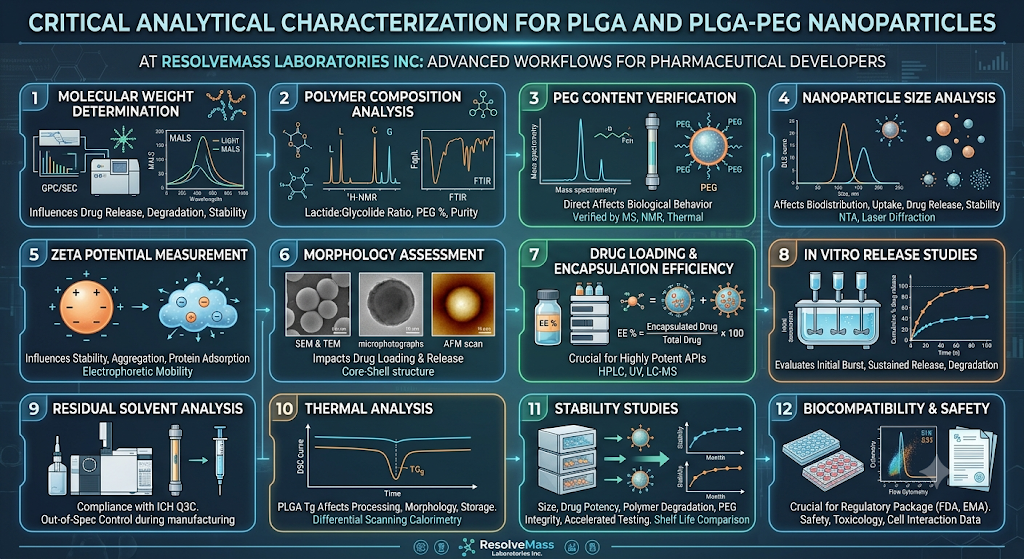
10: Critical Analytical Characterization for PLGA and PLGA-PEG Nanoparticles
Comprehensive analytical characterization is essential to confirm polymer quality, nanoparticle performance, batch consistency, and regulatory compliance. At ResolveMass Laboratories Inc., advanced analytical workflows help pharmaceutical developers understand the critical quality attributes (CQAs) of polymeric nanoparticles throughout development and commercialization — our full range of PLGA characterization methods is applied across the following key studies.
1. Molecular Weight Determination
Molecular weight influences drug release, degradation rate, particle stability, and manufacturing reproducibility. Common techniques: Gel Permeation Chromatography (GPC/SEC) and multi-angle light scattering (MALS).
2. Polymer Composition Analysis
Critical parameters include lactide:glycolide ratio, PEG percentage, copolymer architecture, and polymer purity, typically assessed by ¹H-NMR and FTIR spectroscopy.
3. PEG Content Verification
PEG density directly affects biological behaviour and is typically verified using NMR, chromatographic techniques, mass spectrometry, and thermal analysis.
4. Nanoparticle Size Analysis
Particle size affects biodistribution, cellular uptake, drug release, and stability. Common methods: Dynamic Light Scattering (DLS), Nanoparticle Tracking Analysis (NTA), and laser diffraction.
5. Zeta Potential Measurement
Surface charge influences stability, aggregation, protein adsorption, and cellular interaction.
6. Morphology Assessment
Particle morphology impacts drug loading and release, assessed using Scanning Electron Microscopy (SEM), Transmission Electron Microscopy (TEM), and Atomic Force Microscopy (AFM).
7. Drug Loading and Encapsulation Efficiency
Important parameters include drug loading (%), encapsulation efficiency, batch consistency, and residual free drug, typically measured by HPLC, LC-MS/MS, and UV spectroscopy where applicable. This is especially critical when formulating highly potent APIs using PLGA microspheres, where even small variability in loading has an outsized safety impact.
8. In Vitro Release Studies
Drug release testing evaluates initial burst release, sustained release profile, polymer degradation behaviour, and batch-to-batch consistency, using the full suite of characterization methods for PLGA microspheres.
9. Residual Solvent Analysis
Residual solvents from nanoparticle manufacturing must comply with ICH Q3C requirements, typically assessed by GC-MS and headspace GC. Residual solvent control in PLGA microsphere manufacturing is a common source of out-of-specification results if solvent removal is not tightly controlled during processing.
10. Thermal Analysis
The glass transition temperature of PLGA affects polymer processing, particle morphology, and storage behavior, and is typically assessed by differential scanning calorimetry (DSC).
11. Stability Studies
Comprehensive stability assessment includes particle size stability, drug potency, polymer degradation, PEG integrity, storage condition evaluation, and accelerated stability testing — see also our comparison of shelf life across PLGA, PLA, and PCL systems.
12. Biocompatibility and Safety
Beyond physicochemical testing, PLGA biocompatibility, safety, and toxicology data form a core part of the regulatory package for any new nanoparticle product.
11: Regulatory Considerations
Regulatory agencies expect robust characterization data demonstrating that nanoparticle formulations consistently meet predefined quality attributes. Sponsors should generate data supporting polymer identity, molecular weight distribution, drug loading, release profile, impurity profile, stability, batch reproducibility, and manufacturing consistency.
This is particularly important for generic and 505(b)(2) programs, where demonstrating PLGA polymer sameness for ANDA submissions requires side-by-side comparison against the reference listed drug. PLGA reverse engineering for ANDA programs, supported by an experienced PLGA reverse-engineering CRO, and broader PLGA polymer characterization for generics, are central to building a defensible CMC package — as demonstrated in our reverse engineering of PLGA polymer in Lupron Depot case study for long-acting injectables. Such information supports Chemistry, Manufacturing, and Controls (CMC) documentation and facilitates submissions to agencies including the FDA, Health Canada, and EMA.
12: Manufacturing and Sourcing Considerations
Formulation performance is only as reliable as the raw material behind it, which is why understanding PLGA supplier benefits and qualification criteria matters as much as the formulation science itself. Manufacturers must also work within defined GMP requirements for PLGA-based products, covering everything from raw material qualification to in-process controls.
As programs move from bench to clinic, PLGA formulation development services and dedicated PLGA microsphere scale-up services become essential to maintaining critical quality attributes across batch sizes — a topic explored further in our broader overview of PLGA microsphere formulation development.
13: How ResolveMass Laboratories Supports Nanoparticle Characterization
Developing successful nanoparticle formulations requires more than selecting the right polymer — it requires reliable analytical evidence demonstrating product quality, consistency, and performance.
ResolveMass Laboratories Inc. supports pharmaceutical and biotechnology companies with advanced analytical services for polymeric drug delivery systems, including:
- Polymer characterization
- Molecular weight analysis
- LC-MS/MS method development and validation
- High-resolution mass spectrometry (HRMS)
- Residual solvent analysis
- Drug loading and encapsulation studies
- Impurity profiling
- Forced degradation studies
- Stability studies
- Comparative analytical assessments for generic and complex drug products
Conclusion:
Choosing between PLGA and PLGA-PEG for nanoparticle drug delivery comes down to a single question: does the application need extended systemic circulation, or is local/depot retention the goal? PLGA remains the reliable choice for depot and implant delivery, while PLGA-PEG’s stealth surface makes it the platform of choice for IV-administered, long-circulating, and actively targeted nanoparticle systems. Either way, the decision should be backed by rigorous physicochemical and in vitro release characterization data, since polymer class alone does not predict in vivo performance for a specific drug and formulation.
Frequently Asked Questions:
PLGA-PEG is not always better than PLGA. It is preferred when longer circulation time, reduced immune recognition, and improved nanoparticle stability are required, especially for intravenous drug delivery. PLGA, however, is widely used for sustained-release, depot injections, and implantable formulations. It has a long history of regulatory acceptance and predictable degradation. The best choice depends on the drug, delivery route, and therapeutic objective.
PEG is added to PLGA to improve the biological performance of nanoparticles. It creates a hydrophilic surface that reduces protein adsorption and decreases uptake by immune cells. This helps nanoparticles remain in the bloodstream for longer periods. PEG also improves colloidal stability and reduces particle aggregation. These advantages make PLGA-PEG suitable for targeted and intravenous drug delivery applications.
PLGA-PEG is generally considered the better option for intravenous nanoparticle delivery. The PEG coating reduces rapid clearance by the immune system and extends circulation time in the bloodstream. This can improve drug distribution and therapeutic effectiveness. Conventional PLGA may still be suitable for certain applications where prolonged circulation is not required. The final choice depends on the formulation goals and target tissue.
Yes, PEG can influence the drug release behaviour of nanoparticles. It increases water uptake into the polymer matrix, which may alter drug diffusion and polymer degradation. This can change the initial burst release and sustained-release profile. The effect depends on factors such as PEG content, molecular weight, and polymer composition. Therefore, release studies are essential during formulation development.
Essential analytical tests ensure the quality, safety, and consistency of nanoparticle formulations. These include molecular weight determination, polymer composition analysis, and PEG content verification. Particle size, zeta potential, and morphology are measured to assess physical properties. Drug loading, encapsulation efficiency, and in vitro release studies evaluate formulation performance. Stability and residual solvent analysis are also important to support regulatory submissions and product quality.
Reference
- Locatelli E, Comes Franchini M. Biodegradable PLGA-b-PEG polymeric nanoparticles: synthesis, properties, and nanomedical applications as drug delivery system. Journal of Nanoparticle Research. 2012 Dec;14(12):1316.https://link.springer.com/article/10.1007/s11051-012-1316-4
- Rafiei P, Haddadi A. Docetaxel-loaded PLGA and PLGA-PEG nanoparticles for intravenous application: pharmacokinetics and biodistribution profile. International journal of nanomedicine. 2017 Jan 27:935-47.https://www.tandfonline.com/doi/abs/10.2147/IJN.S121881
- Khalil NM, do Nascimento TC, Casa DM, Dalmolin LF, de Mattos AC, Hoss I, Romano MA, Mainardes RM. Pharmacokinetics of curcumin-loaded PLGA and PLGA–PEG blend nanoparticles after oral administration in rats. Colloids and Surfaces B: Biointerfaces. 2013 Jan 1;101:353-60.https://www.sciencedirect.com/science/article/pii/S0927776512003657
- Perinelli DR, Cespi M, Bonacucina G, Palmieri GF. PEGylated polylactide (PLA) and poly (lactic-co-glycolic acid)(PLGA) copolymers for the design of drug delivery systems. Journal of pharmaceutical investigation. 2019 Jul 1;49(4):443-58.https://search.proquest.com/openview/5a5419b311b021cde76c3adc0088f79a/1?pq-origsite=gscholar&cbl=7435058
- Zhang K, Tang X, Zhang J, Lu W, Lin X, Zhang Y, Tian B, Yang H, He H. PEG–PLGA copolymers: Their structure and structure-influenced drug delivery applications. Journal of Controlled release. 2014 Jun 10;183:77-86.https://www.sciencedirect.com/science/article/pii/S0168365914001710
- Beletsi A, Panagi Z, Avgoustakis K. Biodistribution properties of nanoparticles based on mixtures of PLGA with PLGA–PEG diblock copolymers. International journal of pharmaceutics. 2005 Jul 14;298(1):233-41.https://www.sciencedirect.com/science/article/pii/S0378517305001936
- Afshari M, Derakhshandeh K, Hosseinzadeh L. Characterisation, cytotoxicity and apoptosis studies of methotrexate-loaded PLGA and PLGA-PEG nanoparticles. Journal of microencapsulation. 2014 May 1;31(3):239-45.https://www.tandfonline.com/doi/abs/10.3109/02652048.2013.834991
About the Author


