

Introduction
The key distinction in Peptide Drug Substance vs. Drug Product Characterization is rooted in the scope of analytical evaluation. Drug substance characterization focuses on the inherent molecular attributes of the active pharmaceutical ingredient (API), confirming its amino acid sequence, chemical identity, and synthesis-related purity. In contrast, drug product characterization examines the finished formulated medicine to verify conformational stability, compatibility with formulation components, and immunological safety throughout its intended shelf life.
Synthetic peptides occupy a unique position within pharmaceutical development, bridging the gap between conventional small-molecule drugs and complex biologic therapeutics. Owing to their distinctive molecular size (typically fewer than 40 amino acids) and susceptibility to physicochemical instability, peptides cannot be sufficiently characterized using traditional small-molecule analytical approaches alone. Instead, comprehensive peptide characterization requires a rigorous, stage-appropriate analytical strategy that extends across the entire product lifecycle, from raw material qualification to commercial manufacturing.
As regulatory agencies worldwide continue to strengthen their expectations regarding biopharmaceutical quality, specialized analytical laboratories such as ResolveMass Laboratories Inc. employ advanced orthogonal characterization platforms to establish and monitor critical quality attributes (CQAs). These analytical programs are essential for demonstrating structural integrity, clinical performance, product consistency, and long-term manufacturing control.
Learn more about Peptide Physicochemical Characterization Services designed for full lifecycle support.
Share via:
Article Summary:
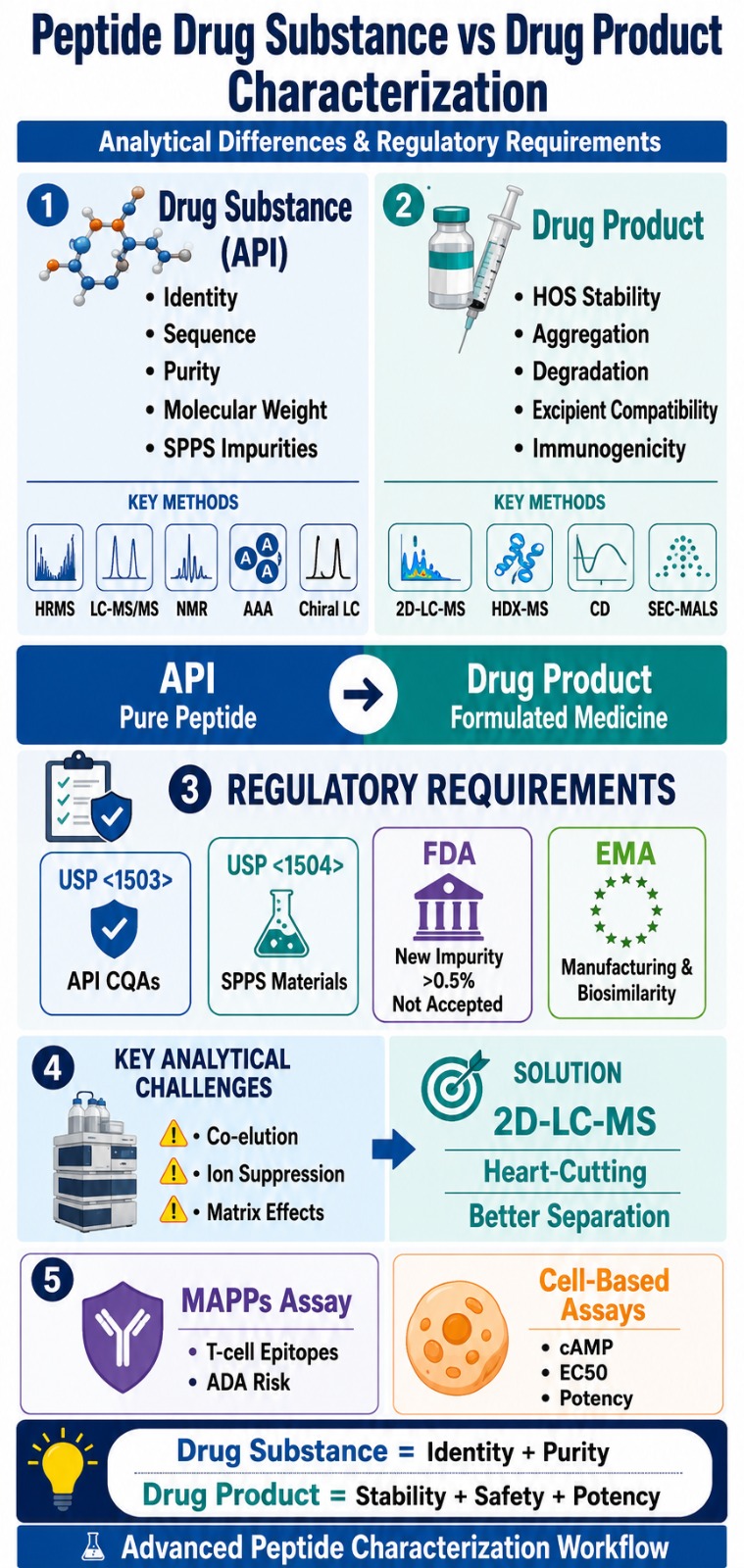
- Drug Substance vs. Drug Product: Drug substance characterization verifies peptide identity, amino acid sequence, purity, molecular weight, and synthesis-related impurities, while drug product characterization evaluates formulation stability, higher-order structure, degradation, aggregation, and immunogenicity.
- Regulatory Expectations: Peptide characterization follows guidance from USP <1503>, USP <1504>, FDA, and EMA, with strict impurity limits, raw material quality requirements, and comprehensive analytical documentation.
- Advanced Analytical Techniques: Drug substance analysis commonly uses HRMS, LC-MS/MS, NMR, Amino Acid Analysis (AAA), and chiral chromatography, whereas drug product analysis relies on 2D-LC-MS, HDX-MS, Circular Dichroism (CD), Raman spectroscopy, and SEC-MALS.
- Formulation Challenges: Finished peptide formulations are more complex due to excipients and packaging interactions. 2D-LC-MS improves separation of co-eluting impurities, minimizes ion suppression, and enables accurate impurity identification in complex matrices.
- Immunogenicity Assessment: Drug products require immunogenicity evaluation using MAPPs assays, LC-MS/MS, and in vitro approaches to identify T-cell epitopes, assess anti-drug antibody (ADA) risk, and support regulatory compliance.
- Biological Potency Testing: Functional cell-based assays, including cAMP accumulation assays, confirm receptor activity, determine EC50, and demonstrate that the peptide retains its intended biological function throughout development and storage.
- Comprehensive Quality Strategy: Combining orthogonal analytical methods with regulatory-compliant testing ensures peptide identity, purity, stability, safety, potency, and consistent product quality from API development through commercial manufacturing.
Regulatory Landscape for Synthetic Peptides: FDA, EMA, and USP Guidelines
Regulatory authorities expect peptide drug substances to be characterized with the molecular precision associated with chemically synthesized small molecules, while peptide drug products must also undergo the biological and immunogenic evaluations commonly applied to biologic therapies. Because synthetic peptides do not fit neatly within either the traditional small-molecule impurity frameworks of ICH Q3A/B or the biologics-focused guidance of ICH Q6B, dedicated regulatory pathways have been developed to address their unique quality considerations.
The United States Pharmacopeia (USP) has introduced comprehensive standards through General Chapter <1503>, Quality Attributes of Synthetic Peptide Drug Substances, and General Chapter <1504>, Quality Attributes of Starting Materials for the Chemical Synthesis of Therapeutic Peptides. These chapters establish detailed expectations for the identification, characterization, and control of peptide-related impurities while also defining quality requirements for raw materials used during solid-phase peptide synthesis (SPPS).
At the same time, the U.S. Food and Drug Administration (FDA) has finalized guidance supporting Abbreviated New Drug Applications (ANDAs) for synthetic peptides that reference recombinant DNA (rDNA)-derived products such as glucagon, liraglutide, and teriparatide. Under this framework, any newly identified and unspecified peptide-related impurity present at levels exceeding 0.5% of the drug substance is generally considered unacceptable. Impurities detected between 0.10% and 0.5% must be isolated, structurally characterized, and scientifically justified through comparative in vitro or in silico immunogenicity assessments to demonstrate that they do not introduce additional immune-related risk.
Review regulatory standards and expectations for GLP-1 platforms with Regulatory Requirements for GLP-1 Peptide Characterization.
Similarly, the European Medicines Agency (EMA) has issued guidance covering the development and manufacturing of synthetic peptide therapeutics. These recommendations provide a structured framework for SPPS process controls, impurity reporting requirements, degradation product management, and the demonstration of biosimilarity when applicable.
| Regulatory Guideline | Scope of Regulation | Key Directives and Thresholds |
|---|---|---|
| USP <1503> | Synthetic Peptide Drug Substances | Defines required CQAs, primary sequence verification, and multi-orthogonal identification of synthesis-related impurities. |
| USP <1504> | Starting Materials for Peptides | Establishes quality requirements for protected amino acid derivatives and raw materials used in SPPS. |
| FDA ANDA Guidance | Synthetic Peptides Referencing rDNA Origin | Requires that new impurities above 0.5% are generally unacceptable; impurities between 0.10% and 0.5% require characterization and immunogenicity assessment. |
| EMA Draft Guideline | Synthetic Peptides (>4 Amino Acids) | Provides recommendations for manufacturing controls, impurity specifications, and biosimilarity demonstration requirements. |
Peptide Drug Substance vs. Drug Product Characterization: Core Analytical Differences
The analytical distinction between Peptide Drug Substance vs. Drug Product Characterization is primarily driven by matrix complexity. Drug substance characterization focuses on evaluating the isolated API to verify primary structural accuracy and identify synthesis-derived impurities. Drug product characterization, however, investigates the formulated peptide within its final dosage form, assessing higher-order structural stability, aggregation potential, and interactions with formulation excipients.
Because these objectives differ substantially, each stage requires specialized analytical methodologies, instrumentation platforms, and interpretation strategies.
Download our Peptide Characterization CRO Deliverables Checklist to streamline your API and finished product testing goals.
Peptide Drug Substance Characterization Strategies
Peptide drug substance characterization is centered on confirming the primary amino acid sequence, establishing molecular identity, assessing mass balance, and profiling impurities generated during chemical synthesis. Most modern peptide APIs are produced through Solid-Phase Peptide Synthesis (SPPS) or Liquid-Phase Peptide Synthesis (LPPS). These sequential coupling processes can inherently generate a wide range of structurally related impurities, including deletion sequences, truncated sequences, and epimeric forms resulting from stereochemical inversion or amino acid racemization.
To comply with the requirements outlined in USP <1503>, manufacturers must apply orthogonal analytical approaches capable of providing comprehensive structural confirmation. High-Resolution Mass Spectrometry (HRMS) coupled with Liquid Chromatography–Mass Spectrometry (LC-MS/MS) serves as a primary platform for peptide sequence verification and impurity characterization. Advanced fragmentation techniques such as Collision-Induced Dissociation (CID) and Electron-Transfer Dissociation (ETD) enable detailed sequence mapping and facilitate confirmation of covalent structural features, including disulfide bond connectivity, which may be difficult to fully resolve using CID alone.
Learn how high-resolution workflows confirm primary structures via GLP-1 Peptide Sequencing CRO Services.
The quality of starting materials also has a direct impact on the purity profile of the final API. According to USP <1504>, protected amino acid derivatives and synthesis reagents must undergo rigorous qualification to identify contaminants that could propagate into the finished drug substance. Trace levels of unintended amino acids, peptide fragments, or related intermediates can lead to the formation of peptide-related impurities during synthesis and purification.
Address trace-level degradants and synthesis-related impurities with GLP-1 Peptide Impurity Characterization.
Routine drug substance characterization programs frequently incorporate Nuclear Magnetic Resonance (NMR) spectroscopy for orthogonal structural confirmation, chiral chromatography for stereochemical analysis, and ion chromatography for the quantification of counterions such as acetate and trifluoroacetic acid (TFA). Together, these complementary techniques provide a robust understanding of molecular identity, purity, and chemical composition.
Discover orthogonal structural analysis tools using 2D NMR for Peptide Characterization.
Peptide Drug Product Characterization Strategies
Peptide drug product characterization shifts analytical attention toward the behavior of the therapeutic peptide within its final formulation environment. The primary objectives include evaluating higher-order structural integrity, monitoring formulation stability, assessing excipient compatibility, and understanding degradation mechanisms that may develop during storage and administration.
Once the peptide API is combined with formulation components such as buffers, preservatives, tonicity modifiers, and stabilizers, it becomes exposed to degradation pathways that may differ significantly from those observed in the bulk drug substance. Common degradation mechanisms include deamidation, oxidation, aspartyl-bond hydrolysis, and the formation of non-covalent aggregates that can compromise therapeutic performance and increase immunogenicity risk.
Evaluate formulation parameters and shelf life using GLP-1 Peptide Stability Analytical Methods.
A critical element of drug product characterization is the assessment of Higher-Order Structure (HOS). The biological activity of many peptide therapeutics depends on the preservation of specific secondary and tertiary conformations, including alpha-helical and beta-sheet structures. Disruption of these conformations often precedes irreversible aggregation and can ultimately result in reduced efficacy or altered safety profiles.
To evaluate HOS, manufacturers employ a range of advanced biophysical techniques. Circular Dichroism (CD) spectroscopy is widely used to monitor secondary structural elements, while Raman spectroscopy provides additional insight into molecular conformation and structural stability. Hydrogen-Deuterium Exchange Mass Spectrometry (HDX-MS) offers highly sensitive mapping of conformational dynamics and structural perturbations under formulation and stress-testing conditions. These techniques collectively provide detailed information regarding the stability of the peptide throughout product development and storage.
Assess secondary conformational stability using CD Spectroscopy for Peptide Secondary Structure Characterization.
Drug product characterization must also consider interactions between the peptide formulation and its packaging system. Materials used in glass syringes, polymer containers, vial coatings, and elastomeric closures can release extractables and leachables that interact with the peptide. Such compounds may accelerate degradation pathways, promote particle formation, or act as immunological adjuvants that increase the risk of unwanted immune responses. Consequently, comprehensive extractables and leachables assessments form an important component of modern peptide drug product characterization programs.
| Attribute Evaluated | Drug Substance (API) Characterization | Drug Product (Formulated) Characterization |
|---|---|---|
| Primary Structural Focus | Primary sequence verification and exact molecular weight determination. | Higher-Order Structure (HOS), conformational stability, and aggregation assessment. |
| Impurity Profiling | Synthesis-related impurities including deletions, truncations, and epimers. | Degradation products including oxidation, deamidation, hydrolysis products, and leachables. |
| Matrix Complexity | Pure, isolated peptide substance. | Complex formulation containing excipients, preservatives, buffers, and other formulation components. |
| Primary Instrumentation | 1D-UHPLC-HRMS, NMR, and Amino Acid Analysis (AAA). | 2D-LC-MS, HDX-MS, Circular Dichroism (CD), and SEC-MALS. |
Overcoming Formulation Challenges: 2D-LC-MS in Drug Product Analysis
Formulated peptide drug products frequently present analytical challenges that are not encountered during the evaluation of a purified drug substance. One of the most significant obstacles is the occurrence of co-elution and excipient-induced ion suppression during mass spectrometric analysis. These issues can be effectively addressed through the application of Two-Dimensional Liquid Chromatography (2D-LC) coupled with Mass Spectrometry (MS).
The characterization of a finished drug product is inherently more complex than the analysis of an isolated API because formulation components such as meta-cresol, phenol, polysorbates, and other excipients can interfere with chromatographic separation and negatively impact ionization efficiency within the mass spectrometer. In addition, conventional one-dimensional (1D) Reverse-Phase High-Performance Liquid Chromatography (RP-HPLC) often lacks sufficient resolving power to separate closely related isomeric degradation products from the primary peptide peak.
To overcome these analytical limitations, advanced 2D-LC-MS methodologies are employed. By integrating two independent and orthogonal separation mechanisms, such as Ion Exchange Chromatography (IEX) in the first dimension and Reverse-Phase (RP) Chromatography in the second dimension, 2D-LC significantly enhances chromatographic peak capacity and overall separation performance.
This analytical strategy is generally implemented through two primary operational modes: Heart-Cutting (LC-LC) and Comprehensive (LC×LC) 2D-LC. In particular, Multiple Heart-Cutting (MHC) enables analysts to selectively transfer specific co-eluting fractions from the first chromatographic dimension into a secondary separation column prior to mass spectrometric detection. This capability is especially valuable for desalting applications. Many validated USP analytical methods rely on non-volatile salts or ion-pairing reagents such as trifluoroacetic acid (TFA) to achieve adequate chromatographic resolution; however, these components can significantly compromise mass spectrometer performance.
Through 2D-LC-MS, peptides can first be separated using TFA-containing mobile phases in the initial dimension, captured on an intermediate trapping system, and subsequently eluted into the mass spectrometer using a volatile, MS-compatible mobile phase during the second dimension. This orthogonal separation workflow allows trace-level impurities, degradation products, and structurally related variants within complex formulation matrices to be accurately detected, identified, and quantified. As a result, manufacturers can generate the comprehensive analytical data required to satisfy stringent expectations outlined by ICH Q3B and regulatory agencies such as the FDA.
Assessing Immunogenicity Risk: MAPPs Assay and In Vitro Strategies
Drug product characterization requires extensive immunogenicity risk evaluation, including the use of advanced methodologies such as the MHC-associated Peptide Proteomics (MAPPs) assay. This highly specialized approach enables the direct identification of naturally presented T-cell epitopes and supports the prediction of potential clinical anti-drug antibody (ADA) responses.
Regulatory agencies consistently emphasize that product-related impurities, formulation changes, and aggregate formation can disrupt natural immune tolerance mechanisms. The development of neutralizing antibodies (NABs) may significantly reduce the pharmacokinetic half-life and pharmacodynamic activity of a therapeutic peptide while also increasing the risk of serious hypersensitivity reactions.
The FDA recommends comprehensive assessments of both adaptive and innate immune responses, particularly when novel peptide-related impurities are detected within the range of 0.10% to 0.5%. Although in silico immunogenicity prediction platforms can rapidly estimate Major Histocompatibility Complex (MHC) binding affinity based on peptide sequence information, these computational approaches often overpredict immunogenic potential because they do not fully account for intracellular antigen processing pathways.
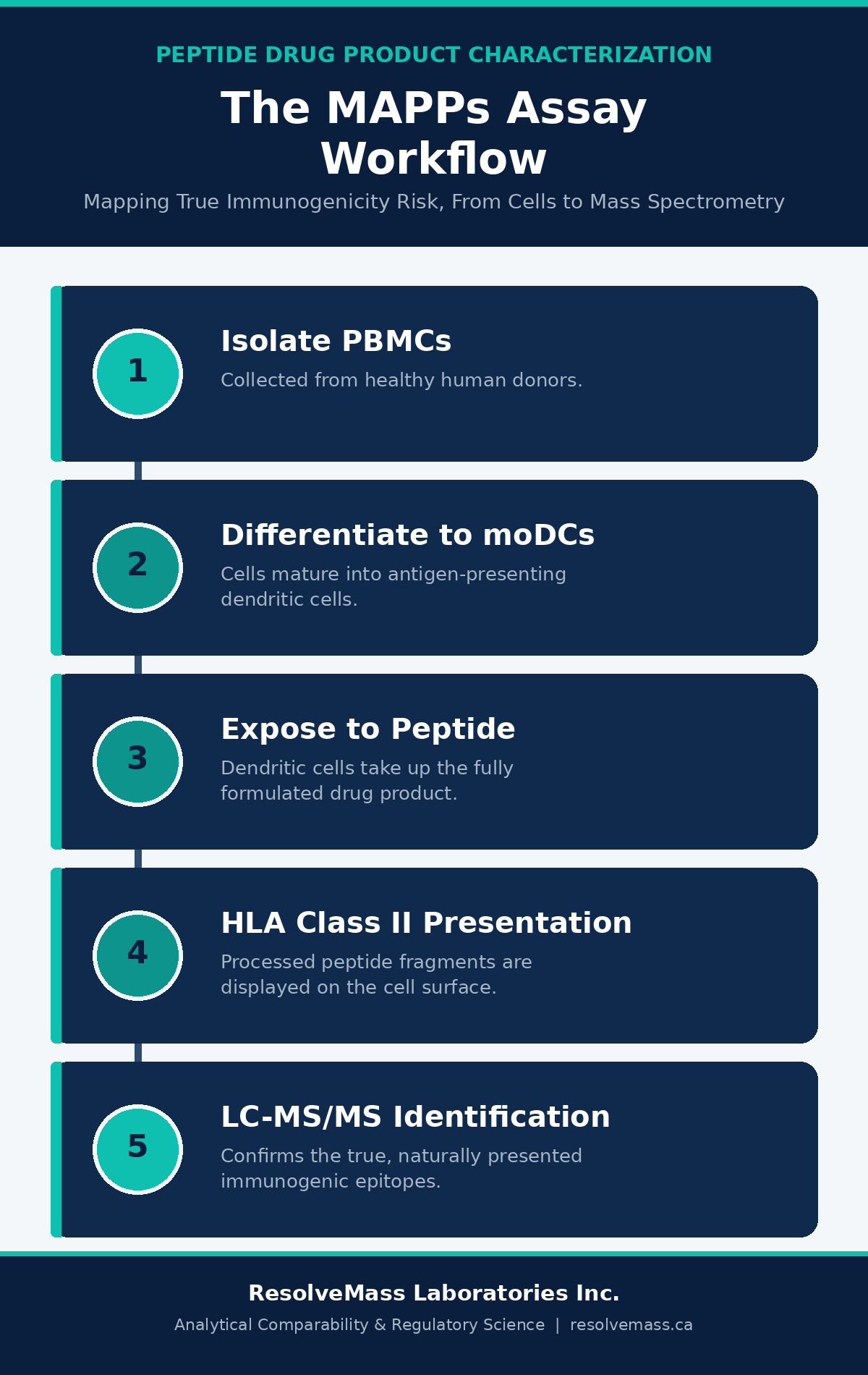
To obtain biologically relevant and experimentally validated data, the MAPPs assay has emerged as one of the most powerful ex vivo immunogenicity assessment tools available. The process begins with the isolation of Peripheral Blood Mononuclear Cells (PBMCs) obtained from healthy human donors. These cells are subsequently differentiated into monocyte-derived dendritic cells (moDCs), which function as professional antigen-presenting cells within the immune system.
The differentiated dendritic cells are then exposed to the fully formulated peptide drug product under controlled experimental conditions. Following uptake of the therapeutic molecule, the cells naturally process and degrade the peptide within lysosomal compartments, generating peptide fragments that are subsequently presented on Human Leukocyte Antigen (HLA) Class II molecules.
The resulting HLA-peptide complexes are isolated through immunoprecipitation techniques, after which the bound peptides are eluted and analyzed using high-resolution LC-MS/MS. By identifying the exact peptide fragments naturally presented to the immune system, the MAPPs assay provides direct experimental evidence regarding the true immunogenic potential of the therapeutic peptide and any associated impurities. This information offers a significantly more accurate assessment of clinical immunogenicity risk than sequence-based predictive models alone.
Measure physical instability and higher-order structural shifts with Peptide Aggregation Analysis.
Evaluating Biological Potency: Functional Cell-Based Assays
The evaluation of biological potency for a formulated peptide drug product relies heavily on functional cell-based in vitro assays that confirm the therapeutic mechanism of action remains intact, biologically active, and quantitatively comparable to an established reference standard. Unlike conventional chemical assays that merely measure the amount of peptide present within a formulation, biological potency assays assess the actual physiological response generated by the therapeutic molecule.
These studies are critical because they verify that the peptide has retained its required three-dimensional structure, receptor-binding capability, and downstream biological activity throughout manufacturing and storage.
For peptide therapeutics that target G Protein-Coupled Receptors (GPCRs), including Glucagon-like Peptide-1 (GLP-1) receptor agonists and Neuropeptide S (NPS) receptor modulators, functional activity is commonly measured using the cyclic adenosine monophosphate (cAMP) accumulation assay. Upon binding of the peptide to its target GPCR, activation of the Gαs signaling pathway stimulates adenylyl cyclase activity, resulting in intracellular accumulation of cAMP.
To perform the assay, specialized clonal cell lines such as HEK 293T or Chinese Hamster Ovary (CHO) cells engineered to stably express the target human receptor are incubated with varying concentrations of the formulated peptide drug product. The resulting concentration-dependent increase in intracellular cAMP levels is then quantified using validated analytical detection systems.
The generated dose-response curve allows calculation of the half-maximal effective concentration (EC50), which serves as a key indicator of biological potency. Demonstrating comparable EC50 values and equivalent signaling behavior between the test product and the Reference Listed Drug (RLD) provides critical evidence of pharmacodynamic comparability. Additional assessments may include evaluation of pathway bias, such as differences between cAMP accumulation and calcium mobilization signaling pathways, further supporting regulatory submissions and product approval.
Conclusion
The distinction between Peptide Drug Substance vs. Drug Product Characterization necessitates two fundamentally different yet highly complementary analytical strategies, each requiring specialized instrumentation, regulatory considerations, and development-stage-appropriate methodologies.
Drug substance characterization focuses on establishing the identity, purity, and structural integrity of the isolated API. This includes confirmation of the primary amino acid sequence, precise molecular mass determination, mass balance evaluation, and detailed profiling of synthesis-related impurities generated during Solid-Phase Peptide Synthesis (SPPS). Advanced analytical platforms such as High-Resolution Mass Spectrometry (HRMS), Nuclear Magnetic Resonance (NMR) spectroscopy, and Amino Acid Analysis (AAA) form the foundation of this characterization framework.
In contrast, drug product characterization examines the peptide within its final formulation environment. This stage requires extensive evaluation of higher-order structural stability, monitoring of aggregation tendencies, assessment of degradation pathways, and mitigation of formulation-related matrix effects through advanced analytical techniques such as Two-Dimensional Liquid Chromatography coupled with Mass Spectrometry (2D-LC-MS). Furthermore, finished drug products must undergo rigorous biological potency assessments using cAMP accumulation assays as well as comprehensive immunogenicity evaluations utilizing advanced platforms such as the MAPPs
Discover specialized contract research solutions by visiting CRO for GLP-1 Peptide Characterization. assay.
As regulatory expectations established by USP <1503>, USP <1504>, and the FDA continue to evolve, implementing these multidimensional characterization strategies remains essential for demonstrating product quality, safety, consistency, and clinical performance. Through the application of comprehensive orthogonal analytical workflows, organizations such as ResolveMass Laboratories Inc. help ensure that both peptide drug substances and finished peptide drug products consistently meet the highest standards of pharmaceutical quality, biological efficacy, and patient safety.
For specialized analytical testing, comprehensive impurity profiling, and robust regulatory support tailored to complex therapeutics, contact ResolveMass Laboratories Inc. to collaborate with experienced scientific experts and accelerate your peptide development program:
Frequently Asked Questions (FAQs)
The FDA applies stringent impurity control requirements to synthetic peptides that reference recombinant DNA-derived products. Any newly detected peptide-related impurity above the established acceptance threshold is generally considered unacceptable, while lower-level impurities must undergo detailed structural characterization and scientific justification. Manufacturers are also expected to assess whether these impurities could alter the product’s safety profile or increase immunogenicity risk through appropriate analytical and computational studies.
USP <1503> outlines the analytical expectations for demonstrating the quality and consistency of synthetic peptide drug substances. The chapter emphasizes comprehensive sequence confirmation, impurity profiling, identity testing, and evaluation of critical quality attributes. It also encourages the use of orthogonal analytical techniques to ensure that synthesis-related variants, stereochemical changes, and structurally related impurities are accurately detected and characterized throughout development and manufacturing.
Two-Dimensional Liquid Chromatography coupled with Mass Spectrometry provides enhanced separation power for complex peptide formulations that contain multiple excipients and closely related impurities. Traditional chromatographic methods may struggle to resolve co-eluting compounds, making impurity identification difficult. By combining two independent separation mechanisms, 2D-LC-MS improves analytical resolution, enabling more accurate detection, characterization, and quantification of degradation products and trace-level impurities.
The MHC-associated Peptide Proteomics (MAPPs) assay is a sophisticated immunogenicity assessment tool that evaluates how human immune cells naturally process and present peptide-derived fragments. The assay identifies peptide sequences displayed on HLA Class II molecules after cellular processing, providing direct insight into potential T-cell activation. This experimental approach helps developers understand whether a therapeutic peptide or its impurities could trigger unwanted immune responses in patients.
Higher-Order Structure analysis focuses on understanding the three-dimensional arrangement of a peptide, which is critical for maintaining biological activity. Scientists use advanced biophysical techniques such as Circular Dichroism (CD), Raman spectroscopy, Nuclear Magnetic Resonance (NMR), and Hydrogen-Deuterium Exchange Mass Spectrometry (HDX-MS) to evaluate structural integrity. These methods can detect subtle conformational changes that may affect stability, efficacy, or aggregation behavior during storage and use.
Biological potency is determined through functional assays designed to measure the peptide’s ability to produce its intended biological response. For peptides that interact with specific cellular receptors, cell-based assays are commonly used to evaluate receptor activation and downstream signaling events. The resulting data demonstrate whether the formulated product maintains its expected pharmacological activity and remains comparable to a validated reference standard.
USP <1504> establishes quality expectations for the starting materials used in the chemical synthesis of therapeutic peptides. The chapter provides guidance on the identification, purity, and impurity control of amino acid derivatives and other synthesis components. Because impurities present in raw materials can carry through the manufacturing process and affect the final API, strict adherence to these standards helps ensure consistent product quality and manufacturing reliability.
Synthetic peptides possess characteristics that place them between conventional small molecules and biologic products, making them difficult to evaluate using traditional impurity frameworks alone. Their manufacturing processes often generate structurally related variants, sequence-related impurities, and degradation products that require more specialized analytical approaches. As a result, regulatory agencies have developed peptide-specific guidance and quality standards that better address their unique structural complexity and potential immunogenicity concerns.
Forced degradation studies intentionally expose peptide drug substances and drug products to stressful conditions such as heat, light, oxidation, and extreme pH environments. These experiments help scientists understand the molecule’s degradation pathways and identify potential degradation products before they occur during routine storage. The knowledge gained supports the development of stability-indicating analytical methods, formulation optimization, and scientifically justified shelf-life assignments.
Reference:
- European Medicines Agency. (2023). Draft guideline on development and manufacture of synthetic peptides (EMA/CHMP/BWP/192908/2022). European Medicines Agency. https://www.ema.europa.eu/en/documents/scientific-guideline/draft-guideline-development-manufacture-synthetic-peptides_en.pdf
- Puig, M., & Shubow, S. (2025). Immunogenicity of therapeutic peptide products: Bridging the gaps regarding the role of product-related risk factors. Frontiers in Immunology, 16, Article 1608401. https://doi.org/10.3389/fimmu.2025.1608401
- Jiao, T. (2024, September 25). Teriparatide injection first generic approval: Quality-related review considerations [Conference presentation]. Advancing Generic Drug Development 2024: Translating Science to Approval, U.S. Food and Drug Administration. https://www.fda.gov/media/184411/download
- United States Pharmacopeia. (2025, January). USP peptide standards and solutions (BIO.1032.B). United States Pharmacopeial Convention. https://www.usp.org/sites/default/files/usp/document/our-work/biologics/resources/1699-peptide-flyer.pdf
- Sauna, Z. E., Jiang, W., Kuriakose, C., Bhat, C., Chirmule, E., & Rajpal, A. (2023). The MHC associated peptide proteomics assay is a useful tool for the non-clinical assessment of immunogenicity. Frontiers in Immunology, 14, 1232996. https://doi.org/10.3389/fimmu.2023.1232996
Get In Touch With Us
About The Author


