


Introduction
A Biosimilar CDMO in United States plays a critical role in achieving analytical comparability and regulatory acceptance by applying high-resolution, orthogonal analytical technologies that meet the stringent totality-of-evidence expectations established by global regulatory authorities. For biopharmaceutical organizations pursuing approval through the complex 351(k) biosimilar pathway, collaborating with a specialized contract development and manufacturing organization (CDMO) extends far beyond manufacturing support. It provides access to the scientific expertise and analytical infrastructure required to demonstrate that a proposed biosimilar exhibits a high degree of similarity to its reference biologic.
The analytical comparability program significantly influences the direction of the entire biosimilar development strategy. Robust analytical evidence can support regulatory arguments for reducing or eliminating extensive comparative clinical efficacy studies, thereby decreasing development timelines and costs. Through the implementation of advanced technologies such as High-Resolution Mass Spectrometry (HRMS) and the Multi-Attribute Method (MAM), an experienced biosimilar CDMO generates comprehensive structural, physicochemical, and functional characterization data. This detailed analytical fingerprinting helps reduce regulatory uncertainty, satisfies the expectations of agencies such as the FDA and EMA, and supports a more efficient route to commercialization.
Evaluating outsourcing models for your pipeline? Learn how different service providers support your milestones in our guide: Peptide CDMO vs. CRO: Choosing the Right Partner.
Share via:
Article Summary:
- Biosimilar CDMOs in the United States support successful FDA and EMA submissions by generating robust analytical comparability data that demonstrates high similarity to reference biologics.
- Advanced analytical technologies such as HRMS, HDX-MS, LC-MS/MS, and the Multi-Attribute Method (MAM) provide detailed characterization of protein structure, post-translational modifications, purity, and biological activity.
- FDA’s three-tier statistical framework evaluates critical quality attributes (CQAs) based on clinical risk, ensuring scientifically sound biosimilarity assessments.
- MAM streamlines quality control by simultaneously monitoring multiple product quality attributes, reducing testing time, improving efficiency, and enabling automated impurity detection.
- Orthogonal analytical approaches strengthen regulatory confidence by confirming molecular similarity through multiple independent techniques and supporting the totality-of-evidence approach.
- Quality by Design (QbD), method validation, and CMC risk management help minimize regulatory delays, reduce Complete Response Letter (CRL) risks, and ensure manufacturing consistency.
- Integrated PK/PD and toxicokinetic bioanalysis, combined with comprehensive analytical characterization, supports regulatory approval by confirming comparable safety, efficacy, and biological performance of biosimilars.
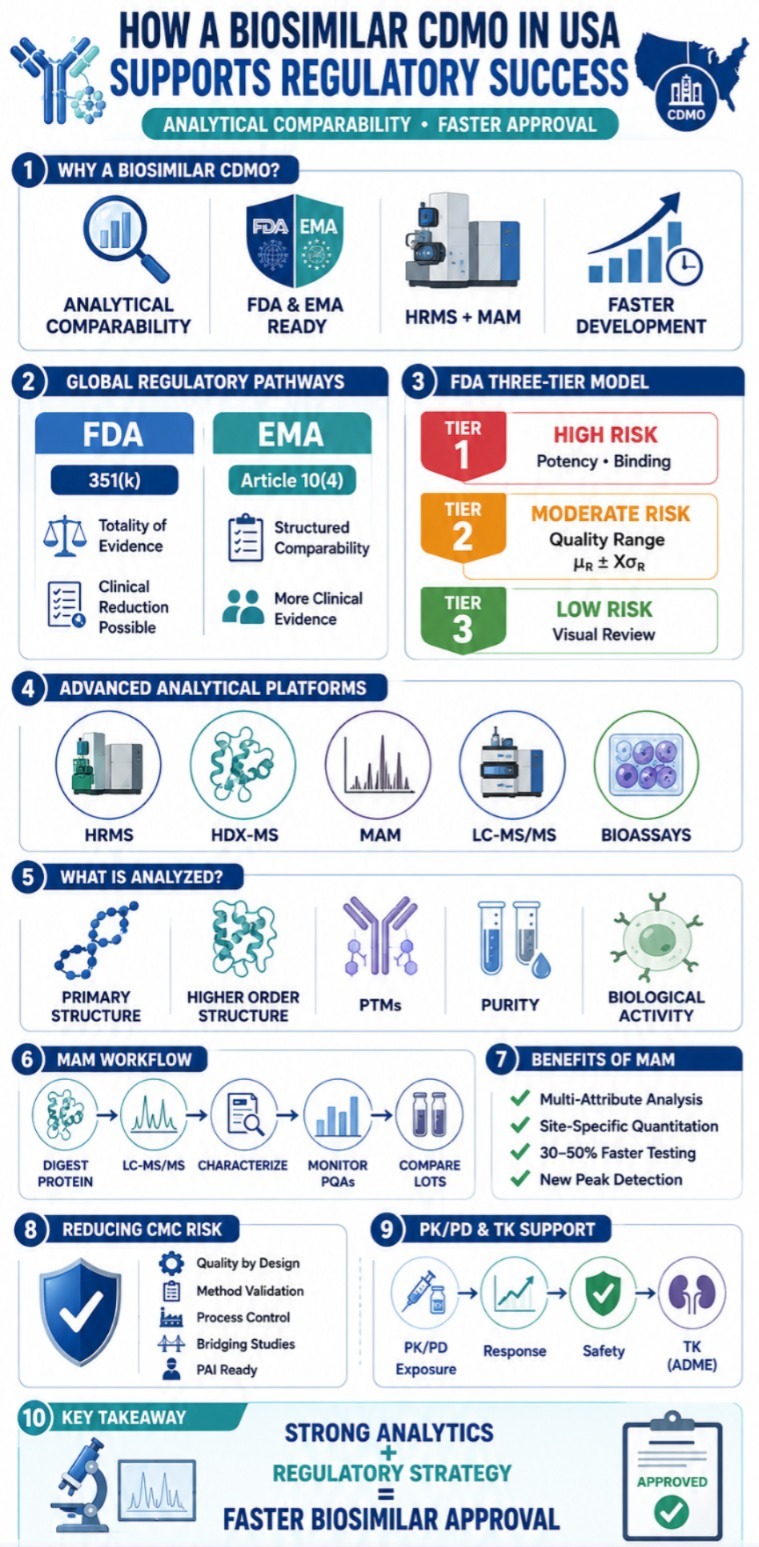
The Strategic Role of a Biosimilar CDMO in United States for Global Submissions
A Biosimilar CDMO in United States contributes significantly to successful regulatory submissions by developing comprehensive analytical data packages that align with both the FDA’s 351(k) biosimilar pathway and the EMA’s Article 10(4) regulatory framework. Biosimilar regulatory requirements vary across global jurisdictions, and failure to align analytical comparability strategies with regional expectations can result in additional bridging studies, regulatory delays, or application deficiencies.
Seeking specialized domestic expertise? Discover our insights on Peptide CDMO Services in the United States.
Within the United States, the Biologics Price Competition and Innovation Act (BPCIA) established the 351(k) pathway, which follows a stepwise and risk-based “totality of evidence” approach. The FDA’s September 2025 final guidance, Development of Therapeutic Protein Biosimilars: Comparative Analytical Assessment and Other Quality-Related Considerations, formally reinforced the principle that a highly persuasive analytical and functional similarity package may provide sufficient evidence to reduce or eliminate the need for certain comparative clinical endpoint studies.
In contrast, the European Medicines Agency (EMA), which introduced the first biosimilar regulatory pathway globally in 2004, follows a more structured and prescriptive framework. The agency requires extensive comparability exercises and generally favors specific clinical study designs, including single-dose, two-period crossover studies conducted in sensitive populations. As a result, biosimilar developers targeting both markets must design analytical programs capable of addressing the expectations of multiple regulatory authorities simultaneously.
ResolveMass Laboratories Inc. operates within this sophisticated regulatory environment, delivering GLP-compliant bioanalytical method development and analytical characterization services that support the preparation of regulatory-ready biosimilar dossiers suitable for dual-market submissions.
Ensure you partner with the right team by reviewing How to Choose a Peptide CDMO in the US.
| Parameter | FDA (United States) | EMA (European Union) |
|---|---|---|
| Legal Basis | Section 351(k) BPCIA / PHS Act | Article 10(4) Directive 2001/83/EC |
| Regulatory Approach | Totality of evidence; stepwise, risk-based | Stepwise, highly prescriptive guidelines |
| Analytical Comparability | Foundational; “fingerprint-like” characterization strongly encouraged to support clinical trial reduction | Mandatory; requires state-of-the-art physicochemical and functional characterization |
| Interchangeability | Distinct statutory designation allowing pharmacy-level substitution | Not recognized by EMA; substitution decisions are determined by individual member states |
| Reference Product (RP) | Requires a US-licensed RP; bridging studies may be necessary when using a non-US RP | Requires an EU-authorized RP; bridging studies may be required for foreign-sourced products |
Implementing the FDA’s Three-Tiered Statistical Approach
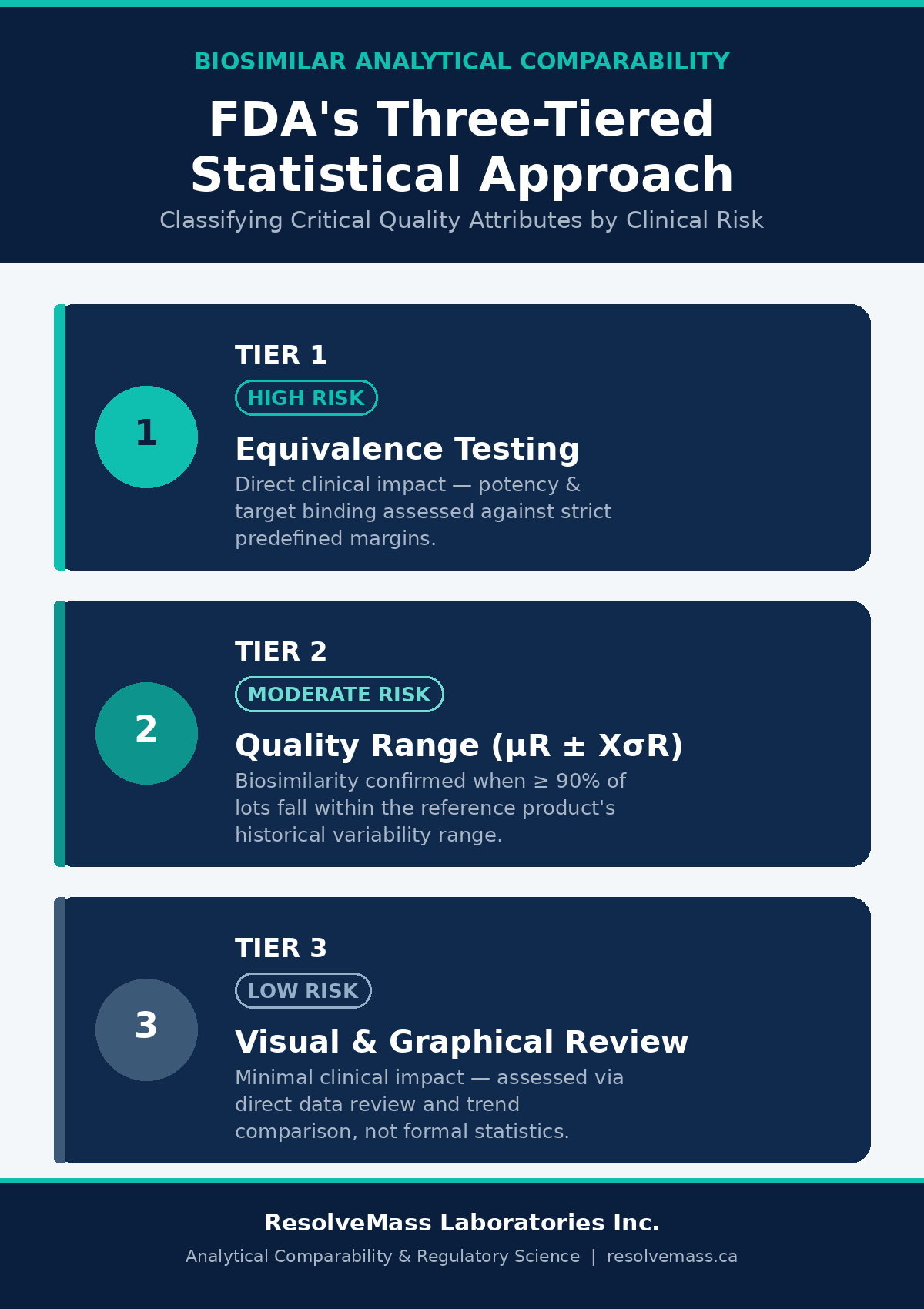
The FDA’s three-tiered statistical framework classifies critical quality attributes (CQAs) according to their potential clinical impact, allowing regulators to apply an appropriate level of statistical rigor when assessing biosimilarity. A capable biosimilar development partner facilitates this process by conducting analytical evaluations using a minimum of ten reference product lots collected across multiple manufacturing periods and expiration dates. This approach enables accurate characterization of natural manufacturing variability within the reference product.
Tier 1 (High Risk)
Tier 1 attributes represent the highest clinical significance because they directly influence the mechanism of action, therapeutic performance, or patient outcomes. Examples include target binding and biological potency. For these attributes, biosimilarity is evaluated using rigorous statistical equivalence testing. The assessment focuses on determining whether the difference in mean values between the biosimilar and reference product remains within predefined equivalence margins.
Tier 2 (Moderate Risk)
Tier 2 attributes are assessed using a Quality Range (QR) methodology. The QR is established using the historical variability observed among multiple reference product lots. Biosimilarity is demonstrated when a predefined proportion of biosimilar lot results—commonly 90% or greater—falls within the established quality range.
The quality range is generally expressed as:
μR ± XσR
where:
- μR represents the mean value of the reference product lots.
- σR represents the standard deviation of the reference product lots.
- X represents a scientifically justified multiplier, often assigned a value of 3 depending on the clinical relevance and risk associated with the attribute.
Tier 3 (Low Risk)
Tier 3 attributes have minimal anticipated clinical impact and therefore require a less stringent evaluation strategy. These attributes are generally assessed through direct review of analytical data, visual comparisons, and graphical trend analysis rather than formal statistical equivalence testing.
Advanced Analytical Platforms Used by a Biosimilar CDMO in United States
A Biosimilar CDMO in United States employs advanced analytical technologies—including High-Resolution Mass Spectrometry and orthogonal biophysical characterization tools—to identify structural and functional differences that may affect clinical performance. Because biologics are highly complex macromolecules, typically ranging from 10,000 to 300,000 Da and produced in living cellular systems, comprehensive characterization requires the integration of multiple analytical methodologies.
Orthogonal analytical techniques are particularly valuable because they evaluate the same quality attribute using different scientific principles. This independent verification strengthens confidence in analytical findings and minimizes the possibility that important molecular differences will remain undetected due to the limitations of a single analytical platform.
A comprehensive biosimilar characterization strategy must evaluate primary structure, higher-order structure (HOS), post-translational modifications (PTMs), physicochemical characteristics, and biological activity.
| Analytical Category | Target Quality Attributes | Key Orthogonal Techniques |
|---|---|---|
| Primary Structure | Amino acid sequence confirmation, terminal structures, disulfide bond mapping | Peptide mapping, High-Resolution Mass Spectrometry (HRMS), Amino acid sequencing |
| Higher-Order Structure | Secondary, tertiary, and quaternary conformational dynamics and stability | Circular dichroism (CD), Hydrogen-Deuterium Exchange MS (HDX-MS), Fluorescence spectroscopy |
| Post-Translational Modifications | Glycosylation patterns, oxidation, deamidation, and charge variants | Glycan profiling (LC-MS/MS), Capillary electrophoresis, Multi-Attribute Method (MAM) |
| Physicochemical Properties | Aggregation, size distribution, and product purity | Size-exclusion chromatography (SEC), Dynamic light scattering (DLS), Analytical ultracentrifugation (AUC) |
| Biological Activity | Receptor binding affinity, functional potency, and mechanism of action (MoA) | Cell-based bioassays, Surface plasmon resonance (SPR), Enzyme activity assays |
High-Resolution Mass Spectrometry (HRMS) and Fingerprinting
High-Resolution Mass Spectrometry (HRMS) functions as one of the most important fingerprinting technologies in biosimilar development, enabling highly accurate intact protein mass analysis, sequence verification, and detailed characterization of complex post-translational modifications. Modern HRMS platforms equipped with Orbitrap or Quadrupole Time-of-Flight (Q-TOF) analyzers provide exceptional resolving power, allowing scientists to identify subtle proteoform variations and low-abundance molecular species that may remain undetected using conventional analytical techniques.
When integrated with complementary orthogonal technologies such as Hydrogen-Deuterium Exchange Mass Spectrometry (HDX-MS), HRMS provides detailed insight into protein conformational behavior, structural stability, and molecular interaction sites. These advanced analytical capabilities enable researchers to generate a highly detailed three-dimensional comparison between a proposed biosimilar and its reference biologic, establishing a robust scientific foundation for demonstrating biosimilarity and supporting regulatory submissions.
Examine an analytical characterization program in action: Peptide Characterization Case Study of Semaglutide.
Leveraging the Multi-Attribute Method (MAM) for Quality Control
The Multi-Attribute Method (MAM) enhances biosimilar development and quality control by enabling the simultaneous assessment of multiple product quality attributes through a single high-resolution LC-MS workflow. Traditionally, the evaluation of critical quality attributes (CQAs) required several independent analytical assays, resulting in increased testing time, greater operational complexity, and a higher likelihood of inter-assay variability. MAM addresses these challenges by consolidating the analysis into a unified platform capable of providing detailed molecular-level characterization.
Explore targeted analytical strategies for complex molecules in GLP-1 Peptide Analytical Characterization.
MAM employs a peptide mapping strategy to examine molecular variants at the amino acid level, providing highly specific information regarding product quality attributes. The workflow is generally divided into two key stages:
Characterization Phase
During the characterization phase, therapeutic protein samples undergo denaturation followed by enzymatic digestion using a proteolytic enzyme such as trypsin. The resulting peptides are analyzed using tandem mass spectrometry (MS/MS). Structural modifications and their precise locations within the amino acid sequence are identified through detailed analysis of the MS/MS data and comparison against established protein sequence databases. This process enables comprehensive characterization of the molecular composition of the biologic.
Monitoring Phase
The monitoring phase focuses on the accurate quantification of specific Product Quality Attributes (PQAs), including modifications such as deamidation and oxidation. Quantitation is achieved by extracting mass peak areas corresponding to both modified and unmodified peptide species from the extracted ion chromatogram (XIC). By comparing these signal intensities, analysts can determine the precise percentage of each modification present within the sample.
When MAM is applied concurrently to both biosimilar and reference product lots, laboratories can generate a comprehensive comparison of multiple attributes within a single analytical workflow. This integrated approach significantly strengthens the analytical similarity package submitted to regulatory agencies and supports a more robust demonstration of biosimilarity.
| Feature | Conventional Analytical Assays | Multi-Attribute Method (MAM) |
|---|---|---|
| PQA Coverage | Single attribute evaluated per assay (e.g., separate methods for glycans, charge variants, and size analysis) | Simultaneous monitoring of multiple attributes, including glycans, deamidation, oxidation, and other modifications |
| Quantitation | Typically provides bulk or relative quantitation, such as total acidic or basic species | Enables site-specific quantitation at the amino acid level |
| Efficiency | Often requires four to six independent analytical workflows for each batch | Consolidates multiple workflows, reducing per-lot testing time by approximately 30–50% |
| New Peak Detection (NPD) | Relies on manual visual comparison by experienced analysts | Utilizes automated three-dimensional data comparison to identify and flag new impurities for MS/MS characterization |
Mitigating CMC Risks to Avoid Complete Response Letters (CRLs)
Biosimilar sponsors can reduce the likelihood of receiving Complete Response Letters (CRLs) by implementing robust Quality by Design (QbD) principles and utilizing advanced process analytical technologies to proactively address Chemistry, Manufacturing, and Controls (CMC) risks. Across both FDA and EMA review processes, manufacturing and quality-related deficiencies remain among the most common reasons for regulatory delays, application refusals, and CRLs.
Because therapeutic proteins are manufactured using highly sensitive living cell systems, even minor variations in upstream or downstream processing parameters can influence critical product attributes. Changes in factors such as dissolved oxygen levels, cell culture media composition, pH conditions, or chromatography resin performance may alter glycosylation profiles, charge variant distributions, or other essential quality characteristics. If these changes result in attribute values falling outside the established statistical ranges derived from the reference product, the analytical comparability strategy may be compromised.
Understand the structural differences between full-service development vs. standard manufacturing in Peptide CDMO vs. CMO: Key Differences.
An additional regulatory vulnerability arises during Pre-Approval Inspections (PAIs). Organizations that rely on multi-site contract manufacturing organization (CMO) networks face the challenge that quality system deficiencies or compliance failures at a single manufacturing location can delay or prevent approval of the entire 351(k) application, regardless of the strength of the analytical, nonclinical, or clinical data package.
To address these challenges, advanced analytical partners such as ResolveMass Laboratories Inc. integrate comprehensive analytical method validation programs throughout biosimilar development. Method validation ensures that characterization techniques are scientifically sound, reproducible, and suitable for their intended purpose. Furthermore, when manufacturing processes are scaled from development batches to commercial production, carefully designed bridging studies and comparative structural characterization programs help confirm that process modifications have not affected the molecular integrity, safety profile, or performance characteristics of the biosimilar product.
Ensure smooth commercial transfer with our detailed guide on Peptide CDMO Scale-Up Services.
Integrating PK/PD and Toxicokinetic Bioanalysis
The integration of pharmacokinetic/pharmacodynamic (PK/PD) and toxicokinetic (TK) bioanalysis with advanced structural characterization provides critical evidence that a biosimilar exhibits systemic exposure and biological activity comparable to its reference biologic. While analytical similarity assessments establish structural comparability, in vivo studies are essential for demonstrating that these structural similarities translate into equivalent biological behavior and clinical performance.
Toxicokinetic (TK) bioanalysis investigates the absorption, distribution, metabolism, and excretion (ADME) characteristics of a biosimilar under supra-therapeutic dosing conditions in animal models. Conducted in compliance with Good Laboratory Practice (GLP) requirements, these studies evaluate key exposure parameters, including maximum plasma concentration (Cmax) and area under the concentration-time curve (AUC). Such evaluations help identify potential toxicological concerns, exposure-related risks, pathway saturation effects, or active metabolite accumulation before initiating human clinical studies.
As biosimilar programs advance into clinical development, PK/PD bioanalysis utilizes highly sensitive LC-MS/MS platforms and immunoassays to evaluate concentration-time profiles and correlate systemic exposure with biological receptor responses. These studies provide essential evidence that the biosimilar produces therapeutic effects equivalent to those of the reference product while maintaining a comparable safety profile and avoiding unexpected immunogenic responses.
Learn how end-to-end service integration accelerates your timeline in Peptide Drug Development CDMO Services.
Conclusion
The successful development and approval of a biosimilar require navigating a highly complex scientific, analytical, and regulatory landscape, making the selection of a Biosimilar CDMO in United States a crucial factor in determining program success. As regulatory agencies increasingly emphasize analytics-driven and risk-based assessment frameworks, the strength of a biosimilar application depends heavily on the quality, sensitivity, and orthogonality of the comparative analytical evidence generated throughout development.
By leveraging advanced characterization technologies such as High-Resolution Mass Spectrometry (HRMS), Hydrogen-Deuterium Exchange Mass Spectrometry (HDX-MS), and the Multi-Attribute Method (MAM), developers can establish comprehensive molecular fingerprints, demonstrate analytical similarity across the FDA’s tiered statistical framework, and potentially reduce the need for extensive confirmatory clinical efficacy studies. These capabilities provide a strong scientific foundation for regulatory decision-making while accelerating biosimilar development timelines.
Achieving long-term regulatory success requires collaboration with an analytical partner that possesses the specialized bioanalytical expertise, validated methodologies, and advanced infrastructure necessary to transform complex analytical data into a comprehensive, regulatory-ready 351(k) submission package.
To learn more about how comprehensive analytical comparability testing and analytical method validation can strengthen your next biologics development program, visit our contact page:
Frequently Asked Questions
The FDA’s totality of evidence framework is a comprehensive evaluation strategy used to determine whether a proposed biosimilar is highly similar to its reference biologic. Rather than relying on a single study, regulators assess analytical characterization, nonclinical findings, and clinical pharmacology data collectively. The objective is to demonstrate that any observed differences do not have a meaningful impact on safety, purity, or therapeutic performance.
Orthogonal analytical techniques are essential because biologics possess complex molecular structures that cannot be fully characterized using a single analytical method. Different technologies evaluate the same quality attribute through independent scientific principles, allowing researchers to confirm results from multiple perspectives. This layered approach improves confidence in analytical findings and helps ensure that subtle structural differences are accurately identified and assessed.
The Multi-Attribute Method (MAM) is a mass spectrometry-based analytical approach that enables simultaneous monitoring of multiple product quality attributes within a single workflow. Through peptide mapping and high-resolution LC-MS analysis, MAM can detect and quantify modifications such as oxidation, deamidation, and glycosylation. This technology enhances analytical efficiency while providing detailed molecular-level information that supports biosimilar comparability assessments and quality control programs.
Regulatory agencies generally recommend evaluating at least ten reference product lots to adequately characterize the inherent variability of the originator biologic. These lots should ideally represent different manufacturing periods and expiration dates to capture natural product variation over time. Establishing a robust reference dataset allows sponsors to develop scientifically justified statistical ranges against which biosimilar attributes can be compared.
Many biosimilar applications encounter regulatory challenges due to deficiencies related to Chemistry, Manufacturing, and Controls (CMC). Common issues include inadequate process validation, insufficient analytical comparability data, manufacturing inconsistencies, or weaknesses in quality management systems. Findings identified during Pre-Approval Inspections (PAIs) can also delay approval if regulatory authorities determine that manufacturing operations do not consistently support product quality and compliance.
Analytical comparability serves as the foundation of biosimilar development because it establishes whether the proposed product closely matches the reference biologic at the molecular and functional levels. When comprehensive analytical evidence demonstrates a high degree of similarity, regulatory agencies may determine that extensive comparative efficacy trials provide limited additional value. As a result, development programs can often focus on targeted pharmacokinetic and pharmacodynamic studies rather than large-scale clinical investigations.
Hydrogen-Deuterium Exchange Mass Spectrometry (HDX-MS) is a sophisticated analytical technique used to study higher-order structure and conformational behavior in proteins. By monitoring the exchange of hydrogen atoms with deuterium under controlled conditions, scientists can evaluate protein folding, structural stability, and molecular interaction sites. This information is particularly valuable in biosimilar development because it helps confirm that the three-dimensional structure of the biosimilar closely resembles that of the reference biologic.
Reference:
- Nupur, N., Joshi, S., Gulliarme, D., & Rathore, A. S. (2022). Analytical similarity assessment of biosimilars: Global regulatory landscape, recent studies and major advancements in orthogonal platforms. Frontiers in Bioengineering and Biotechnology, 10, Article 832059. https://doi.org/10.3389/fbioe.2022.832059
- Bas, T. G. (2025). Innovative formulation strategies for biosimilars: Trends focused on buffer-free systems, safety, regulatory alignment, and intellectual property challenges. Pharmaceuticals, 18(6), 908. https://doi.org/10.3390/ph18060908
- Iezzi, D. (2014). Contract development and manufacturing organizations (CDMO): Are they needed in Brazil. BMC Proceedings, 8(Suppl 4), O3. https://doi.org/10.1186/1753-6561-8-S4-O3
- Al-Sabbagh, A., Olech, E., McClellan, J. E., & Kirchhoff, C. F. (2016). Development of biosimilars. Seminars in Arthritis and Rheumatism, 45(5 Suppl), S11–S18. https://doi.org/10.1016/j.semarthrit.2016.01.002
Get In Touch With Us
About The Author


