

Cross-Border Drug Development: One Testing Lab for Both FDA and Health Canada Submissions
 By Anusha Sinha
•
August 6, 2026
By Anusha Sinha
•
August 6, 2026
Introduction
Centralizing analytical testing within a single qualified contract testing facility enables biopharmaceutical sponsors to meet regulatory expectations from both the U.S. Food and Drug Administration (FDA) and Health Canada through a harmonized analytical strategy. This approach minimizes duplicate validation activities, reduces variability associated with multiple testing sites, and expedites regulatory submissions across North American markets.
Executing Cross-Border Drug Development requires sponsors to navigate two separate regulatory authorities—the United States Food and Drug Administration (FDA) and Health Canada—which oversee the North American pharmaceutical landscape. Although both agencies operate according to the scientific principles established by the International Council for Harmonisation (ICH), their facility authorization models, quality system requirements, and submission procedures differ in several important operational areas. Partnering with a single analytical testing laboratory capable of satisfying both FDA registration expectations and Health Canada Drug Establishment Licence (DEL) requirements eliminates the operational inefficiencies associated with maintaining separate analytical testing sites.
Discover how our integrated CDMO services streamline end-to-end drug development for biopharmaceutical sponsors.
Organizations pursuing commercialization in both the United States and Canada often encounter duplicated administrative processes and regulatory obligations. While the scientific content submitted within the Electronic Common Technical Document (eCTD) framework is largely harmonized across Modules 2 through 5, regional Module 1 requirements require clear evidence of facility compliance and regulatory preparedness specific to each authority. Historically, pharmaceutical submissions in Canada have often lagged behind corresponding U.S. filings due to resource limitations and fragmented testing programs. Utilizing a dual-compliant analytical laboratory creates a unified and reliable source of analytical data, facilitating seamless integration between U.S. and Canadian regulatory submission pathways.
Recent regulatory collaborations, including the FDA and Health Canada Request for Information Sharing (RIS) pilot program for generic drug applications and the broader adoption of shared electronic submission gateways, demonstrate increasing regulatory alignment between the two agencies. Sponsors that leverage a single laboratory equipped with advanced analytical instrumentation and robust dual-compliance quality systems can benefit from this growing convergence, optimize Chemistry, Manufacturing, and Controls (CMC) activities, and reduce the likelihood of costly regulatory deficiencies.
Learn how our one-stop CDMO analytical services for ANDA submissions accelerate your generic drug approval timelines.
Need analytical testing support for cross-border drug development? Contact our experts today to discuss FDA- and Health Canada-ready testing solutions for your drug product, API, biologic, peptide, or generic drug program. Contact us
Article Summary Key Takeaways
- One dual-compliant testing laboratory can support both FDA and Health Canada submissions, reducing duplicate testing, validation efforts, costs, and regulatory delays while streamlining North American drug development.
- FDA and Health Canada follow different authorization models—FDA requires facility registration and cGMP compliance, whereas Health Canada requires a Drug Establishment Licence (DEL) with authorized testing activities before commercial testing begins.
- eCTD Modules 2–5 are scientifically harmonized, allowing the same analytical data to support both agencies, while Module 1 contains region-specific administrative requirements that must be prepared separately.
- Advanced analytical capabilities such as HRMS, LC-MS/MS, GC-MS/MS, E&L testing, residual solvent analysis, qNMR, DSC/TGA, GPC/SEC, and peptide characterization are essential for meeting both FDA and Health Canada regulatory expectations.
- Centralized testing improves consistency by eliminating method transfers, reducing inter-laboratory variability, minimizing Out-of-Specification (OOS) risks, and enabling faster, more consistent responses to regulatory queries.
- Robust quality systems and data integrity must comply with 21 CFR Part 11, Health Canada Annex 11 (GUI-0050), ICH Q2(R2), and ICH M10 to ensure reliable analytical data for both jurisdictions.
- Choosing a laboratory with FDA registration and a valid Health Canada DEL helps accelerate simultaneous U.S. and Canadian submissions, improves regulatory efficiency, lowers compliance risks, and speeds market access across North America.
Regulatory Framework Divergence: FDA Registration vs. Health Canada Licensing
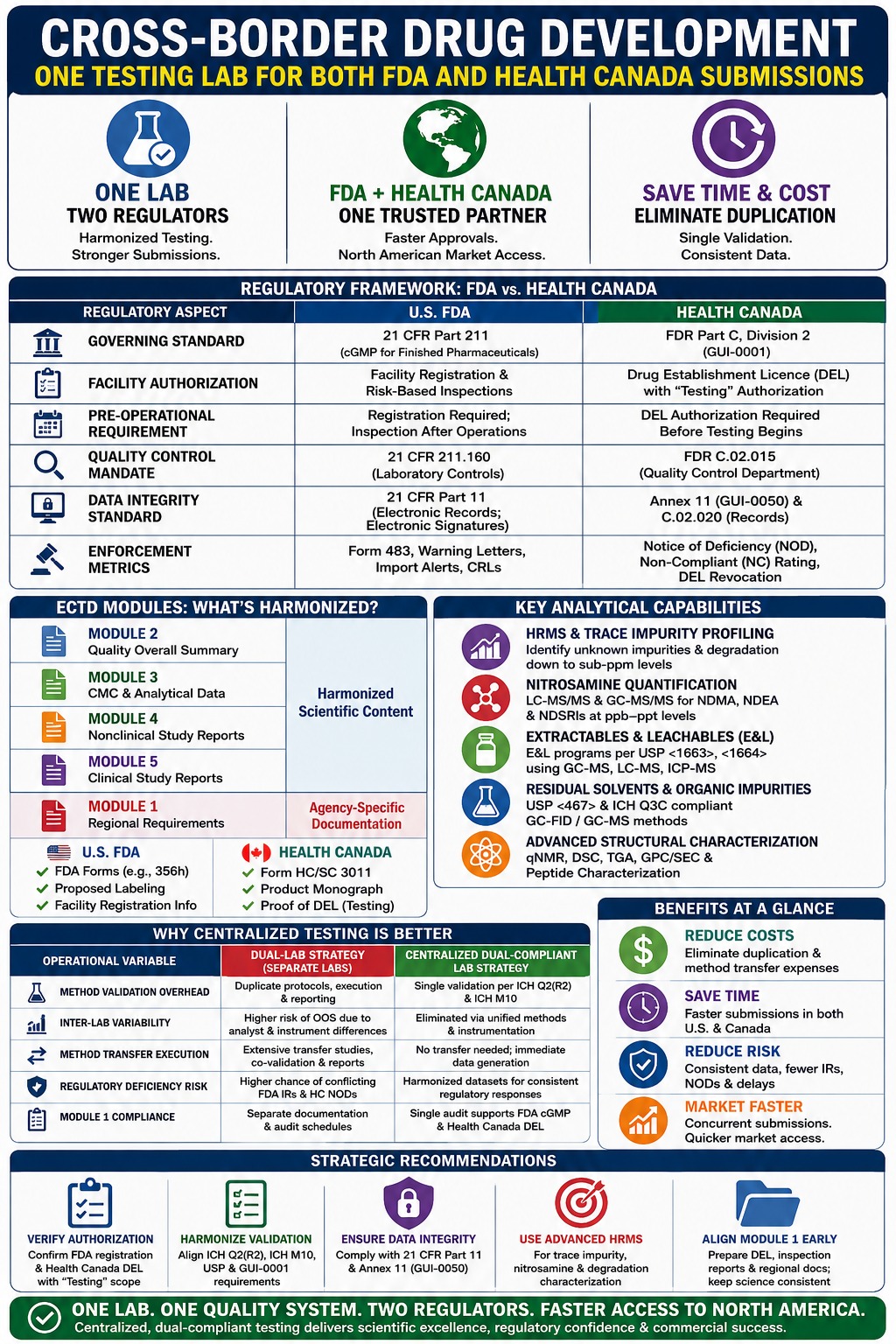
The most significant operational distinction between U.S. and Canadian analytical regulatory oversight lies in their respective facility authorization mechanisms. The FDA relies on establishment registration followed by risk-based Current Good Manufacturing Practice (cGMP) inspections conducted under 21 CFR Part 211, while Health Canada requires facilities to obtain a Drug Establishment Licence (DEL) before initiating testing operations, with specific authorization for testing activities under Part C, Division 2 of the Food and Drug Regulations (GUI-0001). Understanding these structural differences is essential for sponsors developing cross-border analytical programs.
Under FDA oversight, domestic and international analytical laboratories responsible for testing active pharmaceutical ingredients (APIs), raw materials, intermediates, or finished drug products must register their facilities and comply with Current Good Manufacturing Practice (cGMP) requirements established under 21 CFR Part 211. FDA compliance is assessed through risk-based surveillance inspections and pre-approval inspections (PAIs) associated with specific New Drug Applications (NDAs) and Abbreviated New Drug Applications (ANDAs). Failure to comply may result in FDA Form 483 observations, Warning Letters, Import Alerts, or Complete Response Letters (CRLs) linked to the corresponding application.
Read our key criteria on how to choose a peptide CDMO in the US to ensure full 21 CFR Part 211 compliance.
Conversely, Health Canada requires facilities to obtain regulatory authorization before analytical testing activities begin. Under Part C, Division 2 of the Food and Drug Regulations (FDR), specifically Regulation C.02.015, any establishment performing analytical testing for products intended for the Canadian market must possess a valid Drug Establishment Licence (DEL) that explicitly includes “Testing” within its authorized activities. Health Canada’s Regulatory Operations and Enforcement Branch (ROEB) evaluates facilities against the requirements outlined in the Good manufacturing practices guide for drug products (GUI-0001). Inspection findings are assessed using the risk-based framework described in GUI-0023, where critical deficiencies can result in a Non-Compliant (NC) rating, immediate DEL suspension, and significant delays to market authorization.
Compare strategic advantages in our in-depth analysis of Canadian vs. US peptide CDMOs.
| Regulatory Aspect | U.S. Food and Drug Administration (FDA) | Health Canada (HC) |
|---|---|---|
| Primary Governing Standard | 21 CFR Part 211 (cGMP for Finished Pharmaceuticals) | Food and Drug Regulations (FDR) Part C, Division 2 (GUI-0001) |
| Facility Authorization Mechanism | Facility Registration and Risk-Based Surveillance Inspections | Drug Establishment Licence (DEL) with explicit “Testing” authorization |
| Pre-Operational Requirement | Registration required; inspection may occur after operations begin | DEL authorization required before commercial or release testing |
| Quality Control Mandate | 21 CFR 211.160 (General requirements for laboratory controls) | FDR Division 2, Regulation C.02.015 (Quality Control Department) |
| Data Integrity Standard | 21 CFR Part 11 (Electronic Records; Electronic Signatures) | Health Canada Annex 11 (GUI-0050) and C.02.020 (Records) |
| Enforcement Metrics | Form 483, Warning Letters, Import Alerts, CRLs | Notice of Deficiency (NOD), Non-Compliant (NC) Rating, DEL Revocation |
Swipe horizontally to view the full table on smaller screens.
A laboratory supporting both regulatory jurisdictions must maintain an integrated Pharmaceutical Quality System (PQS) designed to satisfy the most stringent requirements from each framework. For example, although both agencies place significant emphasis on data integrity, a dual-compliant laboratory must demonstrate adherence to FDA 21 CFR Part 11 requirements while simultaneously meeting Health Canada GUI-0050 (Annex 11) expectations for computerized systems. This comprehensive compliance approach ensures that analytical data generated for release testing, stability programs, and product characterization remain fully defensible during FDA inspections and Health Canada audits.
Cross-Border Drug Development and Module 1 eCTD Harmonization
Within Cross-Border Drug Development programs, the Electronic Common Technical Document (eCTD) structure separates application content into internationally harmonized technical sections (Modules 2–5) and region-specific administrative documentation (Module 1). A centralized analytical laboratory can generate standardized datasets that support Modules 3, 4, and 5 across both jurisdictions while simultaneously fulfilling agency-specific Module 1 compliance requirements.
The eCTD framework, developed and maintained by the International Council for Harmonisation (ICH), organizes pharmaceutical submissions into five standardized modules. Modules 2 through 5 represent the scientific foundation of the regulatory application:
- Module 2 (Quality Overall Summary): Provides high-level summaries and scientific overviews of the drug substance and drug product.
- Module 3 (Chemistry, Manufacturing, and Controls): Includes detailed CMC information such as analytical method validation, batch release testing, stability data, structural characterization studies, and impurity assessments.
- Module 4 (Nonclinical Study Reports): Contains pharmacology and toxicology studies supported by validated bioanalytical methodologies.
- Module 5 (Clinical Study Reports): Includes clinical trial information, bioequivalence (BE) studies, and pharmacokinetic (PK) analytical results.
Because Modules 2 through 5 are harmonized under globally accepted standards such as ICH Q2(R2) for analytical method validation and ICH M10 for bioanalytical method validation, sponsors generally do not need to duplicate scientific testing activities. Analytical methods validated according to ICH Q2(R2)—including evaluations of specificity, linearity, range, accuracy, precision, limit of detection (LOD), limit of quantitation (LOQ), and robustness—are recognized by both FDA and Health Canada reviewers.
Regulatory divergence primarily occurs within Module 1, which contains country-specific administrative documentation. For FDA submissions such as NDAs, ANDAs, and INDs, Module 1 includes U.S.-specific administrative forms, including Form FDA 356h, proposed labeling materials, and facility registration information. For Canadian submissions, including New Drug Submissions (NDS), Abbreviated New Drug Submissions (ANDS), and Clinical Trial Applications (CTA), Module 1 requires Form HC/SC 3011, Canadian Product Monographs, and documented proof that all analytical testing facilities possess a valid Health Canada DEL.
Regulatory efficiency in cross-border development continues to improve through bilateral collaborative initiatives. The FDA and Health Canada Request for Information Sharing (RIS) pilot program allows scientific reviewers from both agencies to exchange assessments, evaluation reports, and review outcomes during generic drug application reviews involving ANDAs and ANDSs. In addition, the adoption of shared electronic submission pathways, including the Common Electronic Submissions Gateway, facilitates efficient transmission of regulatory information to both authorities. When analytical testing is conducted through a single dual-compliant laboratory, regulatory review becomes more streamlined because both agencies assess identical analytical datasets, validation reports, and supporting documentation.
Technical Imperatives for Dual-Submission Analytical Testing Laboratories
Analytical laboratories supporting simultaneous FDA and Health Canada submissions must maintain advanced analytical capabilities, validated methodologies, and comprehensive quality systems capable of identifying, characterizing, and quantifying impurities, degradation products, and structural attributes at extremely low detection levels. Centralizing testing activities within a qualified facility ensures that data generated for critical quality attributes (CQAs) consistently satisfy the expectations of both regulatory agencies.
Key analytical competencies required to support cross-border CMC and bioanalytical compliance include the following:
High-Resolution Mass Spectrometry (HRMS) and Trace Impurity Profiling
Advanced high-resolution mass spectrometry technologies, including Orbitrap HRMS and Q-TOF platforms, play a critical role in the structural characterization of unknown impurities, degradation products, and extractable and leachable compounds. These systems provide exceptional mass resolution and sub-ppm mass accuracy, enabling detailed fragmentation analysis and definitive molecular identification. Such capabilities are essential for satisfying FDA and Health Canada reviewers during comprehensive CMC assessments and regulatory dossier evaluations.
Explore our specialized peptide analytical characterization services for advanced HRMS profiling and impurity identification.
Nitrosamine Impurity Quantification
Nitrosamine risk evaluation and ultra-trace quantification remain major regulatory priorities for both the FDA and Health Canada. Analytical laboratories must utilize validated LC-MS/MS and GC-MS/MS methodologies capable of detecting trace levels of nitrosamine impurities, including NDMA, NDEA, and complex Nitrosamine Drug Substance-Related Impurities (NDSRIs), at parts-per-billion (ppb) and parts-per-trillion (ppt) concentrations. Successful dual-jurisdiction submissions require analytical methods that align with FDA-recommended thresholds while simultaneously meeting Health Canada Acceptable Intake (AI) requirements.
Extractables and Leachables (E&L) Testing Programs
Assessment of container closure systems, single-use manufacturing assemblies, and drug delivery devices requires scientifically rigorous and regulatory-compliant Extractables and Leachables (E&L) programs. These studies must be designed in accordance with USP <1663>, USP <1664>, and Product Quality Research Institute (PQRI) recommendations, utilizing complementary analytical technologies such as GC-MS, LC-MS, and ICP-MS. Generating standardized E&L datasets through a single qualified laboratory helps minimize regulatory concerns and reduces the likelihood of receiving FDA Information Requests (IRs) or Health Canada Notices of Deficiency (NODs) during dossier review.
Residual Solvents and Organic Impurities
Testing for volatile organic impurities must simultaneously satisfy the requirements outlined in USP <467> and ICH Q3C. Analytical laboratories commonly employ validated static headspace GC-FID or GC-MS methodologies to accurately identify and quantify residual solvents at specified limits. Laboratories operating under dual-compliant quality systems ensure that sample preparation procedures, calibration strategies, system suitability requirements, and analytical controls consistently meet the expectations of both United States Pharmacopeia (USP) standards and applicable European and Canadian pharmacopeial requirements.
Advanced Physical-Chemical and Structural Characterization
For complex generic products, peptides, and biosimilars, demonstrating structural identity, equivalence, and product sameness requires comprehensive analytical characterization using multiple orthogonal techniques. Key characterization approaches include:
Quantitative NMR (qNMR)
Quantitative Nuclear Magnetic Resonance (qNMR) provides highly accurate determination of absolute purity and supports structural confirmation of active pharmaceutical ingredients (APIs), peptides, polymers, and other complex pharmaceutical materials. This technique serves as a valuable tool for reference standard qualification and detailed molecular characterization.
Thermal Analysis (DSC and TGA)
Differential Scanning Calorimetry (DSC) is used to evaluate polymorphic transitions, glass transition temperature (Tg), melting behavior, and crystallinity characteristics of pharmaceutical materials. Thermogravimetric Analysis (TGA) complements DSC by measuring thermal stability, decomposition behavior, and moisture or solvent content associated with the material under investigation.
Gel Permeation Chromatography (GPC/SEC)
Gel Permeation Chromatography (GPC), also referred to as Size Exclusion Chromatography (SEC), is utilized to determine molecular weight distribution, molecular architecture, and structural branching patterns in drug-polymer conjugates, excipients, and other complex formulations. These measurements are often essential for demonstrating consistency and quality during regulatory review.
Peptide Characterization
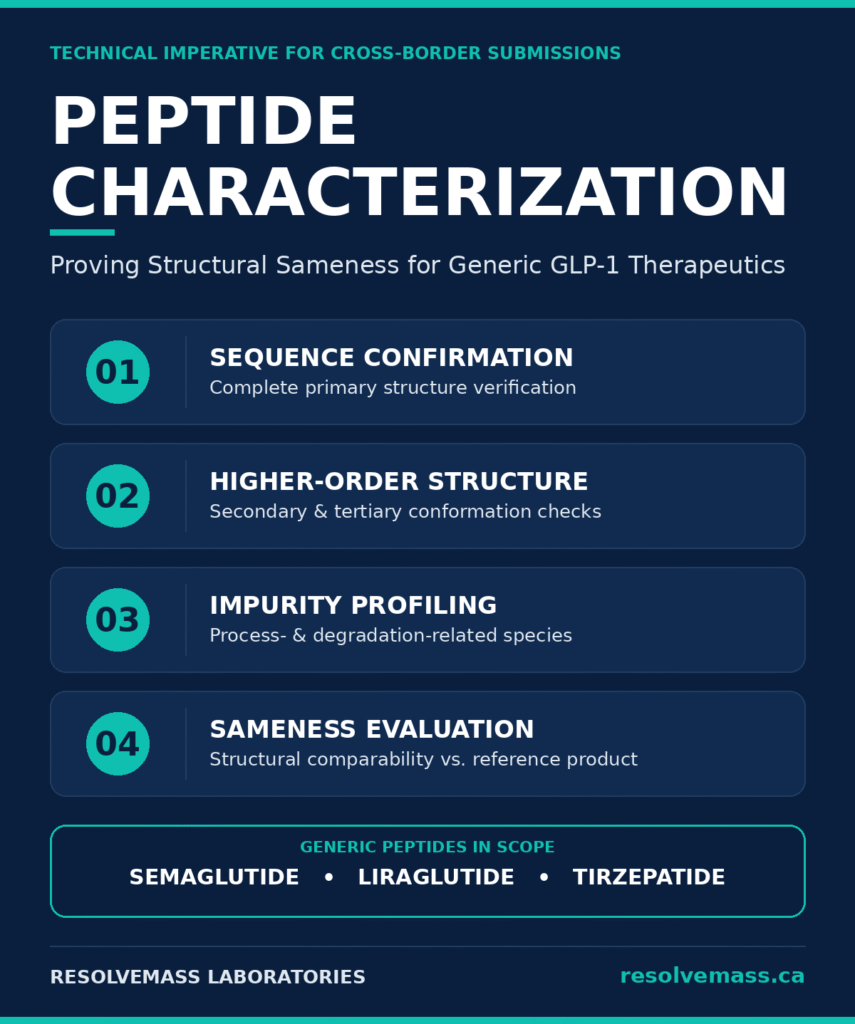
Comprehensive peptide characterization includes complete sequence confirmation, higher-order structural assessment, impurity profiling, and peptide sameness evaluations. Such studies are particularly important for generic synthetic peptides, including Semaglutide, Liraglutide, and Tirzepatide, where detailed structural comparability is a critical regulatory requirement.
Learn more about our targeted approaches for GLP-1 peptide analytical characterization and regulatory release testing.
Strategic Value of Centralized Testing in Cross-Border Drug Development
Consolidating analytical operations within a single dual-accredited contract laboratory eliminates challenges associated with method transfers, minimizes analytical inconsistencies across regulatory submissions, and improves resource utilization throughout Cross-Border Drug Development programs. This integrated strategy simplifies Chemistry, Manufacturing, and Controls (CMC) management while significantly accelerating market entry in both the United States and Canada.
Weigh your development options with our detailed comparison on Peptide CDMO vs CMO capabilities.
| Operational Variable | Dual-Laboratory Strategy (Separate U.S. and Canadian Labs) | Centralized Dual-Compliant Laboratory Strategy |
|---|---|---|
| Method Validation Overhead | Duplicate validation protocols, execution activities, and reporting requirements | Single validation protocol aligned with ICH Q2(R2) and ICH M10 |
| Inter-Laboratory Variability | Increased risk of OOS results caused by analyst and instrument variability | Eliminates inter-facility variability through unified methods and instrumentation |
| Method Transfer Execution | Requires extensive transfer studies, co-validation activities, and formal reports | Method transfer eliminated; immediate data generation for submissions |
| Regulatory Deficiency Risk | Greater likelihood of conflicting responses to FDA IRs and Health Canada NODs | Harmonized datasets support consistent responses across regulatory pathways |
| Module 1 Compliance | Separate compliance documentation and independent audit schedules required | Single audit framework supports FDA cGMP and Health Canada DEL requirements |
Swipe horizontally to view the full table on smaller screens.
The operational and economic benefits of a centralized analytical testing strategy extend throughout the entire product development and commercialization lifecycle.
Elimination of Method Transfer Friction and Cost Redundancies
Transferring analytical methods from one testing facility to another requires significant investment of time, resources, and technical expertise. Method transfer activities typically involve comparative testing, predefined acceptance criteria, co-validation exercises, and extensive supporting documentation. By centralizing analytical testing within a single dual-compliant laboratory, sponsors can perform method validation once according to ICH Q2(R2) standards and leverage the resulting data for both U.S. and Canadian regulatory submissions.
See how to eliminate friction during expansion with our peptide CDMO scale-up services.
Prevention of Inter-Laboratory Analytical Discrepancies
Variability between laboratories remains a common contributor to Out-of-Specification (OOS) investigations and inconsistent stability study outcomes during regulatory assessments. Minor differences in instrumentation, chromatographic conditions, sample preparation techniques, environmental controls, or analyst execution can produce divergent analytical results. Operating through a single laboratory governed by a unified quality system promotes consistency in analytical execution and ensures that data submitted to both the FDA and Health Canada remain fully aligned.
Streamlined Regulatory Query Response and Risk Mitigation
Regulatory agencies frequently issue technical questions, Information Requests (IRs), or requests for clarification regarding analytical procedures, impurity specifications, stability data, and batch release testing results. Managing these inquiries through a single scientific and quality team enables sponsors to provide clear, consistent, and scientifically aligned responses. Given that agencies may exchange scientific assessments through programs such as the RIS pilot initiative, maintaining consistent scientific justifications across both jurisdictions helps prevent conflicting responses that could delay regulatory review.
Optimized Submission Timelines for Canadian Market Access
Historically, many biopharmaceutical organizations have submitted applications to Health Canada months or even years after initiating FDA filings. Centralized analytical testing removes the burden of developing separate analytical packages for the Canadian market. Standardized datasets generated within a dual-compliant laboratory support concurrent or closely synchronized eCTD submissions in both jurisdictions, thereby enhancing commercial efficiency and accelerating return on investment.
Strategic Recommendations for Dual Submissions in Cross-Border Drug Development
Biopharmaceutical companies preparing simultaneous U.S. and Canadian regulatory applications should prioritize selection of an analytical testing partner that maintains both active FDA registration and a Health Canada Drug Establishment Licence (DEL) with authorized testing activities. Early implementation of dual-compliant analytical strategies helps ensure efficient regulatory acceptance across both jurisdictions.
To strengthen compliance, improve operational efficiency, and reduce regulatory risk during Cross-Border Drug Development, sponsors should consider the following best practices:
Verify Explicit Scope of Authorization
Before initiating analytical testing agreements, conduct a comprehensive review of the laboratory’s regulatory credentials. Confirm that the facility maintains a valid Health Canada DEL specifically authorizing “Testing” under C.02.015 and possesses a documented FDA registration history supported by successful cGMP inspection outcomes.
Develop Harmonized Validation Protocols
Create analytical and bioanalytical validation strategies that integrate the requirements of ICH Q2(R2), ICH M10, applicable USP compendial standards, and Health Canada GUI-0001 expectations. Harmonized validation protocols help eliminate unnecessary duplication and support broader regulatory acceptance.
Implement Robust Data Integrity Controls
Verify that computerized systems, laboratory information management systems, and analytical instruments comply with both 21 CFR Part 11 and Health Canada Annex 11 (GUI-0050) requirements. Comprehensive audit trails, controlled user access, electronic record protection, and automated backup procedures are essential components of a compliant data integrity framework.
Leverage Advanced HRMS for Trace Impurity Defense
Implement high-resolution mass spectrometry technologies early in the development lifecycle to characterize extractables, leachables, nitrosamines, degradation products, and other trace-level impurities. Comprehensive structural characterization data can proactively address complex CMC review requirements and reduce the likelihood of regulatory deficiency notices.
Align eCTD Module 1 Documentation Early
Prepare laboratory compliance documentation, including DEL certificates, inspection reports, and supporting quality records, in the appropriate regional format for Module 1 submissions. At the same time, maintain consistency of scientific data across Modules 3, 4, and 5 to support harmonized regulatory review.
Read a practical demonstration of regulatory compliance in our peptide characterization case study of Semaglutide.
Conclusion: Streamlining Cross-Border Drug Development Through Integrated Testing
Utilizing a single dual-compliant analytical testing laboratory offers biopharmaceutical sponsors a streamlined, scientifically rigorous, and economically efficient pathway to obtaining market access across North America. By harmonizing CMC datasets while satisfying regional administrative requirements, sponsors can significantly reduce the risk of regulatory delays, deficiencies, and duplicative testing activities.
Centralized analytical operations within a contract laboratory that complies with both FDA 21 CFR Part 211 requirements and Health Canada DEL C.02.015 licensing obligations help eliminate the traditional fragmentation that has historically existed between U.S. and Canadian regulatory submissions. As collaboration between regulatory agencies continues to expand through information-sharing initiatives, shared electronic gateways, and joint review programs, reliance on a single, high-quality analytical dataset becomes an increasingly valuable risk-management strategy for pharmaceutical and biotechnology organizations.
To learn how advanced mass spectrometry, analytical method validation, and dual-jurisdiction testing strategies can support faster and more efficient regulatory approvals, contact the scientific experts at ResolveMass Laboratories Inc. through the ResolveMass Contact Page.
Frequently Asked Questions
What is the key distinction between an FDA-registered laboratory and a Health Canada-licensed laboratory?
The primary difference lies in how each regulatory authority authorizes and oversees laboratory operations. FDA-registered laboratories are subject to facility registration requirements and are monitored through risk-based inspections. In contrast, Health Canada requires laboratories to obtain a Drug Establishment Licence (DEL) before conducting regulated testing activities for the Canadian market. This licensing process includes a formal assessment of the facility’s compliance with applicable regulatory requirements.
How does ICH M10 support dual FDA and Health Canada regulatory submissions?
ICH M10 establishes internationally harmonized standards for bioanalytical method validation and the analysis of study samples. Because both the FDA and Health Canada recognize this guideline, sponsors can develop and validate a single bioanalytical method for pharmacokinetic (PK) and bioequivalence (BE) studies that satisfies the expectations of both agencies. This harmonized framework reduces duplication of work and improves regulatory efficiency during global drug development programs.
What is the FDA and Health Canada Request for Information Sharing (RIS) pilot program?
The Request for Information Sharing (RIS) pilot program is a collaborative initiative that allows the FDA and Health Canada to exchange scientific assessments and regulatory review information during the evaluation of certain generic drug applications. By sharing relevant review findings and technical evaluations, both agencies can reduce redundant assessment activities and improve overall review efficiency. The program supports greater regulatory alignment and can contribute to faster decision-making for sponsors pursuing approval in both markets.
What is eSTAR and why is it relevant to dual regulatory submissions?
eSTAR is an electronic submission template designed to standardize the preparation and submission of regulatory applications in a structured digital format. Although it has primarily been associated with medical device submissions, it reflects a broader trend toward harmonized electronic submission processes among regulatory authorities. Its development highlights the ongoing movement toward more efficient and standardized regulatory interactions across North America.
Why is High-Resolution Mass Spectrometry (HRMS) important for cross-border CMC submissions?
High-Resolution Mass Spectrometry (HRMS) provides exceptional mass accuracy and detailed fragmentation information, making it a powerful tool for identifying unknown compounds and confirming molecular structures. It is particularly valuable for the characterization of impurities, degradation products, nitrosamines, and complex pharmaceutical molecules. The high-quality data generated through HRMS supports Chemistry, Manufacturing, and Controls (CMC) requirements and helps satisfy the scientific expectations of both FDA and Health Canada reviewers.
How are Extractables and Leachables (E&L) testing requirements aligned between the FDA and Health Canada?
Both agencies expect E&L studies to follow scientifically justified, risk-based approaches consistent with USP <1663>, USP <1664>, and PQRI recommendations. Comprehensive E&L programs typically include extraction studies, toxicological risk assessments, Analytical Evaluation Threshold (AET) calculations, and ongoing leachable monitoring. When properly designed and executed, a single E&L study can provide the data necessary to support regulatory submissions in both the United States and Canada.
What happens if a laboratory receives a Non-Compliant (NC) rating from Health Canada?
A Non-Compliant (NC) rating indicates that significant regulatory deficiencies were identified during a Health Canada inspection. Such a finding may result in the suspension or revocation of the facility’s Drug Establishment Licence (DEL), preventing the laboratory from performing authorized testing activities for products intended for the Canadian market. In addition to affecting ongoing projects, the outcome may increase regulatory scrutiny and create delays in associated drug development and submission programs.
How does eCTD Module 1 differ between FDA and Health Canada submissions?
Module 1 contains administrative and regional information that is specific to each regulatory authority. For FDA submissions, this section includes U.S.-specific forms, labeling information, and facility registration details. Health Canada submissions require Canadian administrative forms, product monographs, and documentation demonstrating regulatory authorization of involved facilities, including DEL information where applicable. In contrast, Modules 2 through 5 contain the harmonized scientific content that is generally shared between both submissions.
How does centralized testing help reduce analytical discrepancy risks?
Centralized testing minimizes the variability that can arise when multiple laboratories are involved in a development program. Differences in instrumentation, analytical procedures, environmental conditions, and analyst techniques can sometimes lead to inconsistent results between facilities. By generating all analytical data within a single dual-compliant laboratory, sponsors can maintain greater consistency, improve data reliability, and ensure alignment between FDA and Health Canada regulatory submissions.
Reference:
- Shajarizadeh, A., & Hollis, A. (2015). Delays in the submission of new drugs in Canada. Canadian Medical Association Journal, 187(1), E47–E51. https://doi.org/10.1503/cmaj.130814
- Health Canada. (2020, July 1). Good manufacturing practices guide for drug products (GUI-0001). Government of Canada. https://www.canada.ca/en/health-canada/services/drugs-health-products/compliance-enforcement/good-manufacturing-practices/guidance-documents/gmp-guidelines-0001.html
- Health Canada. (2020, August 31). Risk classification guide for drug good manufacturing practices observations (GUI-0023). Government of Canada. https://www.canada.ca/en/health-canada/services/drugs-health-products/compliance-enforcement/good-manufacturing-practices/guidance-documents/risk-classification-drug-gmp-observations-0023/document.html
- U.S. Food and Drug Administration. (2023, January 27). Health Canada and FDA eSTAR pilot. U.S. Department of Health and Human Services. https://www.fda.gov/medical-devices/how-study-and-market-your-device/health-canada-and-fda-estar-pilot
Need analytical testing support for cross-border drug development?
Contact our experts today to discuss FDA- and Health Canada-ready testing solutions for your drug product, API, biologic, peptide, or generic drug program.
Contact usAbout The Author
Anusha Sinha
Anusha Sinha, B.Pharm, is an experienced pharma professional with a strong background in Analytical Chemistry and Polymer Chemistry. With a passion for translating complex scientific data into clear, accessible content, she plays a vital role in communicating ResolveMass Laboratories Inc.’s advanced testing capabilities. In addition to her scientific expertise, Anusha leads Business Development initiatives, helping clients across pharmaceutical, biotechnology, and materials science sectors find tailored analytical solutions. Her combined experience in science and strategy positions her at the forefront of client engagement and technical communication.

