

Introduction:
Hybrid LBA/LC-MS/MS Assays for Large Molecule Quantification provide a powerful analytical strategy when neither a conventional ligand-binding assay nor direct LC-MS/MS alone can adequately address the requirements of a complex biologic bioanalysis program. By combining immunocapture or another selective enrichment step with chromatographic mass-spectrometric detection, hybrid workflows improve molecular specificity while retaining the sensitivity associated with ligand-based capture.
Large-molecule therapeutics — including monoclonal antibodies (mAbs), therapeutic proteins, peptides, fusion proteins, and antibody-drug conjugates — present analytical challenges that differ substantially from those encountered with small molecules. High molecular weight, structural heterogeneity, post-translational modifications, endogenous counterparts, target binding, aggregation, proteolytic degradation, and immunogenicity risk can all complicate quantitative analysis.
The choice of bioanalytical platform should therefore be driven by the scientific question. An LBA may be highly sensitive and operationally efficient for measuring circulating drug concentrations, while LC-MS/MS may offer superior molecular specificity and additional structural information. A hybrid approach bridges these two capabilities, and current regulatory expectations emphasize that any bioanalytical method — hybrid or otherwise — must be demonstrated to be fit for its intended purpose.
Summary:
- Hybrid LBA/LC-MS/MS Assays for Large Molecule Quantification combine the molecular selectivity of ligand-binding assays (LBA) with the structural specificity of liquid chromatography–tandem mass spectrometry (LC-MS/MS).
- They are particularly useful when a conventional LBA cannot adequately distinguish the therapeutic molecule from endogenous proteins, metabolites, degradation products, or closely related biologics.
- Hybrid assays can provide complementary information on total drug exposure, molecular identity, target specificity, and structural integrity.
- Typical applications include monoclonal antibodies, therapeutic proteins, peptides, antibody-drug conjugates (ADCs), mRNA-related biologics, and other complex modalities.
- Platform selection should be based on the analyte, biological matrix, study objective, expected concentration range, specificity requirements, and regulatory purpose — not on technology preference alone.
- ICH M10 provides the principal harmonized framework for validation of bioanalytical assays used to support regulatory submissions, covering both chromatographic and ligand-binding methods.
- Critical validation considerations include selectivity/specificity, calibration model, accuracy, precision, sensitivity, stability, dilution integrity, carryover, matrix effects, and incurred sample reanalysis where applicable.
- ResolveMass Laboratories Inc. integrates LC-MS/MS, ligand-binding technologies, and large-molecule bioanalysis to build fit-for-purpose analytical strategies across PK, TK, biomarker, and regulated bioanalytical programs.
1: What Is a Hybrid LBA/LC-MS/MS Assay?
A hybrid LBA/LC-MS/MS assay combines ligand-based enrichment or immunocapture with LC-MS/MS detection to quantify a large molecule or a representative peptide derived from it.
In a typical workflow, the therapeutic protein is selectively captured from plasma or another biological matrix using an antibody, antigen, receptor, or other affinity reagent. The captured analyte then undergoes enzymatic digestion, followed by LC-MS/MS measurement of one or more signature peptides.
Simplified workflow: Biological sample → immunocapture → washing → elution → enzymatic digestion → LC separation → MS/MS detection → quantification
This differs fundamentally from a conventional ELISA or LBA, where the final signal is generated through an immunochemical detection system. The hybrid method essentially uses LBA for molecular enrichment and LC-MS/MS for analytical detection, drawing on the same underlying LC-MS/MS instrumentation and expertise used across ResolveMass’s broader LC-MS/MS bioanalytical services.
2: Why Are Hybrid LBA/LC-MS/MS Assays Needed for Large Molecules?
Hybrid assays are needed when a conventional LBA does not provide sufficient molecular specificity, or when LC-MS/MS alone struggles with sensitivity and matrix complexity.
Large molecules can exist in biological samples alongside:
- Endogenous proteins
- Structurally related proteins
- Drug metabolites
- Proteolytic fragments
- Anti-drug antibodies (ADAs)
- Target-bound drug
- Soluble receptors
- Drug aggregates
- Conjugated and unconjugated species
A conventional LBA may detect several molecular forms that share the same epitope. Direct LC-MS/MS can provide excellent specificity but often requires extensive sample preparation or digestion to achieve adequate sensitivity for large molecules. The hybrid approach addresses these limitations by combining affinity-based selectivity with mass-spectrometric molecular specificity.
3: How Does Hybrid LBA/LC-MS/MS Compare With Conventional LBA and LC-MS/MS?
The three approaches answer somewhat different analytical questions, summarized below.
| Parameter | Conventional LBA | Direct/Bottom-Up LC-MS/MS | Hybrid LBA/LC-MS/MS |
|---|---|---|---|
| Primary detection | Immunochemical signal | Mass spectrometry | Immunocapture + MS |
| Molecular specificity | Moderate–high, reagent-dependent | High | Very high when properly designed |
| Sensitivity | Typically excellent | Variable for large molecules | Potentially excellent |
| Structural information | Limited | High | High relative to LBA |
| Sample enrichment | Usually inherent | Often required | Affinity-based |
| Endogenous interference | Potential concern | Controllable analytically | Often reduced via selective capture |
| Closely related analytes | May cross-react | Better differentiation | Strong differentiation potential |
| Multiplexing | Possible | Strong potential | Possible, method-dependent |
| Development complexity | Moderate | Moderate–high | High |
| Best use | Routine exposure measurement | Molecularly specific quantification | Complex biologic quantification |
The correct platform depends on the intended purpose rather than simply choosing the most technologically advanced method.
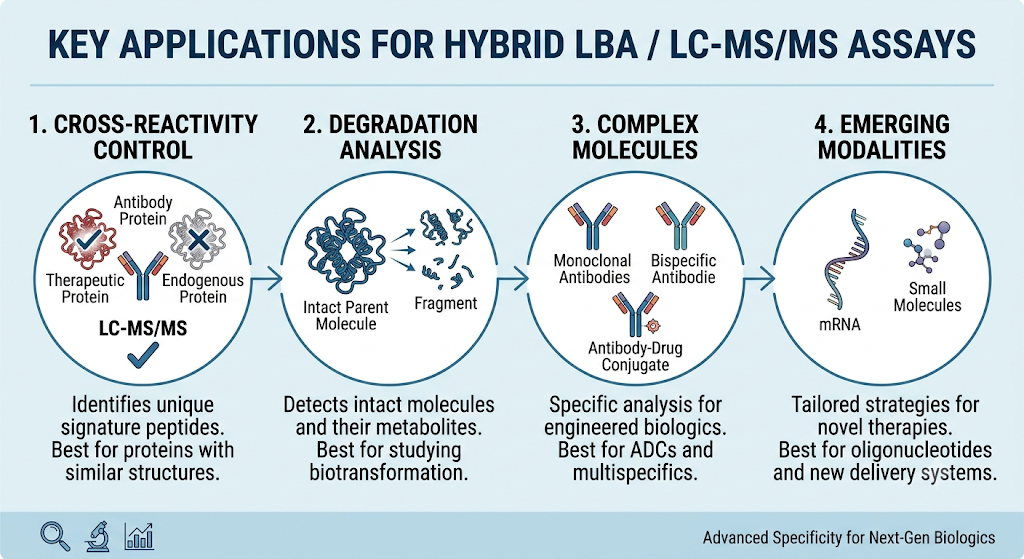
4: When Should You Use a Hybrid LBA/LC-MS/MS Assay?
A hybrid assay should be considered when molecular specificity is a major concern and the therapeutic cannot be reliably distinguished using a conventional LBA alone.
1. When endogenous counterparts are present
Some therapeutic proteins share substantial sequence or structural similarity with endogenous proteins, which can cause cross-reactivity in an antibody-based assay. Immunocapture followed by LC-MS/MS detection of a unique signature peptide improves differentiation.
2. When metabolites or degradation products matter
Biologics can undergo proteolysis, truncation, oxidation, deamidation, or aggregation after administration. A conventional LBA may detect the parent molecule together with related products, while a hybrid LC-MS/MS assay can be designed around a peptide sequence specific to the intended analyte — valuable when the scientific question concerns intact or representative drug exposure rather than total immunoreactive material.
3. When the therapeutic has complex molecular architecture
Hybrid approaches are commonly applied to monoclonal antibodies, bispecific antibodies, fusion proteins, antibody-drug conjugates, therapeutic peptides, recombinant proteins, protein fragments, and other engineered biologics, including LC-MS/MS-based characterization for biosimilar programs. The analytical strategy can be customized around unique peptide sequences, capture reagents, digestion conditions, and MS transitions.
4. When the modality falls outside conventional protein bioanalysis
Emerging modalities — including RNA-based therapeutics — often require tailored bioanalytical strategies distinct from standard protein assays; ResolveMass’s bioanalytical method development for mRNA therapeutics illustrates how platform selection is adapted to modality-specific analytical challenges.
5: What Are the Major Advantages of Hybrid LBA/LC-MS/MS?
The primary advantage is orthogonal specificity: the analyte must first satisfy the affinity-based capture requirement and then generate the expected mass-spectrometric signal.
- Improved selectivity in complex biological matrices
- Reduced interference from unrelated endogenous proteins
- Molecular-level confirmation through signature peptides
- Potential differentiation of closely related therapeutic species
- Compatibility with highly sensitive MS/MS detection
- Greater flexibility in assay design
- Improved confidence in pharmacokinetic exposure measurements
- Ability to combine enrichment and quantitative MS detection
This combination is particularly valuable in development programs where incorrectly measuring a related molecular species could affect PK interpretation or dose-exposure relationships.
6: What Are the Main Challenges of Hybrid LBA/LC-MS/MS?
Hybrid assays are powerful but more complex than either conventional LBA or LC-MS/MS alone, and several sources of variability must be controlled.
Critical reagent dependence. The capture antibody or affinity reagent becomes a critical component of the assay. ICH M10 emphasizes characterizing reference standards and identifying critical reagents for ligand-binding assays; critical reagent changes may require additional assessment.
Enzymatic digestion variability. For bottom-up LC-MS/MS workflows, digestion efficiency can influence the measured response, driven by enzyme concentration, digestion time, temperature, denaturation/reduction conditions, matrix composition, missed cleavage, and peptide recovery.
Matrix complexity. Plasma and serum contain very high concentrations of endogenous proteins, which can affect immunocapture efficiency, nonspecific binding, digestion efficiency, chromatographic separation, ionization, and MS response. For programs sampling less common matrices, tissue and CSF bioanalytical services require additional matrix-specific method adaptation.
Assay development time and cost. Hybrid methods generally require optimization of both immunochemical and mass-spectrometric components, which can extend timelines relative to a single-platform method — a consideration sponsors should weigh alongside cost-effective bioanalytical services options and, for early-phase programs, bioanalytical services for rapid proof of concept.
Standardization. The relationship between the protein reference standard and the signature peptide response must be carefully understood and documented.
7: How Is a Hybrid LBA/LC-MS/MS Method Developed?
A robust development program begins with defining the analytical purpose and target measurand before any capture reagent or peptide is selected.
| Step | Focus |
|---|---|
| 1. Define the analyte | Total, free, or intact therapeutic; specific domain, conjugate, or degradation product |
| 2. Select the capture strategy | Monoclonal or polyclonal antibodies, antigens, receptors, or affinity ligands |
| 3. Select signature peptides | Unique to the therapeutic, stable, reliably generated, free of problematic PTMs |
| 4. Optimize LC-MS/MS detection | Chromatography, precursor/product ions, collision energy, internal standards |
| 5. Optimize sample preparation | Capture → wash → elution → reduction/alkylation → digestion → internal standard addition |
| 6. Establish calibration range | Reflects concentrations expected in intended study samples |
| 7. Perform validation | Aligned with intended purpose and applicable regulatory expectations |
This development sequence follows the same core principles applied across ResolveMass’s broader bioanalytical method development and validation work, and in the U.S. regulatory context draws on considerations discussed in bioanalytical method development in the United States: key techniques.
8: What Regulatory Guidelines Apply to Hybrid LBA/LC-MS/MS Assays?
ICH M10 is the primary harmonized regulatory framework for bioanalytical method validation and study sample analysis, covering both chromatographic and ligand-binding assays. FDA finalized its M10 guidance in 2022, and EMA identifies ICH M10 as the current guideline superseding its earlier standalone bioanalytical validation guideline.
For U.S. regulatory programs, FDA’s M10 guidance describes recommendations for bioanalytical assays used in nonclinical and clinical studies supporting regulatory submissions. FDA’s earlier 2018 Bioanalytical Method Validation guidance remains an important historical reference, but sponsors should assess the current applicable framework — particularly ICH M10 — when designing contemporary programs, including those ultimately supporting regulated bioanalytical services for NDA and BLA submission or studies conducted under GLP bioanalytical services.
9: What Validation Parameters Should Be Evaluated?
Validation should demonstrate that the assay is fit for its intended purpose, which ICH M10 frames as the central objective of bioanalytical method validation.
| Validation Parameter | Key Question |
|---|---|
| Selectivity | Can the analyte be distinguished from endogenous components? |
| Specificity | Does the method measure the intended molecular species? |
| Calibration model | Is response accurately related to concentration? |
| Accuracy | Are measured concentrations close to nominal values? |
| Precision | Are repeated measurements reproducible? |
| Sensitivity | Is the LLOQ appropriate for study requirements? |
| Dilution integrity | Can samples above ULOQ be reliably diluted? |
| Stability | Does the analyte remain stable during handling and storage? |
| Carryover | Can a high-concentration sample affect subsequent samples? |
| Recovery | Is analyte recovery consistent? |
| Matrix effects | Does the matrix alter analytical response? |
| Reproducibility | Does the method remain reliable across runs? |
For LBA components, critical reagent performance, selectivity, calibration curves, accuracy, precision, and stability require particular attention, as described in ICH M10 materials addressing calibration and QC expectations specific to ligand-binding assays.
10: How Should Selectivity Be Evaluated?
Selectivity is particularly important for large-molecule bioanalysis because biological matrices can contain endogenous proteins that resemble the therapeutic analyte.
ICH M10 materials describe evaluation using multiple individual matrix sources and emphasize demonstrating that interfering substances do not compromise assay performance. A scientifically sound hybrid assay should investigate potential interference from:
- Endogenous proteins
- Closely related therapeutic proteins
- Capture reagent components
- Detection reagents
- Target proteins
- Soluble receptors
- Anti-drug antibodies
- Relevant metabolites or fragments
The exact experimental design should be based on the molecule and its intended use.
11: What Is the Role of Calibration Standards and Quality Controls?
Calibration standards establish the relationship between analyte concentration and analytical response, while quality controls independently assess assay performance.
For ligand-binding assays, ICH M10 materials describe calibration curves containing a blank and multiple calibration standards spanning the intended range, with performance assessed across multiple analytical runs. Hybrid assays require careful consideration of what the calibrator represents — intact protein concentration, protein-equivalent concentration, peptide concentration, or a defined surrogate analyte — and this distinction should be scientifically justified and clearly documented.
12: What About Anti-Drug Antibodies in Hybrid Assays?
Anti-drug antibodies can substantially affect the measurement of therapeutic proteins, and hybrid assay design should account for this risk explicitly rather than assuming it away.
ADA interference can occur by blocking capture epitopes, blocking detection epitopes, altering drug clearance, forming drug-ADA complexes, changing analyte recovery, or otherwise changing apparent circulating concentrations. Assay development should therefore consider whether the method measures free drug, total drug, or another defined molecular population. A hybrid approach may reduce certain immunoassay-related interferences, but it does not automatically eliminate ADA-related effects — ADA risk should be evaluated scientifically based on the assay format and the specific therapeutic.
14: Hybrid LBA/LC-MS/MS for PK, TK, and Clinical Bioanalysis
Hybrid assays are especially useful in pharmacokinetic and toxicokinetic studies when accurate characterization of systemic exposure is important, an area covered by ResolveMass’s bioanalytical CRO services for PK and TK.
PK/TK programs may require quantification across pre-dose samples, early absorption/distribution samples, peak concentration, distribution phase, elimination phase, trough concentrations, and post-dose recovery, so the assay must provide adequate sensitivity and reproducibility across the expected concentration range. This is particularly relevant in specialized clinical contexts such as bioanalytical CRO support for oncology clinical trials and programs supported by bioanalytical services for rare disease, where sample volume, patient population size, and analyte complexity can all shape assay design. EMA guidance also highlights the importance of analytical methods being capable of distinguishing therapeutic proteins from endogenous equivalents where feasible.
Biomarker data often accompanies PK/TK sampling in these programs, and hybrid platforms can support both endpoints in parallel through dedicated biomarker bioanalytical services, including biomarker bioanalytical CRO support and biomarker bioanalytical services for FDA and Health Canada submissions spanning both regulatory jurisdictions.
15: When Is Conventional LBA Better Than a Hybrid Assay?
A hybrid approach is not automatically superior — a conventional LBA may be preferable in several common scenarios.
- The therapeutic has no meaningful endogenous counterpart
- Highly specific, well-characterized antibodies are already available
- The assay provides adequate sensitivity and selectivity as-is
- High sample throughput is required, an area where ResolveMass’s approach to bioanalytical sample throughput is directly relevant
- The intended endpoint is immunoreactive total drug
- Structural confirmation is not required
- The method is sufficiently robust for the intended regulatory study
The best analytical strategy is the one that reliably and efficiently answers the scientific question at hand.
When Is LC-MS/MS Alone Better?
Direct or bottom-up LC-MS/MS may be preferable when the analyte can be selectively quantified without affinity enrichment. This applies to peptides with suitable MS sensitivity, relatively simple biological matrices, analytes with unique signature peptides, programs requiring strong molecular specificity, quantification of specific protein fragments, and applications requiring simultaneous measurement of several analytes — all areas supported through ResolveMass’s peptide bioanalytical services and broader LC-MS/MS bioanalytical services, which enable analytical strategy selection according to molecular characteristics and study objectives.
16: How Does ResolveMass Approach Hybrid Large-Molecule Bioanalysis?
ResolveMass Laboratories Inc. approaches large-molecule bioanalysis by integrating scientific method development, advanced analytical platforms, and regulatory-oriented validation, rather than treating assay development as a one-size-fits-all workflow. Its bioanalytical services span large-molecule analysis using hybrid LBA-MS approaches alongside LC-MS/MS, immunoassay technologies, biomarker analysis, and regulated bioanalytical support, delivered through an integrated chemistry and bioanalytical CRO model that connects analytical chemistry expertise directly to bioanalytical execution.
A project-specific strategy can address analyte characterization, matrix selection, immunocapture design, signature peptide selection, digestion optimization, LC-MS/MS optimization, calibration strategy, critical reagent qualification, validation planning, PK/PD sample analysis, and regulatory documentation. This integrated model is particularly useful when a sponsor needs to connect analytical development decisions with the eventual regulatory use of the data, and it underpins how ResolveMass supports bioanalytical services in North America for both U.S. and Canadian submissions.
For sponsors evaluating whether to build internal capability or work with a partner lab, bioanalytical outsourcing and outsourced bioanalytical services models are worth weighing against in-house development timelines, particularly for programs exploring newer applications such as bioanalytical CRO support for AI drug discovery, where fast, iterative bioanalytical turnaround can meaningfully shape discovery-stage decision-making.
17: Regulatory Documentation: What Should Sponsors Expect?
A regulated hybrid assay program should generate documentation that allows reviewers to understand how the method works and why its performance is appropriate.
Typical documentation includes:
- Method development report
- Assay principle and workflow
- Reference standard and critical reagent information
- Calibration model justification
- Validation protocol and validation report
- Accuracy, precision, and selectivity/specificity assessments
- Stability, dilution integrity, and carryover data
- Sample analysis records and any deviations/investigations
- Incurred sample analysis/reanalysis documentation, where applicable
- Final bioanalytical report
ICH M10 emphasizes appropriate characterization, validation, documentation, and reliable study sample analysis for bioanalytical methods supporting regulatory decisions, whether the ultimate submission is destined for FDA, EMA, or Health Canada.
Conclusion:
Hybrid LBA/LC-MS/MS Assays for Large Molecule Quantification provide a valuable analytical option when biologic complexity requires both affinity-based enrichment and molecularly specific mass-spectrometric detection. They are particularly useful for therapeutic proteins, monoclonal antibodies, peptides, fusion proteins, and other complex biologics where conventional LBA or LC-MS/MS alone may not fully address the analytical question.
The decision to use a hybrid assay should be based on the intended analyte, molecular structure, biological matrix, expected concentration range, endogenous interference, required specificity, study objectives, and regulatory expectations. For regulated development programs, assay validation should be designed around the current applicable regulatory framework, with ICH M10 serving as the key harmonized reference for bioanalytical method validation and study sample analysis.
Frequently Asked Questions:
Hybrid LBA/LC-MS/MS Assays for Large Molecule Quantification combine ligand-binding assay (LBA) or immunocapture with liquid chromatography–tandem mass spectrometry (LC-MS/MS). The LBA component selectively enriches the therapeutic molecule from a complex biological matrix, while LC-MS/MS provides highly specific detection, often through a unique signature peptide after enzymatic digestion.
Yes. ICH M10, Bioanalytical Method Validation and Study Sample Analysis, provides recommendations applicable to both ligand-binding assays and chromatographic methods, including LC-MS/MS. For hybrid assays, validation should be scientifically justified and appropriate for the specific assay format, analyte, matrix, and intended regulatory use.
Hybrid LBA/LC-MS/MS may be preferred when conventional ELISA or LBA does not provide sufficient molecular specificity. Combining selective immunocapture with LC-MS/MS detection can help distinguish the therapeutic from endogenous proteins, closely related molecules, metabolites, or degradation products while providing molecular-level analytical confirmation.
Yes. Hybrid assays can quantify monoclonal antibodies (mAbs) in biological matrices such as plasma or serum. A typical workflow uses an affinity reagent to capture the mAb, followed by enzymatic digestion and LC-MS/MS measurement of a mAb-specific signature peptide. This approach can provide improved molecular specificity compared with some conventional immunoassays.
Yes. Hybrid LBA/LC-MS/MS assays can support clinical pharmacokinetic (PK) studies when appropriately developed, validated, and demonstrated to be fit for the intended purpose. They can be particularly valuable for biologics where accurate measurement of therapeutic exposure requires high selectivity and reliable differentiation from endogenous or related molecular species.
The biggest challenge is controlling variability across the entire analytical workflow, from affinity capture and sample preparation through enzymatic digestion, LC separation, and MS/MS detection. Critical reagent performance, matrix effects, digestion efficiency, signature peptide selection, sensitivity, and reproducibility must all be carefully controlled to produce reliable quantitative results.
Reference
- Khan RN, Zeng Y, Lanihun AA, Arisa OT, Horner JL, Figg WD. Recent advances in bioanalytical methods for quantification and pharmacokinetic analyses of antibody–drug conjugates. The AAPS journal. 2025 Sep 4;27(6):138.https://link.springer.com/article/10.1208/s12248-025-01115-9
- Qin Q, Gong L. Current analytical strategies for antibody–drug conjugates in biomatrices. Molecules. 2022 Sep 24;27(19):6299.https://www.mdpi.com/1420-3049/27/19/6299
- de Merbel NV, Gnoth MJ, Wilson A, Blattmann P, Ingelse B, Jordan G, Fusetti F, Blackburn M, Sporring SH, Love I, Muccio S. Perspective on LC-MS (/MS) for biotherapeutic and biomarker proteins in research and regulated Bioanalysis: a consolidation of more than a decade of experience across the European Bioanalysis Forum community (Part 2:“The How”). Bioanalysis. 2025 Jan 17;17(2):71-7.https://www.tandfonline.com/doi/abs/10.1080/17576180.2024.2418251
- Rajapaksha RD, Farmer JT. Regulatory and scientific considerations in PK and biomarker assay validation: lessons from bioanalytical practice. Bioanalysis. 2026 Feb 11;18(3):293-311.https://www.tandfonline.com/doi/abs/10.1080/17576180.2026.2658614
- Huang Y, Woolf MS, Wang CC, Naser SM, Wheeler AM, Mylott Jr WR, Ma E, Rosenbaum AI. Comprehensive performance evaluation of ligand-binding assay–LC–MS/MS method for co-dosed monoclonal anti-SARS-CoV-2 antibodies (AZD7442). Bioanalysis. 2024 Apr 1;16(7):149-63.https://www.tandfonline.com/doi/abs/10.4155/bio-2023-0225
About the Author


